Yes! Send me the FREE digital editions of Spa Business and Spa Business insider magazines and the FREE weekly Spa Business and Spa Business insider ezines and breaking news alerts!
Creating giant cooled conservatories in Singapore's subtropical climate in an environmentally sensible way required clever thinking, says Wilkinson Eyre's Paul Baker
Since opening in 2012, the £350m cooled conservatories at Gardens by the Bay in Singapore have won numerous awards – most recently the coveted RIBA Lubetkin Prize in September 2013 for best new international building – with judges applauding the design team for pushing the boundaries of environmental and structural design. The two giant biomes are carbon positive – no mean feat considering the amount of energy needed to keep plants cool in a sub-tropical climate like Singapore's – and explore how plants in the Mediterranean and cloud forest environments could be affected by climate change.
The project is made up of three waterfront gardens: Bay South, Bay East and Bay Central; the cooled conservatories are located in Bay South and were designed by architect Wilkinson Eyre, landscape architect Grant Associates, structural engineer Atelier One and environmental design consultant Atelier Ten.
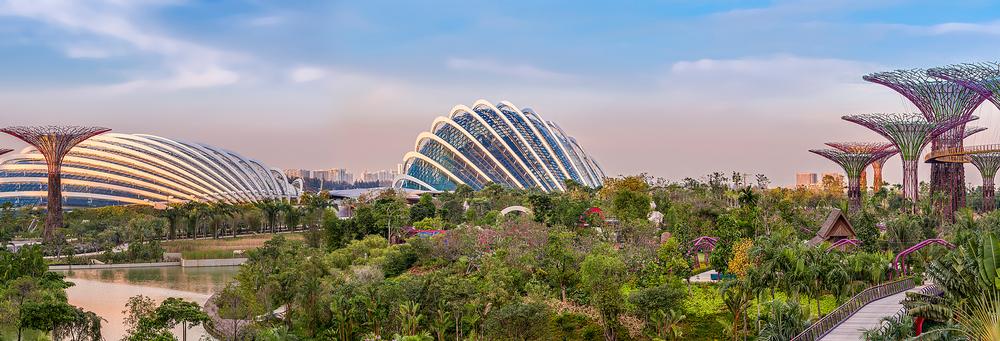
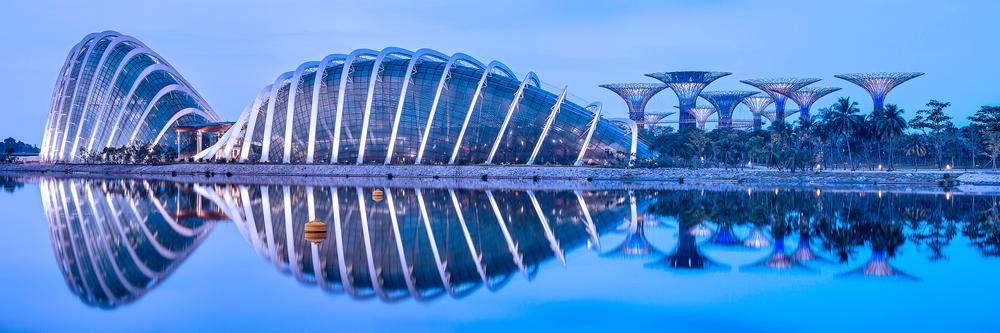
The 12,800sq m Flower Dome is home to a collection of plants from Mediterranean regions around the world, and features lavender fields, olive groves and giant baobab trees.
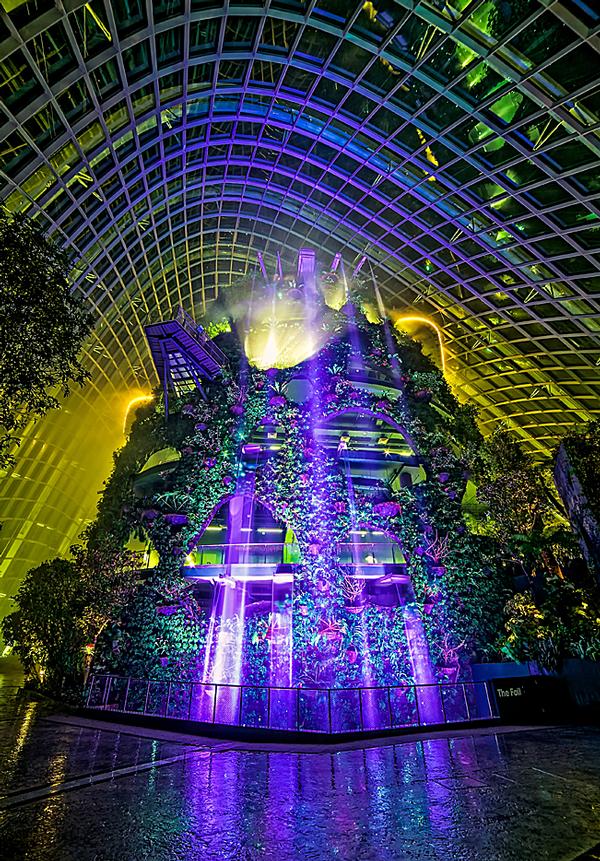
The 7,300sq m Cloud Forest Dome tells the story of plants that grow in cool tropical cloud forests. It features a 'mountain' covered in lush vegetation from which a 35m waterfall drops down. Within the 'mountain', exhibition spaces explore the impact of incremental changes to the earth's temperature and explain the sustainable technologies used in the creation of the cooled conservatories.
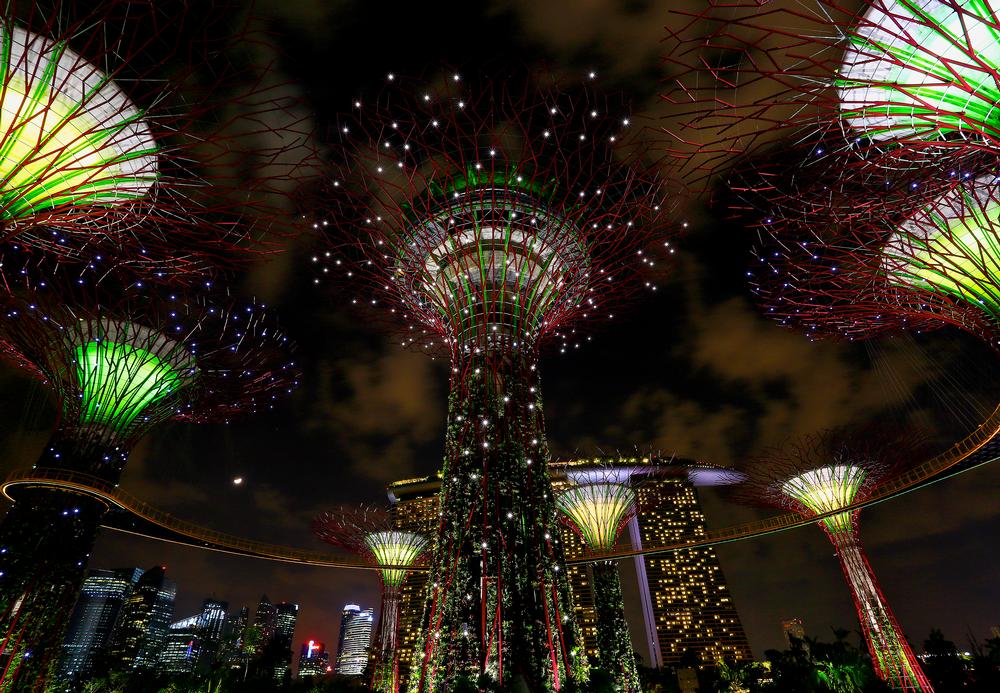
Gardens by the Bay also features 18 supertrees, designed by Grant Associates, which are home to thousands of plants and feature photovoltaic cells to harvest solar energy.
The biomes have been designed to cast as little shadow as possible, while highly selective glass filters out heat from the sun. Retractable shades are used to control light levels and limit the heat gain when the sun is out.
The energy used to cool the biomes comes from an on-site biomass CHP system fired by horticultural waste. The wider development is also fitted with arrays of photovoltaic panels.
Here project architect Paul Baker discusses the project.
How did you get involved with the Gardens by the Bay project? We'd worked with the landscape architect Andrew Grant of Grant Associates for many years on various projects, including the Alpine House at Kew Gardens (a small, cooled Alpine plant conservatory). He was contacted by the National Parks Board of Singapore and he phoned us and said, 'There's this mad competition for a fantastic park in Singapore. Do you fancy joining us?'
We teamed up with structural engineers Atelier One and environmental design consultants Atelier Ten, and put a lot of energy into the competition.
From our work on the Alpine House at Kew, we understood that the plants determine the brief and that to make a particular type of plant grow well, you need a certain range of circumstances. There's no point working on a monster visitor attraction where the plants look shrivelled up and unhappy.
What was the brief? To design two different environments of a very significant scale; one for Mediterranean plants and one for tropical but high altitude plants.
How did the idea for the biomes develop? We hit on the idea quite early on that we'd like to put a mountain inside the Cloud Forest Dome, because you don't get the opportunity to do that very often! We then liked the idea of creating the opposite – a kind of valley – inside the Mediterranean dome.
We quickly understood that we weren't conditioning the total volume of air inside the biomes, because that would be insane. The idea of layering the heat or cool became logical. In the Mediterranean biome, the valley shape works really well for cooling. The cool air comes around the perimeter and kind of tumbles down the valley, then sits at the lowest point. In the Cloud Forest dome, we made the mountain itself a machine to supply air – it has lots of holes in it and the air tumbles down, cooling the plants.
How did the solar supertrees come about? They were Andrew Grant's brainchild. There was a danger that a newly planted landscape on reclaimed land would be a bit flat and wouldn't have enough draw. Andrew was keen to create some height and interest.
We had a biomass boiler, and we knew that we didn't want to expel hot air at ground level. It became clear that a few chimneys were needed, and we realised we could dress them with the supertrees. It all fitted together.
Because Singapore is so humid, plants sit quite happily on trees and other structures, so we could have plants clinging to a frame on the supertrees. The client and Andrew were keen to demonstrate really creative horticulture; to be really out there and exciting and make it different.
We designed a bar with panoramic views in one of the highest supertrees. They took on a life of their own.
What was the aim of the Gardens by the Bay project? The Singapore government has done a lot to promote leisure on Sentosa Island, with the introduction of big resorts and casinos. The Gardens by the Bay project was part of a plan to balance that with a more cultural story.
The idea was to build on the success of Singapore's Botanic Garden and create a new pleasure garden. The park is open and free, and gives something back to everyone in Singapore, while also maximising the value of the land around the site.
The glasshouses are carbon neutral. How did you achieve this? A cooled conservatory is a tough one to pull off in an environmentally sensible way, because glasshouses like to get hot and not cold. That's where having a good team was fundamental. Thinking about conditioning the places where the people and plants are, not the whole volume, was key.
We were very focused on the envelope being as efficient as possible. The biomes are bobble shaped, with minimum surface area and maximum enclosed space. They are also responsive, with fabric sails that extend across the biomes to stop heat gain when the sun is out.
Next, we needed to find an energy source. We looked at all the typical sources of cooling – water, the ground, wind and solar – but none worked. The sea is warm in Singapore, there's no shift in temperature between day and night, there are no seasons. There's no free energy sink.
Singapore has lots of rain trees that have been planted along most of the highways and roads. These are cut frequently to provide optimum shade, with the pruned branches going to landfill or being used as compost. We realised they could be a great source of energy so we decided to burn them in an on-site steam biomass boiler, which provides energy to cool the domes.
It means that we don't have to ship them from anywhere complicated; they're available on the island. It became a great story.
Why was it so important to be environmentally responsible? The thrust of our argument was that if we can do the cooling of conservatories – one of the trickiest things to do in a carbon responsible way – that's a great message for Singapore to put out there. The visitors to Gardens by the Bay are quite diverse and their awareness of climate issues is not as great as in the UK, so it seemed like a good place to start telling some stories about climate change. We worked with Land Design on a projection in the Cloud Forest Dome called + Five Degrees, which illustrates what would happen if the temperature of the earth rose by five degrees.
Can you describe the design of the two domes? We designed two distinct domes, differently shaped, but with a very strong synergy, directly responding to the climate within each one.
The two biomes offer very different experiences. The Mediterranean Dome is much wider, lower and softer in form than the Cloud Forest Dome. There's no prescriptive journey; you arrive high, then walk down through the space along terraces and walkways, following your own route. The Cloud Forest Dome is very different; you arrive low and your journey takes you to the top, then there's a very prescriptive route as you walk down.
They're both fun, and a good contrast to one another. The cloud forest environment is wet and cold, and quite loud because of the waterfall. The Mediterranean biome is calmer and quieter and the colours are much richer.
What were the biggest challenges of the project? Doing it in an environmentally responsible way, but making it look effortless. We wanted it to be elegant and beautiful and appealing in every possible way, while doing it sensibly from an environmental perspective.
What drew you to a career in architecture? I always wanted to be an architect. I don't know where it came from, but there was never any doubt about what I wanted to do. I studied at Oxford Polytechnic (now Oxford Brookes University). My first job was during a year out, when I went to work for my tutor, John Craig, at Aldington, Craig and Collinge. John Craig was a great tutor and a powerful influence. When I left college I worked for Covent Garden Housing Project for eight years, before joining Wilkinson Eyre 24 years ago.
I became passionately interested in doing cultural projects with a message.
Where are your favourite places on earth? I like my garden in Dorset, and I wouldn't say no to the Maldives or to the top of a mountain somewhere.
What inspires you? I love looking at art and visiting galleries and museums – that generates ideas. I also love being outdoors and looking at plants and nature.
Are you working on any other leisure projects? We're currently doing a refurbishment of the Wellcome Collection on Euston Road in London, which will open this September with a whole range of new floors and gallery spaces.
We're working on the Crown Sydney Hotel Resort on Sydney Harbour – a big waterfront development which will feature hotels rooms and suites, a casino, restaurants, a spa and a residential component. That's due for completion in 2019.
We're also working on the Carlsberg Brewhouse project – a visitor centre in a redundant brewery in Copenhagen. The starting point for that project is four giant granite elephants! That's due to open in 2017.
Project In brief: Cooled Conservatories, Bay South, Singapore Gardens by the Bay The building
Project value: £350m Gross area: The Flower Dome 12,800sq m The Cloud Forest 7,300sq m Structure: Composite structure comprised of a steel gridshell supported by a superstructure of radially arranged steel 'ribs' Envelope: Low-e coated glazing. Automated retractable fabric shades Renewable energy systems: A biomass combined heat and power system fired from horticultural and other waste, with a useable thermal output of 5.8MW and electrical output of 1,000kW. In addition to these approximately 100kWp of photovoltaic panels are installed within the wider development.
The team
Architecture: Wilkinson Eyre Landscape architecture: Grant Associates Environmental design consulting: Atelier Ten Structural engineering: Atelier One Exhibition design: Land Design Studio Branding and signage: Thomas Matthews
Gardens by the Bay is a key part of the government's vision to create a 'city in a garden'
The Cloud Forest Dome features an artifical, plant-covered mountain, which visitors can climb
The supertrees provide shade by day and come alive with lighting and projected media by night. Some of them feature photovoltaic cells and some act as air exhausts for the cooled conservatories
Creating giant cooled conservatories in Singapore's subtropical climate in an environmentally sensible way required clever thinking, says Wilkinson Eyre's Paul Baker
Since opening in 2012, the £350m cooled conservatories at Gardens by the Bay in Singapore have won numerous awards – most recently the coveted RIBA Lubetkin Prize in September 2013 for best new international building – with judges applauding the design team for pushing the boundaries of environmental and structural design. The two giant biomes are carbon positive – no mean feat considering the amount of energy needed to keep plants cool in a sub-tropical climate like Singapore's – and explore how plants in the Mediterranean and cloud forest environments could be affected by climate change.
The project is made up of three waterfront gardens: Bay South, Bay East and Bay Central; the cooled conservatories are located in Bay South and were designed by architect Wilkinson Eyre, landscape architect Grant Associates, structural engineer Atelier One and environmental design consultant Atelier Ten.
The 12,800sq m Flower Dome is home to a collection of plants from Mediterranean regions around the world, and features lavender fields, olive groves and giant baobab trees.
The 7,300sq m Cloud Forest Dome tells the story of plants that grow in cool tropical cloud forests. It features a 'mountain' covered in lush vegetation from which a 35m waterfall drops down. Within the 'mountain', exhibition spaces explore the impact of incremental changes to the earth's temperature and explain the sustainable technologies used in the creation of the cooled conservatories.
Gardens by the Bay also features 18 supertrees, designed by Grant Associates, which are home to thousands of plants and feature photovoltaic cells to harvest solar energy.
The biomes have been designed to cast as little shadow as possible, while highly selective glass filters out heat from the sun. Retractable shades are used to control light levels and limit the heat gain when the sun is out.
The energy used to cool the biomes comes from an on-site biomass CHP system fired by horticultural waste. The wider development is also fitted with arrays of photovoltaic panels.
Here project architect Paul Baker discusses the project.
How did you get involved with the Gardens by the Bay project? We'd worked with the landscape architect Andrew Grant of Grant Associates for many years on various projects, including the Alpine House at Kew Gardens (a small, cooled Alpine plant conservatory). He was contacted by the National Parks Board of Singapore and he phoned us and said, 'There's this mad competition for a fantastic park in Singapore. Do you fancy joining us?'
We teamed up with structural engineers Atelier One and environmental design consultants Atelier Ten, and put a lot of energy into the competition.
From our work on the Alpine House at Kew, we understood that the plants determine the brief and that to make a particular type of plant grow well, you need a certain range of circumstances. There's no point working on a monster visitor attraction where the plants look shrivelled up and unhappy.
What was the brief? To design two different environments of a very significant scale; one for Mediterranean plants and one for tropical but high altitude plants.
How did the idea for the biomes develop? We hit on the idea quite early on that we'd like to put a mountain inside the Cloud Forest Dome, because you don't get the opportunity to do that very often! We then liked the idea of creating the opposite – a kind of valley – inside the Mediterranean dome.
We quickly understood that we weren't conditioning the total volume of air inside the biomes, because that would be insane. The idea of layering the heat or cool became logical. In the Mediterranean biome, the valley shape works really well for cooling. The cool air comes around the perimeter and kind of tumbles down the valley, then sits at the lowest point. In the Cloud Forest dome, we made the mountain itself a machine to supply air – it has lots of holes in it and the air tumbles down, cooling the plants.
How did the solar supertrees come about? They were Andrew Grant's brainchild. There was a danger that a newly planted landscape on reclaimed land would be a bit flat and wouldn't have enough draw. Andrew was keen to create some height and interest.
We had a biomass boiler, and we knew that we didn't want to expel hot air at ground level. It became clear that a few chimneys were needed, and we realised we could dress them with the supertrees. It all fitted together.
Because Singapore is so humid, plants sit quite happily on trees and other structures, so we could have plants clinging to a frame on the supertrees. The client and Andrew were keen to demonstrate really creative horticulture; to be really out there and exciting and make it different.
We designed a bar with panoramic views in one of the highest supertrees. They took on a life of their own.
What was the aim of the Gardens by the Bay project? The Singapore government has done a lot to promote leisure on Sentosa Island, with the introduction of big resorts and casinos. The Gardens by the Bay project was part of a plan to balance that with a more cultural story.
The idea was to build on the success of Singapore's Botanic Garden and create a new pleasure garden. The park is open and free, and gives something back to everyone in Singapore, while also maximising the value of the land around the site.
The glasshouses are carbon neutral. How did you achieve this? A cooled conservatory is a tough one to pull off in an environmentally sensible way, because glasshouses like to get hot and not cold. That's where having a good team was fundamental. Thinking about conditioning the places where the people and plants are, not the whole volume, was key.
We were very focused on the envelope being as efficient as possible. The biomes are bobble shaped, with minimum surface area and maximum enclosed space. They are also responsive, with fabric sails that extend across the biomes to stop heat gain when the sun is out.
Next, we needed to find an energy source. We looked at all the typical sources of cooling – water, the ground, wind and solar – but none worked. The sea is warm in Singapore, there's no shift in temperature between day and night, there are no seasons. There's no free energy sink.
Singapore has lots of rain trees that have been planted along most of the highways and roads. These are cut frequently to provide optimum shade, with the pruned branches going to landfill or being used as compost. We realised they could be a great source of energy so we decided to burn them in an on-site steam biomass boiler, which provides energy to cool the domes.
It means that we don't have to ship them from anywhere complicated; they're available on the island. It became a great story.
Why was it so important to be environmentally responsible? The thrust of our argument was that if we can do the cooling of conservatories – one of the trickiest things to do in a carbon responsible way – that's a great message for Singapore to put out there. The visitors to Gardens by the Bay are quite diverse and their awareness of climate issues is not as great as in the UK, so it seemed like a good place to start telling some stories about climate change. We worked with Land Design on a projection in the Cloud Forest Dome called + Five Degrees, which illustrates what would happen if the temperature of the earth rose by five degrees.
Can you describe the design of the two domes? We designed two distinct domes, differently shaped, but with a very strong synergy, directly responding to the climate within each one.
The two biomes offer very different experiences. The Mediterranean Dome is much wider, lower and softer in form than the Cloud Forest Dome. There's no prescriptive journey; you arrive high, then walk down through the space along terraces and walkways, following your own route. The Cloud Forest Dome is very different; you arrive low and your journey takes you to the top, then there's a very prescriptive route as you walk down.
They're both fun, and a good contrast to one another. The cloud forest environment is wet and cold, and quite loud because of the waterfall. The Mediterranean biome is calmer and quieter and the colours are much richer.
What were the biggest challenges of the project? Doing it in an environmentally responsible way, but making it look effortless. We wanted it to be elegant and beautiful and appealing in every possible way, while doing it sensibly from an environmental perspective.
What drew you to a career in architecture? I always wanted to be an architect. I don't know where it came from, but there was never any doubt about what I wanted to do. I studied at Oxford Polytechnic (now Oxford Brookes University). My first job was during a year out, when I went to work for my tutor, John Craig, at Aldington, Craig and Collinge. John Craig was a great tutor and a powerful influence. When I left college I worked for Covent Garden Housing Project for eight years, before joining Wilkinson Eyre 24 years ago.
I became passionately interested in doing cultural projects with a message.
Where are your favourite places on earth? I like my garden in Dorset, and I wouldn't say no to the Maldives or to the top of a mountain somewhere.
What inspires you? I love looking at art and visiting galleries and museums – that generates ideas. I also love being outdoors and looking at plants and nature.
Are you working on any other leisure projects? We're currently doing a refurbishment of the Wellcome Collection on Euston Road in London, which will open this September with a whole range of new floors and gallery spaces.
We're working on the Crown Sydney Hotel Resort on Sydney Harbour – a big waterfront development which will feature hotels rooms and suites, a casino, restaurants, a spa and a residential component. That's due for completion in 2019.
We're also working on the Carlsberg Brewhouse project – a visitor centre in a redundant brewery in Copenhagen. The starting point for that project is four giant granite elephants! That's due to open in 2017.
Project In brief: Cooled Conservatories, Bay South, Singapore Gardens by the Bay The building
Project value: £350m Gross area: The Flower Dome 12,800sq m The Cloud Forest 7,300sq m Structure: Composite structure comprised of a steel gridshell supported by a superstructure of radially arranged steel 'ribs' Envelope: Low-e coated glazing. Automated retractable fabric shades Renewable energy systems: A biomass combined heat and power system fired from horticultural and other waste, with a useable thermal output of 5.8MW and electrical output of 1,000kW. In addition to these approximately 100kWp of photovoltaic panels are installed within the wider development.
The team
Architecture: Wilkinson Eyre Landscape architecture: Grant Associates Environmental design consulting: Atelier Ten Structural engineering: Atelier One Exhibition design: Land Design Studio Branding and signage: Thomas Matthews
Gardens by the Bay is a key part of the government's vision to create a 'city in a garden'
The Cloud Forest Dome features an artifical, plant-covered mountain, which visitors can climb
The supertrees provide shade by day and come alive with lighting and projected media by night. Some of them feature photovoltaic cells and some act as air exhausts for the cooled conservatories
Global Wellness Day (GWD) marked its 15th anniversary on Saturday 13 June 2026, with the
theme: #JoyMagenta – a celebration of the healing qualities of simple gestures and activities
that spark joy.
Global luxury hospitality brand, Six Senses, has partnered with longevity healthcare provider,
HUM2N, to launch a clinic at Six Senses London, at The Whiteley.
As part of its first hotel partnership, Mayrlife – the medical health resort company known for its
site in Altaussee, Austria – has launched a day clinic at the Rosewood Vienna.
Premium London health club, KX Chelsea, will imminently unveil its most significant
redevelopment since its launch in 2002 to create an integrated wellness model combining
training, recovery and relaxation.
Rosewood Le Guanahani St Barth, on the northeast coast of Saint Barthélemy in the French
West Indies, is offering a programme of ocean-inspired yoga classes between 8-14 June to
celebrate Global Wellness Day (GWD).
Hotel de France, located on the British Isle of Jersey, has created a wellness retreat package
that includes a hot yoga session that will take place in Jersey Zoo’s butterfly sanctuary.
The Ritz-Carlton, Langkawi, in Malaysia, has revealed a schedule for Global Wellness Day
(GWD) that includes guided rainforest walks, mindful movement and guided coastal meditation
experiences.
Longevitix, a clinical platform for preventive and longevity medicine, has launched its AI-
powered intelligence system to help physicians deliver continuous, personalised longevity-
focused care at scale.
Atmantan Wellness Centre, an integrative wellness destination in Mulshi, near Pune in India, is
expanding its portfolio by adding a new centre in Hyderabad that will launch between 2028 and
2029.