Yes! Send me the FREE digital editions of Spa Business and Spa Business insider magazines and the FREE weekly Spa Business and Spa Business insider ezines and breaking news alerts!
Networks today are larger and more efficient than at any other time in history / photo: www.shutterstock.com/ Syda Productions
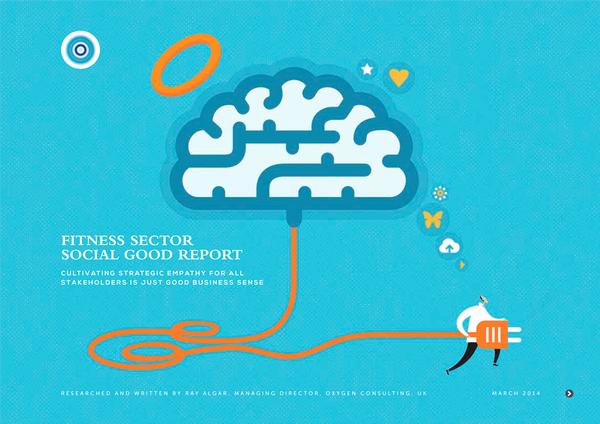
The Fitness Sector Social Good Report, published in 2014, explores the idea that a business with a purpose beyond maximising its own self-interests can ensure long-term relevance with its stakeholders, thereby creating a more valued and sustainable organisation.
The report is structured around eight themes: purposeful, responsible, authentic, generous, compassionate, connected, collaborative and influential. In this article, I briefly discuss four themes and what they mean for your business.
Purposeful When I discover a new and interesting new business, there are normally two things I immediately want to understand. First, what the business makes. Then I want to know the founder’s story: why did they start the business and what’s the big idea that’s fuelling it? Understanding its purpose – the shared understanding of the reason why the business exists – is the filter I use to help me decide if I’m going to care about this business.
Remember, if I care, then I will share with my network. I believe clarity of purpose matters because it unites people and drives actions. As Nikos Mourkogiannis, global expert in strategic leadership, says: “Purpose is a reason for doing something that appeals to a person’s sense of what is right and what is worthwhile. So it creates a sense of obligation. Business purpose is the most powerful, but least leveraged, weapon in leadership.”
There are four distinct types of business purpose. The first is Heroism: driving the standards for the world to follow (Facebook, Zipcar). The second is Excellence: providing the best possible product or service, with an insatiable pursuit of ever-higher standards (Apple, Lego). Then there’s Discovery: a love of the new and innovative, where the founders are often intellectually curious and have a desire to re-invent industries (Twitter, Samsung). Finally there’s Altruism: serving the needs of others (Disney, Kickstarter).
The fitness sector is driven by an altruistic purpose. However, some external industry observers see a contradiction. During an interview with Giles Gibbons, CEO of Good Business, he commented: “What’s interesting about the fitness industry is that it has an incredibly strong social purpose: to help others. [It’s a purpose] that’s well understood by the general public. It’s a fantastic place to start and actually quite rare. I think the challenge for the fitness industry is that it seems to forget about this and sees people as numbers, thinking of it as a cost-driven business. As a result, I don’t think it’s achieving the aspiration, the loyalty and the warmth it should from such an important societal function.”
So consider this… What does your organisation fundamentally stand for? Are you creating a legacy that will be long remembered?
Responsible In 1970, Milton Friedman, the Nobel prize-winning economist, wrote a famous essay in the New York Times Magazine titled ‘The Social Responsibility of Business is to Increase its Profits’.
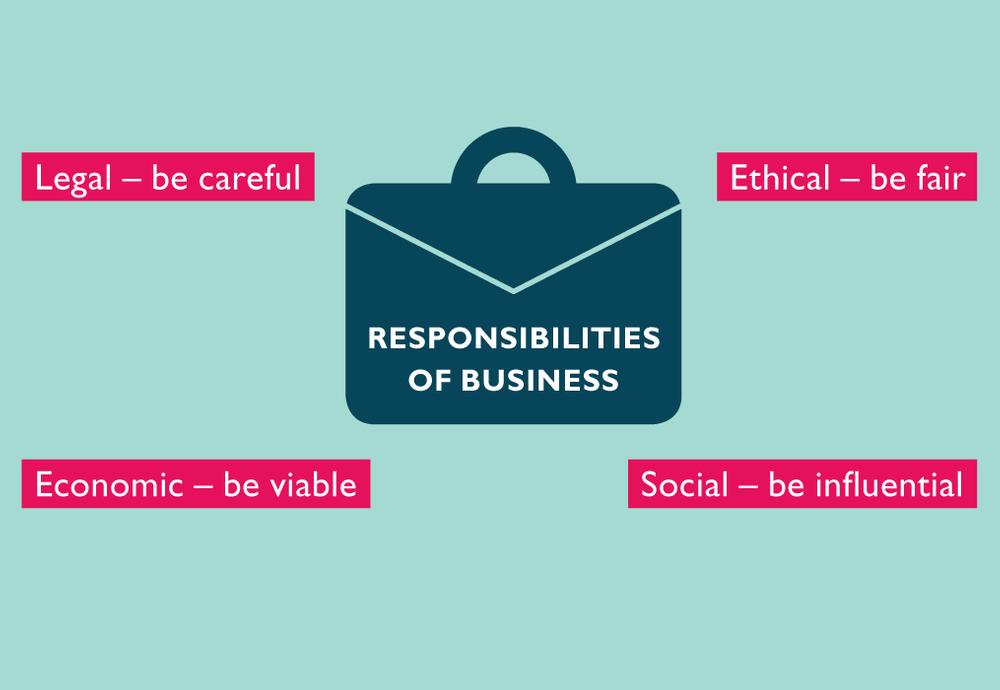
More than 44 years have since passed and the world of business is now very different, with the responsibilities of business arguably far more complex to define (see Figure 1, p105). Now, an increasing number of businesses routinely invest in social and environmental projects that may seem well outside the scope of their core business activity.
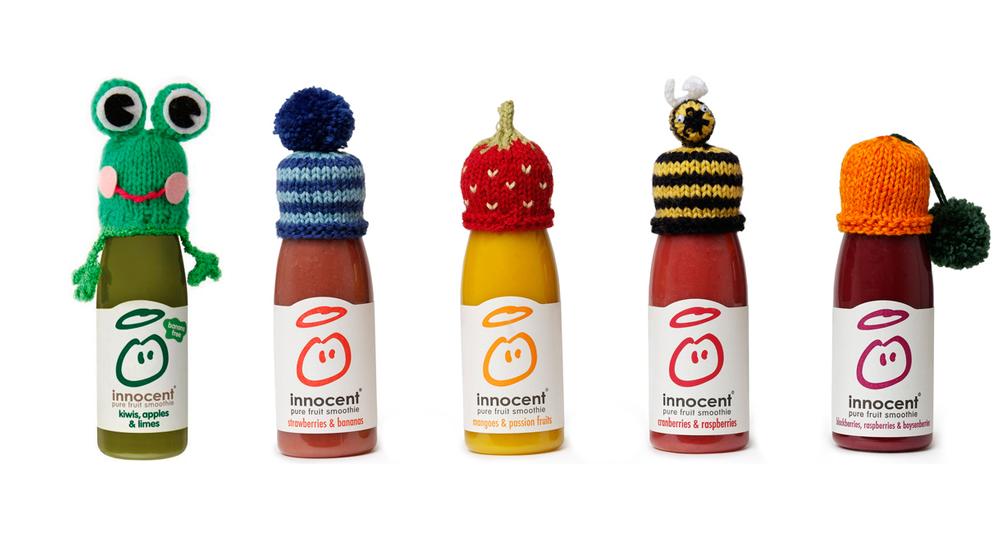
For example, while I was writing my report, Innocent Drinks was encouraging people across the UK to knit little woollen hats to adorn the tops of its smoothie bottles. The company donated £0.25 to the charity Age UK each time a bottle with a hat was sold, with the goal of reducing the number of old and frail people dying from the cold weather in England and Wales. So what was the connection between a business that liquidises fruit and an elderly person who has never purchased a smoothie? Well, it seems as though many businesses are fundamentally redefining their role in society, which is reshaping their perspective of who is a stakeholder.
So consider this… How much clarity is there in your organisation about core responsibilities? Would a neutral person conclude that your organisation’s terms of business are transparent, fair and reasonable?
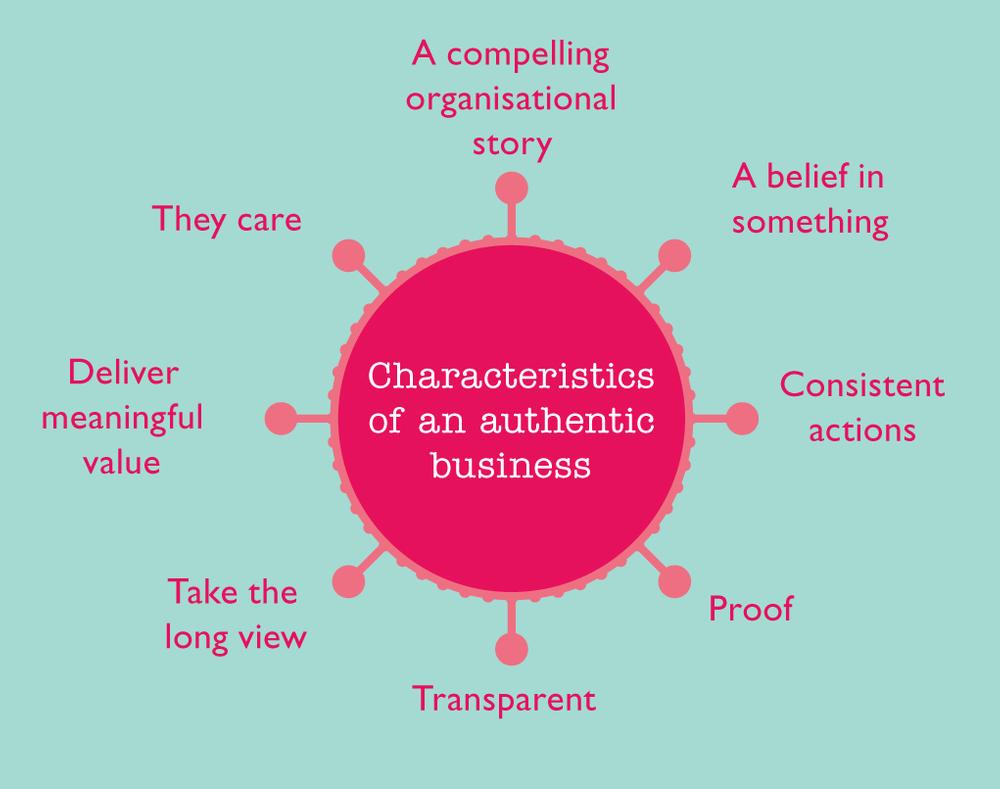
Authentic ‘Authentic’ means to be real or genuine. In a business context, it broadly translates to: “This is who we are and this is what we stand for. Please come join us if this matters to you as well” – but I believe there are many facets to an authentic business (see Figure 2, left). When an individual and a business do genuinely connect, there’s a meeting of both heart and mind. Customers become enthusiastic advocates who just love talking about your organisational story. So what’s your organisation’s story? Do you have one, and would it captivate a room full of strangers? This matters because a remarkable story has the potential to rapidly spread through a person’s network – and networks today are larger and more efficient than at any other time in the history of humanity. Organisations with a remarkable story get more mentions on social networks, powered by an individual’s passion and excitement to inform others. This means they spend less on paid advertising trying to convince others to ‘like’ them.
So consider this… Does your organisation have a compelling story that spreads far beyond its geographic boundaries? How good is your organisation at proving the difference it makes to the lives of its customers and its community?
Generous Organisations need to have a reputation for authentic generosity if they are to remain relevant to their stakeholders. Throwing out a few scraps of charity once a quarter is neither credible nor sufficient. Indeed, it smells of putting the interests of the business first – especially when the press release is rushed out, talking more about the act while lacking proof of results or details of the difference made.
So is your business a ‘net giver’ or ‘net taker’? Communities will care if a club is perceived as a net giver rather than a net taker. What is a ‘net giver’? Simply put, it’s a club that, over the course of time, gives more to its community than it takes out. A business never wants to have a reputation for being a ‘net taker’, as it’s a label that’s very hard to shrug off.
As Thomas Kolster said in his book Goodvertising: “Generosity can be a clear differentiator in a crowded market. Generosity is a powerful story to tell about a brand and can attract new customers, new suppliers and partnerships.”
So consider this… How generous is your organisation when the press and media aren’t looking? How could a sustained sense of generosity be embedded into your organisation – one that will be genuinely credible to consumers?
FOR FURTHER INFORMATION Ray Algar is MD of Oxygen Consulting, a company that provides strategic business insights for organisations connected to the global health and fitness industry. He also founded Gymtopia, an award-winning digital platform that shares stories about how the fitness industry is creating positive social impact in communities around the world.
Download a complimentary copy of the Fitness Sector Social Good Report: http://bit.ly/SocialGoodReport
Fitness Sector Social Good Report
How generous is your business? Are your charity efforts ad hoc and superficial, or is sustained generosity embedded in your organisation? / photo: www.shutterstock.com/breakwavemedia
Figure 1: Multiple responsibilities of a modern business / VISUAL INSIGHT,OXYGEN CONSULTING, 2014
Figure 2: Characteristics of an authentic business
Innocent Drinks donated £0.25 to Age UK for every bottle sold with
a knitted hat
In the fast-paced world of fitness and wellness, where high-intensity workouts push us to
our limits and the sweat pours, the importance of efficient recovery cannot be overstated. [more...]
+ More featured suppliers
COMPANY PROFILES
Gharieni Group
For 35 years, the Gharieni Group has
redefined wellness, spa and medical
equipment, setting global [more...]
Sommerhuber GmbH
Sommerhuber specialises in the manufacturing of heat-storing ceramics for spas. [more...]
Networks today are larger and more efficient than at any other time in history / photo: www.shutterstock.com/ Syda Productions
The Fitness Sector Social Good Report, published in 2014, explores the idea that a business with a purpose beyond maximising its own self-interests can ensure long-term relevance with its stakeholders, thereby creating a more valued and sustainable organisation.
The report is structured around eight themes: purposeful, responsible, authentic, generous, compassionate, connected, collaborative and influential. In this article, I briefly discuss four themes and what they mean for your business.
Purposeful When I discover a new and interesting new business, there are normally two things I immediately want to understand. First, what the business makes. Then I want to know the founder’s story: why did they start the business and what’s the big idea that’s fuelling it? Understanding its purpose – the shared understanding of the reason why the business exists – is the filter I use to help me decide if I’m going to care about this business.
Remember, if I care, then I will share with my network. I believe clarity of purpose matters because it unites people and drives actions. As Nikos Mourkogiannis, global expert in strategic leadership, says: “Purpose is a reason for doing something that appeals to a person’s sense of what is right and what is worthwhile. So it creates a sense of obligation. Business purpose is the most powerful, but least leveraged, weapon in leadership.”
There are four distinct types of business purpose. The first is Heroism: driving the standards for the world to follow (Facebook, Zipcar). The second is Excellence: providing the best possible product or service, with an insatiable pursuit of ever-higher standards (Apple, Lego). Then there’s Discovery: a love of the new and innovative, where the founders are often intellectually curious and have a desire to re-invent industries (Twitter, Samsung). Finally there’s Altruism: serving the needs of others (Disney, Kickstarter).
The fitness sector is driven by an altruistic purpose. However, some external industry observers see a contradiction. During an interview with Giles Gibbons, CEO of Good Business, he commented: “What’s interesting about the fitness industry is that it has an incredibly strong social purpose: to help others. [It’s a purpose] that’s well understood by the general public. It’s a fantastic place to start and actually quite rare. I think the challenge for the fitness industry is that it seems to forget about this and sees people as numbers, thinking of it as a cost-driven business. As a result, I don’t think it’s achieving the aspiration, the loyalty and the warmth it should from such an important societal function.”
So consider this… What does your organisation fundamentally stand for? Are you creating a legacy that will be long remembered?
Responsible In 1970, Milton Friedman, the Nobel prize-winning economist, wrote a famous essay in the New York Times Magazine titled ‘The Social Responsibility of Business is to Increase its Profits’.
More than 44 years have since passed and the world of business is now very different, with the responsibilities of business arguably far more complex to define (see Figure 1, p105). Now, an increasing number of businesses routinely invest in social and environmental projects that may seem well outside the scope of their core business activity.
For example, while I was writing my report, Innocent Drinks was encouraging people across the UK to knit little woollen hats to adorn the tops of its smoothie bottles. The company donated £0.25 to the charity Age UK each time a bottle with a hat was sold, with the goal of reducing the number of old and frail people dying from the cold weather in England and Wales. So what was the connection between a business that liquidises fruit and an elderly person who has never purchased a smoothie? Well, it seems as though many businesses are fundamentally redefining their role in society, which is reshaping their perspective of who is a stakeholder.
So consider this… How much clarity is there in your organisation about core responsibilities? Would a neutral person conclude that your organisation’s terms of business are transparent, fair and reasonable?
Authentic ‘Authentic’ means to be real or genuine. In a business context, it broadly translates to: “This is who we are and this is what we stand for. Please come join us if this matters to you as well” – but I believe there are many facets to an authentic business (see Figure 2, left). When an individual and a business do genuinely connect, there’s a meeting of both heart and mind. Customers become enthusiastic advocates who just love talking about your organisational story. So what’s your organisation’s story? Do you have one, and would it captivate a room full of strangers? This matters because a remarkable story has the potential to rapidly spread through a person’s network – and networks today are larger and more efficient than at any other time in the history of humanity. Organisations with a remarkable story get more mentions on social networks, powered by an individual’s passion and excitement to inform others. This means they spend less on paid advertising trying to convince others to ‘like’ them.
So consider this… Does your organisation have a compelling story that spreads far beyond its geographic boundaries? How good is your organisation at proving the difference it makes to the lives of its customers and its community?
Generous Organisations need to have a reputation for authentic generosity if they are to remain relevant to their stakeholders. Throwing out a few scraps of charity once a quarter is neither credible nor sufficient. Indeed, it smells of putting the interests of the business first – especially when the press release is rushed out, talking more about the act while lacking proof of results or details of the difference made.
So is your business a ‘net giver’ or ‘net taker’? Communities will care if a club is perceived as a net giver rather than a net taker. What is a ‘net giver’? Simply put, it’s a club that, over the course of time, gives more to its community than it takes out. A business never wants to have a reputation for being a ‘net taker’, as it’s a label that’s very hard to shrug off.
As Thomas Kolster said in his book Goodvertising: “Generosity can be a clear differentiator in a crowded market. Generosity is a powerful story to tell about a brand and can attract new customers, new suppliers and partnerships.”
So consider this… How generous is your organisation when the press and media aren’t looking? How could a sustained sense of generosity be embedded into your organisation – one that will be genuinely credible to consumers?
FOR FURTHER INFORMATION Ray Algar is MD of Oxygen Consulting, a company that provides strategic business insights for organisations connected to the global health and fitness industry. He also founded Gymtopia, an award-winning digital platform that shares stories about how the fitness industry is creating positive social impact in communities around the world.
Download a complimentary copy of the Fitness Sector Social Good Report: http://bit.ly/SocialGoodReport
Fitness Sector Social Good Report
How generous is your business? Are your charity efforts ad hoc and superficial, or is sustained generosity embedded in your organisation? / photo: www.shutterstock.com/breakwavemedia
Figure 1: Multiple responsibilities of a modern business / VISUAL INSIGHT,OXYGEN CONSULTING, 2014
Figure 2: Characteristics of an authentic business
Innocent Drinks donated £0.25 to Age UK for every bottle sold with
a knitted hat
As part of its first hotel partnership, Mayrlife – the medical health resort company known for its
site in Altaussee, Austria – has launched a day clinic at the Rosewood Vienna.
Premium London health club, KX Chelsea, will imminently unveil its most significant
redevelopment since its launch in 2002 to create an integrated wellness model combining
training, recovery and relaxation.
Rosewood Le Guanahani St Barth, on the northeast coast of Saint Barthélemy in the French
West Indies, is offering a programme of ocean-inspired yoga classes between 8-14 June to
celebrate Global Wellness Day (GWD).
Hotel de France, located on the British Isle of Jersey, has created a wellness retreat package
that includes a hot yoga session that will take place in Jersey Zoo’s butterfly sanctuary.
The Ritz-Carlton, Langkawi, in Malaysia, has revealed a schedule for Global Wellness Day
(GWD) that includes guided rainforest walks, mindful movement and guided coastal meditation
experiences.
Longevitix, a clinical platform for preventive and longevity medicine, has launched its AI-
powered intelligence system to help physicians deliver continuous, personalised longevity-
focused care at scale.
Atmantan Wellness Centre, an integrative wellness destination in Mulshi, near Pune in India, is
expanding its portfolio by adding a new centre in Hyderabad that will launch between 2028 and
2029.
A recent survey by the UK Spa Association (UKSA) into the industry’s approach to cancer care
has revealed that almost half of participating respondents (46 per cent) are unaware that
cancer is a disability and guests with a cancer diagnosis must be given
Mexican operator, Solmar Hotels and Resorts, is hosting a series of events in celebration of
Global Wellness Day, including a Temazcal ceremony at its Playa Grande Resort and Spa in Los
Cabos.
Mandarin Oriental has announced a standalone residence brand, Mansions, which will debut at
Emirates Palace, Mandarin Oriental Mansions, Abu Dhabi, in 2029.
In the fast-paced world of fitness and wellness, where high-intensity workouts push us to
our limits and the sweat pours, the importance of efficient recovery cannot be overstated. [more...]
+ More featured suppliers
COMPANY PROFILES
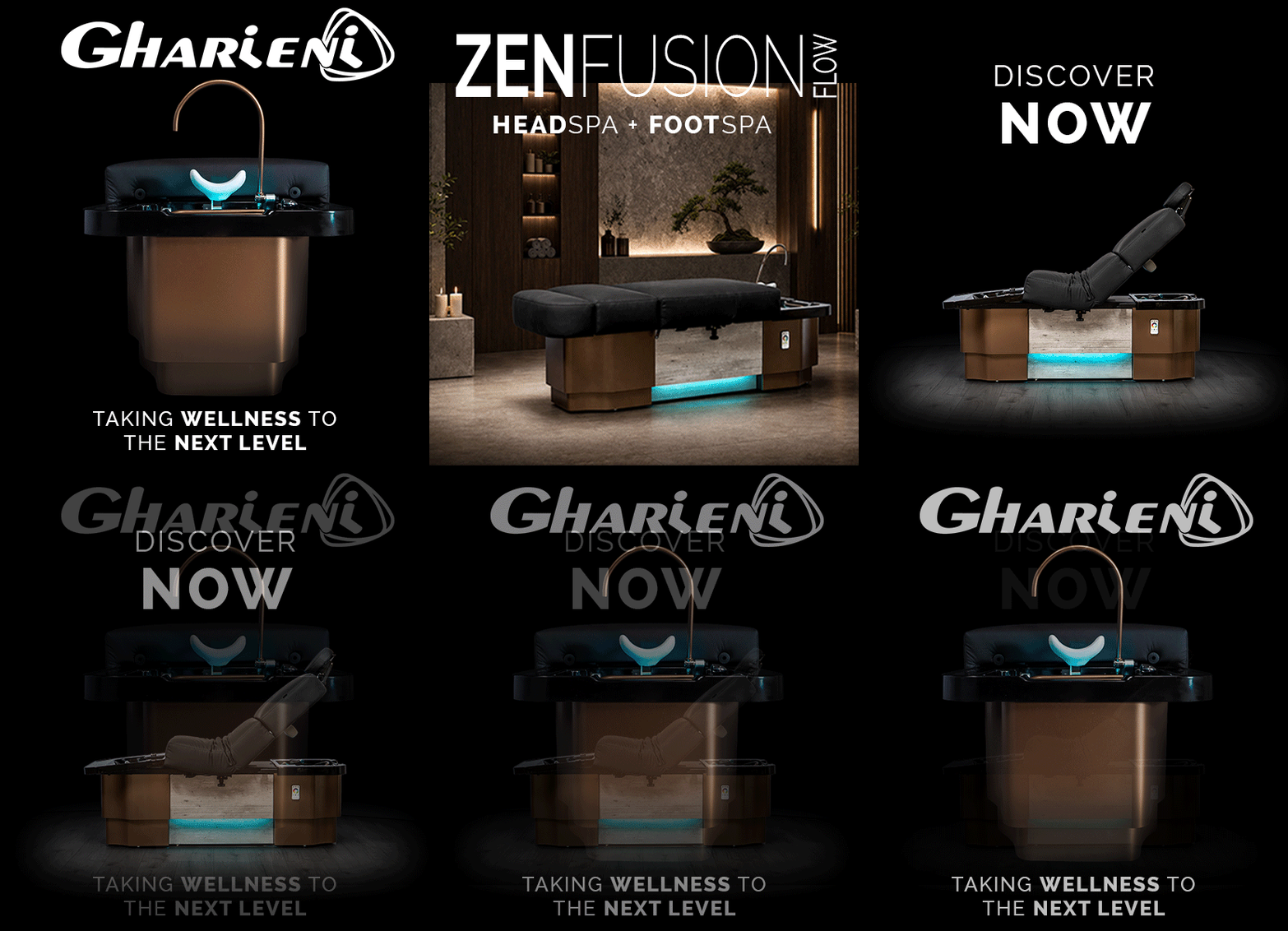
Gharieni Group For 35 years, the Gharieni Group has
redefined wellness, spa and medical
equipment, setting global [more...]