In part two of our series on university sports centres, we look at two universities which have made commercial community usage of their facilities the bedrock of their business models
By Rhianon Howells | Published in Sports Management 2015 issue 4
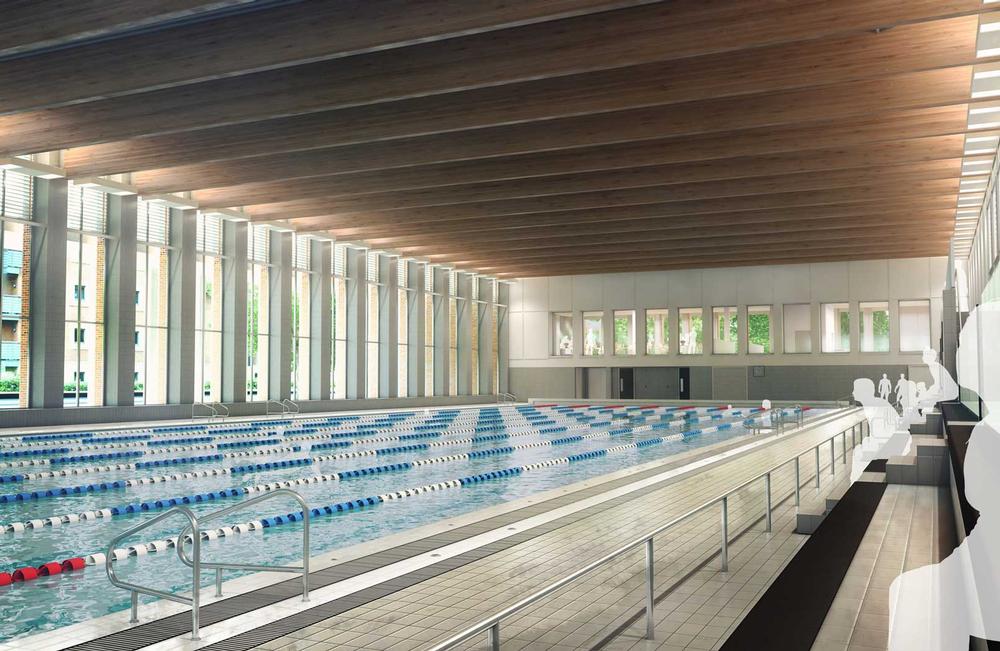
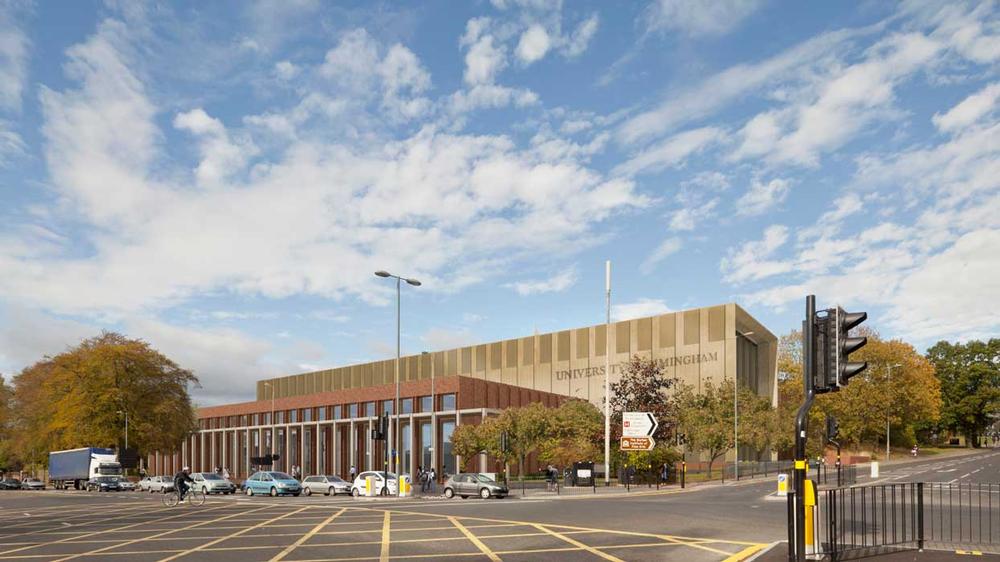
Birmingham will open a new £55m indoor sports centre in 2016
In part one of our series on university sports centres (see Sports Management, Issue 3, 2015), we looked at how three universities – Loughborough, Durham and Sheffield Hallam – were balancing the needs of their students with those of elite athletes and the wider community while also meeting commercial goals.
All of these centres work for and within their communities in meaningful and varied ways, whether through outreach to schools, partnerships with local clubs or by offering limited memberships and pay-and-play options to community users. For a growing number of university sports operations, however, community usage is not only part of the offering – it is absolutely integral to their commercial model.
As more universities fund new sports facilities with NGB and/or Lottery grants, many are signing up to Community Use Agreements (CUAs) which require them to place community usage, not at the sidelines, but front and centre of what they do. But how do these models work in practice? And what benefits do they bring?
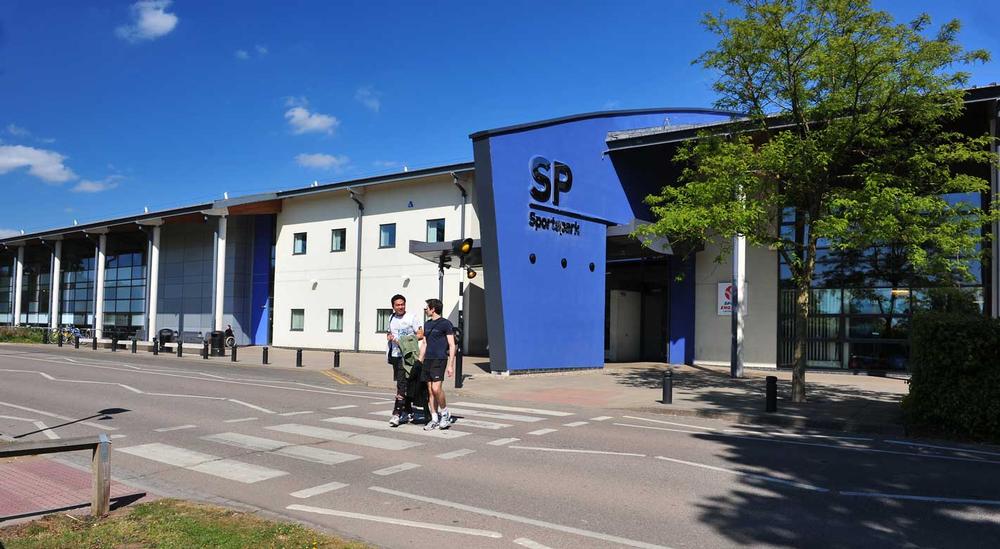
university of east anglia Opened in 2000 and still the largest Lottery-funded indoor university sports centre in the country, the University of East Anglia’s Sportspark was one of the first to prove the potential of this kind of community-focused model.
As a predominately Lottery-funded facility, Sportspark is bound by a CUA until August 2018, which requires it to prioritise community over university usage – the rule of thumb is 80:20 – albeit that for the purposes of memberships and pay-and-play access, UEA students are counted as part of the community.
Membership numbers also reveal the emphasis on community, with 8,800 community adult members, 2,800 junior members and 1,900 student members. While community members pay monthly, from £5 for a pay-and-play discount card to £40 for peak all-access membership, students pay a one-off annual fee ranging from £135 to £300, depending on usage.
In addition, pay-and-play visits will exceed 1.4 million visits this year and approximately 9,000 students have an activated campus card giving them discounted pay-and-play access (the student population is around 14,000). Further to this, 42 of the university’s 65 sports clubs make regular use of Sportspark facilities, alongside the top regional swimming and athletics clubs. According to UEA’s director of sport, Phil Steele, the programme is managed to ensure there are always slots available for members and pay-and-play users, as well as club- and performance-related activity. There is inevitably some conflict, particularly when hosting large-scale events, but careful planning keeps this to a minimum.
The benefit of the model to the university is clear, says Steele: “It cost the university £2m [initial capital spend] for what is now a £30m facility, in terms of what it’s cost to build and extend. If we had to build it now, it would be £60m.”
Crucially, the CUA also allows any surpluses from the commercial side (Steele receives a grant from the university to subsidise student use) to be reinvested in facilities or programming.
With regard to performance, Steele admits UEA is not yet an elite sports university, although he hints plans are afoot to offer more support to its talented athletes. In terms of facilities, a £1.5m refurbishment project completed last year included more performance-oriented training equipment and a studio for higher-intensity training, while specific strength and conditioning and targeted training sessions have also been introduced at the request of university clubs.
When it comes to staying ahead of the game, Steele sets much store by Quest, Sport England’s national quality scheme, which functions both as a badge of accreditation and a tool for continuous improvement. Sportspark received its first accreditation – Quest Entry, a one-day assessment – in January this year, and Steele now wants UEA to be the first university to get a Quest ‘Excellent’ rating at the Quest Plus level, which involves a two-day assessment plus a mystery visit. “The framework it creates ensures we continuously reflect on service delivery and review impact and outcomes, something that commonly gets overlooked,” he says. “This in turn should drive improved customer satisfaction and a more consistent level of service, both of which help us to be more financially successful.”
University of Birmingham At the University of Birmingham – which next year will replace its existing indoor centre with a new £55m facility – the practice of catering for community users alongside staff and students has an even longer history than at UEA. According to director of sport Zena Wooldridge, the UB Sport team has been juggling the needs of these different groups for 40 years. But while management and staff are adept at managing the inherent challenges, the existing centre is now simply too small and inadequately designed to cope with what is being asked of it. “It causes huge problems in terms of where we put everyone,” says Wooldridge. While extending opening hours, ruthless policing of time slots and creative use of dead space – the conversion of a storeroom to a group cycling studio, for example – papered over the problems for a while, it eventually reached a tipping point, says Wooldridge: “As a leading sporting university we were falling behind, in terms of the expectations of our students and our profile.”
While redeveloping the current facilities to 21st century standards would have cost around £30m, the university was persuaded to make an even bigger commitment – £52.5m, with a further £2m in Lottery funding and half a million in alumni donations. What the extra investment has done, says Wooldridge, is allow the university to build the new centre big enough to increase participation and therefore revenue. This will not only help subsidise student- and performance-related activity, but will also enable the facility to be self-sustaining.
Community Benefits In place of a conventional CUA, the university has agreed a community use “in principle statement” in consultation with Sport England and Birmingham City Council. According to Wooldridge, the statement “simply reflects what we were intending to do anyway”, but by enabling the university to demonstrate the extent of its current community provision and planned future provision, it has proved “a useful perception-changing exercise.”
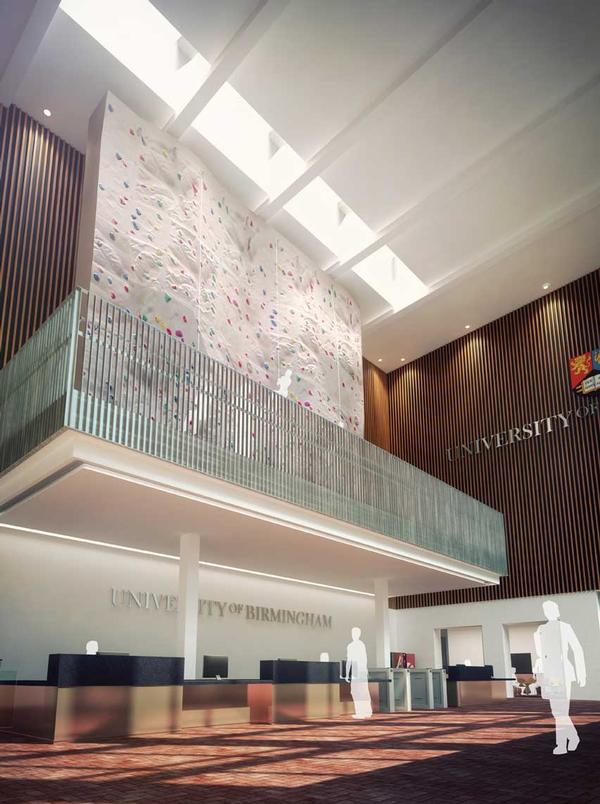
As well as being significantly bigger, the new centre – designed by architects Lifschutz Davidson Sandilands and AFLS&P – will have less wasted space and greater accessibility, not only for disabled people but also for transgender and religious groups. Facilities will include a 50m pool, two sports halls, a 220-station gym, six squash courts, five studios, a high performance centre, a climbing wall, sauna, steamroom and a café. This is in addition to the university’s outdoor tennis courts and multiple grass and synthetic pitches.
The centre, says Wooldridge, will “serve a wide range of users, from early years’ swimming to retired groups, and absolute beginners to world-class performers.” As well as catering for 15 community clubs, 55 student clubs and a 2,500-strong intramural programme, it will offer a wide range of memberships and pay-and-play options. Membership estimates are 6,000 for students, 1,650 for staff and 2,500 for community members. Community members will pay, on average, between two and 2.5 times as much as students (student memberships currently start at £104 a year). While the opening of the new facility will naturally lessen demand on available space, some continuing tension between different user groups is inevitable. The key to managing this, says Wooldridge, is good advance planning and communication: “For example, our student clubs understand that their subsidies are to a large extent dependent on our members gaining use. As long as we share that, and they understand that, it does generally work.”
Like Steele, Wooldridge also puts faith in the value of external accreditation and benchmarking schemes. In 2012, UB Sport took part in the National Benchmarking Service – administered by Leisure-net Solutions in partnership with Sheffield Hallam University’s Sport Industry Research Centre – “because it’s a valuable benchmark against industry standards and informs us how much we need to improve in the lead-in to a new facility.”
Like UEA, UB Sport is also one of seven Quest-accredited university sports centres, and the first to achieve Quest Combo, which assesses both facilities and sports development. The motivation, says Wooldridge, was to help operational staff to “understand the standards to aspire to if they are to be the best in the industry.”
“The university sector is good at sitting back and saying, ‘operationally, we’re very good, aren’t we?’ But there are a lot of things in the commercial sector we can learn from. Our students and members come to us from private clubs: that’s what their expectations are, that’s what we have to deliver. It’s very easy for [staff] to get comfortable and not necessarily see that. So all Quest does is it changes the lens through which they see the world.”
In part two of our series on university sports centres, we look at two universities which have made commercial community usage of their facilities the bedrock of their business models
By Rhianon Howells | Published in Sports Management 2015 issue 4
Birmingham will open a new £55m indoor sports centre in 2016
In part one of our series on university sports centres (see Sports Management, Issue 3, 2015), we looked at how three universities – Loughborough, Durham and Sheffield Hallam – were balancing the needs of their students with those of elite athletes and the wider community while also meeting commercial goals.
All of these centres work for and within their communities in meaningful and varied ways, whether through outreach to schools, partnerships with local clubs or by offering limited memberships and pay-and-play options to community users. For a growing number of university sports operations, however, community usage is not only part of the offering – it is absolutely integral to their commercial model.
As more universities fund new sports facilities with NGB and/or Lottery grants, many are signing up to Community Use Agreements (CUAs) which require them to place community usage, not at the sidelines, but front and centre of what they do. But how do these models work in practice? And what benefits do they bring?
university of east anglia Opened in 2000 and still the largest Lottery-funded indoor university sports centre in the country, the University of East Anglia’s Sportspark was one of the first to prove the potential of this kind of community-focused model.
As a predominately Lottery-funded facility, Sportspark is bound by a CUA until August 2018, which requires it to prioritise community over university usage – the rule of thumb is 80:20 – albeit that for the purposes of memberships and pay-and-play access, UEA students are counted as part of the community.
Membership numbers also reveal the emphasis on community, with 8,800 community adult members, 2,800 junior members and 1,900 student members. While community members pay monthly, from £5 for a pay-and-play discount card to £40 for peak all-access membership, students pay a one-off annual fee ranging from £135 to £300, depending on usage.
In addition, pay-and-play visits will exceed 1.4 million visits this year and approximately 9,000 students have an activated campus card giving them discounted pay-and-play access (the student population is around 14,000). Further to this, 42 of the university’s 65 sports clubs make regular use of Sportspark facilities, alongside the top regional swimming and athletics clubs. According to UEA’s director of sport, Phil Steele, the programme is managed to ensure there are always slots available for members and pay-and-play users, as well as club- and performance-related activity. There is inevitably some conflict, particularly when hosting large-scale events, but careful planning keeps this to a minimum.
The benefit of the model to the university is clear, says Steele: “It cost the university £2m [initial capital spend] for what is now a £30m facility, in terms of what it’s cost to build and extend. If we had to build it now, it would be £60m.”
Crucially, the CUA also allows any surpluses from the commercial side (Steele receives a grant from the university to subsidise student use) to be reinvested in facilities or programming.
With regard to performance, Steele admits UEA is not yet an elite sports university, although he hints plans are afoot to offer more support to its talented athletes. In terms of facilities, a £1.5m refurbishment project completed last year included more performance-oriented training equipment and a studio for higher-intensity training, while specific strength and conditioning and targeted training sessions have also been introduced at the request of university clubs.
When it comes to staying ahead of the game, Steele sets much store by Quest, Sport England’s national quality scheme, which functions both as a badge of accreditation and a tool for continuous improvement. Sportspark received its first accreditation – Quest Entry, a one-day assessment – in January this year, and Steele now wants UEA to be the first university to get a Quest ‘Excellent’ rating at the Quest Plus level, which involves a two-day assessment plus a mystery visit. “The framework it creates ensures we continuously reflect on service delivery and review impact and outcomes, something that commonly gets overlooked,” he says. “This in turn should drive improved customer satisfaction and a more consistent level of service, both of which help us to be more financially successful.”
University of Birmingham At the University of Birmingham – which next year will replace its existing indoor centre with a new £55m facility – the practice of catering for community users alongside staff and students has an even longer history than at UEA. According to director of sport Zena Wooldridge, the UB Sport team has been juggling the needs of these different groups for 40 years. But while management and staff are adept at managing the inherent challenges, the existing centre is now simply too small and inadequately designed to cope with what is being asked of it. “It causes huge problems in terms of where we put everyone,” says Wooldridge. While extending opening hours, ruthless policing of time slots and creative use of dead space – the conversion of a storeroom to a group cycling studio, for example – papered over the problems for a while, it eventually reached a tipping point, says Wooldridge: “As a leading sporting university we were falling behind, in terms of the expectations of our students and our profile.”
While redeveloping the current facilities to 21st century standards would have cost around £30m, the university was persuaded to make an even bigger commitment – £52.5m, with a further £2m in Lottery funding and half a million in alumni donations. What the extra investment has done, says Wooldridge, is allow the university to build the new centre big enough to increase participation and therefore revenue. This will not only help subsidise student- and performance-related activity, but will also enable the facility to be self-sustaining.
Community Benefits In place of a conventional CUA, the university has agreed a community use “in principle statement” in consultation with Sport England and Birmingham City Council. According to Wooldridge, the statement “simply reflects what we were intending to do anyway”, but by enabling the university to demonstrate the extent of its current community provision and planned future provision, it has proved “a useful perception-changing exercise.”
As well as being significantly bigger, the new centre – designed by architects Lifschutz Davidson Sandilands and AFLS&P – will have less wasted space and greater accessibility, not only for disabled people but also for transgender and religious groups. Facilities will include a 50m pool, two sports halls, a 220-station gym, six squash courts, five studios, a high performance centre, a climbing wall, sauna, steamroom and a café. This is in addition to the university’s outdoor tennis courts and multiple grass and synthetic pitches.
The centre, says Wooldridge, will “serve a wide range of users, from early years’ swimming to retired groups, and absolute beginners to world-class performers.” As well as catering for 15 community clubs, 55 student clubs and a 2,500-strong intramural programme, it will offer a wide range of memberships and pay-and-play options. Membership estimates are 6,000 for students, 1,650 for staff and 2,500 for community members. Community members will pay, on average, between two and 2.5 times as much as students (student memberships currently start at £104 a year). While the opening of the new facility will naturally lessen demand on available space, some continuing tension between different user groups is inevitable. The key to managing this, says Wooldridge, is good advance planning and communication: “For example, our student clubs understand that their subsidies are to a large extent dependent on our members gaining use. As long as we share that, and they understand that, it does generally work.”
Like Steele, Wooldridge also puts faith in the value of external accreditation and benchmarking schemes. In 2012, UB Sport took part in the National Benchmarking Service – administered by Leisure-net Solutions in partnership with Sheffield Hallam University’s Sport Industry Research Centre – “because it’s a valuable benchmark against industry standards and informs us how much we need to improve in the lead-in to a new facility.”
Like UEA, UB Sport is also one of seven Quest-accredited university sports centres, and the first to achieve Quest Combo, which assesses both facilities and sports development. The motivation, says Wooldridge, was to help operational staff to “understand the standards to aspire to if they are to be the best in the industry.”
“The university sector is good at sitting back and saying, ‘operationally, we’re very good, aren’t we?’ But there are a lot of things in the commercial sector we can learn from. Our students and members come to us from private clubs: that’s what their expectations are, that’s what we have to deliver. It’s very easy for [staff] to get comfortable and not necessarily see that. So all Quest does is it changes the lens through which they see the world.”
Preidlhof Luxury DolceVita Resort, a destination resort and spa in Naturno, South Tyrol in Italy,
will reveal a new spa in February 2027, which has been designed by wellness expert and
consultant Patrizia Bortolin.
Private hotel owner and developer HVL Hotels will open a new luxury resort and tourism
destination called Laval Hunter Valley in the second half of 2027 in Pokolbin, Australia.
The annual wellness festival dedicated to wellbeing, culture, longevity and human connection,
called Alma, will be hosted by Rocco Forte hotel, Verdura Resort in Sicily, Italy.
Capella Hotel Group has appointed Feisal Jaffer as chief development officer as the company
ramps up its global expansion of both its Capella and Patina brands.
People taking GLP-1 weight loss medications such as Ozempic, Wegovy, Mounjaro and Zepbound
may be losing weight, but they’re also becoming less physically active, according to new
research presented at the ENDO 2026 annual meeting of the Endocrine Society
Abu Dhabi-based investment firm Mubadala Capital has made a binding, fully financed
€1 billion
offer to acquire Pierre and Vacances SA, the European holiday resort operator behind the
continental European Center Parcs business.
Global retreat trade show, Synergy The Retreat Show, has launched a resource called The
Source, which hosts an open-access online Transformation Series programme.