It’s light, strong, fast-growing
and environmentally sound –
bamboo is seeing a resurgence in
popularity as a building material.
Christopher DeWolf takes a look at a
few extraordinary structures
By Christopher DeWolf | Published in CLADmag 2016 issue 1
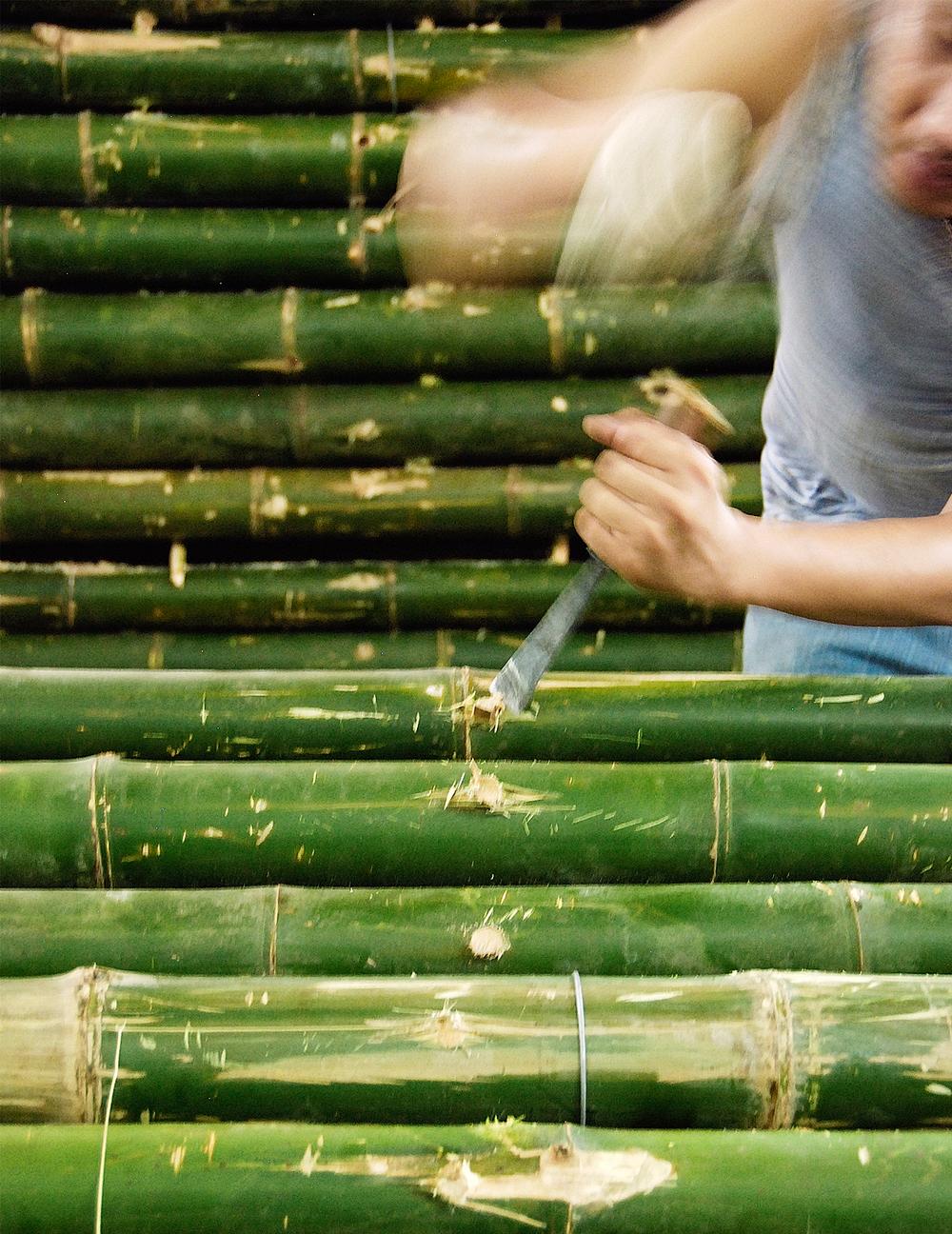
Bamboo, dubbed ‘green steel’, is light, strong and highly sustainable, needing only four years to grow to maturity
It was an astonishing sight. At the corner of two busy roads in Hong Kong, surrounded by glass and concrete skyscrapers, an enormous bamboo theatre rose from a vacant lot, its gnarly skeleton clad with tin sheets and festive banners. For just over a month in 2013, the West Kowloon Bamboo Theatre echoed with the wails of Cantonese opera as spectators munched on curried fish balls from the food stalls gathered outdoors.
Designed by Hong Kong architect William Lim, the theatre was built using 10,000 bamboo rods held together with plastic ties. With room for 800 people, it was one of the largest bamboo theatres ever built, but Lim could not take credit for the idea: these types of temporary theatres have been built in the villages of Hong Kong and Guangdong province for hundreds of years, playing host to travelling opera troupes and celebratory feasts. The West Kowloon Bamboo Theatre was a government-sponsored effort to bring the tradition to a high-profile location in central Hong Kong. “It’s a very vernacular, local structure,” says Lim.
The vernacular is increasingly in vogue. Around 1 billion people live in bamboo structures around the world, mostly in informal, hand-built houses, but the fast-growing grass is finding its way into hotels, restaurants, museums and other public facilities. Bamboo owes its new found popularity to the same qualities that made it the material of choice for Hong Kong’s theatre-builders: it’s strong, lightweight and remarkably sustainable. It takes just four years to mature and 70 hectares of bamboo produces the same amount of construction material as 600 hectares of trees. It’s even more efficient than trees at cleaning the air, with 1 hectare of bamboo removing over 80 tonnes of carbon dioxide from the atmosphere every year.
“I think bamboo and laminated bamboo will replace other materials and become the ‘green steel’ of the 21st century,” said Vietnamese architect Vo Trong Nghia in an interview last year.
He is not alone in his opinion: more and more architects are doing ground-breaking work with bamboo. Here are five to watch.
1. Vo Trong Nghia, Vietnam Vo Trong Nghia has proven that sustainability is stylish. Since establishing his firm in 2006, the Vietnamese architect has completed several bamboo projects, including restaurants, cafés, a community hall and Vietnam’s national pavilion at the 2015 Milan Expo. The design of the pavilion was inspired by lotus ponds, with thick clusters of bamboo columns that appear to sprout from a shallow body of water. The bamboo elements were prefabricated, allowing them to be easily assembled, disassembled and recycled.
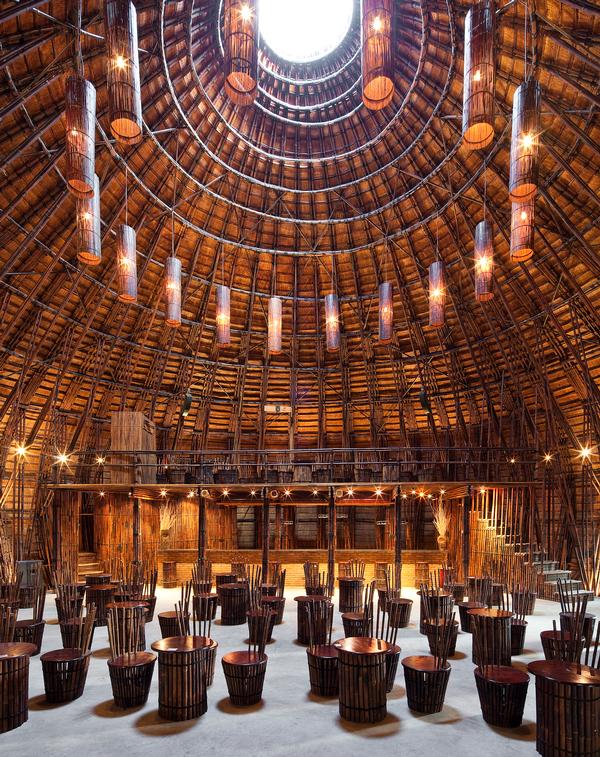
Nghia’s work has been lauded for its beauty, but it is his structural innovations that are truly noteworthy. In the case of the Wind and Water Bar, an event space just north of Ho Chi Minh City, Nghia designed a 10-metre-high, 15-metre-wide dome made of 48 prefabricated bamboo units bound together with bamboo bolts. Clad in rattan and grass, the building sits on an island in an artificial pond, which creates a naturally cool breeze that passes through the base of the structure. Hot air escapes through a circular opening at the top of the dome.
Nghia treats the bamboo stalks using traditional methods. He first subjects them to heat in order to bend them into shape. Then he soaks the stalks in mud, which reduces the sugar content to stop them attracting insects, before smoking them to create a carbonised layer that prevents them being damaged by moisture. This allows Nghia to create durable, all-bamboo buildings that do not rely on steel or timber for support. “Using steel joints kills the cost benefit of bamboo structures,” says Nghia.
Though Nghia has established himself as one of the world’s most innovative bamboo architects, he says there’s still a lot of work to be done before bamboo can be more widely used. “There’s almost no contractor with experience of bamboo construction,” he said in an interview last year. “To realise the space as envisioned, it’s essential for us to educate workers and build the construction together.”
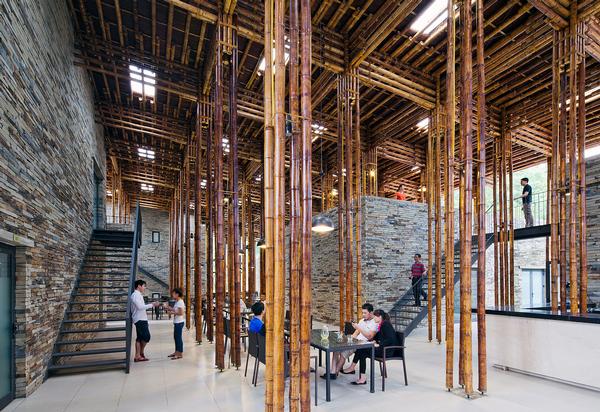
Son La Restaurant in Son La, Vietnam, is a low-cost structure by Vo Trong Nghia Architects that uses bamboo and stone
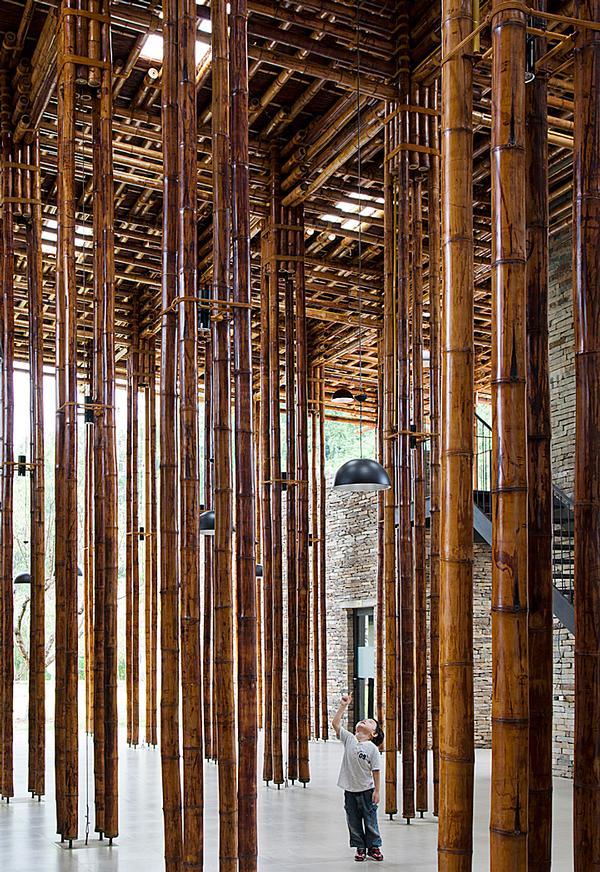
The dining room’s roof structure is made from ‘luong’, a local bamboo that grows to 8m tall
Vo Trong Nghia’s Wind and Water Bar is a dome-shaped performance venue
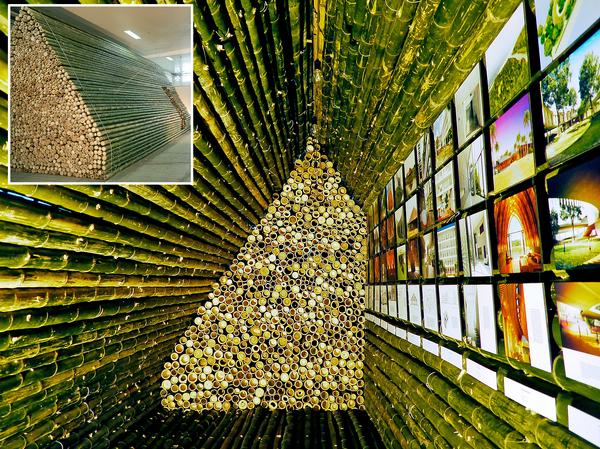
Bamboo Booth, built for the Vietnam Architecture Exhibition in 2012 supported by huge bamboo columns
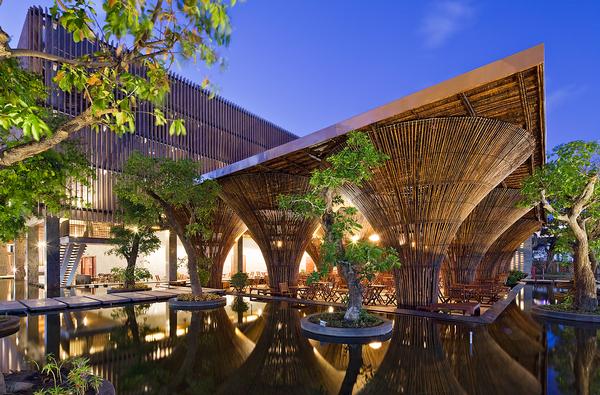
A restaurant designed for Kontum Indochine Hotel supported by huge bamboo columns
2. Simón Vélez, Colombia Colombian architect Simón Vélez is something of a bamboo evangelist, using his country’s native guadua species of bamboo in dozens of projects around the world, including a temporary museum in Mexico City, a non- denominational temple in Cartagena, a resort in China and a 2000 Expo pavilion in Hanover, which was the first bamboo structure to ever receive building approval in Germany.
“I like bamboo because it’s humble, it’s very structural and very light,” says Vélez from his home in Bogotá. “It’s high tech from nature.”
Vélez has been working with bamboo for more than 30 years, ever since he discovered a method of creating joints between rods by filling them with cement, which allowed him to insert steel plates and screws. This enhances the bamboo’s tensile strength, turning it into what Vélez calls “vegetable steel.” He has been using the same technique ever since. “It’s so simple,” he says. “It’s a joint for idiots.”
Like many bamboo architects, Vélez has taken advantage of bamboo’s warm tone and unique texture to create soaring yet intimate spaces. In 1999, he built a temporary cathedral in Pereira, Colombia, whose internal bamboo structure curved up into a sharp point – an ethereal counterpoint to the heavy stone arches of Gothic architecture. Many of his projects blend raw bamboo with other materials that complement or contrast its rustic texture. “I like to mix materials,” says Vélez. “In the tropics you have a lot of diversity and I like to have diversity in construction.”
What distinguishes Vélez from his contemporaries is his preference for guadua, which is taller and sturdier than Asian bamboo. “For me, it’s the best, and I don’t say that just because I’m from Colombia,” he says. “Asian bamboo is conical, it starts big on the bottom and by the middle it’s already very narrow. You have maybe four or five metres to use. With guadua, you have twelve.” (Vélez did use Chinese bamboo for one project, a curvy bridge at the Crosswaters Ecolodge in China’s Guangdong province.)
Vélez says that guadua was traditionally seen in Colombia as “the wood of the poor,” thanks to its use as a cheap building material by 19th-century gold rush settlers in the country’s central region, where bamboo is abundant. These days, its environmental friendliness has made it a fashionable choice of material for the wealthy clients who commission Vélez to build their houses.
The next step, he says, is to make it more widely available to the masses. “I keep working with raw bamboo, but the future of bamboo is laminated, like any timber,” says Vélez, who recently opened a laminated bamboo factory in his hometown in central Colombia. “The best thing about this material is that nobody needs to touch the tropical forests anymore.”
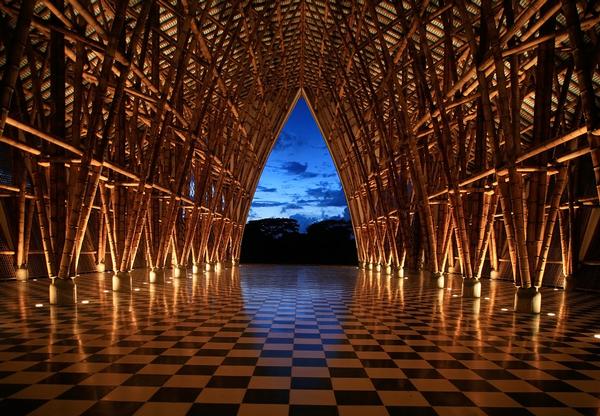
Simón Vélez’s non- denominational temple in Colombia
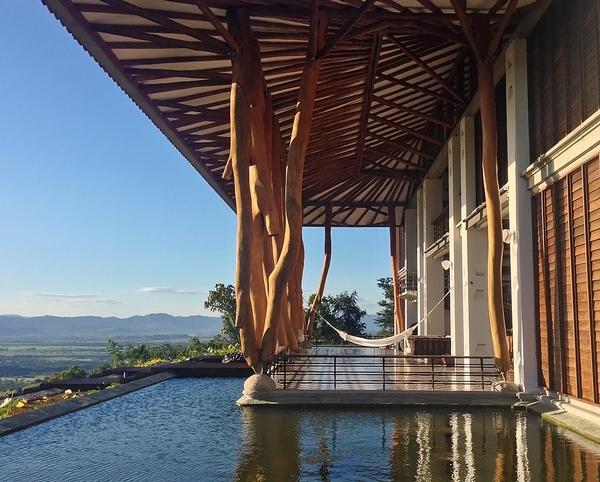
A private residence
With this material, nobody needs to touch the tropical forests anymore
Detail from a bamboo roof structure; and Crosswaters Ecolodge in China’s Guangdong province
3. William Lim, Hong Kong William Lim had already been using bamboo for 10 years when he designed the West Kowloon Bamboo Theatre. His first bamboo structure, Lantern Wonderland, was a massive illuminated pavilion in Hong Kong’s Victoria Park for the 2003 Mid-Autumn Festival, when families enjoy night-time picnics with candles and lanterns.
“Some of the earlier inspiration for using bamboo was not as a material but as a construction technique, which is pretty unusual to Hong Kong,” says Lim. Bamboo scaffolding is ubiquitous in the city, even on skyscrapers. “One thing I learned very rapidly is that it’s not a flexible material because it doesn’t bend easily. It’s very strong because it’s so rigid,” he says.
Although Lim is the director of architecture firm CL3, his bamboo projects are mostly personal, not commercial. “My interest is really more in the rawness and the indigenous quality of how people used bamboo structures before there were building regulations,” he says. “I’m fascinated by the handcrafted quality of it.”
For an architect, that means setting aside some measure of control and learning to trust the experience of bamboo masters who have built with the material for decades. “There are things you need to improvise on site,” he says. That was especially true for the bamboo theatre. Lim wanted the interior space to be unobstructed, so he hatched a plan with the bamboo workers to create a novel cantilevered structure to minimise the use of timber pillars.
The West Kowloon Bamboo Theatre was taken down after a month, its bamboo rods recycled for scaffolding or perhaps another theatre somewhere else.
“That transient nature is part of the beauty of bamboo structures,” says Lim. “The impermanence is part of this ritualistic culture. I don’t think you can see anything as permanent. It’s just a matter of duration.”
West Kowloon Bamboo Theatre hosted live Cantonese opera in Hong Kong in 2013
Lim created a bamboo pavilion when he participated in Mid-Autumn Festival in 2003
4. Penda, China Inspired by the bamboo scaffolding used in Hong Kong and a handful of other Asian cities, Beijing-based architecture firm Penda has developed a concept for a modular hotel. Co-founder Chris Precht says the hotel was prompted by AIM Legend of the Tent, a competition that encouraged architects to design tent-themed hotels with a connection to the natural landscape of southern China.
“We always like to look at the local material and the local craftsmanship before we start a project. It was an obvious thing to use bamboo as a construction material,” says Precht.
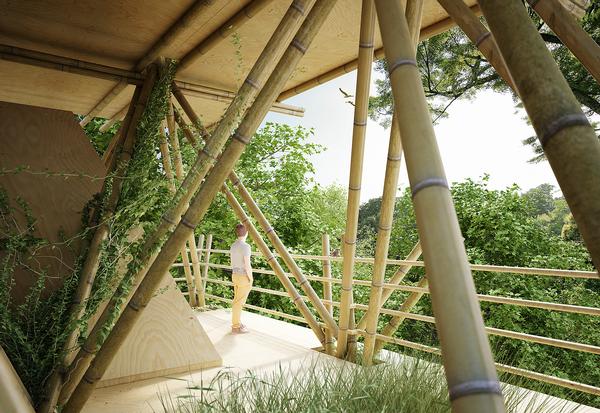
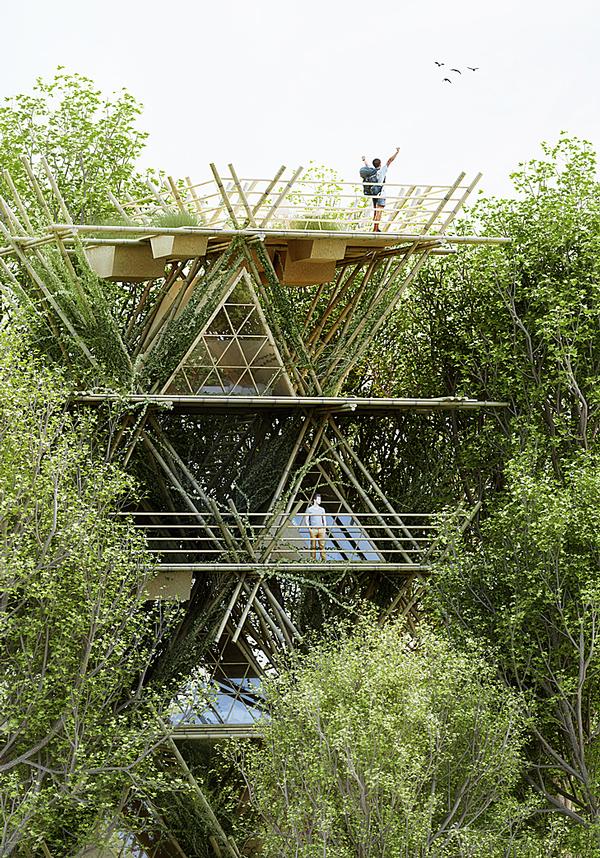
The hotel would consist of triangular pods supported by a grid of locally-grown bamboo rods that connect in X-shaped bamboo joints. Eight rods connect at each joint. “Our general goal was to make more a product design than architecture itself,” says Precht. “The main focus is the joint between the bamboo. The structural concept can be expanded in all kinds of directions, so it can grow horizontally but also vertically.”
The competition called for a temporary, low-impact hotel, so Penda’s structure could be easily disassembled and rebuilt elsewhere, or used for another purpose. Precht compares the hotel to a tree house: a hideaway completely integrated with its surroundings, to the point where vegetation could gradually become intertwined with the bamboo support structure.
“Nature is stronger than all of us. In the end it will take over architecture, so we are giving this opportunity back to nature. It’s changeable, so that when you go back as a guest to the hotel, it always looks different,” says Precht.
Modular hotel concept One With The Birds can expand both horizontally and vertically
Modular hotel concept One With The Birds can expand both horizontally and vertically
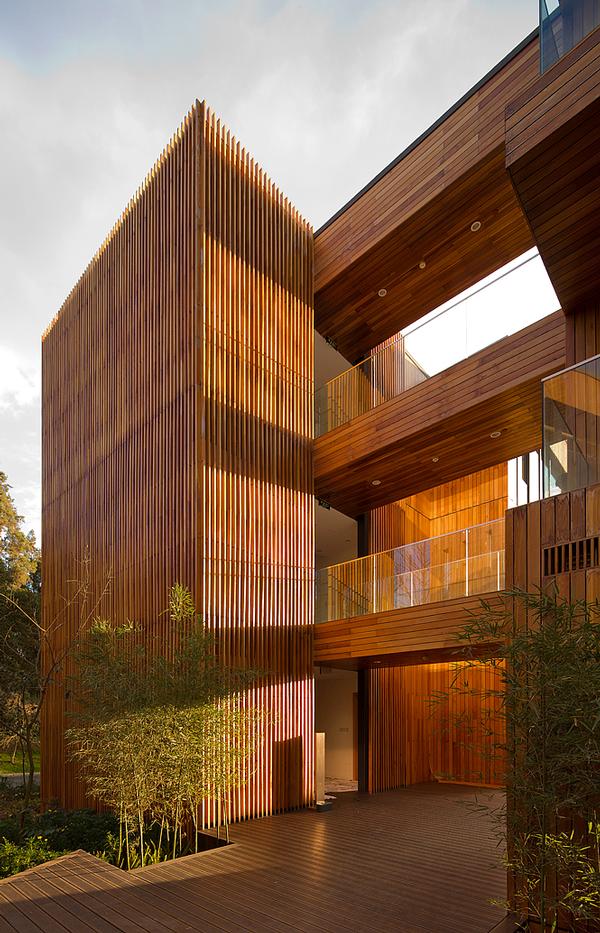
5. Oval Partnership, Hong Kong When Christopher Law set out to design a model house at Expo Integer, a new eco-town in the southwestern Chinese city of Kunming, he had one goal: prove that an entire multi-storey building could be made entirely from laminated bamboo. The two-storey house is distinguished by smooth surfaces and clean lines, a deliberate rebuke to the raw texture embraced by most bamboo architects. “We wanted to create a whole bamboo lifestyle to persuade people that a bamboo house doesn’t have to be rough,” says Law, the director of Hong Kong architecture firm Oval Partnership. “It’s much warmer than concrete. More human.”
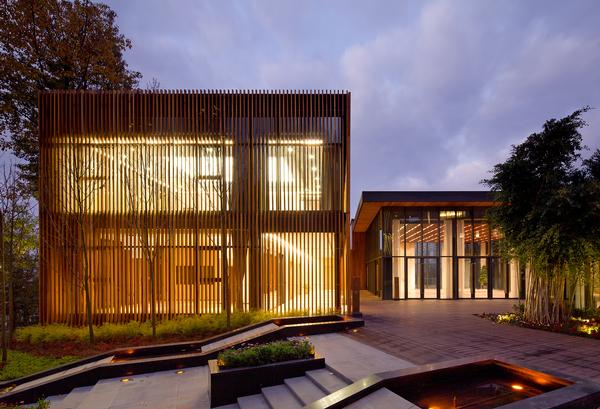
The house was completed in 2010 and it set the stage for an even more ambitious hotel built on the same site in 2012. The Innhouse Eco Hotel was designed as a series of three- to-four-storey guesthouses linked by courtyards — a nod to the traditional ye ki yin houses of Yunnan province — and it is built mainly with laminated bamboo and locally-sourced timber.
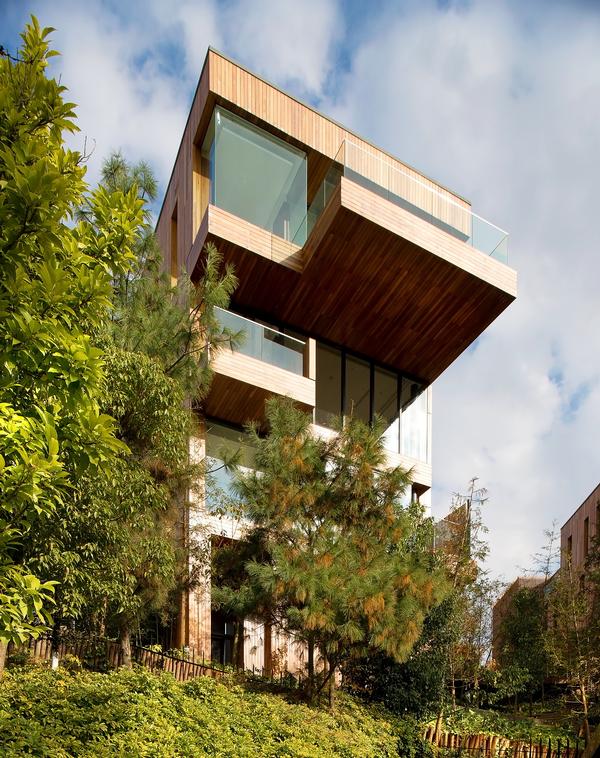
Law says that, with a steel frame, a laminated bamboo structure could rise as high as nine storeys. Given the environmental benefits of bamboo over wood and concrete, it could prove a useful model for China’s fast-growing cities. In most places, however, bamboo faces a regulatory roadblock as few cities have approved its use as a permanent building material. Law is optimistic nonetheless. “There are a lot of obstacles, but eventually we will get there,” he says. “This is the first time in more than a hundred years that we’ve found a new way to build with an entirely sustainable material. We can’t stop.”
Bamboo is the primary building material for the Innhouse Eco Hotel in Kunming
The eco-boutique hotel combines sustainable tourism with luxury experience
The resort consists of three- to four-storey bamboo guesthouses linked by courtyards
Le Atelier by C.O.D.E. doesn't offer a standard bespoke service, it provides a highly
customised approach to designing massage beds and loungers in high-end wellness
environments. [more...]
+ More featured suppliers
COMPANY PROFILES
AKT Group
AKT Group is the Franco–Italian parent company of SKYY, C.O.D.E. and AKTMe, operating as an integrat [more...]
It’s light, strong, fast-growing
and environmentally sound –
bamboo is seeing a resurgence in
popularity as a building material.
Christopher DeWolf takes a look at a
few extraordinary structures
By Christopher DeWolf | Published in CLADmag 2016 issue 1
Bamboo, dubbed ‘green steel’, is light, strong and highly sustainable, needing only four years to grow to maturity
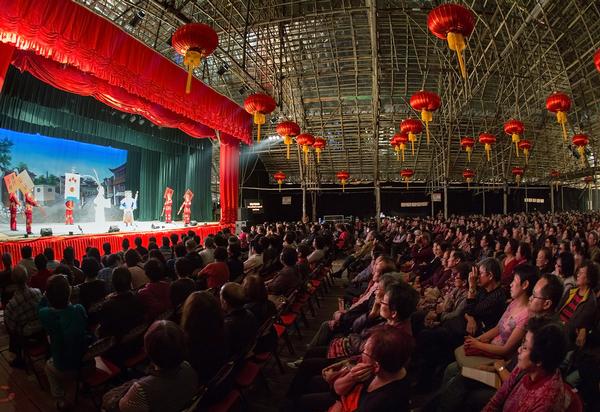
It was an astonishing sight. At the corner of two busy roads in Hong Kong, surrounded by glass and concrete skyscrapers, an enormous bamboo theatre rose from a vacant lot, its gnarly skeleton clad with tin sheets and festive banners. For just over a month in 2013, the West Kowloon Bamboo Theatre echoed with the wails of Cantonese opera as spectators munched on curried fish balls from the food stalls gathered outdoors.
Designed by Hong Kong architect William Lim, the theatre was built using 10,000 bamboo rods held together with plastic ties. With room for 800 people, it was one of the largest bamboo theatres ever built, but Lim could not take credit for the idea: these types of temporary theatres have been built in the villages of Hong Kong and Guangdong province for hundreds of years, playing host to travelling opera troupes and celebratory feasts. The West Kowloon Bamboo Theatre was a government-sponsored effort to bring the tradition to a high-profile location in central Hong Kong. “It’s a very vernacular, local structure,” says Lim.
The vernacular is increasingly in vogue. Around 1 billion people live in bamboo structures around the world, mostly in informal, hand-built houses, but the fast-growing grass is finding its way into hotels, restaurants, museums and other public facilities. Bamboo owes its new found popularity to the same qualities that made it the material of choice for Hong Kong’s theatre-builders: it’s strong, lightweight and remarkably sustainable. It takes just four years to mature and 70 hectares of bamboo produces the same amount of construction material as 600 hectares of trees. It’s even more efficient than trees at cleaning the air, with 1 hectare of bamboo removing over 80 tonnes of carbon dioxide from the atmosphere every year.
“I think bamboo and laminated bamboo will replace other materials and become the ‘green steel’ of the 21st century,” said Vietnamese architect Vo Trong Nghia in an interview last year.
He is not alone in his opinion: more and more architects are doing ground-breaking work with bamboo. Here are five to watch.
1. Vo Trong Nghia, Vietnam Vo Trong Nghia has proven that sustainability is stylish. Since establishing his firm in 2006, the Vietnamese architect has completed several bamboo projects, including restaurants, cafés, a community hall and Vietnam’s national pavilion at the 2015 Milan Expo. The design of the pavilion was inspired by lotus ponds, with thick clusters of bamboo columns that appear to sprout from a shallow body of water. The bamboo elements were prefabricated, allowing them to be easily assembled, disassembled and recycled.
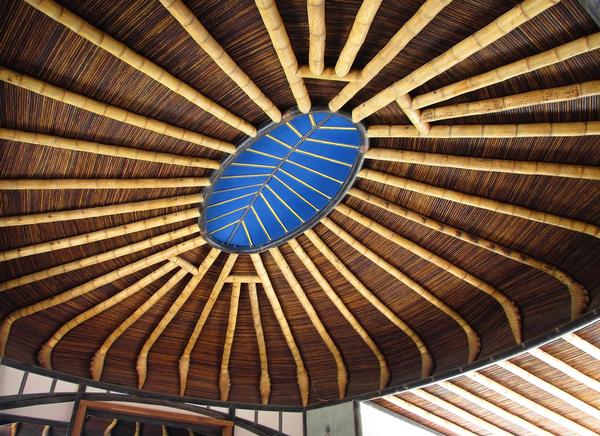
Nghia’s work has been lauded for its beauty, but it is his structural innovations that are truly noteworthy. In the case of the Wind and Water Bar, an event space just north of Ho Chi Minh City, Nghia designed a 10-metre-high, 15-metre-wide dome made of 48 prefabricated bamboo units bound together with bamboo bolts. Clad in rattan and grass, the building sits on an island in an artificial pond, which creates a naturally cool breeze that passes through the base of the structure. Hot air escapes through a circular opening at the top of the dome.
Nghia treats the bamboo stalks using traditional methods. He first subjects them to heat in order to bend them into shape. Then he soaks the stalks in mud, which reduces the sugar content to stop them attracting insects, before smoking them to create a carbonised layer that prevents them being damaged by moisture. This allows Nghia to create durable, all-bamboo buildings that do not rely on steel or timber for support. “Using steel joints kills the cost benefit of bamboo structures,” says Nghia.
Though Nghia has established himself as one of the world’s most innovative bamboo architects, he says there’s still a lot of work to be done before bamboo can be more widely used. “There’s almost no contractor with experience of bamboo construction,” he said in an interview last year. “To realise the space as envisioned, it’s essential for us to educate workers and build the construction together.”
Son La Restaurant in Son La, Vietnam, is a low-cost structure by Vo Trong Nghia Architects that uses bamboo and stone
The dining room’s roof structure is made from ‘luong’, a local bamboo that grows to 8m tall
Vo Trong Nghia’s Wind and Water Bar is a dome-shaped performance venue
Bamboo Booth, built for the Vietnam Architecture Exhibition in 2012 supported by huge bamboo columns
A restaurant designed for Kontum Indochine Hotel supported by huge bamboo columns
2. Simón Vélez, Colombia Colombian architect Simón Vélez is something of a bamboo evangelist, using his country’s native guadua species of bamboo in dozens of projects around the world, including a temporary museum in Mexico City, a non- denominational temple in Cartagena, a resort in China and a 2000 Expo pavilion in Hanover, which was the first bamboo structure to ever receive building approval in Germany.
“I like bamboo because it’s humble, it’s very structural and very light,” says Vélez from his home in Bogotá. “It’s high tech from nature.”
Vélez has been working with bamboo for more than 30 years, ever since he discovered a method of creating joints between rods by filling them with cement, which allowed him to insert steel plates and screws. This enhances the bamboo’s tensile strength, turning it into what Vélez calls “vegetable steel.” He has been using the same technique ever since. “It’s so simple,” he says. “It’s a joint for idiots.”
Like many bamboo architects, Vélez has taken advantage of bamboo’s warm tone and unique texture to create soaring yet intimate spaces. In 1999, he built a temporary cathedral in Pereira, Colombia, whose internal bamboo structure curved up into a sharp point – an ethereal counterpoint to the heavy stone arches of Gothic architecture. Many of his projects blend raw bamboo with other materials that complement or contrast its rustic texture. “I like to mix materials,” says Vélez. “In the tropics you have a lot of diversity and I like to have diversity in construction.”
What distinguishes Vélez from his contemporaries is his preference for guadua, which is taller and sturdier than Asian bamboo. “For me, it’s the best, and I don’t say that just because I’m from Colombia,” he says. “Asian bamboo is conical, it starts big on the bottom and by the middle it’s already very narrow. You have maybe four or five metres to use. With guadua, you have twelve.” (Vélez did use Chinese bamboo for one project, a curvy bridge at the Crosswaters Ecolodge in China’s Guangdong province.)
Vélez says that guadua was traditionally seen in Colombia as “the wood of the poor,” thanks to its use as a cheap building material by 19th-century gold rush settlers in the country’s central region, where bamboo is abundant. These days, its environmental friendliness has made it a fashionable choice of material for the wealthy clients who commission Vélez to build their houses.
The next step, he says, is to make it more widely available to the masses. “I keep working with raw bamboo, but the future of bamboo is laminated, like any timber,” says Vélez, who recently opened a laminated bamboo factory in his hometown in central Colombia. “The best thing about this material is that nobody needs to touch the tropical forests anymore.”
Simón Vélez’s non- denominational temple in Colombia
A private residence
With this material, nobody needs to touch the tropical forests anymore
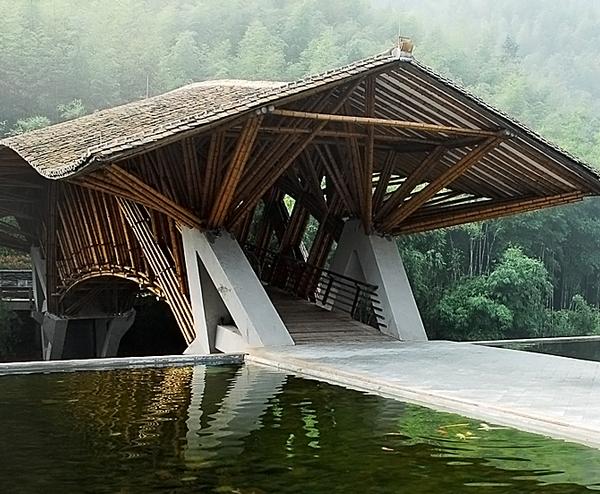
Detail from a bamboo roof structure; and Crosswaters Ecolodge in China’s Guangdong province
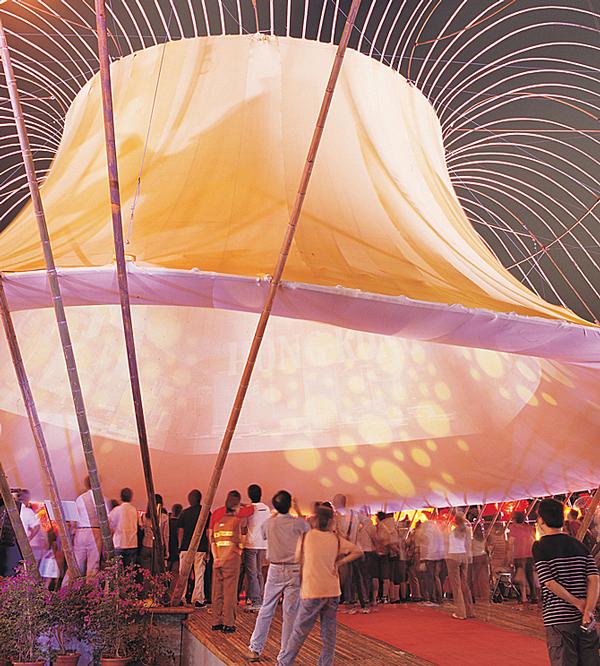
3. William Lim, Hong Kong William Lim had already been using bamboo for 10 years when he designed the West Kowloon Bamboo Theatre. His first bamboo structure, Lantern Wonderland, was a massive illuminated pavilion in Hong Kong’s Victoria Park for the 2003 Mid-Autumn Festival, when families enjoy night-time picnics with candles and lanterns.
“Some of the earlier inspiration for using bamboo was not as a material but as a construction technique, which is pretty unusual to Hong Kong,” says Lim. Bamboo scaffolding is ubiquitous in the city, even on skyscrapers. “One thing I learned very rapidly is that it’s not a flexible material because it doesn’t bend easily. It’s very strong because it’s so rigid,” he says.
Although Lim is the director of architecture firm CL3, his bamboo projects are mostly personal, not commercial. “My interest is really more in the rawness and the indigenous quality of how people used bamboo structures before there were building regulations,” he says. “I’m fascinated by the handcrafted quality of it.”
For an architect, that means setting aside some measure of control and learning to trust the experience of bamboo masters who have built with the material for decades. “There are things you need to improvise on site,” he says. That was especially true for the bamboo theatre. Lim wanted the interior space to be unobstructed, so he hatched a plan with the bamboo workers to create a novel cantilevered structure to minimise the use of timber pillars.
The West Kowloon Bamboo Theatre was taken down after a month, its bamboo rods recycled for scaffolding or perhaps another theatre somewhere else.
“That transient nature is part of the beauty of bamboo structures,” says Lim. “The impermanence is part of this ritualistic culture. I don’t think you can see anything as permanent. It’s just a matter of duration.”
West Kowloon Bamboo Theatre hosted live Cantonese opera in Hong Kong in 2013
Lim created a bamboo pavilion when he participated in Mid-Autumn Festival in 2003
4. Penda, China Inspired by the bamboo scaffolding used in Hong Kong and a handful of other Asian cities, Beijing-based architecture firm Penda has developed a concept for a modular hotel. Co-founder Chris Precht says the hotel was prompted by AIM Legend of the Tent, a competition that encouraged architects to design tent-themed hotels with a connection to the natural landscape of southern China.
“We always like to look at the local material and the local craftsmanship before we start a project. It was an obvious thing to use bamboo as a construction material,” says Precht.
The hotel would consist of triangular pods supported by a grid of locally-grown bamboo rods that connect in X-shaped bamboo joints. Eight rods connect at each joint. “Our general goal was to make more a product design than architecture itself,” says Precht. “The main focus is the joint between the bamboo. The structural concept can be expanded in all kinds of directions, so it can grow horizontally but also vertically.”
The competition called for a temporary, low-impact hotel, so Penda’s structure could be easily disassembled and rebuilt elsewhere, or used for another purpose. Precht compares the hotel to a tree house: a hideaway completely integrated with its surroundings, to the point where vegetation could gradually become intertwined with the bamboo support structure.
“Nature is stronger than all of us. In the end it will take over architecture, so we are giving this opportunity back to nature. It’s changeable, so that when you go back as a guest to the hotel, it always looks different,” says Precht.
Modular hotel concept One With The Birds can expand both horizontally and vertically
Modular hotel concept One With The Birds can expand both horizontally and vertically
5. Oval Partnership, Hong Kong When Christopher Law set out to design a model house at Expo Integer, a new eco-town in the southwestern Chinese city of Kunming, he had one goal: prove that an entire multi-storey building could be made entirely from laminated bamboo. The two-storey house is distinguished by smooth surfaces and clean lines, a deliberate rebuke to the raw texture embraced by most bamboo architects. “We wanted to create a whole bamboo lifestyle to persuade people that a bamboo house doesn’t have to be rough,” says Law, the director of Hong Kong architecture firm Oval Partnership. “It’s much warmer than concrete. More human.”
The house was completed in 2010 and it set the stage for an even more ambitious hotel built on the same site in 2012. The Innhouse Eco Hotel was designed as a series of three- to-four-storey guesthouses linked by courtyards — a nod to the traditional ye ki yin houses of Yunnan province — and it is built mainly with laminated bamboo and locally-sourced timber.
Law says that, with a steel frame, a laminated bamboo structure could rise as high as nine storeys. Given the environmental benefits of bamboo over wood and concrete, it could prove a useful model for China’s fast-growing cities. In most places, however, bamboo faces a regulatory roadblock as few cities have approved its use as a permanent building material. Law is optimistic nonetheless. “There are a lot of obstacles, but eventually we will get there,” he says. “This is the first time in more than a hundred years that we’ve found a new way to build with an entirely sustainable material. We can’t stop.”
Bamboo is the primary building material for the Innhouse Eco Hotel in Kunming
The eco-boutique hotel combines sustainable tourism with luxury experience
The resort consists of three- to four-storey bamboo guesthouses linked by courtyards
Global Wellness Day (GWD) marked its 15th anniversary on Saturday 13 June 2026, with the
theme: #JoyMagenta – a celebration of the healing qualities of simple gestures and activities
that spark joy.
Global luxury hospitality brand, Six Senses, has partnered with longevity healthcare provider,
HUM2N, to launch a clinic at Six Senses London, at The Whiteley.
As part of its first hotel partnership, Mayrlife – the medical health resort company known for its
site in Altaussee, Austria – has launched a day clinic at the Rosewood Vienna.
Premium London health club, KX Chelsea, will imminently unveil its most significant
redevelopment since its launch in 2002 to create an integrated wellness model combining
training, recovery and relaxation.
Rosewood Le Guanahani St Barth, on the northeast coast of Saint Barthélemy in the French
West Indies, is offering a programme of ocean-inspired yoga classes between 8-14 June to
celebrate Global Wellness Day (GWD).
Hotel de France, located on the British Isle of Jersey, has created a wellness retreat package
that includes a hot yoga session that will take place in Jersey Zoo’s butterfly sanctuary.
The Ritz-Carlton, Langkawi, in Malaysia, has revealed a schedule for Global Wellness Day
(GWD) that includes guided rainforest walks, mindful movement and guided coastal meditation
experiences.
Longevitix, a clinical platform for preventive and longevity medicine, has launched its AI-
powered intelligence system to help physicians deliver continuous, personalised longevity-
focused care at scale.
Atmantan Wellness Centre, an integrative wellness destination in Mulshi, near Pune in India, is
expanding its portfolio by adding a new centre in Hyderabad that will launch between 2028 and
2029.
Le Atelier by C.O.D.E. doesn't offer a standard bespoke service, it provides a highly
customised approach to designing massage beds and loungers in high-end wellness
environments. [more...]
+ More featured suppliers
COMPANY PROFILES
AKT Group AKT Group is the Franco–Italian parent company of SKYY, C.O.D.E. and AKTMe, operating as an integrat [more...]