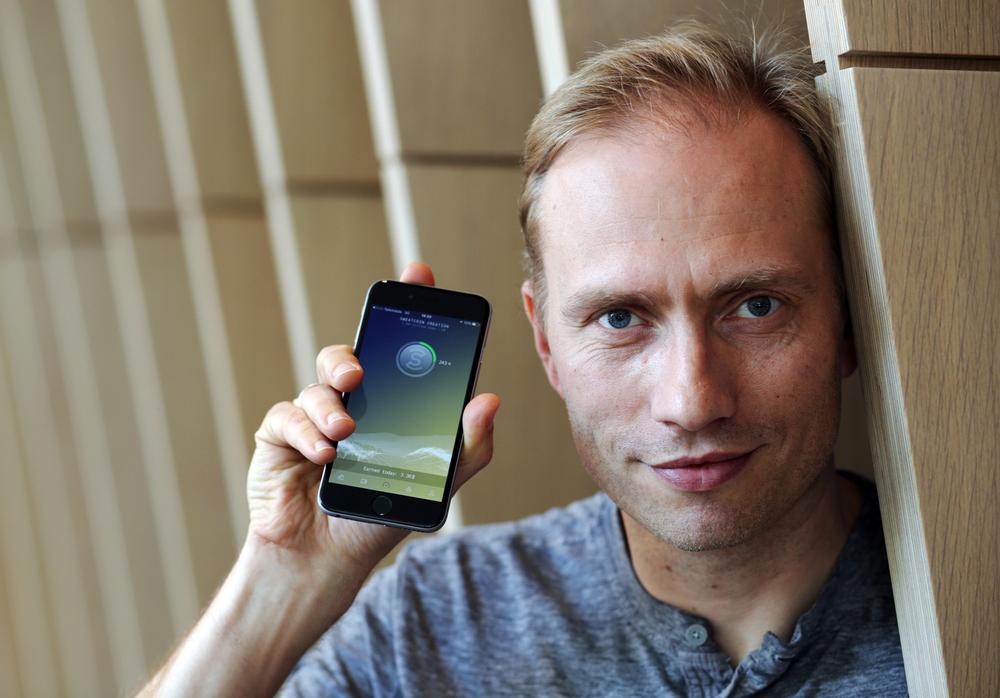
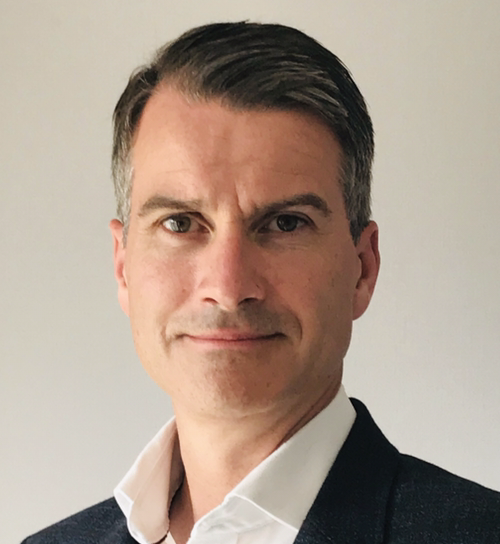
Co-founder Oleg Fomenko
with the Sweatcoin app / PHOTO: REUTERS/Paul Hackett
What is Sweatcoin? Sweatcoin is a free iPhone app, available in the UK, which went live on 5 May 2016. It securely records your outdoor movement and rewards your activity with Sweatcoins – a digital currency – so you’re getting paid to be physically active. The idea is to get people past that initial sense of inertia and give them a reason to be active right now.
How does it work? Every 1,000 steps gives you one Sweatcoin, which can be collected and traded in for rewards – from vouchers for Wonderush or fitness classes at BOOMCycle, to products such as Kymira infra-red clothing and Vivobarefoot running shoes. For example, 45 Sweatcoins – equivalent to 45,000 steps – gets you a free yoga lesson, 200 Sweatcoins gets you a fitness tracker from Fitbug, and 300 gets you 80 per cent off a pair of Vivobarefoot shoes.
We’re also creating a peer-to-peer marketplace where anyone can make an offer of a product and service in exchange for Sweatcoins – i.e. for other people’s movement. Parents can also peg kids’ pocket money to their physical activity levels, so it becomes a whole family affair.
How can you be sure it’s accurate? We’ve used complex software to measure movement and location to prevent cheating, and we tracked 1.5 billion steps to refine our platform and proprietary algorithms.
The digital currency can’t be generated by shaking your iPhone or placing it on top of a washing machine, and we cross-check data on activity and location to verify steps.
What has uptake been like? More than 20,000 people have already installed the app, with more than 10,000 using it daily. We’re now in conversations with a number of businesses to organise corporate wellness trials, where employees can earn benefits and perks like extra days off, subsidised healthy meals or massages.
We’ve also spoken to all the major health insurers, but the first step is to prove Sweatcoin can attract users. In the long run, we’d hope that unique products or lower health insurance premiums could be offered in exchange for verified physical activity in the shape of Sweatcoins.
For now, we aim to encourage Londoners to be active. So far we’re seeing three daily visits per person, with over 70 per cent still active at the end of the first month.
Any plans to further evolve the product? Work has accelerated since we’ve gone live. We’ll continue to improve our movement verification algorithms, and we’re also working on the Android version of the app.
What are your long-term aspirations for Sweatcoin? By making Sweatcoin truly valuable – accepted by many companies for their goods and services, with an exchange rate linked to Sterling – we want to help people realise the value of movement, and become fitter and happier.
It would make a lot of sense for the NHS to start buying Sweatcoins from the public to encourage people to be more active, reducing the cost of inactivity to the NHS.
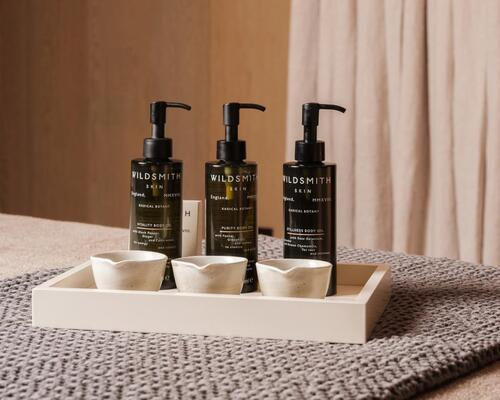
In a world where imbalance often accumulates quietly, Wildsmith unveils its newest
wellbeing innovation: Silent Loads, an approach designed to meet the needs of modern spa
guests with precision and depth. [more...]
In the fast-paced world of fitness and wellness, where high-intensity workouts push us to
our limits and the sweat pours, the importance of efficient recovery cannot be overstated. [more...]
+ More featured suppliers
COMPANY PROFILES
Elemis
Elemis was founded in London in 1989 by Linda Steiner whose vision was to create a skincare range as [more...]
Co-founder Oleg Fomenko
with the Sweatcoin app / PHOTO: REUTERS/Paul Hackett
What is Sweatcoin? Sweatcoin is a free iPhone app, available in the UK, which went live on 5 May 2016. It securely records your outdoor movement and rewards your activity with Sweatcoins – a digital currency – so you’re getting paid to be physically active. The idea is to get people past that initial sense of inertia and give them a reason to be active right now.
How does it work? Every 1,000 steps gives you one Sweatcoin, which can be collected and traded in for rewards – from vouchers for Wonderush or fitness classes at BOOMCycle, to products such as Kymira infra-red clothing and Vivobarefoot running shoes. For example, 45 Sweatcoins – equivalent to 45,000 steps – gets you a free yoga lesson, 200 Sweatcoins gets you a fitness tracker from Fitbug, and 300 gets you 80 per cent off a pair of Vivobarefoot shoes.
We’re also creating a peer-to-peer marketplace where anyone can make an offer of a product and service in exchange for Sweatcoins – i.e. for other people’s movement. Parents can also peg kids’ pocket money to their physical activity levels, so it becomes a whole family affair.
How can you be sure it’s accurate? We’ve used complex software to measure movement and location to prevent cheating, and we tracked 1.5 billion steps to refine our platform and proprietary algorithms.
The digital currency can’t be generated by shaking your iPhone or placing it on top of a washing machine, and we cross-check data on activity and location to verify steps.
What has uptake been like? More than 20,000 people have already installed the app, with more than 10,000 using it daily. We’re now in conversations with a number of businesses to organise corporate wellness trials, where employees can earn benefits and perks like extra days off, subsidised healthy meals or massages.
We’ve also spoken to all the major health insurers, but the first step is to prove Sweatcoin can attract users. In the long run, we’d hope that unique products or lower health insurance premiums could be offered in exchange for verified physical activity in the shape of Sweatcoins.
For now, we aim to encourage Londoners to be active. So far we’re seeing three daily visits per person, with over 70 per cent still active at the end of the first month.
Any plans to further evolve the product? Work has accelerated since we’ve gone live. We’ll continue to improve our movement verification algorithms, and we’re also working on the Android version of the app.
What are your long-term aspirations for Sweatcoin? By making Sweatcoin truly valuable – accepted by many companies for their goods and services, with an exchange rate linked to Sterling – we want to help people realise the value of movement, and become fitter and happier.
It would make a lot of sense for the NHS to start buying Sweatcoins from the public to encourage people to be more active, reducing the cost of inactivity to the NHS.
Global Wellness Day (GWD) will mark its 15th anniversary on Saturday 13 June 2026, with the
theme: #JoyMagenta – a celebration of the healing qualities of simple gestures and activities
that spark joy.
Global luxury hospitality brand, Six Senses, has partnered with longevity healthcare provider,
HUM2N, to launch a clinic at Six Senses London, at The Whiteley.
As part of its first hotel partnership, Mayrlife – the medical health resort company known for its
site in Altaussee, Austria – has launched a day clinic at the Rosewood Vienna.
Premium London health club, KX Chelsea, will imminently unveil its most significant
redevelopment since its launch in 2002 to create an integrated wellness model combining
training, recovery and relaxation.
Rosewood Le Guanahani St Barth, on the northeast coast of Saint Barthélemy in the French
West Indies, is offering a programme of ocean-inspired yoga classes between 8-14 June to
celebrate Global Wellness Day (GWD).
Hotel de France, located on the British Isle of Jersey, has created a wellness retreat package
that includes a hot yoga session that will take place in Jersey Zoo’s butterfly sanctuary.
The Ritz-Carlton, Langkawi, in Malaysia, has revealed a schedule for Global Wellness Day
(GWD) that includes guided rainforest walks, mindful movement and guided coastal meditation
experiences.
Longevitix, a clinical platform for preventive and longevity medicine, has launched its AI-
powered intelligence system to help physicians deliver continuous, personalised longevity-
focused care at scale.
Atmantan Wellness Centre, an integrative wellness destination in Mulshi, near Pune in India, is
expanding its portfolio by adding a new centre in Hyderabad that will launch between 2028 and
2029.
A recent survey by the UK Spa Association (UKSA) into the industry’s approach to cancer care
has revealed that almost half of participating respondents (46 per cent) are unaware that
cancer is a disability and guests with a cancer diagnosis must be given
In a world where imbalance often accumulates quietly, Wildsmith unveils its newest
wellbeing innovation: Silent Loads, an approach designed to meet the needs of modern spa
guests with precision and depth. [more...]
In the fast-paced world of fitness and wellness, where high-intensity workouts push us to
our limits and the sweat pours, the importance of efficient recovery cannot be overstated. [more...]
+ More featured suppliers
COMPANY PROFILES
Elemis Elemis was founded in London in 1989 by Linda Steiner whose vision was to create a skincare range as [more...]