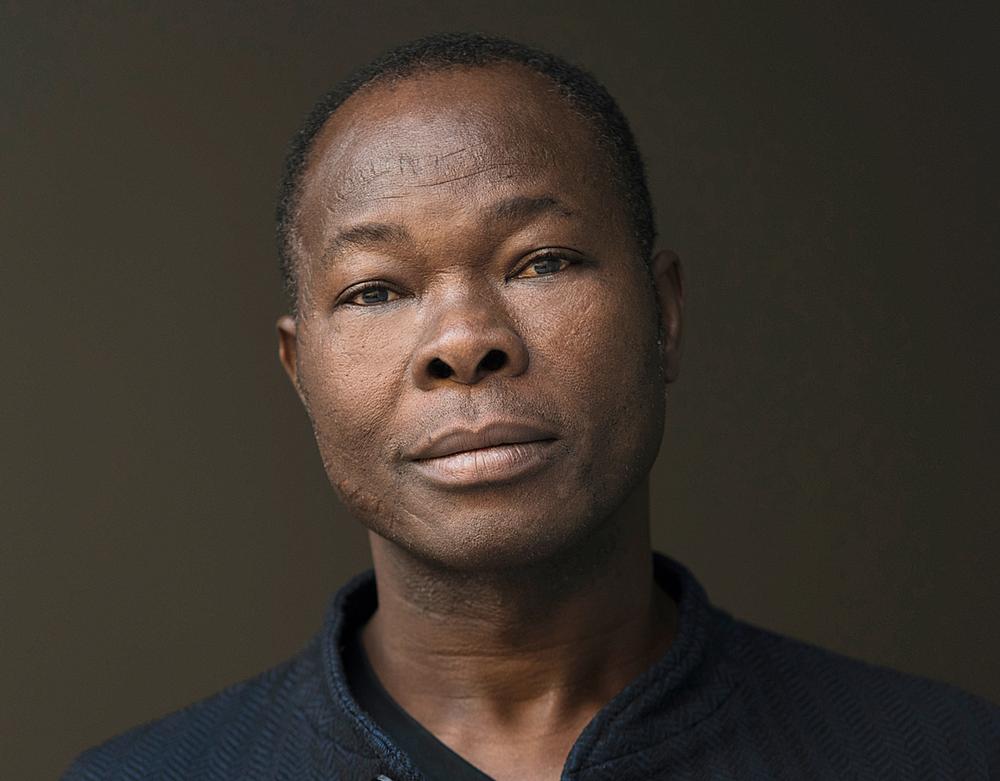
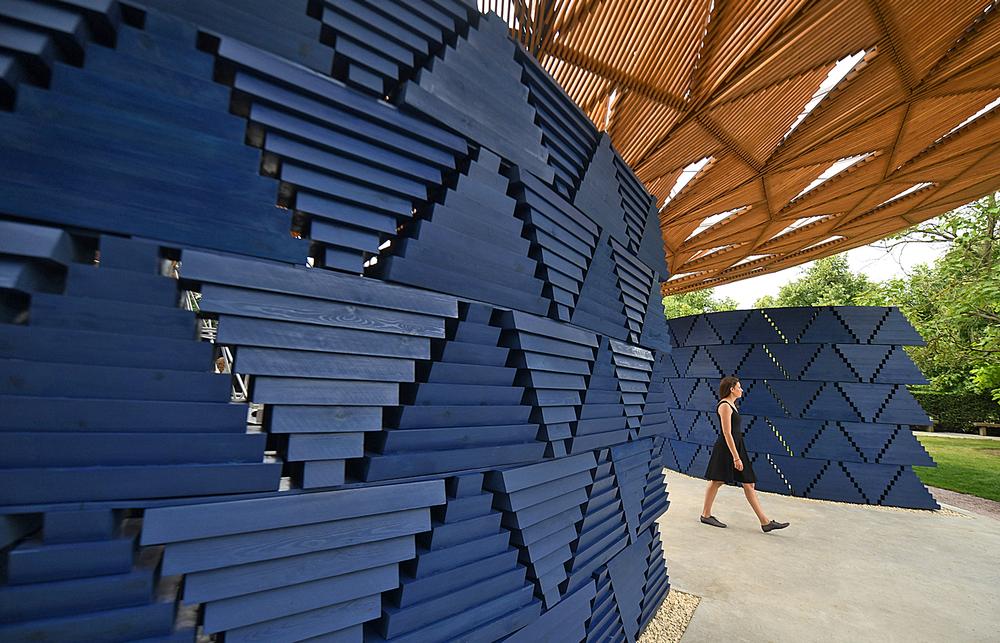
Kéré told CLAD that the value of great public spaces ‘cannot be measured by money’ / Image: Jan Ouwerkerk.
This year’s Serpentine Pavilion, designed by Diébédo Francis Kéré, has been unveiled in London’s Hyde Park.
Speaking to CLAD, the architect said the high-profile commission had given him an “exciting opportunity to explore new ideas, new ways of shaping space, new materials and new ways of using materials.”
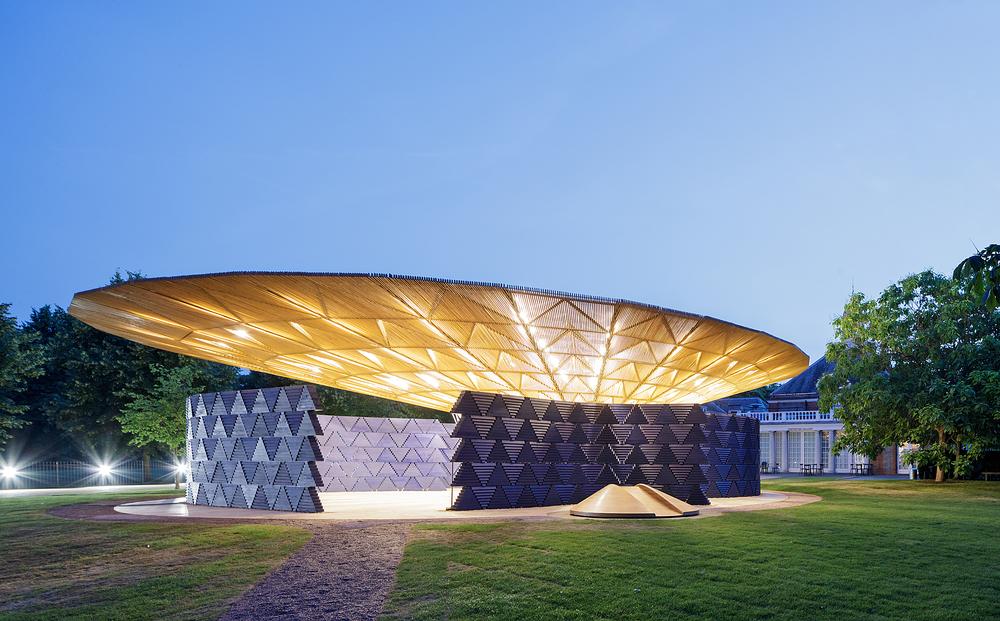
His pavilion, designed “to bring a sense of light and life” to the park, was inspired by the tree that serves as a central meeting point for life in his hometown of Gando, Burkina Faso.
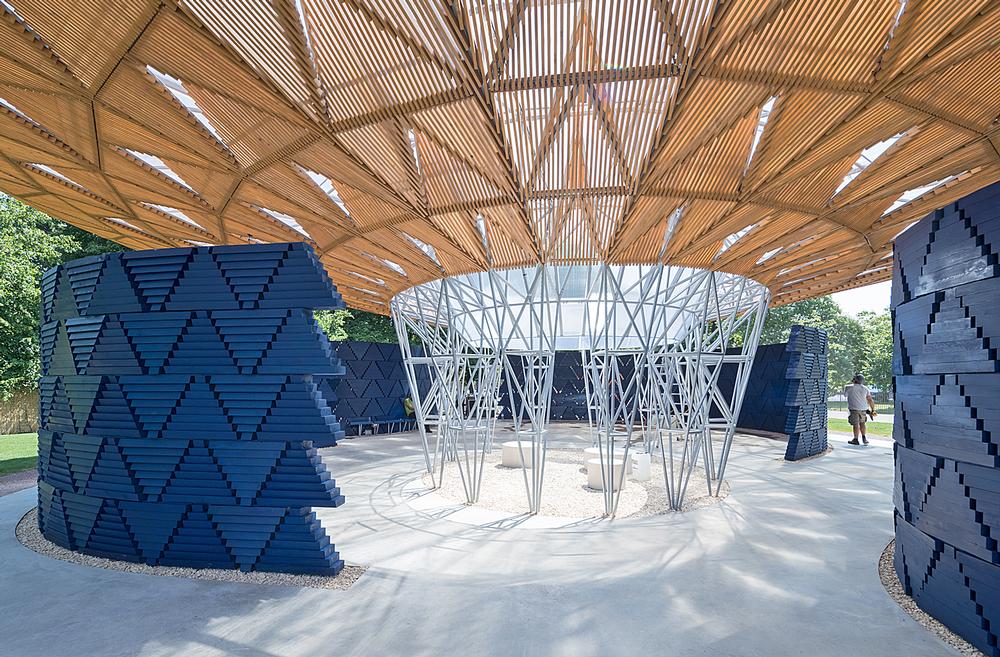
To mimic the tree’s canopy, Kéré visualised an expansive timber roof supported by a central latticed steel framework, which allows air to circulate freely while offering shelter against London rain and summer heat.
An oculus funnels rainwater collected on the roof to create a waterfall effect into an open courtyard below, which is set above a hidden underground storage tank.
There are four separate entry points into the pavilion, and the structure’s bright indigo walls – formed of inverted wooden triangles – are angled so as to let daylight flood in.
“From the very start, it was always my idea to focus on the figure of the tree in the landscape, and design something around community gathering,” Kéré said. “We really pushed that concept as much as we could.”
The architect, who leads the Berlin-based practice Kéré Architecture, was chosen in part for his commitment to socially engaged and ecological design, and this is reflected in the programme of events taking place in the pavilion, including seminars exploring questions of community and rights to the city.
“Well designed public spaces, where we can all meet and come together, are the foundation of a healthy society,” he said. “The value [such spaces] give to a community cannot be measured by money, which is why it’s very important to think how we can create more.
“It’s amazing to see the diversity of people living here in London. It’s amazing if you can have structures that bring them all together.”
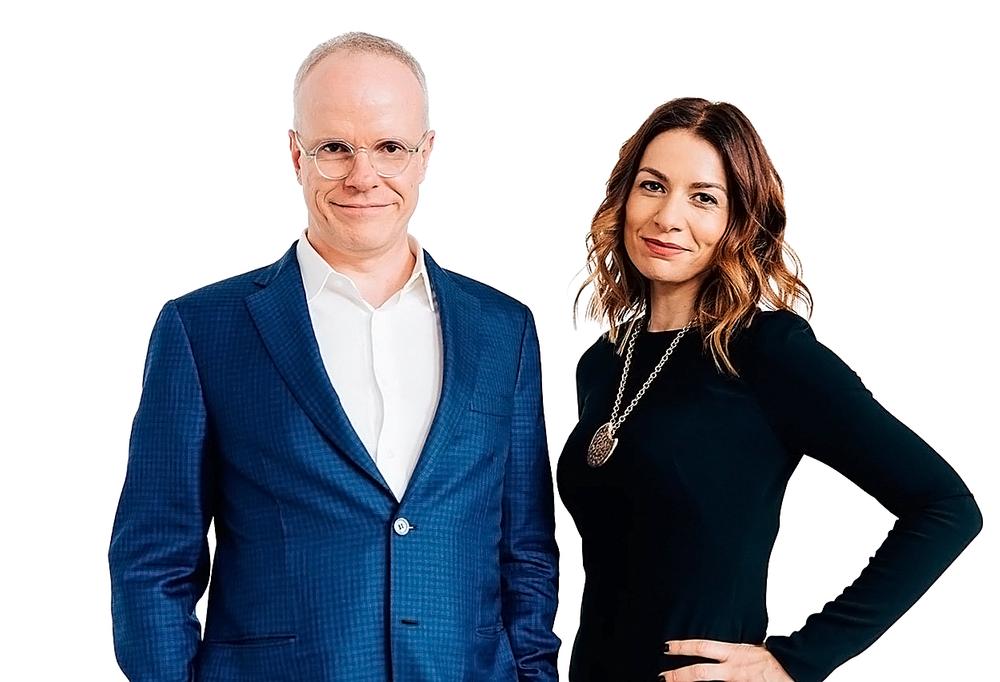
In a joint statement, Serpentine artistic director Hans Ulrich Obrist and CEO Yana Peel described the pavilion as “a space of conversation, collaboration and exchange.”
Technical consultant David Glover, fabrication firm Stage One and engineers AECOM collaborated with the Kéré team on the project, which remains open until 8 October 2017.
The Serpentine Pavilion programme, which began in 2000 with a structure created by the late Zaha Hadid, sees an architect who has never built in the UK create a temporary summer structure in the park’s Kensington Gardens. Herzog & de Meuron, Jean Nouvel, Sou Fujimoto, SANAA and Bjarke Ingels Group are among the international architects to have previously taken part.
Kéré told CLAD that the value of great public spaces ‘cannot be measured by money’ / Image: Iwan Baan
Kéré’s design is inspired by a tree in his hometown of Gando, Burkina Faso / Image: Iwan Baan
Kéré’s design is inspired by a tree in his hometown of Gando, Burkina Faso / Image: Victoria Jones/PA Images
We share Kéré’s belief that architecture, at its best, can enhance our collective creativity and push people to take the future into their own hands - Serpentine artistic director Hans Ulrich Obrist and CEO Yana Peel / Image: Kate Berry
In today’s premium spa environment, every detail shapes the guest experience – right down to
the softness of towels and the freshness of linens. [more...]
Kéré told CLAD that the value of great public spaces ‘cannot be measured by money’ / Image: Jan Ouwerkerk.
This year’s Serpentine Pavilion, designed by Diébédo Francis Kéré, has been unveiled in London’s Hyde Park.
Speaking to CLAD, the architect said the high-profile commission had given him an “exciting opportunity to explore new ideas, new ways of shaping space, new materials and new ways of using materials.”
His pavilion, designed “to bring a sense of light and life” to the park, was inspired by the tree that serves as a central meeting point for life in his hometown of Gando, Burkina Faso.
To mimic the tree’s canopy, Kéré visualised an expansive timber roof supported by a central latticed steel framework, which allows air to circulate freely while offering shelter against London rain and summer heat.
An oculus funnels rainwater collected on the roof to create a waterfall effect into an open courtyard below, which is set above a hidden underground storage tank.
There are four separate entry points into the pavilion, and the structure’s bright indigo walls – formed of inverted wooden triangles – are angled so as to let daylight flood in.
“From the very start, it was always my idea to focus on the figure of the tree in the landscape, and design something around community gathering,” Kéré said. “We really pushed that concept as much as we could.”
The architect, who leads the Berlin-based practice Kéré Architecture, was chosen in part for his commitment to socially engaged and ecological design, and this is reflected in the programme of events taking place in the pavilion, including seminars exploring questions of community and rights to the city.
“Well designed public spaces, where we can all meet and come together, are the foundation of a healthy society,” he said. “The value [such spaces] give to a community cannot be measured by money, which is why it’s very important to think how we can create more.
“It’s amazing to see the diversity of people living here in London. It’s amazing if you can have structures that bring them all together.”
In a joint statement, Serpentine artistic director Hans Ulrich Obrist and CEO Yana Peel described the pavilion as “a space of conversation, collaboration and exchange.”
Technical consultant David Glover, fabrication firm Stage One and engineers AECOM collaborated with the Kéré team on the project, which remains open until 8 October 2017.
The Serpentine Pavilion programme, which began in 2000 with a structure created by the late Zaha Hadid, sees an architect who has never built in the UK create a temporary summer structure in the park’s Kensington Gardens. Herzog & de Meuron, Jean Nouvel, Sou Fujimoto, SANAA and Bjarke Ingels Group are among the international architects to have previously taken part.
Kéré told CLAD that the value of great public spaces ‘cannot be measured by money’ / Image: Iwan Baan
Kéré’s design is inspired by a tree in his hometown of Gando, Burkina Faso / Image: Iwan Baan
Kéré’s design is inspired by a tree in his hometown of Gando, Burkina Faso / Image: Victoria Jones/PA Images
We share Kéré’s belief that architecture, at its best, can enhance our collective creativity and push people to take the future into their own hands - Serpentine artistic director Hans Ulrich Obrist and CEO Yana Peel / Image: Kate Berry
Global Wellness Day (GWD) will mark its 15th anniversary on Saturday 13 June 2026, with the
theme: #JoyMagenta – a celebration of the healing qualities of simple gestures and activities
that spark joy.
Global luxury hospitality brand, Six Senses, has partnered with longevity healthcare provider,
HUM2N, to launch a clinic at Six Senses London, at The Whiteley.
As part of its first hotel partnership, Mayrlife – the medical health resort company known for its
site in Altaussee, Austria – has launched a day clinic at the Rosewood Vienna.
Premium London health club, KX Chelsea, will imminently unveil its most significant
redevelopment since its launch in 2002 to create an integrated wellness model combining
training, recovery and relaxation.
Rosewood Le Guanahani St Barth, on the northeast coast of Saint Barthélemy in the French
West Indies, is offering a programme of ocean-inspired yoga classes between 8-14 June to
celebrate Global Wellness Day (GWD).
Hotel de France, located on the British Isle of Jersey, has created a wellness retreat package
that includes a hot yoga session that will take place in Jersey Zoo’s butterfly sanctuary.
The Ritz-Carlton, Langkawi, in Malaysia, has revealed a schedule for Global Wellness Day
(GWD) that includes guided rainforest walks, mindful movement and guided coastal meditation
experiences.
Longevitix, a clinical platform for preventive and longevity medicine, has launched its AI-
powered intelligence system to help physicians deliver continuous, personalised longevity-
focused care at scale.
Atmantan Wellness Centre, an integrative wellness destination in Mulshi, near Pune in India, is
expanding its portfolio by adding a new centre in Hyderabad that will launch between 2028 and
2029.
A recent survey by the UK Spa Association (UKSA) into the industry’s approach to cancer care
has revealed that almost half of participating respondents (46 per cent) are unaware that
cancer is a disability and guests with a cancer diagnosis must be given
In today’s premium spa environment, every detail shapes the guest experience – right down to
the softness of towels and the freshness of linens. [more...]