Yes! Send me the FREE digital editions of Spa Business and Spa Business insider magazines and the FREE weekly Spa Business and Spa Business insider ezines and breaking news alerts!
The private gym sector is currently enjoying good growth, but what about local authority fitness facilities? ukactive’s research director Dr Steven Mann shares insights from a new report that explores how local leisure centres are evolving in line with consumer trends
With local authority leisure budgets facing biting austerity cuts and the resultant shift to sub-zero subsidy contracts, many people predicted the death of the community leisure centre as we know it.
In one way they were right. Leisure centres with leaky ceilings and chilly pools are fast becoming a thing of the past, and in their place stand a growing number of forward-thinking facilities with diverse product offerings, run by savvy operators mixing public-sector ethos with private sector efficiency. Rather than dying, local leisure centres are thriving, with significant membership growth and evolving product offerings being driven largely by the female market. These are the findings of Moving Communities: Active Leisure Trends – a new insight report from ukactive and the DataHub.
Using data from over three million customers and 130 million individual visits across 315 leisure centres over the past two years, the report offers an overview of the leisure landscape and how Brits are getting fit.
The insights, which were collected from the membership management systems of leisure centre operators and processed by the DataHub, include analyses of who is visiting facilities, when they are visiting and what they are doing during the visits.
STRENGTH IN NUMBERS The report indicates that total membership across the sites increased 9 per cent from financial year (FY) 2016 to 2017, suggesting that local demand for leisure centres and services is growing. The number of overall visits to facilities increased by 17 per cent from 2015 to 2016 across the sites, and current indications for 2017 suggest that visitor numbers will at least be in line with 2016’s total of 54m. The report findings also show that women make up 52 per cent of members and have an average age of 39 years and 10 months, while the average male age is one year younger.
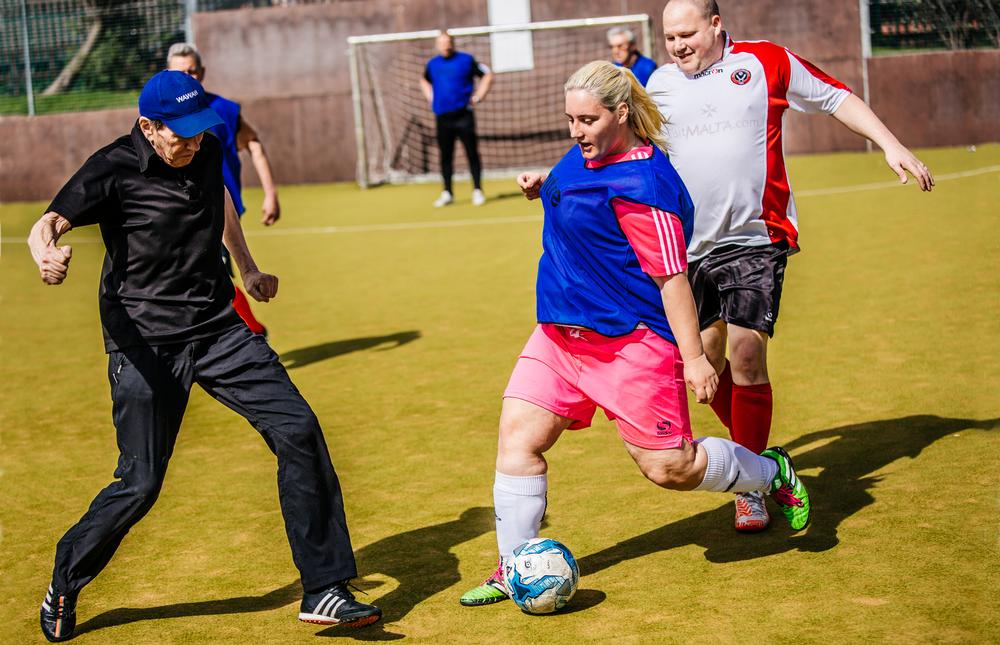
FEMALES TAKE THE LEAD As well as making up a slim majority of overall memberships, the report shows that women are driving some of the most significant changes in leisure centres. Growing numbers are swapping traditional activities like swimming for spin bikes and other group workouts, leading to a significant shake-up of the ‘gym and swim’ status quo.
Indeed, the number of people visiting leisure centres for group exercise classes such as cardio and indoor cycling has increased by almost 30 per cent over the past two years, with almost two thirds of class participants being female. As a result, the proportion of leisure centre visits for indoor cycling classes has risen by 79 per cent since 2016, with this and cardio classes making up over 50 per cent of total group workout visits.
Despite this, swimming remains the most popular single activity at leisure centres, accounting for 35 per cent of all visits. However, the proportion of visits for swimming has fallen by 15 per cent since 2016, as growing numbers of visitors favour group exercise.
Operators have taken great strides to adjust their offerings to the consumer market, as evidenced by the strong female-driven growth around group exercise.
“Our approach to increasing participation among women has centred on ensuring we have the right programmes in place and properly trained staff with the right levels of empathy and understanding of individual needs,” says Places for People Leisure’s CEO Sandra Dodd.
She adds: “Strong female-focused campaigns such as Sport England’s This Girl Can have also been a key driver, as they broaden knowledge of the opportunities available. As demand grows we continue to explore and offer innovative programmes that encourage more women to adopt a love of physical activity.”
BREAKING DATA BOUNDARIES While the industry has previously been forced to base major business decisions on data obtained from less-than-robust straw polls and surveys, the real-time data on millions of consumers’ lifestyles and buying habits provided by DataHub is fast making data, which was once our sector’s biggest weak spot, our greatest weapon.
As Alex Burrows, director at 4 global (which administers the DataHub) notes: “The power of this accumulated data means we can now tell how people are getting active, where and when, so our report offers unparalleled insights into the evolution of the leisure market and we’re only just getting started.
“Leisure operators are being empowered with the tools to make data-driven decisions on how to meet demand and help communities across the UK reap the benefits of a more active lifestyle.”
GROWING OPPORTUNITIES At a time when inactive lifestyles are placing unprecedented strain on the NHS and local social care services, there is a growing sentiment that leisure centres have the chance to step forward and become the lead preventative health provider from cradle to grave. ukactive is currently campaigning for a £1bn investment in local leisure facilities to create state-of-the-art wellness hubs to spearhead this effort. While the current report does little to dispel the potential for local leisure facilities to play a leading role in public health delivery, it does highlight that operators still have some work to do in catering to the outer reaches of that spectrum. Both young people and families, as well as older adults represent significant opportunities that remain unrealised.
The report shows that over 65s are hugely under-represented, making up just 9 per cent of the membership base compared to 22 per cent of the overall UK population. This suggests latent potential for operators to engage older adults with tailored propositions, particularly during off-peak times when they have under-utilised capacity. Interestingly, Saturday is the quietest day of the week despite being the day when people have the most free time, presenting significant opportunities to increase capacity, particularly through more family-friendly activities.
One area where leisure centres are exceeding expectations is diversity; serving to disprove certain long-held assumptions around BAME participation in physical activity. Indeed, the report finds that leisure centres are more ethnically diverse than the population as a whole, with Asian and black users accounting for 13 per cent and 8 per cent of members respectively (8 per cent and 3 per cent of the overall UK population).
MORE TO COME While built on an unprecedented sample size for the physical activity industry, the current report is still limited in the sense that it only reflects 315 leisure centres. Nonetheless, as more operators sign up to the free DataHub platform, an increasingly comprehensive overview of the sector is likely to be obtained, along with the trends that are shaping it.
This is particularly true for private sector operators, who have a lot to gain from taking advantage of this service to access unprecedented levels of insight, while those who don’t risk being left behind. DataHub is a great way for operators to demonstrate the breadth of their membership and detailed demographics to key brand partners. Furthermore, the clearer picture of the overall sector it provides will place us all on a stronger footing to attract greater levels of investment.
The DataHub keeps growing and currently tracks participation data from more than seven million individuals and 320 million visits from over 850 leisure centres. Moving forward, we will be publishing twice-yearly reports, arming the sector with intelligence that will benefit the sector’s quest to get more people more active, more often.
The private gym sector is currently enjoying good growth, but what about local authority fitness facilities? ukactive’s research director Dr Steven Mann shares insights from a new report that explores how local leisure centres are evolving in line with consumer trends
With local authority leisure budgets facing biting austerity cuts and the resultant shift to sub-zero subsidy contracts, many people predicted the death of the community leisure centre as we know it.
In one way they were right. Leisure centres with leaky ceilings and chilly pools are fast becoming a thing of the past, and in their place stand a growing number of forward-thinking facilities with diverse product offerings, run by savvy operators mixing public-sector ethos with private sector efficiency. Rather than dying, local leisure centres are thriving, with significant membership growth and evolving product offerings being driven largely by the female market. These are the findings of Moving Communities: Active Leisure Trends – a new insight report from ukactive and the DataHub.
Using data from over three million customers and 130 million individual visits across 315 leisure centres over the past two years, the report offers an overview of the leisure landscape and how Brits are getting fit.
The insights, which were collected from the membership management systems of leisure centre operators and processed by the DataHub, include analyses of who is visiting facilities, when they are visiting and what they are doing during the visits.
STRENGTH IN NUMBERS The report indicates that total membership across the sites increased 9 per cent from financial year (FY) 2016 to 2017, suggesting that local demand for leisure centres and services is growing. The number of overall visits to facilities increased by 17 per cent from 2015 to 2016 across the sites, and current indications for 2017 suggest that visitor numbers will at least be in line with 2016’s total of 54m. The report findings also show that women make up 52 per cent of members and have an average age of 39 years and 10 months, while the average male age is one year younger.
FEMALES TAKE THE LEAD As well as making up a slim majority of overall memberships, the report shows that women are driving some of the most significant changes in leisure centres. Growing numbers are swapping traditional activities like swimming for spin bikes and other group workouts, leading to a significant shake-up of the ‘gym and swim’ status quo.
Indeed, the number of people visiting leisure centres for group exercise classes such as cardio and indoor cycling has increased by almost 30 per cent over the past two years, with almost two thirds of class participants being female. As a result, the proportion of leisure centre visits for indoor cycling classes has risen by 79 per cent since 2016, with this and cardio classes making up over 50 per cent of total group workout visits.
Despite this, swimming remains the most popular single activity at leisure centres, accounting for 35 per cent of all visits. However, the proportion of visits for swimming has fallen by 15 per cent since 2016, as growing numbers of visitors favour group exercise.
Operators have taken great strides to adjust their offerings to the consumer market, as evidenced by the strong female-driven growth around group exercise.
“Our approach to increasing participation among women has centred on ensuring we have the right programmes in place and properly trained staff with the right levels of empathy and understanding of individual needs,” says Places for People Leisure’s CEO Sandra Dodd.
She adds: “Strong female-focused campaigns such as Sport England’s This Girl Can have also been a key driver, as they broaden knowledge of the opportunities available. As demand grows we continue to explore and offer innovative programmes that encourage more women to adopt a love of physical activity.”
BREAKING DATA BOUNDARIES While the industry has previously been forced to base major business decisions on data obtained from less-than-robust straw polls and surveys, the real-time data on millions of consumers’ lifestyles and buying habits provided by DataHub is fast making data, which was once our sector’s biggest weak spot, our greatest weapon.
As Alex Burrows, director at 4 global (which administers the DataHub) notes: “The power of this accumulated data means we can now tell how people are getting active, where and when, so our report offers unparalleled insights into the evolution of the leisure market and we’re only just getting started.
“Leisure operators are being empowered with the tools to make data-driven decisions on how to meet demand and help communities across the UK reap the benefits of a more active lifestyle.”
GROWING OPPORTUNITIES At a time when inactive lifestyles are placing unprecedented strain on the NHS and local social care services, there is a growing sentiment that leisure centres have the chance to step forward and become the lead preventative health provider from cradle to grave. ukactive is currently campaigning for a £1bn investment in local leisure facilities to create state-of-the-art wellness hubs to spearhead this effort. While the current report does little to dispel the potential for local leisure facilities to play a leading role in public health delivery, it does highlight that operators still have some work to do in catering to the outer reaches of that spectrum. Both young people and families, as well as older adults represent significant opportunities that remain unrealised.
The report shows that over 65s are hugely under-represented, making up just 9 per cent of the membership base compared to 22 per cent of the overall UK population. This suggests latent potential for operators to engage older adults with tailored propositions, particularly during off-peak times when they have under-utilised capacity. Interestingly, Saturday is the quietest day of the week despite being the day when people have the most free time, presenting significant opportunities to increase capacity, particularly through more family-friendly activities.
One area where leisure centres are exceeding expectations is diversity; serving to disprove certain long-held assumptions around BAME participation in physical activity. Indeed, the report finds that leisure centres are more ethnically diverse than the population as a whole, with Asian and black users accounting for 13 per cent and 8 per cent of members respectively (8 per cent and 3 per cent of the overall UK population).
MORE TO COME While built on an unprecedented sample size for the physical activity industry, the current report is still limited in the sense that it only reflects 315 leisure centres. Nonetheless, as more operators sign up to the free DataHub platform, an increasingly comprehensive overview of the sector is likely to be obtained, along with the trends that are shaping it.
This is particularly true for private sector operators, who have a lot to gain from taking advantage of this service to access unprecedented levels of insight, while those who don’t risk being left behind. DataHub is a great way for operators to demonstrate the breadth of their membership and detailed demographics to key brand partners. Furthermore, the clearer picture of the overall sector it provides will place us all on a stronger footing to attract greater levels of investment.
The DataHub keeps growing and currently tracks participation data from more than seven million individuals and 320 million visits from over 850 leisure centres. Moving forward, we will be publishing twice-yearly reports, arming the sector with intelligence that will benefit the sector’s quest to get more people more active, more often.
The Standards Authority for Touch in Cancer Care (SATCC) charity has announced its first five-
day Living with Cancer and Beyond retreat, which will be held at Carden Park Hotel and Spa in
Cheshire, UK, between 1 and 5 September.
Patmos Aktis, a Luxury Collection Resort and Spa, has opened in Greece, with a renovated and
rebranded wellness offering called Ansana Wellness and Spa.
The Mauna Kea Beach Hotel, an Autograph Collection property in Hawaii, US, has opened its
22,000 sq ft indoor-outdoor Spa at Mauna Kea as the final step in the property’s overall
renovation, which has cost more than US$180 million (€166 million, £140 mill
The UK spa review and discovery platform for consumers, the Good Spa Guide, has announced
it will host the Good Spa Guide Awards 2026 during an event on 16 November at Sopwell House
Hotel in St Albans, UK.
Eighty-four per cent of consumers now say wellness is a top priority in their lives, with this
percentage increasing year on year, according to a preview presentation of McKinsey’s Future of
Wellness 2026 research report.
Mass protests have been taking place since Monday 1 June in Albania over the development of
a luxury resort by Donald Trump’s daughter Ivanka Trump and her husband Jared Kushner.
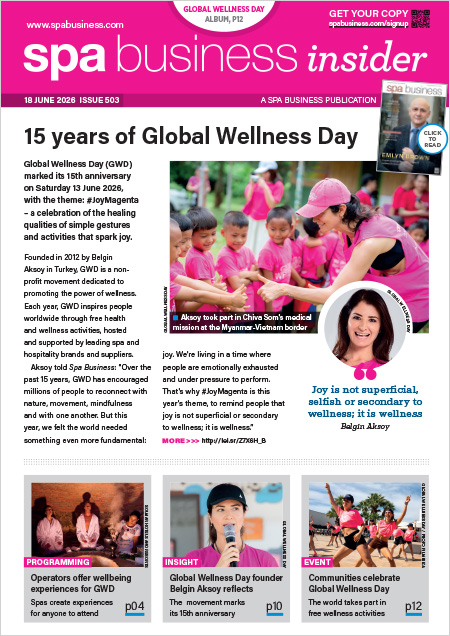
Global Wellness Day (GWD) marked its 15th anniversary on Saturday 13 June 2026, with the
theme: #JoyMagenta – a celebration of the healing qualities of simple gestures and activities
that spark joy.
Global luxury hospitality brand, Six Senses, has partnered with longevity healthcare provider,
HUM2N, to launch a clinic at Six Senses London, at The Whiteley.
As part of its first hotel partnership, Mayrlife – the medical health resort company known for its
site in Altaussee, Austria – has launched a day clinic at the Rosewood Vienna.
Premium London health club, KX Chelsea, will imminently unveil its most significant
redevelopment since its launch in 2002 to create an integrated wellness model combining
training, recovery and relaxation.