Yes! Send me the FREE digital editions of Spa Business and Spa Business insider magazines and the FREE weekly Spa Business and Spa Business insider ezines and breaking news alerts!
We look at the current group exercise landscape and ask what’s likely to
be trending in the year ahead, as well as tactics club operators
can use to improve their results
roup exercise has come a long way since Jane Fonda’s iconic 1980s classes – the array of group exercise classes available in 2019 is so diverse it’s mind boggling.
Keeping a group exercise timetable current, while still appealing to loyal members who stick to the same class each week is a constant challenge for operators.
Gym members are typically more engaged when operators deliver new and innovative group fitness programmes, but there are also those who hate change and would go so far as to look elsewhere if their routine is disrupted.
“Group exercise has a universal appeal – according to industry research, 60 per cent of members state the number of group exercise classes offered influences their decision to join a gym and risk of cancellation by gym-only members is 56 per cent higher than those that regularly attend group exercise classes,” says Datahub’s Chris Phillips.
“There’s demand for ever more innovative classes in which the workouts feel fun, social and not like fitness at all. In a market where everyone is screaming ‘join us’, the right group exercise programme can help cut through the noise, but knowing which of the latest trends to adopt can seem a challenge.”
Until recently, programming decisions have been driven by past experiences or gut feel. Timetables are sometimes just a scheduling task – juggling popular classes against peak times, studio capacity and instructor availability, rather than members’ preferences and desires.
But new tools on the market enable operators to develop an on-trend class timetable that appeals to existing members, while also reaching out to new ones.
Conduct a review Exercise Move Dance UK (EMD) is the national governing body for group exercise, founded in 2006.
Each year, it releases the Group Exercise National Survey. Last year’s report showed an additional 1.1 million people aged 45 and over took part in weekly group exercise during 2017 (compared to 2016 figures), while yoga has continued to grow in popularity, with more than 1.2m weekly participants.
Equally important for operators, the survey revealed more than 50 per cent of group exercise growth came from a C2DE audience (the three lower social and economic groups).
EMD also offers consumer access to an online class-finder tool to enable operators to promote classes to a wider audience. It utilises open data to pull classes from operators, while individual instructors can also upload to the site. Full functionality is expected by March 2019.
There is also an EMD Training Academy, offering a career pathway for group exercise instructors; the thinking behind this being that supporting team members increases staff, and therefore customer, retention.
Gillian Reeves, EMD UK head of instructor development, says of the Academy: “We know customer satisfaction is closely linked to staff satisfaction and while customer feedback periodically gets relayed to instructors, it’s rare that instructor feedback is sought from the operator that hires them. We recommend this happens before programme changes are made.
“We also suggest operators conduct a programming review, including looking at other activities offered within the site, as well as local needs, and that they benchmark against trend and cost model options,” she says.
“Mystery shopping can give insight into the current set-up at the start of this process. The next step is to take a deep dive into your offering in terms of maximising utilisation of space, timetable optimisation, offering low barrier to entry classes at key times in the calendar year and clear sign posting to demystify the offering and encourage more people to attend,” says Reeves.
Plunder your CMS Legend Software’s Business Intelligence & Reporting module offers a KPI Management feature, which customers can use to set up standards on exercise class goals and minimum class attendance levels. The system then alerts operators automatically, based on actual attendance for each standard set.
“If group exercise capacity standards were, for example <60 per cent = too low and >95 per cent = excellent, the system will automatically alert management if a class didn’t meet the standard, enabling them to swiftly make changes to timings, class format or location to improve customer service,” explains Sean Maguire, managing director at Legend.
“The system can also be set to flag up positive results – for example, where attendance was excellent – so management can look at successful classes and mimic best practice in others.”
Using your CMS effectively enables much more dynamic timetabling, swiftly fixing what’s not working and emulating what is.
The DataHub allows health club operators to take this process even further, offering an overview of what’s working in group exercise studios nationwide and what’s not.
Geo targeting The DataHub’s Geo Impacts module allows operators to identify the most active demographic profiles for their location and within a drive time of their selected facilities. It does this using ONS, population and government deprivation data.
A live interactive map shows the location of customers mapped by time, facility, visit frequency, demographics, member type, activity participation and facility area utilisation, as well as competing facilities.
“We can make recommendations based on the highest trending group exercise classes, or those with the highest throughput, all aligned with local targeted demographic segments,” explains Phillips.
“So for example, if an operator’s focus is acquisition, Geo Impacts can demonstrate which classes have the highest throughput and, therefore, the biggest draw for their demographic profile.
“On the flip side, if a competitor is opening in the area, Geo Impacts can highlight trending exercise classes, so operators can adjust programming to include classes with the largest draw, ensuring existing members aren’t tempted by new offerings.”
The system can then cross reference findings with Experian Mosaic Categorisation, to enable operators to identify the preferred communication method for their existing and potential members.
“Successful health club operators going forwards will be those that align their local performance with relative and relevant sector intelligence to ensure they have a consistent real-world view of the group exercise landscape,” says Phillips.
Group exercise: a snapshot
• 4.86
million people
participate in group
exercise every week #3
• Nearly
4 million more
people participated in
group exercise in 2018
than in 2016 #4
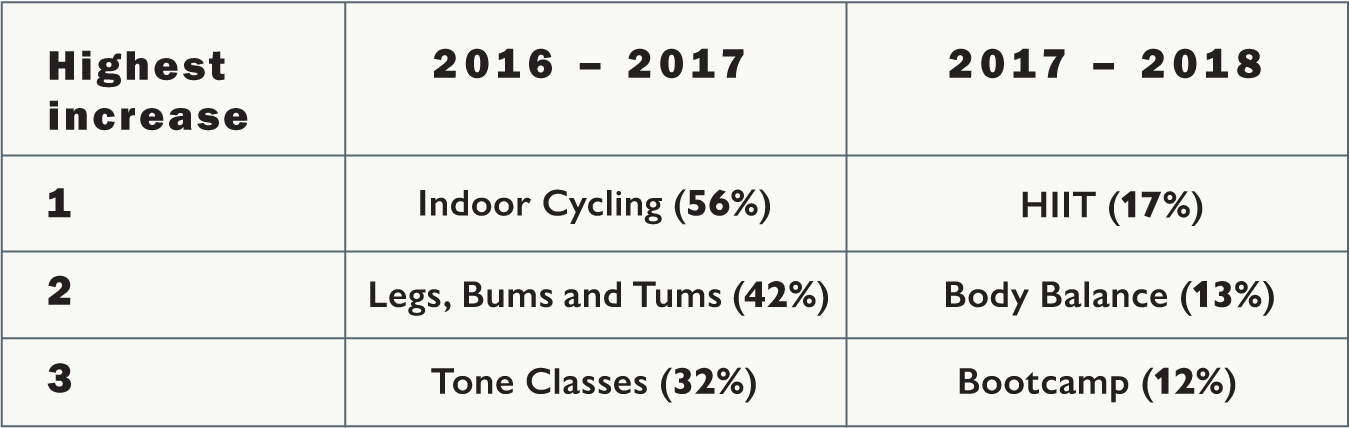
The most popular UK group exercise classes (based on % increase in throughput) #5
Upcoming classes, popular in 2018 and likely to emerge more in 2019
1. Les Mills Sprint
2. DanceFit
3. Barre Classes
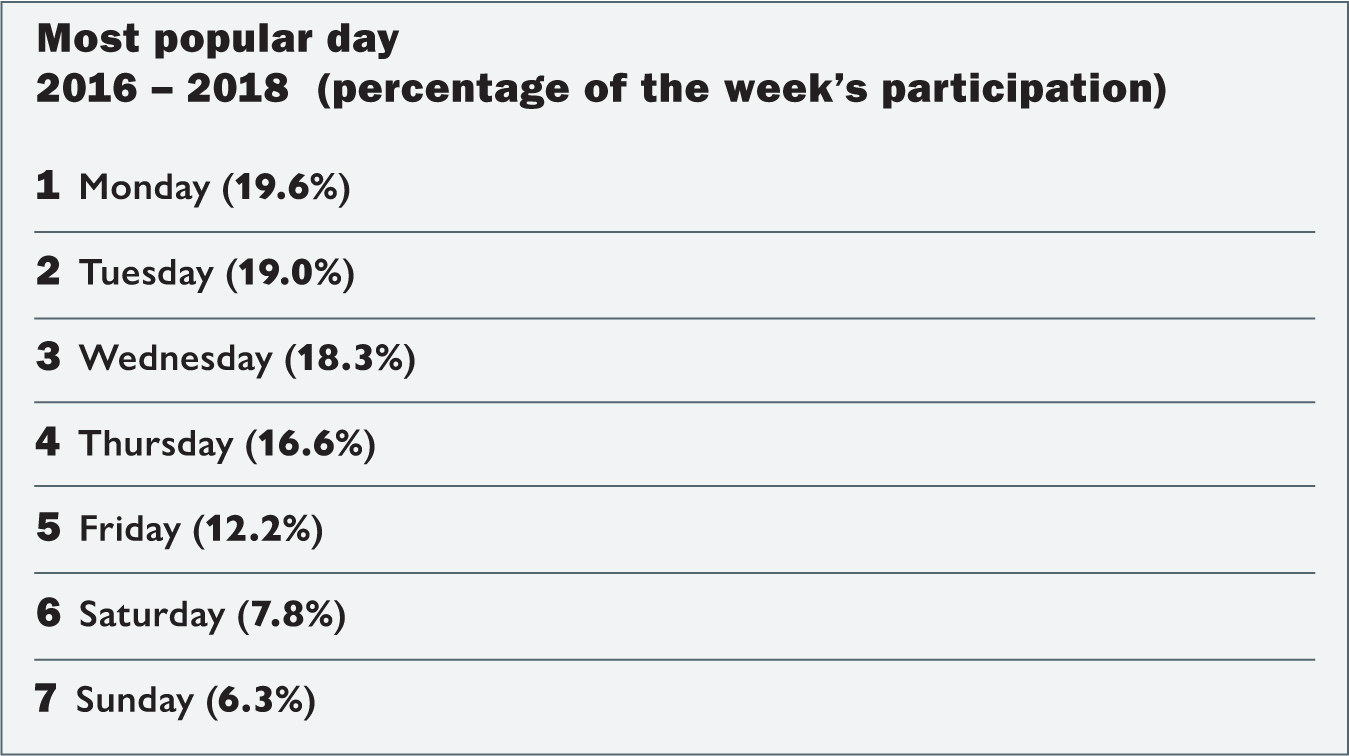
The most popular UK day/time
for group workouts
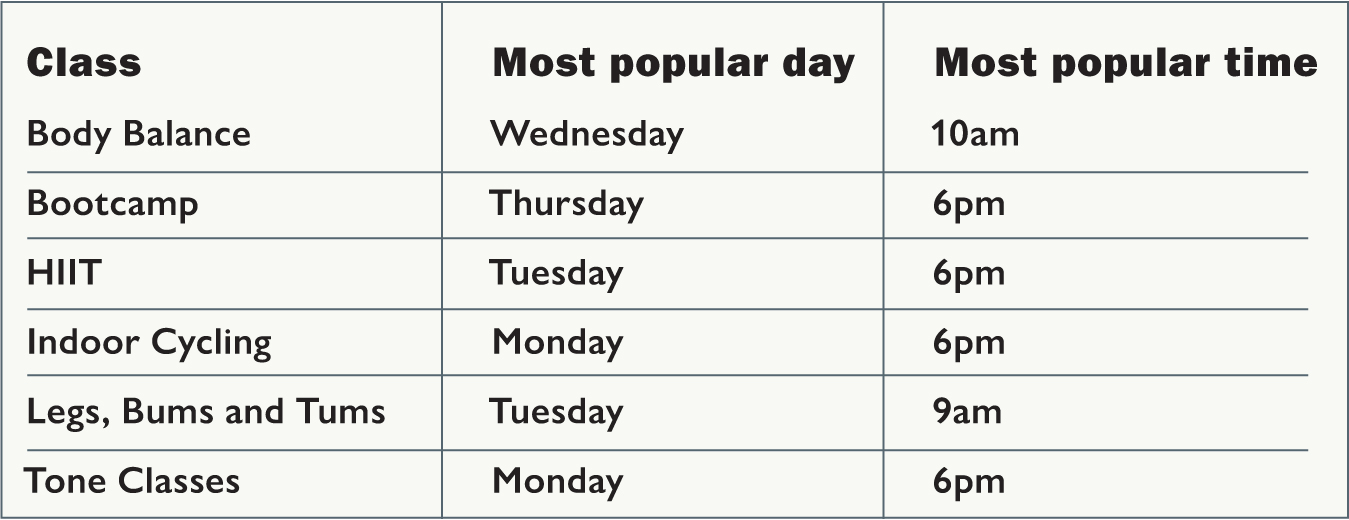
The most popular UK day/time for most popular group workouts
2. A 2017 study by TRP on group exercise vs gym only exercise
3. EMD UK (2018) - Group Exercise National Survey
4. EMD UK (2018) - Group Exercise National Survey
5. Analysis conducted across 361 UK sites by the DataHub. The time frames being compared are not full years (January to November only) as December was not yet complete for 2018 at the time of compilation, and as such December has also been left out in 2016 and 2017. Some group workout classes will not have been excluded as their annual participation was below the cut-off point. Percentage changes are always compared between years and not within the year, hence why there are only two data sets for popularity.
6. The ranking of the days was the same for all three years. The most popular time in each year was also 6pm. (16’, 17’ and 18’)
In the fast-paced world of fitness and wellness, where high-intensity workouts push us to
our limits and the sweat pours, the importance of efficient recovery cannot be overstated. [more...]
+ More featured suppliers
COMPANY PROFILES
We Work Well Inc
In 2019 Monica Helmstetter and Lucy Hugo founded the American hosted buyer event company We Work Wel [more...]
AKT Group
AKT Group is the Franco–Italian parent company of SKYY, C.O.D.E. and AKTMe, operating as an integrat [more...]
We look at the current group exercise landscape and ask what’s likely to
be trending in the year ahead, as well as tactics club operators
can use to improve their results
roup exercise has come a long way since Jane Fonda’s iconic 1980s classes – the array of group exercise classes available in 2019 is so diverse it’s mind boggling.
Keeping a group exercise timetable current, while still appealing to loyal members who stick to the same class each week is a constant challenge for operators.
Gym members are typically more engaged when operators deliver new and innovative group fitness programmes, but there are also those who hate change and would go so far as to look elsewhere if their routine is disrupted.
“Group exercise has a universal appeal – according to industry research, 60 per cent of members state the number of group exercise classes offered influences their decision to join a gym and risk of cancellation by gym-only members is 56 per cent higher than those that regularly attend group exercise classes,” says Datahub’s Chris Phillips.
“There’s demand for ever more innovative classes in which the workouts feel fun, social and not like fitness at all. In a market where everyone is screaming ‘join us’, the right group exercise programme can help cut through the noise, but knowing which of the latest trends to adopt can seem a challenge.”
Until recently, programming decisions have been driven by past experiences or gut feel. Timetables are sometimes just a scheduling task – juggling popular classes against peak times, studio capacity and instructor availability, rather than members’ preferences and desires.
But new tools on the market enable operators to develop an on-trend class timetable that appeals to existing members, while also reaching out to new ones.
Conduct a review Exercise Move Dance UK (EMD) is the national governing body for group exercise, founded in 2006.
Each year, it releases the Group Exercise National Survey. Last year’s report showed an additional 1.1 million people aged 45 and over took part in weekly group exercise during 2017 (compared to 2016 figures), while yoga has continued to grow in popularity, with more than 1.2m weekly participants.
Equally important for operators, the survey revealed more than 50 per cent of group exercise growth came from a C2DE audience (the three lower social and economic groups).
EMD also offers consumer access to an online class-finder tool to enable operators to promote classes to a wider audience. It utilises open data to pull classes from operators, while individual instructors can also upload to the site. Full functionality is expected by March 2019.
There is also an EMD Training Academy, offering a career pathway for group exercise instructors; the thinking behind this being that supporting team members increases staff, and therefore customer, retention.
Gillian Reeves, EMD UK head of instructor development, says of the Academy: “We know customer satisfaction is closely linked to staff satisfaction and while customer feedback periodically gets relayed to instructors, it’s rare that instructor feedback is sought from the operator that hires them. We recommend this happens before programme changes are made.
“We also suggest operators conduct a programming review, including looking at other activities offered within the site, as well as local needs, and that they benchmark against trend and cost model options,” she says.
“Mystery shopping can give insight into the current set-up at the start of this process. The next step is to take a deep dive into your offering in terms of maximising utilisation of space, timetable optimisation, offering low barrier to entry classes at key times in the calendar year and clear sign posting to demystify the offering and encourage more people to attend,” says Reeves.
Plunder your CMS Legend Software’s Business Intelligence & Reporting module offers a KPI Management feature, which customers can use to set up standards on exercise class goals and minimum class attendance levels. The system then alerts operators automatically, based on actual attendance for each standard set.
“If group exercise capacity standards were, for example <60 per cent = too low and >95 per cent = excellent, the system will automatically alert management if a class didn’t meet the standard, enabling them to swiftly make changes to timings, class format or location to improve customer service,” explains Sean Maguire, managing director at Legend.
“The system can also be set to flag up positive results – for example, where attendance was excellent – so management can look at successful classes and mimic best practice in others.”
Using your CMS effectively enables much more dynamic timetabling, swiftly fixing what’s not working and emulating what is.
The DataHub allows health club operators to take this process even further, offering an overview of what’s working in group exercise studios nationwide and what’s not.
Geo targeting The DataHub’s Geo Impacts module allows operators to identify the most active demographic profiles for their location and within a drive time of their selected facilities. It does this using ONS, population and government deprivation data.
A live interactive map shows the location of customers mapped by time, facility, visit frequency, demographics, member type, activity participation and facility area utilisation, as well as competing facilities.
“We can make recommendations based on the highest trending group exercise classes, or those with the highest throughput, all aligned with local targeted demographic segments,” explains Phillips.
“So for example, if an operator’s focus is acquisition, Geo Impacts can demonstrate which classes have the highest throughput and, therefore, the biggest draw for their demographic profile.
“On the flip side, if a competitor is opening in the area, Geo Impacts can highlight trending exercise classes, so operators can adjust programming to include classes with the largest draw, ensuring existing members aren’t tempted by new offerings.”
The system can then cross reference findings with Experian Mosaic Categorisation, to enable operators to identify the preferred communication method for their existing and potential members.
“Successful health club operators going forwards will be those that align their local performance with relative and relevant sector intelligence to ensure they have a consistent real-world view of the group exercise landscape,” says Phillips.
Group exercise: a snapshot
• 4.86
million people
participate in group
exercise every week #3
• Nearly
4 million more
people participated in
group exercise in 2018
than in 2016 #4
The most popular UK group exercise classes (based on % increase in throughput) #5
Upcoming classes, popular in 2018 and likely to emerge more in 2019
1. Les Mills Sprint
2. DanceFit
3. Barre Classes
The most popular UK day/time
for group workouts
The most popular UK day/time for most popular group workouts
2. A 2017 study by TRP on group exercise vs gym only exercise
3. EMD UK (2018) - Group Exercise National Survey
4. EMD UK (2018) - Group Exercise National Survey
5. Analysis conducted across 361 UK sites by the DataHub. The time frames being compared are not full years (January to November only) as December was not yet complete for 2018 at the time of compilation, and as such December has also been left out in 2016 and 2017. Some group workout classes will not have been excluded as their annual participation was below the cut-off point. Percentage changes are always compared between years and not within the year, hence why there are only two data sets for popularity.
6. The ranking of the days was the same for all three years. The most popular time in each year was also 6pm. (16’, 17’ and 18’)
Longevitix, a clinical platform for preventive and longevity medicine, has launched its AI-
powered intelligence system to help physicians deliver continuous, personalised longevity-
focused care at scale.
Atmantan Wellness Centre, an integrative wellness destination in Mulshi, near Pune in India, is
expanding its portfolio by adding a new centre in Hyderabad that will launch between 2028 and
2029.
A recent survey by the UK Spa Association (UKSA) into the industry’s approach to cancer care
has revealed that almost half of participating respondents (46 per cent) are unaware that
cancer is a disability and guests with a cancer diagnosis must be given
Mexican operator, Solmar Hotels and Resorts, is hosting a series of events in celebration of
Global Wellness Day, including a Temazcal ceremony at its Playa Grande Resort and Spa in Los
Cabos.
Mandarin Oriental has announced a standalone residence brand, Mansions, which will debut at
Emirates Palace, Mandarin Oriental Mansions, Abu Dhabi, in 2029.
Four Seasons Resort The Nam Hai in Hoi An, Vietnam, has put together a Global Wellness Day
(GWD) agenda with activations rooted in nature and shaped by four pillars of Joy – in
alignment with the day’s theme #JoyMagenta.
The Global Wellness Summit (GWS) will celebrate its 20th anniversary at the 2026 event in
Phuket, Thailand, later this year with the theme: The Science, Art and Soul of Wellness.
Auko, an all-inclusive development, is opening in Phong Nha in Vietnam in Q3 2026, with a
series of 30 tented eco-lodges and wellness hospitality operations by Lumina Wellbeing.
In the fast-paced world of fitness and wellness, where high-intensity workouts push us to
our limits and the sweat pours, the importance of efficient recovery cannot be overstated. [more...]
+ More featured suppliers
COMPANY PROFILES
We Work Well Inc In 2019 Monica Helmstetter and Lucy Hugo founded the American hosted buyer event company We Work Wel [more...]