Could ‘breathable’
electronics pave
the way for the
next generation of
wearable tech?
A new ultra-thin, stretchable electronic material that allows a product to “breathe” could have the potential to help create more functional wearable tech.
Created by a team of engineering researchers at North Carolina State University (NCSU), the as-yet-unnamed material combines a stretchable polymer film with silver nanowires, making it flexible but highly conductive.
Allows sweat to evaporate Being gas permeable, the material allows sweat and organic compounds to evaporate from the skin – making it more comfortable for users, especially for long-term wear.
Designed specifically to be used in wearable tech solutions, the product is only a few micrometers thick – allowing for better contact with the skin and giving the electronics a better “signal-to-noise ratio”.
“The resulting film shows an excellent combination of electric conductivity, optical transmittance and water-vapor permeability,” said Yong Zhu, professor of mechanical and aerospace engineering at NCSU.
“The gas permeability is the big advance over earlier stretchable electronics – and because the silver nanowires are embedded just below the surface of the polymer, the material also exhibits excellent stability in the presence of sweat and after long-term wear.”
To demonstrate its potential for use in wearables, researchers tested prototypes for two representative applications:
The first prototype consisted of skin-mountable, dry electrodes for use as electrophysiologic sensors. These have multiple potential applications, such as measuring electrocardiography (ECG) and electromyography (EMG) signals.
“The sensors were able to record signals with excellent quality, on a par with commercially available electrodes,” Zhu says.
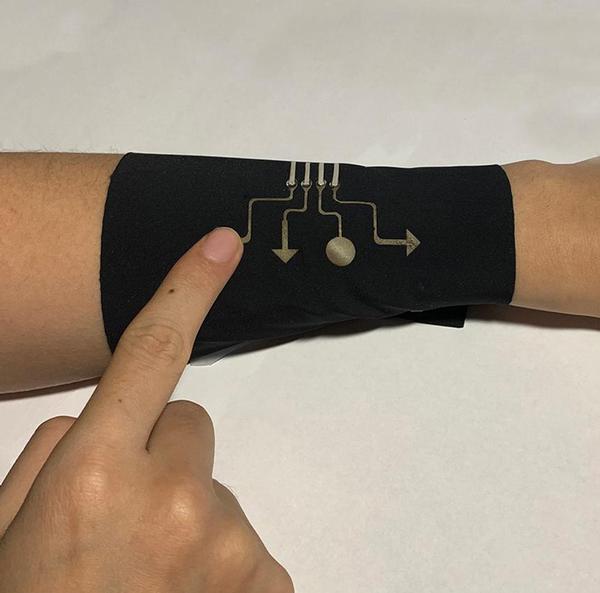
Human:machine interface The second prototype demonstrated textile-integrated touch-sensing for human-machine interfaces. The authors used a wearable textile sleeve integrated with the porous electrodes to play computer games, such as Tetris.
“If we want to develop wearable sensors or user interfaces that can be worn for a significant period of time, we need gas-permeable electronic materials,” Zhu added. “So this is a significant step forward.”
Could ‘breathable’
electronics pave
the way for the
next generation of
wearable tech?
A new ultra-thin, stretchable electronic material that allows a product to “breathe” could have the potential to help create more functional wearable tech.
Created by a team of engineering researchers at North Carolina State University (NCSU), the as-yet-unnamed material combines a stretchable polymer film with silver nanowires, making it flexible but highly conductive.
Allows sweat to evaporate Being gas permeable, the material allows sweat and organic compounds to evaporate from the skin – making it more comfortable for users, especially for long-term wear.
Designed specifically to be used in wearable tech solutions, the product is only a few micrometers thick – allowing for better contact with the skin and giving the electronics a better “signal-to-noise ratio”.
“The resulting film shows an excellent combination of electric conductivity, optical transmittance and water-vapor permeability,” said Yong Zhu, professor of mechanical and aerospace engineering at NCSU.
“The gas permeability is the big advance over earlier stretchable electronics – and because the silver nanowires are embedded just below the surface of the polymer, the material also exhibits excellent stability in the presence of sweat and after long-term wear.”
To demonstrate its potential for use in wearables, researchers tested prototypes for two representative applications:
The first prototype consisted of skin-mountable, dry electrodes for use as electrophysiologic sensors. These have multiple potential applications, such as measuring electrocardiography (ECG) and electromyography (EMG) signals.
“The sensors were able to record signals with excellent quality, on a par with commercially available electrodes,” Zhu says.
Human:machine interface The second prototype demonstrated textile-integrated touch-sensing for human-machine interfaces. The authors used a wearable textile sleeve integrated with the porous electrodes to play computer games, such as Tetris.
“If we want to develop wearable sensors or user interfaces that can be worn for a significant period of time, we need gas-permeable electronic materials,” Zhu added. “So this is a significant step forward.”
Four Seasons Resort The Nam Hai in Hoi An, Vietnam, has put together a Global Wellness Day
(GWD) agenda with activations rooted in nature and shaped by four pillars of Joy – in
alignment with the day’s theme #JoyMagenta.
The Global Wellness Summit (GWS) will celebrate its 20th anniversary at the 2026 event in
Phuket, Thailand, later this year with the theme: The Science, Art and Soul of Wellness.
Auko, an all-inclusive development, is opening in Phong Nha in Vietnam in Q3 2026, with a
series of 30 tented eco-lodges and wellness hospitality operations by Lumina Wellbeing.
Therme Manchester’s 28-acre development, which will include interconnected glass pavilions
that measure 65,000sq m, will be the largest bathing and wellbeing attraction in the world once
complete, according to prof David Russell, CEO of Therme UK.
Naples Beach Club, a Four Seasons Resort, has opened a 2,800sq m spa called The Sanctuary,
with the design and concept inspired by the Native American people that populated Florida’s
Southwest coast – the Calusa.
Swire Hotels’ luxury hospitality brand Upper House has revealed it will roll out its two-day
House of Healing retreats at its three hotels in Hong Kong, Chengdu and Shanghai.
LVMH-owned beauty house Guerlain will launch up to five spas with partners a year as part of
its plan to expand globally, according to the brand’s international spa and wellness director,
Diane Davody.
A new global study by Kevin Kelly and Peter Yesawich, called WELLSurvey 2.0, has revealed
more than half of consumers in the UK, US and Germany would not choose numerous high-
profile wellness resort brands for a future trip.
Luxury hospitality and wellness pioneer Jeremy McCarthy has launched Leisure Alchemy, a
digital platform that will provide professionals with strategic guidance on how to build
transformational leisure experiences that drive profit.