64% of women say they prefer clubs that offer a variety of workouts / photo: ndab creativity/shutterstock
Consumers and wellness brands have been surveyed to understand how the industry has shifted over the past year and a half and more importantly, where it’s headed in the months to come.
The data gathered has been published in two studies: the Mindbody 2021 US Consumer Survey which was compiled from 1,232 responses and the Mindbody 2021 US Business Study, which received 1,200 responses.
“For fitness operators, knowledge is innovation waiting to happen,” says Mindbody CEO, Josh McCarter. “We hope these data points help inform operators’ business strategy, at a time that calls for you to adapt more rapidly than ever.”
Consumers are open
to trying out something new in their routines
52 per cent of respondents shared that they’re more open to new workouts than they were before the pandemic.
In the US, some consumers are reluctant to return
Some consumers are still reluctant to return to the studio. The top five reasons are cited as feeling uncomfortable knowing not all attendees are vaccinated (29 per cent), not being comfortable near others (24 per cent), not being vaccinated yet (23 per cent), feeling too intimidated because they are out of shape/gained weight (19 per cent) and having established a new at-home virtual routine (17 per cent).
Cost and location matter to consumers, but they’re not everything
When it comes to choosing a fitness business, US consumers still cite location (37 per cent) and cost (36 per cent) as top considerations – and when motivating people to return, 37 per cent credit lower costs as a winning strategy. Unsurprisingly, cleanliness has also emerged as a key factor.
When it comes to other important factors, consumers also cite atmosphere (30 per cent), the time of classes (26 per cent), the variety of classes (25 per cent) and reputation (23 per cent), as well as instructors (23 per cent) and amenities (22 per cent).
The trend for
bookings is upwards
Researchers found that studio bookings are recovering in the US. While the volume continues to vary considerably by state, the overall trend line for bookings is heading toward pre-pandemic levels and once restrictions were lifted or relaxed, state-by-state, pent-up consumer demand was, and continues to be, the driver for recovery.
Offering workout variety is a big advantage
69 per cent of men and 64 per cent of women stated they prefer a fitness studio or gym which have a variety of workout types available.
Men are working out more than women, both in-person and virtually
59 per cent of men are attending in-person classes compared with 40 per cent of women in the US. Furthermore, 52 per cent of men are attending in-person classes at boutique studios versus 37 per cent of women.
As we see virtual fitness continue in popularity, men in the US are also attending virtual classes significantly more than women (59 per cent versus 43 per cent of women).
The industry is clear about the challenges it’s facing
Franchise organisations state their top three obstacles to growth as learning how to more effectively optimise their business (45 per cent), getting new/more customers (45 per cent), and ‘keeping, engaging and retaining existing customers' (43 per cent).
Similarly, non-franchise organisations reported that their largest roadblocks are getting new/more customers (54 per cent), learning how to more effectively optimise their business (42 per cent) and optimising their use of technology and software (39 per cent).
Reinstating growth is a vital part of recovery
31 per cent of business owners said their goal is to maintain the business for the foreseeable future and 44 per cent say they’re ready to start growing again.
Diversifying services is key
88 per cent of fitness businesses have already added something besides fitness classes or training sessions to their roster of services. The top five supplemental services are wellness (45 per cent), nutrition (40 per cent), massage therapy (36 per cent), physical therapy (35 per cent) and meditation (31 per cent).
Technology continues to become more fundamental to success
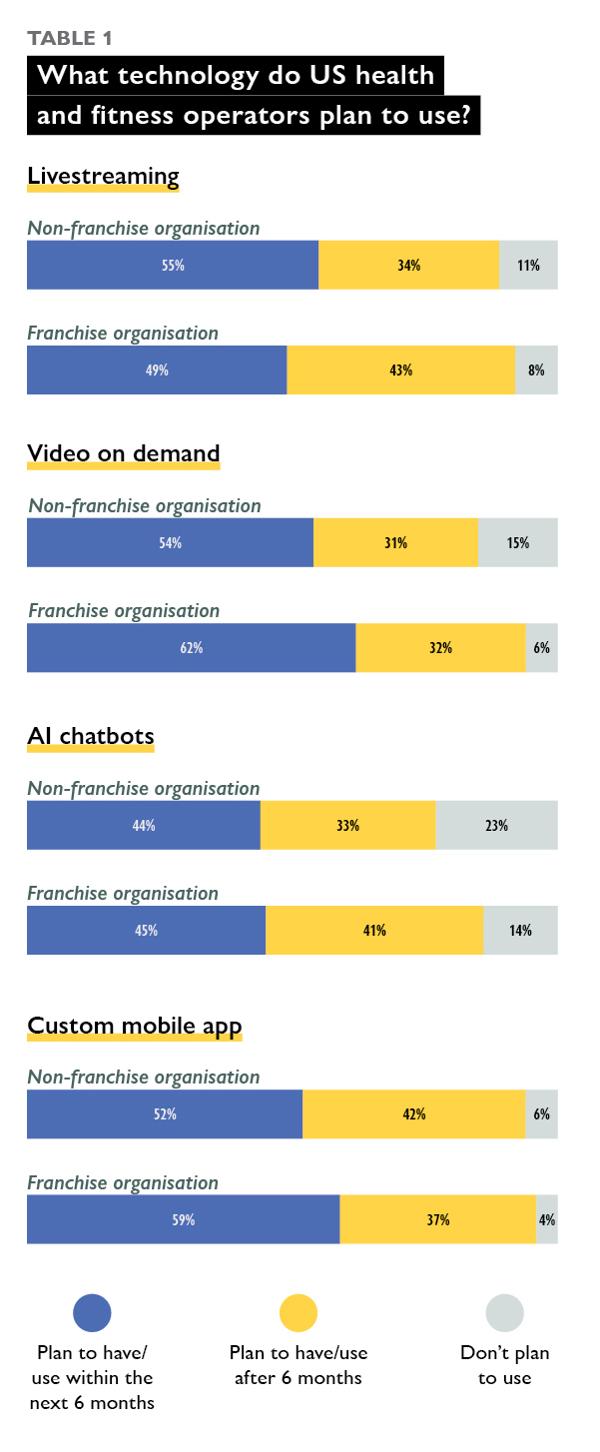
The majority of franchise and non-franchise businesses have implemented, or plan to implement the following tech: livestreaming, video on demand, custom mobile apps and AI chatbots.
Drilling into the numbers (Table 1) shows a difference of approach to technology between non-franchise and franchise operators, with a total of 86 per cent of non-franchise operators using or planning to use livestreaming and a higher number – 92 per cent – of franchise operators going down this road.
Video on demand is also more popular with franchise businesses, with 85 per cent of non-franchise operators using or planning to use it, vs 94 per cent of franchise operators.
The opposite is true of custom mobile apps, with 94 per cent of non-franchise operators using or planning to use them vs 86 per cent of franchise operators.
The adoption of AI is further behind the curve, showing the potential for growth in this area. Again franchises showed greater interest, with only 77 per cent of non-franchise operators saying they are using or planning to use AI chatbots, against 86 per cent of franchise owners.
The MSpa Oslo series is a perennial bestseller in global markets. With innovative
engineering and premium performance, this completely portable spa line-up is expertly
designed to meet the needs of customers worldwide. [more...]
In the fast-paced world of fitness and wellness, where high-intensity workouts push us to
our limits and the sweat pours, the importance of efficient recovery cannot be overstated. [more...]
+ More featured suppliers
COMPANY PROFILES
Aquaform
With a rich heritage in the spa industry, Aquaform offers a diverse array of water wellness experien [more...]
bbspa_Group
The technical advice offered by bbspa is
delivered via four specialist departments which offer turn [more...]
64% of women say they prefer clubs that offer a variety of workouts / photo: ndab creativity/shutterstock
Consumers and wellness brands have been surveyed to understand how the industry has shifted over the past year and a half and more importantly, where it’s headed in the months to come.
The data gathered has been published in two studies: the Mindbody 2021 US Consumer Survey which was compiled from 1,232 responses and the Mindbody 2021 US Business Study, which received 1,200 responses.
“For fitness operators, knowledge is innovation waiting to happen,” says Mindbody CEO, Josh McCarter. “We hope these data points help inform operators’ business strategy, at a time that calls for you to adapt more rapidly than ever.”
Consumers are open
to trying out something new in their routines
52 per cent of respondents shared that they’re more open to new workouts than they were before the pandemic.
In the US, some consumers are reluctant to return
Some consumers are still reluctant to return to the studio. The top five reasons are cited as feeling uncomfortable knowing not all attendees are vaccinated (29 per cent), not being comfortable near others (24 per cent), not being vaccinated yet (23 per cent), feeling too intimidated because they are out of shape/gained weight (19 per cent) and having established a new at-home virtual routine (17 per cent).
Cost and location matter to consumers, but they’re not everything
When it comes to choosing a fitness business, US consumers still cite location (37 per cent) and cost (36 per cent) as top considerations – and when motivating people to return, 37 per cent credit lower costs as a winning strategy. Unsurprisingly, cleanliness has also emerged as a key factor.
When it comes to other important factors, consumers also cite atmosphere (30 per cent), the time of classes (26 per cent), the variety of classes (25 per cent) and reputation (23 per cent), as well as instructors (23 per cent) and amenities (22 per cent).
The trend for
bookings is upwards
Researchers found that studio bookings are recovering in the US. While the volume continues to vary considerably by state, the overall trend line for bookings is heading toward pre-pandemic levels and once restrictions were lifted or relaxed, state-by-state, pent-up consumer demand was, and continues to be, the driver for recovery.
Offering workout variety is a big advantage
69 per cent of men and 64 per cent of women stated they prefer a fitness studio or gym which have a variety of workout types available.
Men are working out more than women, both in-person and virtually
59 per cent of men are attending in-person classes compared with 40 per cent of women in the US. Furthermore, 52 per cent of men are attending in-person classes at boutique studios versus 37 per cent of women.
As we see virtual fitness continue in popularity, men in the US are also attending virtual classes significantly more than women (59 per cent versus 43 per cent of women).
The industry is clear about the challenges it’s facing
Franchise organisations state their top three obstacles to growth as learning how to more effectively optimise their business (45 per cent), getting new/more customers (45 per cent), and ‘keeping, engaging and retaining existing customers' (43 per cent).
Similarly, non-franchise organisations reported that their largest roadblocks are getting new/more customers (54 per cent), learning how to more effectively optimise their business (42 per cent) and optimising their use of technology and software (39 per cent).
Reinstating growth is a vital part of recovery
31 per cent of business owners said their goal is to maintain the business for the foreseeable future and 44 per cent say they’re ready to start growing again.
Diversifying services is key
88 per cent of fitness businesses have already added something besides fitness classes or training sessions to their roster of services. The top five supplemental services are wellness (45 per cent), nutrition (40 per cent), massage therapy (36 per cent), physical therapy (35 per cent) and meditation (31 per cent).
Technology continues to become more fundamental to success
The majority of franchise and non-franchise businesses have implemented, or plan to implement the following tech: livestreaming, video on demand, custom mobile apps and AI chatbots.
Drilling into the numbers (Table 1) shows a difference of approach to technology between non-franchise and franchise operators, with a total of 86 per cent of non-franchise operators using or planning to use livestreaming and a higher number – 92 per cent – of franchise operators going down this road.
Video on demand is also more popular with franchise businesses, with 85 per cent of non-franchise operators using or planning to use it, vs 94 per cent of franchise operators.
The opposite is true of custom mobile apps, with 94 per cent of non-franchise operators using or planning to use them vs 86 per cent of franchise operators.
The adoption of AI is further behind the curve, showing the potential for growth in this area. Again franchises showed greater interest, with only 77 per cent of non-franchise operators saying they are using or planning to use AI chatbots, against 86 per cent of franchise owners.
The Wellness Tourism Association (WTA) has published a non-regulatory global industry
framework designed to ensure the retreat market offers responsible experiences.
A new survey of UK and international spa practitioners shows that stress, burnout and
wellbeing concerns have caused one in three respondents to consider leaving the industry.
The UK's four Chief Medical Officers have published a refreshed edition of Physical activity
guidelines: UK Chief Medical Officers' report, updating the evidence that underpins the nation's
physical activity recommendations and placing greater emphasis on strength, balance, reducing
sedentary behaviour and, for the first time, supporting people taking weight loss medications.
Anna Bjurstam has left her role as Wellness Pioneer at Six Senses Hotels and Resorts and
launched a new wellness, longevity and “consciousness consultancy” called Wahayla.
Fairmont Cheshire, The Mere, has opened today (10 July) in the Northwest of England
with a
1,715sq m Fairmont Spa that has been designed using a ‘Wellness without Walls’
concept.
Wellness hotels generating less than US$1 million (€932,700, £785,200) – or 10 per cent of
total revenue from wellness and leisure – recorded the strongest RevPAR and TRevPAR growth
in 2025 across categories when compared with 2024, according to the latest Wellness Real
Estate Report by RLA Global, produced in partnership with P and L benchmarking firm HotStats.
Lefay Resorts, the portfolio of two luxury wellness properties in Italy, has added emotional
dance classes and group cold plunge sessions in response to market demand for social
connection.
The MSpa Oslo series is a perennial bestseller in global markets. With innovative
engineering and premium performance, this completely portable spa line-up is expertly
designed to meet the needs of customers worldwide. [more...]
In the fast-paced world of fitness and wellness, where high-intensity workouts push us to
our limits and the sweat pours, the importance of efficient recovery cannot be overstated. [more...]
+ More featured suppliers
COMPANY PROFILES
Aquaform With a rich heritage in the spa industry, Aquaform offers a diverse array of water wellness experien [more...]