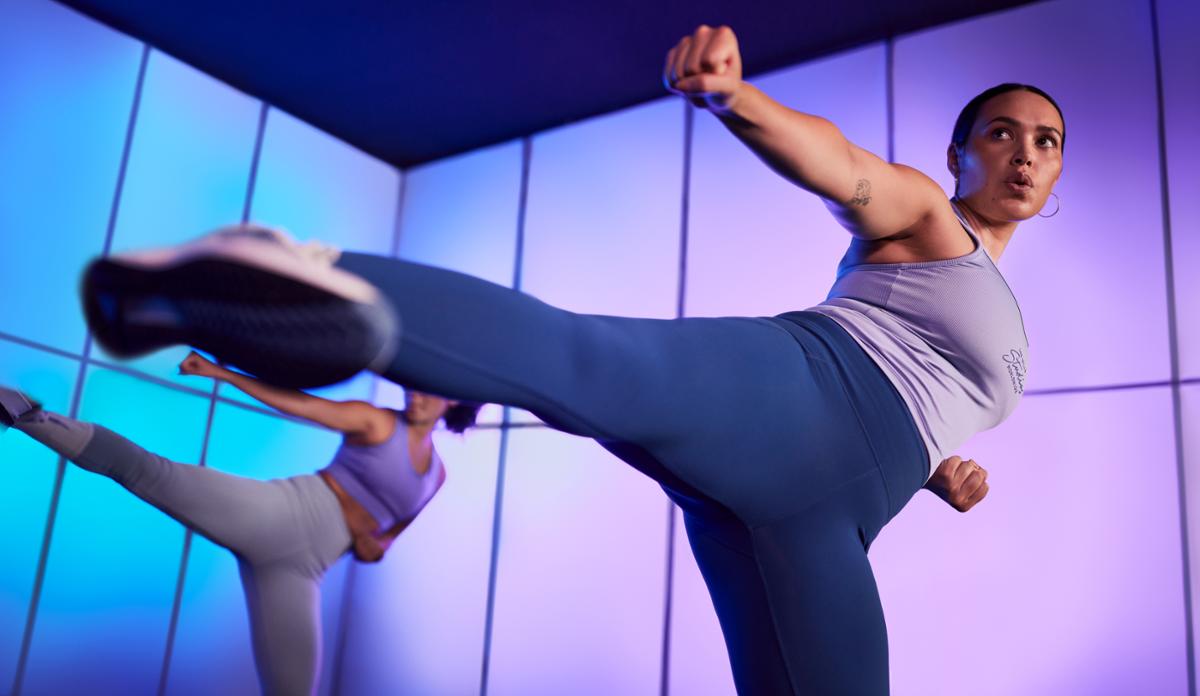
The gym-based class was 13 per cent more enjoyable than the same class done at home / photo: LES MILLS
Having exploded in popularity during the pandemic, is it possible that on-demand workouts could render gyms redundant? Perhaps the answer can be found by examining what exactly we’re doing when we work out at home versus at the gym.
First of all, we don’t appear to be training as hard at home as we do in the gym.
Dr Jinger Gottschall and I conducted a pilot study comparing exertion and enjoyment levels between a live class in the gym and exactly the same workout followed digitally at home. The findings of our research were presented at the recent 2022 ACSM Annual Meeting and World Congresses in San Diego.
The study involved 54 regular Bodycombat participants from five different gyms across the US, who each wore a Bluetooth heart-rate chest transmitter to record their intensity levels. After each session, they completed a survey containing questions related to rate of perceived exertion, enjoyment, and satisfaction.
Despite doing exactly the same class, participants’ average heart rate was 14 per cent higher during the gym class when compared to the on-demand session. As well as motivating them to work harder, participants rated the gym-based workout as 13 per cent more enjoyable and 14 per cent more satisfying than the digital workout.
The power of groupness We believe the greater levels of positive perceptions and intensity experienced in a gym-based class can be attributed to what we call ‘groupness’. This term was coined during previous research we conducted at Penn State University and the nearby Fitology club – which found that people in a live group exercise class experience increased levels of individual exertion, enjoyment, and satisfaction as a result of exercising in the presence of others, particularly when their movements are synchronised (www.hcmmag.com/Groupness).
When it comes to duration, it appears that most exercisers prefer shorter workouts when they’re at-home. Data from our Les Mills+ on-demand workout platform shows that around 70 per cent of at-home workouts are 45 minutes or less, with 50 per cent of attendees opting for workouts that are a maximum of 30 minutes.
Home workouts – the upside There are, however, definite positives to working out at home. Despite the fact that digital home workouts are less intense and tend to be shorter in duration, study participants reported feeling less self-conscious and worried about their performance during the on-demand workout. This highlights its potential as a gateway into regular exercise for newcomers who may not yet feel confident enough to join a live gym class, or simply a way to top up live workouts.
Live classes in gyms remain the pinnacle experience, but the rise of digital fitness and flexible working reinforces the notion that hybrid fitness habits are becoming the norm. The Les Mills 2021 Global Fitness Report(www.HCMmag.com/LMGFR) found the majority of exercisers now favour a 60:40 split of gym to home workouts, so it will be interesting to see how fitness habits shift as the world learns to live with COVID.
The ultimate winners will be consumers, who now have more ways to work out and greater flexibility, making it easier to sustain their exercise habit. For clubs, the key challenge will be to leverage these digital tools to maintain member motivation and engagement in a way that complements the in-club experience.
Maximising this opportunity requires a reimagination of the member journey and how we measure engagement. Instead of simply tracking club attendances, we need to pan out and look holistically at all the touchpoints a member has with their facility – including home workouts via the club’s digital offering, and even use of the club app – to accurately assess member engagement and take actions to enhance this. Ultimately this combined approach can only help establish sustainable exercise habits, benefiting both those new to exercise and experienced users.
14 per cent
more effort
Heart rates were 14 per cent higher during the gym-based class when compared to the same class done at home
13 per cent
more enjoyment
The gym-based class was 13 per cent more enjoyable than the same class done at home
14 per cent
more satisfaction
The gym-based class was 14 per cent more satisfying than the same class done at home
photo: LES MILLS
Bryce Hastings is head of research at Les Mills, while Dr Jinger Gottschall is an associate professor of kinesiology at Pennsylvania State University
In today’s premium spa environment, every detail shapes the guest experience – right down to
the softness of towels and the freshness of linens. [more...]
+ More featured suppliers
COMPANY PROFILES
Lovinfit Group
Lovinfit Group was founded in Parma, Italy in 2016 by a team of doctors, wellness and sports profess [more...]
The gym-based class was 13 per cent more enjoyable than the same class done at home / photo: LES MILLS
Having exploded in popularity during the pandemic, is it possible that on-demand workouts could render gyms redundant? Perhaps the answer can be found by examining what exactly we’re doing when we work out at home versus at the gym.
First of all, we don’t appear to be training as hard at home as we do in the gym.
Dr Jinger Gottschall and I conducted a pilot study comparing exertion and enjoyment levels between a live class in the gym and exactly the same workout followed digitally at home. The findings of our research were presented at the recent 2022 ACSM Annual Meeting and World Congresses in San Diego.
The study involved 54 regular Bodycombat participants from five different gyms across the US, who each wore a Bluetooth heart-rate chest transmitter to record their intensity levels. After each session, they completed a survey containing questions related to rate of perceived exertion, enjoyment, and satisfaction.
Despite doing exactly the same class, participants’ average heart rate was 14 per cent higher during the gym class when compared to the on-demand session. As well as motivating them to work harder, participants rated the gym-based workout as 13 per cent more enjoyable and 14 per cent more satisfying than the digital workout.
The power of groupness We believe the greater levels of positive perceptions and intensity experienced in a gym-based class can be attributed to what we call ‘groupness’. This term was coined during previous research we conducted at Penn State University and the nearby Fitology club – which found that people in a live group exercise class experience increased levels of individual exertion, enjoyment, and satisfaction as a result of exercising in the presence of others, particularly when their movements are synchronised (www.hcmmag.com/Groupness).
When it comes to duration, it appears that most exercisers prefer shorter workouts when they’re at-home. Data from our Les Mills+ on-demand workout platform shows that around 70 per cent of at-home workouts are 45 minutes or less, with 50 per cent of attendees opting for workouts that are a maximum of 30 minutes.
Home workouts – the upside There are, however, definite positives to working out at home. Despite the fact that digital home workouts are less intense and tend to be shorter in duration, study participants reported feeling less self-conscious and worried about their performance during the on-demand workout. This highlights its potential as a gateway into regular exercise for newcomers who may not yet feel confident enough to join a live gym class, or simply a way to top up live workouts.
Live classes in gyms remain the pinnacle experience, but the rise of digital fitness and flexible working reinforces the notion that hybrid fitness habits are becoming the norm. The Les Mills 2021 Global Fitness Report(www.HCMmag.com/LMGFR) found the majority of exercisers now favour a 60:40 split of gym to home workouts, so it will be interesting to see how fitness habits shift as the world learns to live with COVID.
The ultimate winners will be consumers, who now have more ways to work out and greater flexibility, making it easier to sustain their exercise habit. For clubs, the key challenge will be to leverage these digital tools to maintain member motivation and engagement in a way that complements the in-club experience.
Maximising this opportunity requires a reimagination of the member journey and how we measure engagement. Instead of simply tracking club attendances, we need to pan out and look holistically at all the touchpoints a member has with their facility – including home workouts via the club’s digital offering, and even use of the club app – to accurately assess member engagement and take actions to enhance this. Ultimately this combined approach can only help establish sustainable exercise habits, benefiting both those new to exercise and experienced users.
14 per cent
more effort
Heart rates were 14 per cent higher during the gym-based class when compared to the same class done at home
13 per cent
more enjoyment
The gym-based class was 13 per cent more enjoyable than the same class done at home
14 per cent
more satisfaction
The gym-based class was 14 per cent more satisfying than the same class done at home
photo: LES MILLS
Bryce Hastings is head of research at Les Mills, while Dr Jinger Gottschall is an associate professor of kinesiology at Pennsylvania State University
Global Wellness Day (GWD) will mark its 15th anniversary on Saturday 13 June 2026, with the
theme: #JoyMagenta – a celebration of the healing qualities of simple gestures and activities
that spark joy.
Global luxury hospitality brand, Six Senses, has partnered with longevity healthcare provider,
HUM2N, to launch a clinic at Six Senses London, at The Whiteley.
As part of its first hotel partnership, Mayrlife – the medical health resort company known for its
site in Altaussee, Austria – has launched a day clinic at the Rosewood Vienna.
Premium London health club, KX Chelsea, will imminently unveil its most significant
redevelopment since its launch in 2002 to create an integrated wellness model combining
training, recovery and relaxation.
Rosewood Le Guanahani St Barth, on the northeast coast of Saint Barthélemy in the French
West Indies, is offering a programme of ocean-inspired yoga classes between 8-14 June to
celebrate Global Wellness Day (GWD).
Hotel de France, located on the British Isle of Jersey, has created a wellness retreat package
that includes a hot yoga session that will take place in Jersey Zoo’s butterfly sanctuary.
The Ritz-Carlton, Langkawi, in Malaysia, has revealed a schedule for Global Wellness Day
(GWD) that includes guided rainforest walks, mindful movement and guided coastal meditation
experiences.
Longevitix, a clinical platform for preventive and longevity medicine, has launched its AI-
powered intelligence system to help physicians deliver continuous, personalised longevity-
focused care at scale.
Atmantan Wellness Centre, an integrative wellness destination in Mulshi, near Pune in India, is
expanding its portfolio by adding a new centre in Hyderabad that will launch between 2028 and
2029.
A recent survey by the UK Spa Association (UKSA) into the industry’s approach to cancer care
has revealed that almost half of participating respondents (46 per cent) are unaware that
cancer is a disability and guests with a cancer diagnosis must be given
In today’s premium spa environment, every detail shapes the guest experience – right down to
the softness of towels and the freshness of linens. [more...]
+ More featured suppliers
COMPANY PROFILES
Lovinfit Group Lovinfit Group was founded in Parma, Italy in 2016 by a team of doctors, wellness and sports profess [more...]