The global wellness economy has exceeded US$5.6 trillion.
Katherine Johnston and Ophelia Yeung outline areas
of growth and regional differences from the 2023
Global Wellness Economy Monitor report
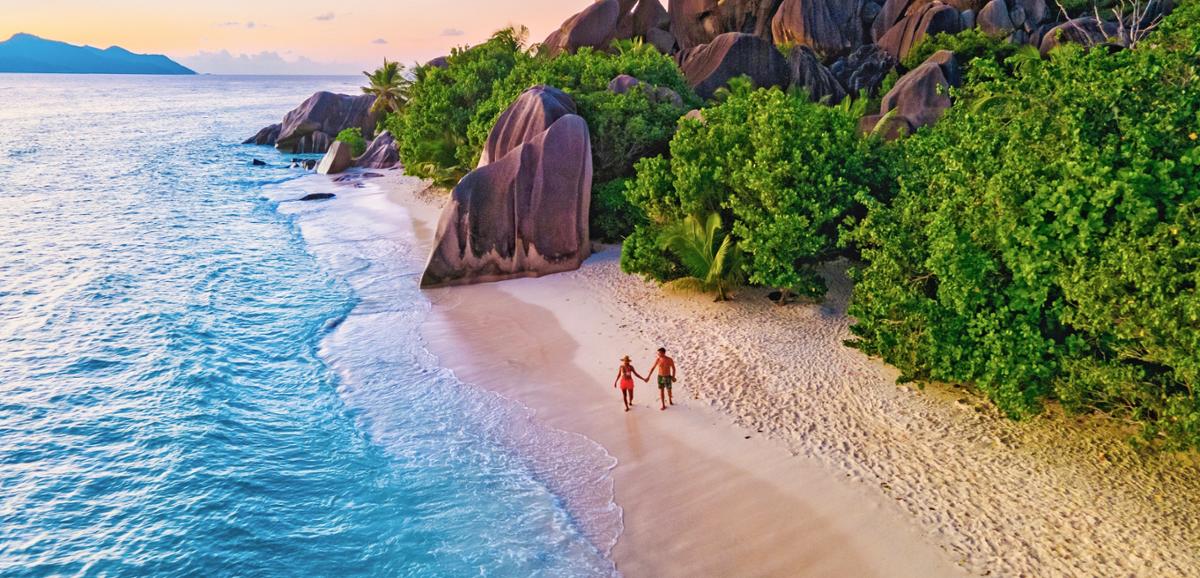
The global wellness economy will reach $8.5 trillion by 2027 / shutterstock/fokke baarssen
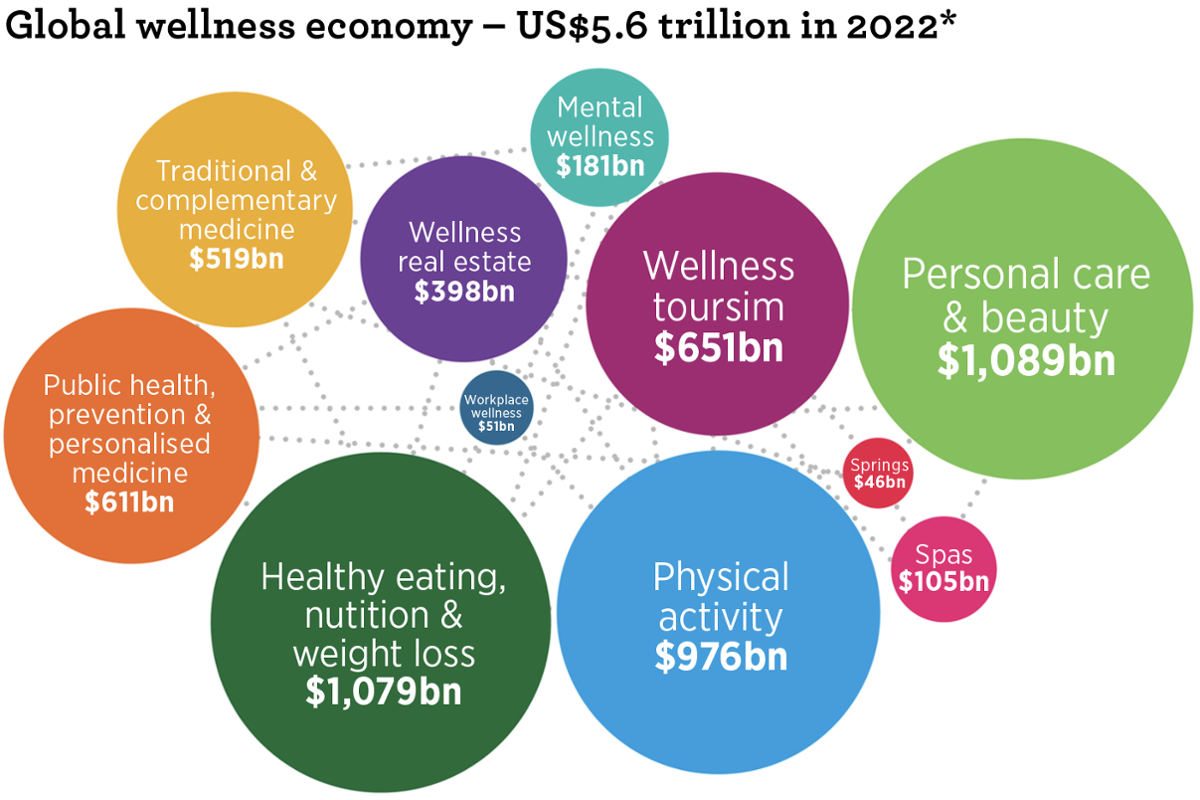
For the first time, the global wellness economy has exceeded US$5.6 trillion (€5.2 trillion, £4.4 trillion), and we’re predicting it will reach US$8.5 trillion (€7.9 trillion, £6.7 trillion) by 2027. These figures represent a major turnaround after COVID-19, which saw the market shrink from US$4.9 trillion (€4.5 trillion, £3.9 trillion) to US$4.5 trillion (€4.2 trillion, £3.5 trillion) – or 9.5 per cent – between 2019 and 2020.
It’s since grown by 26 per cent to reach its new peak of US$5.6 trillion (€5.2 trillion, £4.4 trillion) in 2022, and seven of the 11 wellness sectors exceeded their 2019, pre-pandemic values as of the end of 2022.
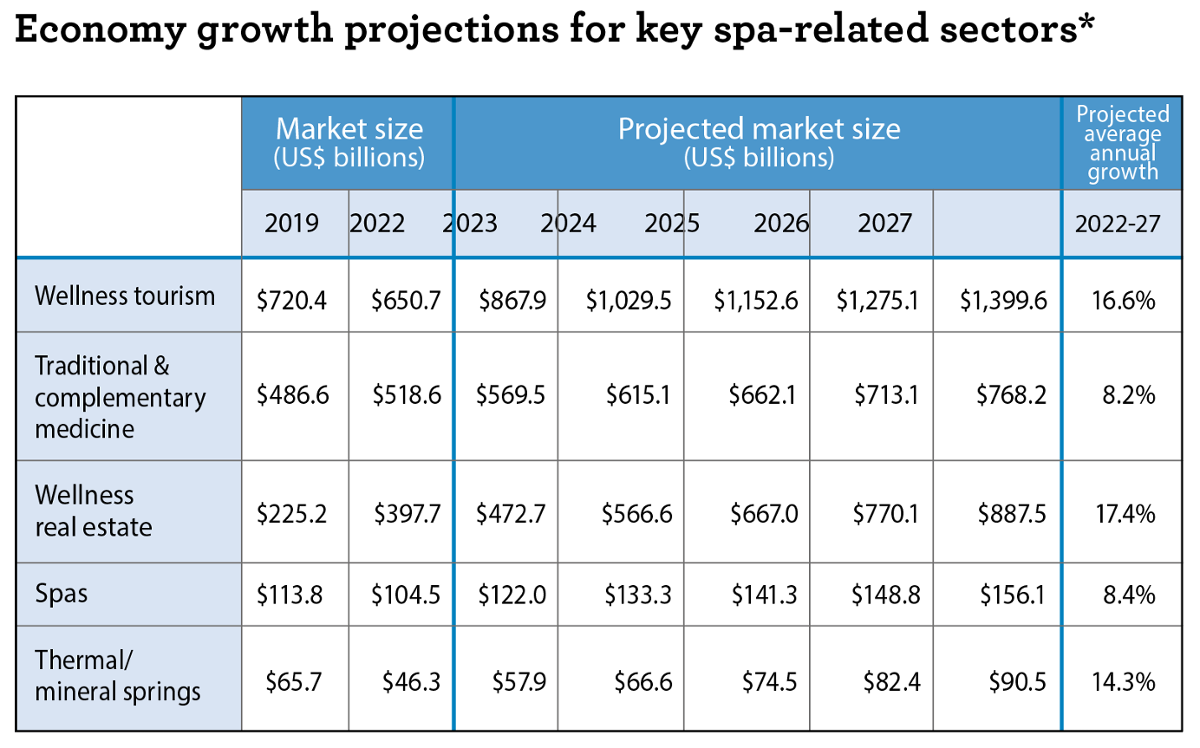
Spa-related sectors The traditional and complementary medicine sector increased by 15 per cent from 2020-2022 and is now worth US$518.6 billion (€483 billion, £408 billion). The global spa market is valued at US$104.5 billion (€97 billion, £82 billion) and thermal/mineral springs at US$46.3 billion (€43 billion, £36.4 billion).
While these sectors increased by 50 per cent and 16 per cent respectively from 2020 to 2022, they’re still behind their 2019 values.
Yet we predict that a full recovery for spas and thermal/mineral springs will be swift, increasing by 8.3 per cent and 14.3 per cent a year respectively in the next few years, given pent-up demand.
By 2027, we estimate that the spa industry will be worth US$156.1 billion (€145.1 billion, £122.6 billion) and thermal/mineral springs will generate US$90.5 billion (€84.1 billion, £71.1 billion).
Country rankings In a companion report, ‘The Global Wellness Economy: Country Rankings’, we’ve also ranked 145 countries by their wellness market size.
The five largest wellness markets are the US at US$1.8 trillion (€1.7 trillion, £1.4 trillion), China at US$790 billion (€734 billion, £621 billion), Germany at US$269 billion (€250 billion, £211 billion), Japan at US$241 billion (€224 billion, £189 billion) and the UK at US$224 billion (€208 billion, £176 billion). Just these Top 5 countries account for a staggering 59 per cent of the global wellness economy, while the top 10 largest markets represent 70 per cent of the global wellness economy, and the top 25 represent 86 per cent.
The countries in the Top 25 tend to be very rich countries – like Switzerland and Sweden – or very large countries by population – like China, Indonesia and Brazil. Some – like the US, Germany and Japan – are both large and rich.
The vast majority of the 25 largest wellness markets have seen robust recent growth; comparing market sizes in 2019 vs. 2022, 22 of 25 countries (except Thailand, Japan and Brazil) are now larger than they were pre-pandemic, when measured in US dollars. For some countries, like Japan and Brazil, currency depreciation has affected the measurements of their markets, and the performance of their wellness economies is stronger when measured in their local currencies.
Continental shift The global wellness industry is heavily concentrated in North America, which is valued at US$1.9 trillion (€1.8 trillion, £1.5 trillion), Asia-Pacific, valued at US$1.7 trillion (€1.6 trillion, £1.3 trillion), and Europe, valued at US$1.5 trillion (€1.4 trillion, £1.2 trillion), which together account for 90 per cent of the entire global wellness economy.
In 2022, North America surpassed Asia-Pacific to become the largest regional wellness economy, a shift due to slower growth and recovery in some major Asian markets, as well as prolonged restrictions and travel bans.
Post-pandemic recovery Almost all the Top-25 wellness markets have seen strong growth since the pandemic, with the UK, the Netherlands, the US, Mexico, Canada and Australia as standouts, surpassing their pre-pandemic market sizes by 120 per cent or more.
Globally, the wellness economy drives 5.6 per cent of total GDP — so, roughly 1 in every 20 “dollars” spent by consumers worldwide is on wellness. To put all this wellness spending in context, our research finds that annual, global per capita spending on wellness (US$706, €657, £555) is on par with consumer out-of-pocket spending on healthcare (US$711, €661, £559). At the regional level, per-capita wellness spending is higher than consumer out-of-pocket spending on healthcare across every region except North America. And wellness spending per capita is higher than spending on clothing/shoes (US$289, €269, £227) and hotels/restaurants (US$475, €442, £373) all across the world (based on Euromonitor data).
Wellness spending per capita Spending on wellness is (no surprise) highest in wealthy countries that also rank in the Top 25 for GDP per capita, including Switzerland, Iceland, the US, Austria and Australia. And those countries have seen significant recent growth in per capita wellness spending: in the US, that spend has risen to $5,321 (€4,949, £4,181)— and in Switzerland to $5,737 (€5,337, £4508) — in 2022.
While it may be surprising to see small countries like the Seychelles and Aruba so high on this list (the Maldives and the Bahamas also rank in the Top-25), it’s because these islands are major high-end wellness tourism destinations, with a huge portion (50-90 per cent) of their wellness spending coming from inbound wellness tourists rather than locals. The impact of the wellness market (heavily dominated by inbound wellness tourism) on these countries’ economies is staggering: in the Seychelles the wellness market accounts for 42.1 per cent of the total economy, while in the Maldives that number is 22.6 per cent.
Wellness and GDP Looking at regional data, the ratio of how much the wellness economy contributes to GDP is highest in North America (6.9 per cent) and Europe (5.8 per cent) — and lowest in the Middle East-North Africa region, at 3.3 per cent.
The wellness markets in North America, Europe, Asia-Pacific, and Latin America-Caribbean have all been growing faster than the overall economy from 2020-2022. Among the Top 25 wellness markets, some of the countries where wellness makes up a bigger percentage of GDP are the Philippines (10.1 per cent), Austria (9 per cent), the UK (7.3 per cent), the US (7 per cent) and South Korea (6.8 per cent).
The United States of wellness The US remains the undisputed goliath in wellness spending, with an annual market worth $1.8 trillion (€1.7 trillion, £1.4 trillion), and ranking first in nine of the 11 wellness sectors. It completely dwarfed the second largest market – China – by one trillion dollars, so you can say Americans really “hog” wellness products and services, considering that they take up about one-third of the global wellness market.
After taking a dip in 2020, the US wellness industry has grown rapidly in subsequent years, and now it is significantly bigger than before the pandemic. On a per capita level, Americans are spending more than $5,000 (€4,651, £3,950) a year on wellness. This spending now represents 7 per cent of the economy.
The US wellness industry is not only big but very diverse; in fact, the US has one of most diversified wellness economies in the world. It has many wellness sectors that are large and important – six of them valued at more than a hundred billion US dollars – but none of them dominate the wellness industry in the way that some small island nations are dominated by wellness tourism.
Final words As a companion to GWI’s well-known ‘Global Wellness Economy Monitor’, the ‘Global Wellness Economy: Country Rankings’ report provides detailed data on the size of the wellness economy for 145 countries from 2019 to 2022 and ranks them by their wellness market size.
For countries interested in growing their wellness economy, it’s crucial to know where they stand in this massive global industry. It’s also important to see how different countries’ wellness markets have responded to the impacts of the pandemic.
Credits: Global Wellness Institute, The Global Wellness Economy: Country Rankings (2019-2022), January 2024. Global Wellness Institute, Global Wellness Economy Monitor 2023, November 2023.
The Spa Life UK Convention returns from 21–23 June 2026 at Whittlebury Park Hotel, Spa &
Golf Resort, bringing together spa managers, directors and owners for two days of focused
education, meaningful connection and commercial insight. [more...]
Le Atelier by C.O.D.E. doesn't offer a standard bespoke service, it provides a highly
customised approach to designing massage beds and loungers in high-end wellness
environments. [more...]
+ More featured suppliers
COMPANY PROFILES
AKT Group
AKT Group is the Franco–Italian parent company of SKYY, C.O.D.E. and AKTMe, operating as an integrat [more...]
Beautylizer
Beautylizer brings
its deep aesthetic expertise and
strong R&D focus to holistic wellness,
offeri [more...]
The global wellness economy has exceeded US$5.6 trillion.
Katherine Johnston and Ophelia Yeung outline areas
of growth and regional differences from the 2023
Global Wellness Economy Monitor report
The global wellness economy will reach $8.5 trillion by 2027 / shutterstock/fokke baarssen
For the first time, the global wellness economy has exceeded US$5.6 trillion (€5.2 trillion, £4.4 trillion), and we’re predicting it will reach US$8.5 trillion (€7.9 trillion, £6.7 trillion) by 2027. These figures represent a major turnaround after COVID-19, which saw the market shrink from US$4.9 trillion (€4.5 trillion, £3.9 trillion) to US$4.5 trillion (€4.2 trillion, £3.5 trillion) – or 9.5 per cent – between 2019 and 2020.
It’s since grown by 26 per cent to reach its new peak of US$5.6 trillion (€5.2 trillion, £4.4 trillion) in 2022, and seven of the 11 wellness sectors exceeded their 2019, pre-pandemic values as of the end of 2022.
Spa-related sectors The traditional and complementary medicine sector increased by 15 per cent from 2020-2022 and is now worth US$518.6 billion (€483 billion, £408 billion). The global spa market is valued at US$104.5 billion (€97 billion, £82 billion) and thermal/mineral springs at US$46.3 billion (€43 billion, £36.4 billion).
While these sectors increased by 50 per cent and 16 per cent respectively from 2020 to 2022, they’re still behind their 2019 values.
Yet we predict that a full recovery for spas and thermal/mineral springs will be swift, increasing by 8.3 per cent and 14.3 per cent a year respectively in the next few years, given pent-up demand.
By 2027, we estimate that the spa industry will be worth US$156.1 billion (€145.1 billion, £122.6 billion) and thermal/mineral springs will generate US$90.5 billion (€84.1 billion, £71.1 billion).
Country rankings In a companion report, ‘The Global Wellness Economy: Country Rankings’, we’ve also ranked 145 countries by their wellness market size.
The five largest wellness markets are the US at US$1.8 trillion (€1.7 trillion, £1.4 trillion), China at US$790 billion (€734 billion, £621 billion), Germany at US$269 billion (€250 billion, £211 billion), Japan at US$241 billion (€224 billion, £189 billion) and the UK at US$224 billion (€208 billion, £176 billion). Just these Top 5 countries account for a staggering 59 per cent of the global wellness economy, while the top 10 largest markets represent 70 per cent of the global wellness economy, and the top 25 represent 86 per cent.
The countries in the Top 25 tend to be very rich countries – like Switzerland and Sweden – or very large countries by population – like China, Indonesia and Brazil. Some – like the US, Germany and Japan – are both large and rich.
The vast majority of the 25 largest wellness markets have seen robust recent growth; comparing market sizes in 2019 vs. 2022, 22 of 25 countries (except Thailand, Japan and Brazil) are now larger than they were pre-pandemic, when measured in US dollars. For some countries, like Japan and Brazil, currency depreciation has affected the measurements of their markets, and the performance of their wellness economies is stronger when measured in their local currencies.
Continental shift The global wellness industry is heavily concentrated in North America, which is valued at US$1.9 trillion (€1.8 trillion, £1.5 trillion), Asia-Pacific, valued at US$1.7 trillion (€1.6 trillion, £1.3 trillion), and Europe, valued at US$1.5 trillion (€1.4 trillion, £1.2 trillion), which together account for 90 per cent of the entire global wellness economy.
In 2022, North America surpassed Asia-Pacific to become the largest regional wellness economy, a shift due to slower growth and recovery in some major Asian markets, as well as prolonged restrictions and travel bans.
Post-pandemic recovery Almost all the Top-25 wellness markets have seen strong growth since the pandemic, with the UK, the Netherlands, the US, Mexico, Canada and Australia as standouts, surpassing their pre-pandemic market sizes by 120 per cent or more.
Globally, the wellness economy drives 5.6 per cent of total GDP — so, roughly 1 in every 20 “dollars” spent by consumers worldwide is on wellness. To put all this wellness spending in context, our research finds that annual, global per capita spending on wellness (US$706, €657, £555) is on par with consumer out-of-pocket spending on healthcare (US$711, €661, £559). At the regional level, per-capita wellness spending is higher than consumer out-of-pocket spending on healthcare across every region except North America. And wellness spending per capita is higher than spending on clothing/shoes (US$289, €269, £227) and hotels/restaurants (US$475, €442, £373) all across the world (based on Euromonitor data).
Wellness spending per capita Spending on wellness is (no surprise) highest in wealthy countries that also rank in the Top 25 for GDP per capita, including Switzerland, Iceland, the US, Austria and Australia. And those countries have seen significant recent growth in per capita wellness spending: in the US, that spend has risen to $5,321 (€4,949, £4,181)— and in Switzerland to $5,737 (€5,337, £4508) — in 2022.
While it may be surprising to see small countries like the Seychelles and Aruba so high on this list (the Maldives and the Bahamas also rank in the Top-25), it’s because these islands are major high-end wellness tourism destinations, with a huge portion (50-90 per cent) of their wellness spending coming from inbound wellness tourists rather than locals. The impact of the wellness market (heavily dominated by inbound wellness tourism) on these countries’ economies is staggering: in the Seychelles the wellness market accounts for 42.1 per cent of the total economy, while in the Maldives that number is 22.6 per cent.
Wellness and GDP Looking at regional data, the ratio of how much the wellness economy contributes to GDP is highest in North America (6.9 per cent) and Europe (5.8 per cent) — and lowest in the Middle East-North Africa region, at 3.3 per cent.
The wellness markets in North America, Europe, Asia-Pacific, and Latin America-Caribbean have all been growing faster than the overall economy from 2020-2022. Among the Top 25 wellness markets, some of the countries where wellness makes up a bigger percentage of GDP are the Philippines (10.1 per cent), Austria (9 per cent), the UK (7.3 per cent), the US (7 per cent) and South Korea (6.8 per cent).
The United States of wellness The US remains the undisputed goliath in wellness spending, with an annual market worth $1.8 trillion (€1.7 trillion, £1.4 trillion), and ranking first in nine of the 11 wellness sectors. It completely dwarfed the second largest market – China – by one trillion dollars, so you can say Americans really “hog” wellness products and services, considering that they take up about one-third of the global wellness market.
After taking a dip in 2020, the US wellness industry has grown rapidly in subsequent years, and now it is significantly bigger than before the pandemic. On a per capita level, Americans are spending more than $5,000 (€4,651, £3,950) a year on wellness. This spending now represents 7 per cent of the economy.
The US wellness industry is not only big but very diverse; in fact, the US has one of most diversified wellness economies in the world. It has many wellness sectors that are large and important – six of them valued at more than a hundred billion US dollars – but none of them dominate the wellness industry in the way that some small island nations are dominated by wellness tourism.
Final words As a companion to GWI’s well-known ‘Global Wellness Economy Monitor’, the ‘Global Wellness Economy: Country Rankings’ report provides detailed data on the size of the wellness economy for 145 countries from 2019 to 2022 and ranks them by their wellness market size.
For countries interested in growing their wellness economy, it’s crucial to know where they stand in this massive global industry. It’s also important to see how different countries’ wellness markets have responded to the impacts of the pandemic.
Credits: Global Wellness Institute, The Global Wellness Economy: Country Rankings (2019-2022), January 2024. Global Wellness Institute, Global Wellness Economy Monitor 2023, November 2023.
Mass protests have been taking place since Monday 1 June in Albania over the development of
a luxury resort by Donald Trump’s daughter Ivanka Trump and her husband Jared Kushner.
Global Wellness Day (GWD) marked its 15th anniversary on Saturday 13 June 2026, with the
theme: #JoyMagenta – a celebration of the healing qualities of simple gestures and activities
that spark joy.
Global luxury hospitality brand, Six Senses, has partnered with longevity healthcare provider,
HUM2N, to launch a clinic at Six Senses London, at The Whiteley.
As part of its first hotel partnership, Mayrlife – the medical health resort company known for its
site in Altaussee, Austria – has launched a day clinic at the Rosewood Vienna.
Premium London health club, KX Chelsea, will imminently unveil its most significant
redevelopment since its launch in 2002 to create an integrated wellness model combining
training, recovery and relaxation.
Rosewood Le Guanahani St Barth, on the northeast coast of Saint Barthélemy in the French
West Indies, is offering a programme of ocean-inspired yoga classes between 8-14 June to
celebrate Global Wellness Day (GWD).
Hotel de France, located on the British Isle of Jersey, has created a wellness retreat package
that includes a hot yoga session that will take place in Jersey Zoo’s butterfly sanctuary.
The Ritz-Carlton, Langkawi, in Malaysia, has revealed a schedule for Global Wellness Day
(GWD) that includes guided rainforest walks, mindful movement and guided coastal meditation
experiences.
Longevitix, a clinical platform for preventive and longevity medicine, has launched its AI-
powered intelligence system to help physicians deliver continuous, personalised longevity-
focused care at scale.
Atmantan Wellness Centre, an integrative wellness destination in Mulshi, near Pune in India, is
expanding its portfolio by adding a new centre in Hyderabad that will launch between 2028 and
2029.
The Spa Life UK Convention returns from 21–23 June 2026 at Whittlebury Park Hotel, Spa &
Golf Resort, bringing together spa managers, directors and owners for two days of focused
education, meaningful connection and commercial insight. [more...]
Le Atelier by C.O.D.E. doesn't offer a standard bespoke service, it provides a highly
customised approach to designing massage beds and loungers in high-end wellness
environments. [more...]
+ More featured suppliers
COMPANY PROFILES
AKT Group AKT Group is the Franco–Italian parent company of SKYY, C.O.D.E. and AKTMe, operating as an integrat [more...]