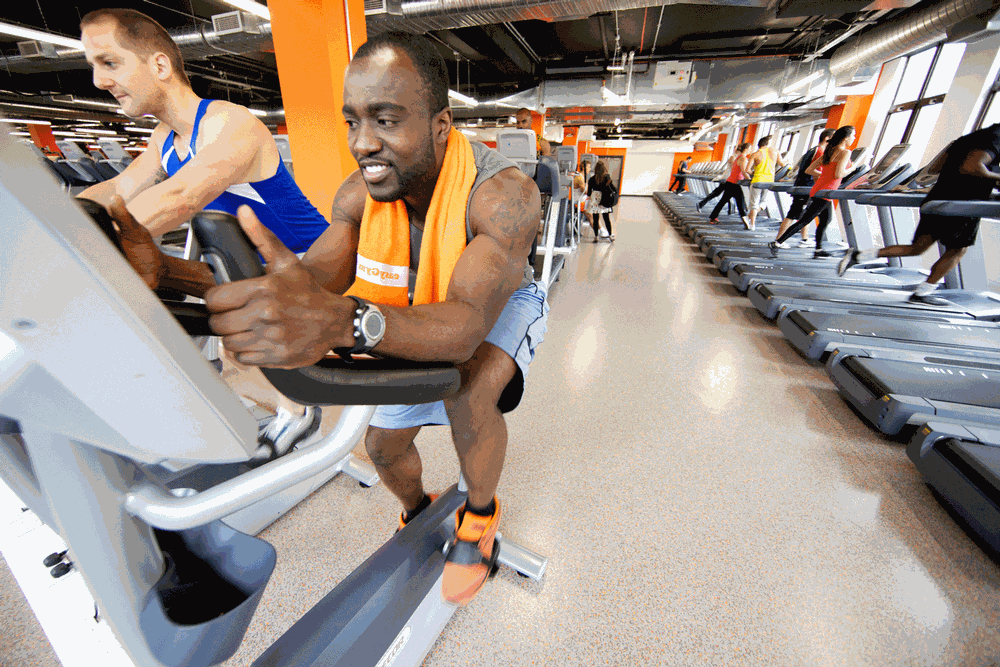
easyGym’s colour scheme fits well with the finding that bright colours in CV zones help raise the heart rate
Influences from within and outside the fitness sector – from brands such as Apple to TV programmes such as Grand Designs – mean consumers are now more design-conscious than ever before. Expectations of a health club or leisure centre are now much higher than they were 20 years ago, and a utilitarian approach is no longer enough. Even in the public sector, people now expect a private sector feel – even if they’re not prepared to pay the price.
But investing in a higher-end look and feel pays back, say the experts, who point out that an attractive club will encourage more people to join and spend time there – and if they like spending time there, they will inevitably spend more money. “We’ve found that a refurbishment at a tired, run-down facility can boost membership three- or fourfold,” says Martin Bransby, director at Pozzoni architects.
Indeed, Alliance Leisure spent £2.8m refurbishing Llantrissant Leisure Centre in South Wales in 2012. Subsequently, between December 2012 and September 2013, direct debit income increased by 109 per cent, and pay and play activity increased by 40 per cent.
First impressions So how can operators tap into member psychology when designing a facility? Psycle London, a premium cycling club due to open in London next month, considered this. Founder Colin Waggett says: “We wanted to break down both the psychological and physical barriers to exercise, so people have a positive frame of mind.
“The design has been inspired by hotels and restaurants more than health clubs. It has a London rough luxe feel: polished concrete, wood, white, some primary colours and bespoke items of furniture. Artists have been used for graphics and images.”
The reception area is light, bright and welcoming. Waggett says a common mistake clubs make is constructing physical barriers as soon as clients step into the building – for example, immediately presenting them with stairs, a turnstile or a booth-style reception. An open, welcoming, bright ground floor space is important and, if there needs to be a turnstile, it shouldn’t be the first thing people see.
“The journey through the club needs to be easy and logical,” adds Bransby. “The reception needs to be welcoming, so even if there has to be a barrier or turnstile, it still feels like a nice, open environment.”
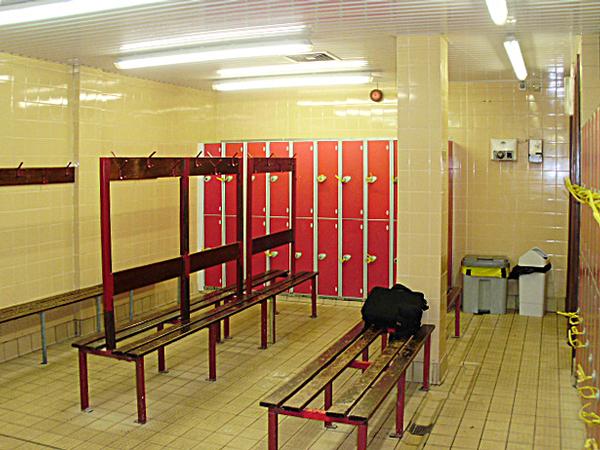
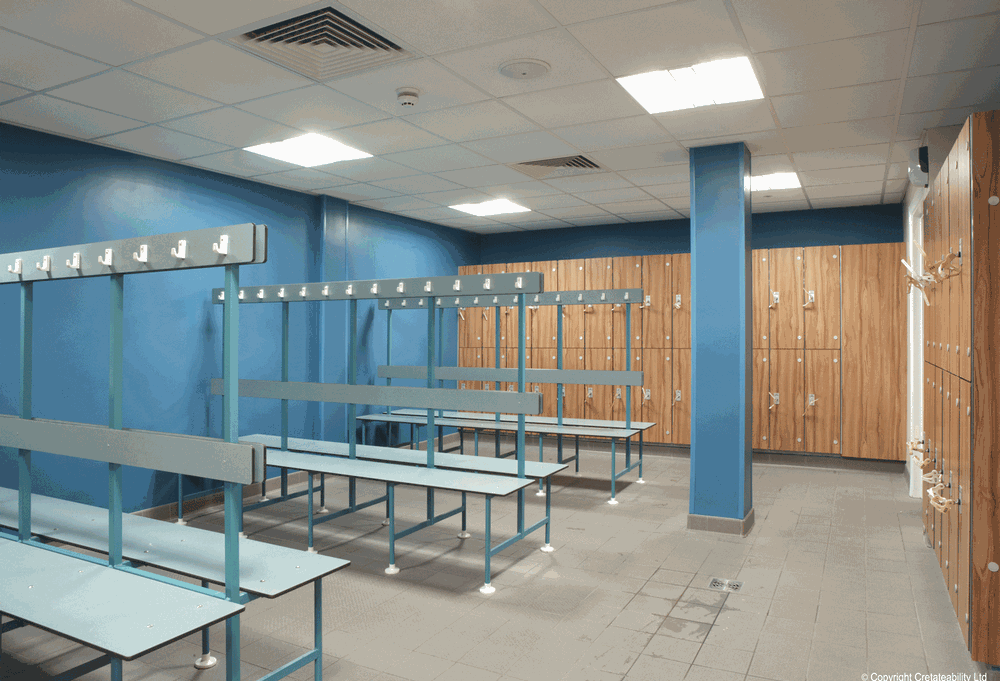
Changing rooms are also key. Pre-workout, they will form the basis of many people’s first impression of a club, and will set the member in the right – or wrong – mood for a good workout. After the workout, if people are happy showering at a facility rather than rushing off, a pleasant changing environment puts them in a relaxed ‘at home’ state of mind, potentially tempting them to stay for a juice or coffee.
Creating a buzz Clubs also need to exude a buzzy vibe to make people want to exercise. This can be created by offering glimpses into the exercise areas, such as the pool or gym, from the communal areas. Bransby advises against having exercise studios on show, as people can be self-conscious in dance classes, but believes group cycling studios are exciting spaces that make a good internal feature. An example of this is the Central YMCA club in London, where the group cycling studio has a curved internal glass wall, allowing the waiting class to get in the mood by watching the previous class.
Meanwhile Jon Griffiths, UK marketing manager for Precor – which has formed Activ Design to help clubs with their design – says colour is very important. Activ Design has studied a wealth of industry research from sources like IHRSA and ACSM, as well as observing how people move in locations like supermarkets and shopping centres.
“CV zones need to be bright, because it’s been shown that bright colours increase the heart rate and breathing,” says Griffiths. “Apparently using blue in the weights area will inspire people to lift heavier weights.”
He also warns against cramming in too much equipment and making the space too busy for people to want to work out: “Thirty-eight per cent of members stay because of the variety of kit, but 11 per cent leave because the gym’s overcrowded. Don’t make the club too full, and make sure there are areas to stretch, as 43 per cent of people say they go to health clubs in order to stay flexible.”
Griffiths adds that it’s important to make the most of the building’s assets to inspire people to want to work out. If there’s a good view, or a large window, place the treadmills – rather than the weights area – there.
Small touches Graham Bryant, project manager for the Llantrissant Leisure Centre project, believes members can be energised and inspired without it costing the earth or requiring a fundamental re-jig of a club layout: “Users are becoming more discerning and are expecting a private sector feel in a public sector facility. We often have to create a five-star feel with a two-star budget. People’s perception of public sector is that it’s poorly maintained and offers function over style, but we’ve raised the bar over the years to address how people feel in a facility. The right design team can achieve a £70/sq m look for £25/sq m.”
At Llantrissant, a wall of stripy wallpaper has been used in reception instead of paint, injecting style at a lower cost. Dominic Evans at PE Contracts also recommends being creative with walls: graffiti, wallpaper and vinyl prints are all effective without being expensive. “It’s important for the whole design to work together: floors, ceilings and walls,” he says. “People notice the overall design concept but not the nitty gritty. They don’t take too much notice of what the floor covering is, but rather the overall feel of the place.”
Creative psychology Ian Cotgrave, MD of Createability, agrees that inspiring and motivating design can be created within a budget, provided there’s ample creativity. “The current thinking is that clubs have to be bright, light, airy and contemporary,” he says. With its work for low-cost operator KISS Gyms, Createability created a look around its logo of a pair of lips. A colour palate of red, grey, black and white was used, and one of its clubs – a 836sq m (9,000sq ft) warehouse – features LED lighting to add ambience and colour wash the walls.
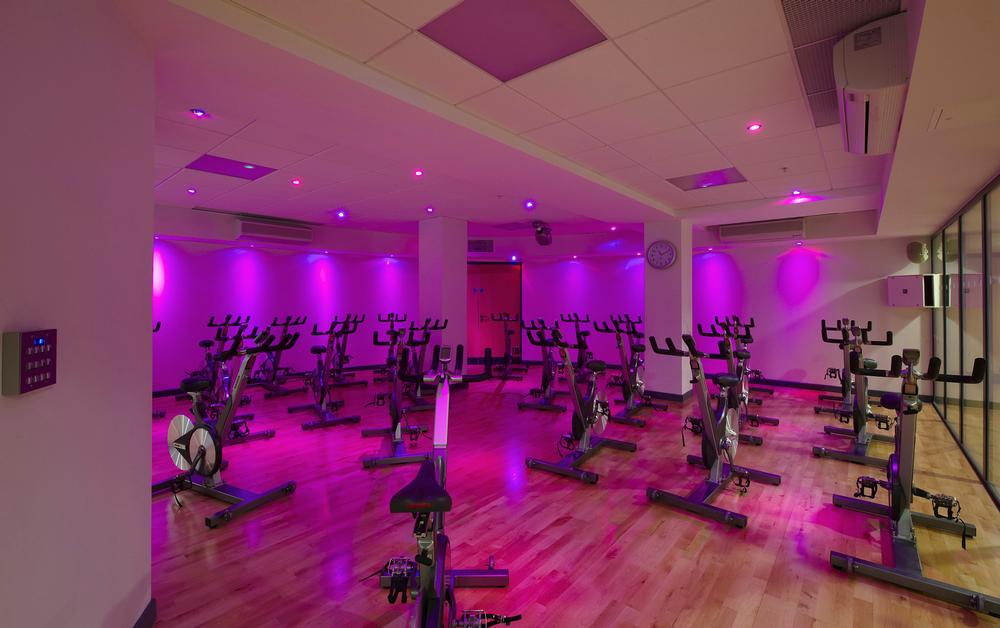
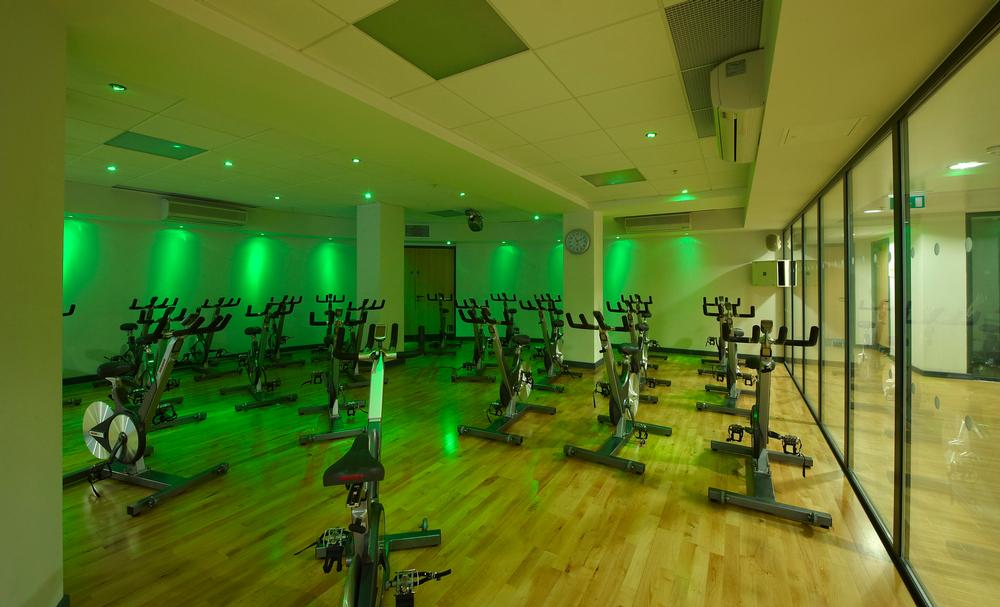
In fact, clever lighting is increasingly being used to influence members’ perceptions and create a feeling of quality. Accent lighting such as lights around mirrors can be effective, and for leisure centres, installing feature lighting in sports halls means they can double up as dance studios.
Mass Designers used lighting to enhance the five-star effect at premium PT facility Healthhaus, based in St Helier, Jersey. Contrast lighting, indirect lighting, pin spots (tightly controlled down-lights) and some unusual pendant lights have all been used to good effect.
Since the ethos at Healthhaus is to offer a personalised service, break-out areas have also been designed into the gym, providing a place for members to talk to PTs and gym instructors. Such design touches can help ensure members perceive the club to be collaborative and supportive, with plenty of opportunity for interaction.
Even if budgets are small, by understanding member expectations and psychology, clubs can use design and layout to enhance and influence the member experience throughout the fitness journey.
In today’s premium spa environment, every detail shapes the guest experience – right down to
the softness of towels and the freshness of linens. [more...]
+ More featured suppliers
COMPANY PROFILES
Cariitti Oy
Cariitti is a Finnish family business founded by Kari Ruokonen in 1998 that offers versatile lightin [more...]
Aquaform
With a rich heritage in the spa industry, Aquaform offers a diverse array of water wellness experien [more...]
easyGym’s colour scheme fits well with the finding that bright colours in CV zones help raise the heart rate
Influences from within and outside the fitness sector – from brands such as Apple to TV programmes such as Grand Designs – mean consumers are now more design-conscious than ever before. Expectations of a health club or leisure centre are now much higher than they were 20 years ago, and a utilitarian approach is no longer enough. Even in the public sector, people now expect a private sector feel – even if they’re not prepared to pay the price.
But investing in a higher-end look and feel pays back, say the experts, who point out that an attractive club will encourage more people to join and spend time there – and if they like spending time there, they will inevitably spend more money. “We’ve found that a refurbishment at a tired, run-down facility can boost membership three- or fourfold,” says Martin Bransby, director at Pozzoni architects.
Indeed, Alliance Leisure spent £2.8m refurbishing Llantrissant Leisure Centre in South Wales in 2012. Subsequently, between December 2012 and September 2013, direct debit income increased by 109 per cent, and pay and play activity increased by 40 per cent.
First impressions So how can operators tap into member psychology when designing a facility? Psycle London, a premium cycling club due to open in London next month, considered this. Founder Colin Waggett says: “We wanted to break down both the psychological and physical barriers to exercise, so people have a positive frame of mind.
“The design has been inspired by hotels and restaurants more than health clubs. It has a London rough luxe feel: polished concrete, wood, white, some primary colours and bespoke items of furniture. Artists have been used for graphics and images.”
The reception area is light, bright and welcoming. Waggett says a common mistake clubs make is constructing physical barriers as soon as clients step into the building – for example, immediately presenting them with stairs, a turnstile or a booth-style reception. An open, welcoming, bright ground floor space is important and, if there needs to be a turnstile, it shouldn’t be the first thing people see.
“The journey through the club needs to be easy and logical,” adds Bransby. “The reception needs to be welcoming, so even if there has to be a barrier or turnstile, it still feels like a nice, open environment.”
Changing rooms are also key. Pre-workout, they will form the basis of many people’s first impression of a club, and will set the member in the right – or wrong – mood for a good workout. After the workout, if people are happy showering at a facility rather than rushing off, a pleasant changing environment puts them in a relaxed ‘at home’ state of mind, potentially tempting them to stay for a juice or coffee.
Creating a buzz Clubs also need to exude a buzzy vibe to make people want to exercise. This can be created by offering glimpses into the exercise areas, such as the pool or gym, from the communal areas. Bransby advises against having exercise studios on show, as people can be self-conscious in dance classes, but believes group cycling studios are exciting spaces that make a good internal feature. An example of this is the Central YMCA club in London, where the group cycling studio has a curved internal glass wall, allowing the waiting class to get in the mood by watching the previous class.
Meanwhile Jon Griffiths, UK marketing manager for Precor – which has formed Activ Design to help clubs with their design – says colour is very important. Activ Design has studied a wealth of industry research from sources like IHRSA and ACSM, as well as observing how people move in locations like supermarkets and shopping centres.
“CV zones need to be bright, because it’s been shown that bright colours increase the heart rate and breathing,” says Griffiths. “Apparently using blue in the weights area will inspire people to lift heavier weights.”
He also warns against cramming in too much equipment and making the space too busy for people to want to work out: “Thirty-eight per cent of members stay because of the variety of kit, but 11 per cent leave because the gym’s overcrowded. Don’t make the club too full, and make sure there are areas to stretch, as 43 per cent of people say they go to health clubs in order to stay flexible.”
Griffiths adds that it’s important to make the most of the building’s assets to inspire people to want to work out. If there’s a good view, or a large window, place the treadmills – rather than the weights area – there.
Small touches Graham Bryant, project manager for the Llantrissant Leisure Centre project, believes members can be energised and inspired without it costing the earth or requiring a fundamental re-jig of a club layout: “Users are becoming more discerning and are expecting a private sector feel in a public sector facility. We often have to create a five-star feel with a two-star budget. People’s perception of public sector is that it’s poorly maintained and offers function over style, but we’ve raised the bar over the years to address how people feel in a facility. The right design team can achieve a £70/sq m look for £25/sq m.”
At Llantrissant, a wall of stripy wallpaper has been used in reception instead of paint, injecting style at a lower cost. Dominic Evans at PE Contracts also recommends being creative with walls: graffiti, wallpaper and vinyl prints are all effective without being expensive. “It’s important for the whole design to work together: floors, ceilings and walls,” he says. “People notice the overall design concept but not the nitty gritty. They don’t take too much notice of what the floor covering is, but rather the overall feel of the place.”
Creative psychology Ian Cotgrave, MD of Createability, agrees that inspiring and motivating design can be created within a budget, provided there’s ample creativity. “The current thinking is that clubs have to be bright, light, airy and contemporary,” he says. With its work for low-cost operator KISS Gyms, Createability created a look around its logo of a pair of lips. A colour palate of red, grey, black and white was used, and one of its clubs – a 836sq m (9,000sq ft) warehouse – features LED lighting to add ambience and colour wash the walls.
In fact, clever lighting is increasingly being used to influence members’ perceptions and create a feeling of quality. Accent lighting such as lights around mirrors can be effective, and for leisure centres, installing feature lighting in sports halls means they can double up as dance studios.
Mass Designers used lighting to enhance the five-star effect at premium PT facility Healthhaus, based in St Helier, Jersey. Contrast lighting, indirect lighting, pin spots (tightly controlled down-lights) and some unusual pendant lights have all been used to good effect.
Since the ethos at Healthhaus is to offer a personalised service, break-out areas have also been designed into the gym, providing a place for members to talk to PTs and gym instructors. Such design touches can help ensure members perceive the club to be collaborative and supportive, with plenty of opportunity for interaction.
Even if budgets are small, by understanding member expectations and psychology, clubs can use design and layout to enhance and influence the member experience throughout the fitness journey.
People taking GLP-1 weight loss medications such as Ozempic, Wegovy, Mounjaro and Zepbound
may be losing weight, but they’re also becoming less physically active, according to new
research presented at the ENDO 2026 annual meeting of the Endocrine Society
Abu Dhabi-based investment firm Mubadala Capital has made a binding, fully financed
€1 billion
offer to acquire Pierre and Vacances SA, the European holiday resort operator behind the
continental European Center Parcs business.
Global retreat trade show, Synergy The Retreat Show, has launched a resource called The
Source, which hosts an open-access online Transformation Series programme.
The Standards Authority for Touch in Cancer Care (SATCC) charity has announced its first five-
day Living with Cancer and Beyond retreat, which will be held at Carden Park Hotel and Spa in
Cheshire, UK, between 1 and 5 September.
Patmos Aktis, a Luxury Collection Resort and Spa, has opened in Greece, with a renovated and
rebranded wellness offering called Ansana Wellness and Spa.
The Mauna Kea Beach Hotel, an Autograph Collection property in Hawaii, US, has opened its
22,000 sq ft indoor-outdoor Spa at Mauna Kea as the final step in the property’s overall
renovation, which has cost more than US$180 million (€166 million, £140 mill
The UK spa review and discovery platform for consumers, the Good Spa Guide, has announced
it will host the Good Spa Guide Awards 2026 during an event on 16 November at Sopwell House
Hotel in St Albans, UK.
Eighty-four per cent of consumers now say wellness is a top priority in their lives, with this
percentage increasing year on year, according to a preview presentation of McKinsey’s Future of
Wellness 2026 research report.
Mass protests have been taking place since Monday 1 June in Albania over the development of
a luxury resort by Donald Trump’s daughter Ivanka Trump and her husband Jared Kushner.
Global Wellness Day (GWD) marked its 15th anniversary on Saturday 13 June 2026, with the
theme: #JoyMagenta – a celebration of the healing qualities of simple gestures and activities
that spark joy.
In today’s premium spa environment, every detail shapes the guest experience – right down to
the softness of towels and the freshness of linens. [more...]
+ More featured suppliers
COMPANY PROFILES
Cariitti Oy Cariitti is a Finnish family business founded by Kari Ruokonen in 1998 that offers versatile lightin [more...]