When a political opposition praises a new government strategy it's a sign it's achieved consensus. Sporting Future: A New Strategy for an Active Nation is a masterful piece of work which will change the wellbeing of the nation and see sport take its rightful place in the wider health agenda
By Liz Terry | Published in Sports Management 2015 issue 4
What a journey sport has been on over the last 50 years: from amateur to professional and from the private school to the mainstream. It's been quite a ride and we've essentially seen it democratised.
Now sport is taking another giant evolutionary leap forward and joining the mainstream health and social agendas with the publication of the government’s report, Sporting Future: A New Strategy for an Active Nation, which lays out plans for the sector.
Most policy documents do little more than gather dust, but once in a generation one comes along which is so in tune with the needs of the times it’s both a game changer and a breath of fresh air. This is such a report. It's ambitious, thorough, inclusive and clear thinking.
First observation is that Sporting Future has achieved a high degree of consensus by identifying issues and solutions which can be endorsed by the industry and the main political parties: the shadow sports minister was complimentary and both Labour and Lib Dems will see some of their best ideas have filtered in via the extensive consultation process.
In the foreword, sports minister, Tracey Crouch, says the strategy has the aspiration to achieve five simple but fundamental outcomes for the nation – nothing less than "physical health, mental health, individual development, social and community development and economic development."
This broad remit places sport firmly at the heart of the nation's wellness agenda and throughout Sporting Future, reference is made to collaboration with a wide range of government departments, private sector partners and quangos, including health and business. It also has social change at its heart.
Everything will be measured and the ways we measure will evolve, with Sport England's behaviour change methodologies being extended to a national scale and new measures being developed in areas such as the impact of sport on mental health.
The Active People research will become Active Lives and be rebuilt to represent a broader definition of activity. Crouch says the outcomes "will define who and what we fund."
So there’s huge change ahead. It will no longer be a given that established bodies will get funding if they fail to make a difference, while other organisations – even outside conventional sport – which prove they're driving positive behaviour change and social good in the target populations, will get it instead.
Sport England has retained pretty much all its funding (£1.40bn vs the existing £1.47bn), so the money's there to make things happen, although some councils facing cuts will need to prioritise when delivering on the vision of Sporting Future.
One of the most exciting announcements is a Sport England focus on physical activity from the age of five to 18 (currently 14-18). This will get children into good exercise habits at a critical stage in their development and must be delivered in partnership with schools if it is to succeed.
Read the report – it's stuffed full of good things which are far too many for the space I have here: a new Sports Business Council, the revival of the Sport Cabinet of nations, the focus on mental health, the endorsement of CIMSPA as the lead body for the 'sports workforce', knowledge transfer between Olympic and non-Olympic sports, funding for kids' cycling – it's a long list.
Hats off to ukActive, whose pivot to wellness and activity has undoubtedly helped this change along and congratulations to everyone involved in making Sporting Future – it's wonderful.
What can we do with a policy like this, a supportive government and the best of ourselves? We can do a great deal of good.
In the fast-paced world of fitness and wellness, where high-intensity workouts push us to
our limits and the sweat pours, the importance of efficient recovery cannot be overstated. [more...]
+ More featured suppliers
COMPANY PROFILES
Elemental Herbology
Founded in 2008 by a Traditional Chinese Medicine Practitioner, Elemental Herbology is a spa, retail [more...]
Bellezi
Founded in 2009 as a Dutch family business, Bellezi brings more than 20 years of experience in treat [more...]
When a political opposition praises a new government strategy it's a sign it's achieved consensus. Sporting Future: A New Strategy for an Active Nation is a masterful piece of work which will change the wellbeing of the nation and see sport take its rightful place in the wider health agenda
By Liz Terry | Published in Sports Management 2015 issue 4
What a journey sport has been on over the last 50 years: from amateur to professional and from the private school to the mainstream. It's been quite a ride and we've essentially seen it democratised.
Now sport is taking another giant evolutionary leap forward and joining the mainstream health and social agendas with the publication of the government’s report, Sporting Future: A New Strategy for an Active Nation, which lays out plans for the sector.
Most policy documents do little more than gather dust, but once in a generation one comes along which is so in tune with the needs of the times it’s both a game changer and a breath of fresh air. This is such a report. It's ambitious, thorough, inclusive and clear thinking.
First observation is that Sporting Future has achieved a high degree of consensus by identifying issues and solutions which can be endorsed by the industry and the main political parties: the shadow sports minister was complimentary and both Labour and Lib Dems will see some of their best ideas have filtered in via the extensive consultation process.
In the foreword, sports minister, Tracey Crouch, says the strategy has the aspiration to achieve five simple but fundamental outcomes for the nation – nothing less than "physical health, mental health, individual development, social and community development and economic development."
This broad remit places sport firmly at the heart of the nation's wellness agenda and throughout Sporting Future, reference is made to collaboration with a wide range of government departments, private sector partners and quangos, including health and business. It also has social change at its heart.
Everything will be measured and the ways we measure will evolve, with Sport England's behaviour change methodologies being extended to a national scale and new measures being developed in areas such as the impact of sport on mental health.
The Active People research will become Active Lives and be rebuilt to represent a broader definition of activity. Crouch says the outcomes "will define who and what we fund."
So there’s huge change ahead. It will no longer be a given that established bodies will get funding if they fail to make a difference, while other organisations – even outside conventional sport – which prove they're driving positive behaviour change and social good in the target populations, will get it instead.
Sport England has retained pretty much all its funding (£1.40bn vs the existing £1.47bn), so the money's there to make things happen, although some councils facing cuts will need to prioritise when delivering on the vision of Sporting Future.
One of the most exciting announcements is a Sport England focus on physical activity from the age of five to 18 (currently 14-18). This will get children into good exercise habits at a critical stage in their development and must be delivered in partnership with schools if it is to succeed.
Read the report – it's stuffed full of good things which are far too many for the space I have here: a new Sports Business Council, the revival of the Sport Cabinet of nations, the focus on mental health, the endorsement of CIMSPA as the lead body for the 'sports workforce', knowledge transfer between Olympic and non-Olympic sports, funding for kids' cycling – it's a long list.
Hats off to ukActive, whose pivot to wellness and activity has undoubtedly helped this change along and congratulations to everyone involved in making Sporting Future – it's wonderful.
What can we do with a policy like this, a supportive government and the best of ourselves? We can do a great deal of good.
Mass protests have been taking place since Monday 1 June in Albania over the development of
a luxury resort by Donald Trump’s daughter Ivanka Trump and her husband Jared Kushner.
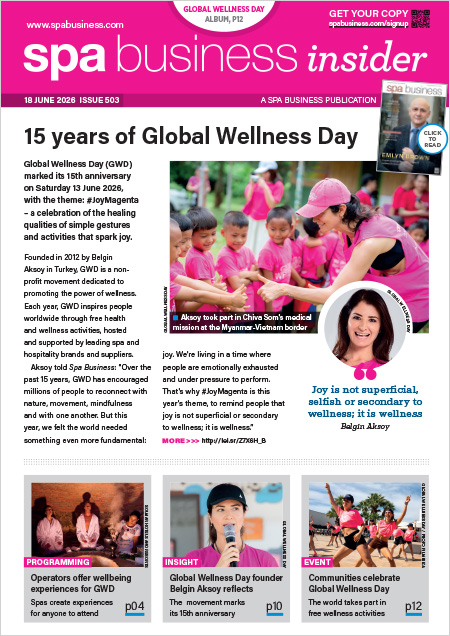
Global Wellness Day (GWD) marked its 15th anniversary on Saturday 13 June 2026, with the
theme: #JoyMagenta – a celebration of the healing qualities of simple gestures and activities
that spark joy.
Global luxury hospitality brand, Six Senses, has partnered with longevity healthcare provider,
HUM2N, to launch a clinic at Six Senses London, at The Whiteley.
As part of its first hotel partnership, Mayrlife – the medical health resort company known for its
site in Altaussee, Austria – has launched a day clinic at the Rosewood Vienna.
Premium London health club, KX Chelsea, will imminently unveil its most significant
redevelopment since its launch in 2002 to create an integrated wellness model combining
training, recovery and relaxation.
Rosewood Le Guanahani St Barth, on the northeast coast of Saint Barthélemy in the French
West Indies, is offering a programme of ocean-inspired yoga classes between 8-14 June to
celebrate Global Wellness Day (GWD).
Hotel de France, located on the British Isle of Jersey, has created a wellness retreat package
that includes a hot yoga session that will take place in Jersey Zoo’s butterfly sanctuary.
The Ritz-Carlton, Langkawi, in Malaysia, has revealed a schedule for Global Wellness Day
(GWD) that includes guided rainforest walks, mindful movement and guided coastal meditation
experiences.
Longevitix, a clinical platform for preventive and longevity medicine, has launched its AI-
powered intelligence system to help physicians deliver continuous, personalised longevity-
focused care at scale.
Atmantan Wellness Centre, an integrative wellness destination in Mulshi, near Pune in India, is
expanding its portfolio by adding a new centre in Hyderabad that will launch between 2028 and
2029.
In the fast-paced world of fitness and wellness, where high-intensity workouts push us to
our limits and the sweat pours, the importance of efficient recovery cannot be overstated. [more...]
+ More featured suppliers
COMPANY PROFILES
Elemental Herbology Founded in 2008 by a Traditional Chinese Medicine Practitioner, Elemental Herbology is a spa, retail [more...]