In the first ever industry benchmark report for wellness spas,
Intelligent Spas finds the niche industry poised for growth – and generating more revenue than industry averages. Julie Garrow shares more
By Julie Garrow | Published in Spa Business Handbook 2017 issue 1
The first ever industry benchmark report for wellness spas revealed that wellness spas employ more people, attract a bigger percentage of local residents, and generate more revenue per square metre or square foot compared with all spa types on average.
Produced by independent research company Intelligent Spas, the Wellness Spas Benchmark Report involved a group of 16 selected spas across Europe, Africa, the Middle East and Asia, with an average size of 3,026sq m (32,570sq ft). For the purposes of the research, Intelligent Spas defined a wellness spa as offering a variety of spa treatments and packages incorporating wellness attributes; health and fitness-related services, classes and consultations; and an emphasis on wellness throughout its branding.
How are wellness spas performing financially? The annual revenue generated in the past financial year averaged US$1.3m (€1.2m, £1m), compared with the industry average of US$690,000 (€635,500, £548,000). On average, 67 per cent of wellness spas’ revenue was generated by treatments, with 4 per cent coming from retail sales.
Annual revenue per square metre was US$857 (€794, £687). And annual expenses per spa amounted to just over 40 per cent of revenue. Wellness spas retained an average of 20.3 employees, significantly higher than the industry average of 14 spa employees retained.
Who visits wellness spas? Wellness spas welcomed 9,526 guests on average during the past financial year, 46 per cent of whom were return visitors. The gender distribution of those visitors is fairly close, with 56 per cent of visitors being women and 44 per cent being men. This is slightly different from the gender split between visitors to the average spa, where 41 per cent are men and 59 per cent are women.
The largest market segment by age for wellness spas was also quite young, with the coveted 30- to 39-year-old range coming in on top. On average, 63 per cent of wellness spa visitors were local residents and 22 per cent were international tourists, compared with 50 per cent and 27 per cent, respectively, in industry averages. At hotels and resorts, 37 per cent of spa visits were captured from guests staying at the property co-located with the wellness spa.
What does a wellness hotel achieve? On average, hotels offering wellness spas contain 209 bedrooms and achieved 63 per cent average annual occupancy during the past financial year, with an average daily rate of US$401 (€372, £322). Revenue per available room (RevPAR) for wellness spas was US$159 (€147, £128).
More hotel groups are incorporating wellness spas into their offering, and these new statistics help them better plan and implement the spa facility as a revenue-generating department, as opposed to an assumed, must-have cost centre. A detailed campaign is required to continually entice hotel guests to the spa, thus increasing RevPAR for the hotel business, while generating guest loyalty by providing spa and wellness options.
What is the unique selling proposition of wellness spas? This was the first time Intelligent Spas incorporated a question about unique selling propositions (USPs) in its spa benchmark survey. This helped us to correctly categorise wellness spas, plus reminded respondents why their spa is special, which helps when promoting their spa in competitive markets. The majority of survey respondents stated their wellness treatments and facilities strongly contributed to their USP.
• 62 per cent of wellness spas offered a hammam or a hammam-style treatment
• 67 per cent offered a relaxing bath experience
• 53 per cent provided consultations for medical-related services, being either conventional and/or complementary
• 80 per cent of spas surveyed stated they offered separate relaxation rooms for females and males
• 94 per cent of spas had a steam room
• 82 per cent provided a sauna
• 67 per cent of spas were designed with a private consultation room
Creating a spa menu that features a range of wellness-inspired experiences is critical to a facility being classified as a wellness spa. Additionally, offering a variety of options, including water experiences and various relaxation areas, is necessary for the physical design of a wellness spa. Relevant marketing items – for example, website content and images – as well as wellness-related campaigns, must be designed to support and reflect the overall wellness concept of the spa.
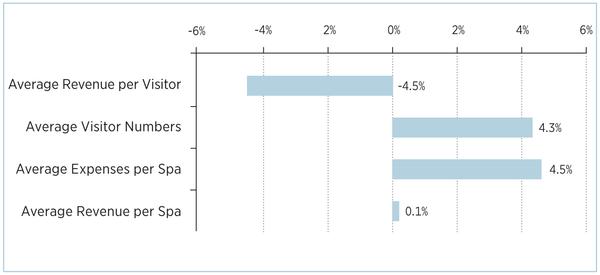
Outlook for 2017 It looks like an eventful year ahead for wellness spas, as many of the key indicators are predicted to fluctuate. Despite more demand for wellness services – with average visitor numbers forecast to increase by 4.3 per cent per spa – owners and managers of wellness spas believe average revenue per guest could drop by 4.5 per cent. Average revenue per spa is forecast to be stable; however, the number of employees required to operate a wellness spa is set to increase by 4.3 per cent, driving total expenses up by 4.5 per cent year-on-year.
Wellness spas, not dissimilar to any spa type, may manage constant changes in key benchmarks by regularly monitoring them, which enables timely action to be taken to correct areas of the business which need slight improvement. Also, benchmarking gives owners and managers time to pivot the business when it experiences a major disruption, such as a new spa entering their marketplace.
How do wellness spas stack up? Financial Benchmarks (US$) Annual Revenue per Spa 1.3 M Revenue Breakdown - Treatments 67% Revenue Breakdown - Retail 4% Annual Revenue per Square Metre 875 Annual Expenses as a % of Revenue 42% Average Employees 20.3
Visitor Benchmarks Annual Spa Visitors 9,526 Repeat Visitation Rate 46% Females 56% Males 44% Top Age 30-39 Local Residents 63% International Tourists 22% Visits Captured from Hotel/Resort 37%
Hotel Benchmarks (US$) Number of Guest Rooms 209 Average Annual Occupancy 63% Average Daily Rate 401 Revenue per Available Room 159
Wellness spas: Outlook for 2017 *Source: Intelligent Spas
About the author:
Julie Garrow
Julie Garrow, founder and MD of Intelligent Spas, has over 20 years of experience in tourism, hospitality and leisure research. Since 2001, she’s focused on the spa industry and consumer research and has authored a range of spa operations and training manuals.
Le Atelier by C.O.D.E. doesn't offer a standard bespoke service, it provides a highly
customised approach to designing massage beds and loungers in high-end wellness
environments. [more...]
In today’s premium spa environment, every detail shapes the guest experience – right down to
the softness of towels and the freshness of linens. [more...]
+ More featured suppliers
COMPANY PROFILES
Elemis
Elemis was founded in London in 1989 by Linda Steiner whose vision was to create a skincare range as [more...]
Knesko Skin
Known for their unique approach to wellness and beauty, Knesko’s products combine ancient healing tr [more...]
In the first ever industry benchmark report for wellness spas,
Intelligent Spas finds the niche industry poised for growth – and generating more revenue than industry averages. Julie Garrow shares more
By Julie Garrow | Published in Spa Business Handbook 2017 issue 1
The first ever industry benchmark report for wellness spas revealed that wellness spas employ more people, attract a bigger percentage of local residents, and generate more revenue per square metre or square foot compared with all spa types on average.
Produced by independent research company Intelligent Spas, the Wellness Spas Benchmark Report involved a group of 16 selected spas across Europe, Africa, the Middle East and Asia, with an average size of 3,026sq m (32,570sq ft). For the purposes of the research, Intelligent Spas defined a wellness spa as offering a variety of spa treatments and packages incorporating wellness attributes; health and fitness-related services, classes and consultations; and an emphasis on wellness throughout its branding.
How are wellness spas performing financially? The annual revenue generated in the past financial year averaged US$1.3m (€1.2m, £1m), compared with the industry average of US$690,000 (€635,500, £548,000). On average, 67 per cent of wellness spas’ revenue was generated by treatments, with 4 per cent coming from retail sales.
Annual revenue per square metre was US$857 (€794, £687). And annual expenses per spa amounted to just over 40 per cent of revenue. Wellness spas retained an average of 20.3 employees, significantly higher than the industry average of 14 spa employees retained.
Who visits wellness spas? Wellness spas welcomed 9,526 guests on average during the past financial year, 46 per cent of whom were return visitors. The gender distribution of those visitors is fairly close, with 56 per cent of visitors being women and 44 per cent being men. This is slightly different from the gender split between visitors to the average spa, where 41 per cent are men and 59 per cent are women.
The largest market segment by age for wellness spas was also quite young, with the coveted 30- to 39-year-old range coming in on top. On average, 63 per cent of wellness spa visitors were local residents and 22 per cent were international tourists, compared with 50 per cent and 27 per cent, respectively, in industry averages. At hotels and resorts, 37 per cent of spa visits were captured from guests staying at the property co-located with the wellness spa.
What does a wellness hotel achieve? On average, hotels offering wellness spas contain 209 bedrooms and achieved 63 per cent average annual occupancy during the past financial year, with an average daily rate of US$401 (€372, £322). Revenue per available room (RevPAR) for wellness spas was US$159 (€147, £128).
More hotel groups are incorporating wellness spas into their offering, and these new statistics help them better plan and implement the spa facility as a revenue-generating department, as opposed to an assumed, must-have cost centre. A detailed campaign is required to continually entice hotel guests to the spa, thus increasing RevPAR for the hotel business, while generating guest loyalty by providing spa and wellness options.
What is the unique selling proposition of wellness spas? This was the first time Intelligent Spas incorporated a question about unique selling propositions (USPs) in its spa benchmark survey. This helped us to correctly categorise wellness spas, plus reminded respondents why their spa is special, which helps when promoting their spa in competitive markets. The majority of survey respondents stated their wellness treatments and facilities strongly contributed to their USP.
• 62 per cent of wellness spas offered a hammam or a hammam-style treatment
• 67 per cent offered a relaxing bath experience
• 53 per cent provided consultations for medical-related services, being either conventional and/or complementary
• 80 per cent of spas surveyed stated they offered separate relaxation rooms for females and males
• 94 per cent of spas had a steam room
• 82 per cent provided a sauna
• 67 per cent of spas were designed with a private consultation room
Creating a spa menu that features a range of wellness-inspired experiences is critical to a facility being classified as a wellness spa. Additionally, offering a variety of options, including water experiences and various relaxation areas, is necessary for the physical design of a wellness spa. Relevant marketing items – for example, website content and images – as well as wellness-related campaigns, must be designed to support and reflect the overall wellness concept of the spa.
Outlook for 2017 It looks like an eventful year ahead for wellness spas, as many of the key indicators are predicted to fluctuate. Despite more demand for wellness services – with average visitor numbers forecast to increase by 4.3 per cent per spa – owners and managers of wellness spas believe average revenue per guest could drop by 4.5 per cent. Average revenue per spa is forecast to be stable; however, the number of employees required to operate a wellness spa is set to increase by 4.3 per cent, driving total expenses up by 4.5 per cent year-on-year.
Wellness spas, not dissimilar to any spa type, may manage constant changes in key benchmarks by regularly monitoring them, which enables timely action to be taken to correct areas of the business which need slight improvement. Also, benchmarking gives owners and managers time to pivot the business when it experiences a major disruption, such as a new spa entering their marketplace.
How do wellness spas stack up? Financial Benchmarks (US$) Annual Revenue per Spa 1.3 M Revenue Breakdown - Treatments 67% Revenue Breakdown - Retail 4% Annual Revenue per Square Metre 875 Annual Expenses as a % of Revenue 42% Average Employees 20.3
Visitor Benchmarks Annual Spa Visitors 9,526 Repeat Visitation Rate 46% Females 56% Males 44% Top Age 30-39 Local Residents 63% International Tourists 22% Visits Captured from Hotel/Resort 37%
Hotel Benchmarks (US$) Number of Guest Rooms 209 Average Annual Occupancy 63% Average Daily Rate 401 Revenue per Available Room 159
Wellness spas: Outlook for 2017 *Source: Intelligent Spas
About the author:
Julie Garrow
Julie Garrow, founder and MD of Intelligent Spas, has over 20 years of experience in tourism, hospitality and leisure research. Since 2001, she’s focused on the spa industry and consumer research and has authored a range of spa operations and training manuals.
The UK spa review and discovery platform for consumers, the Good Spa Guide, has announced
it will host the Good Spa Guide Awards 2026 during an event on 16 November at Sopwell House
Hotel in St Albans, UK.
Eighty-four per cent of consumers now say wellness is a top priority in their lives, with this
percentage increasing year on year, according to a preview presentation of McKinsey’s Future of
Wellness 2026 research report.
Mass protests have been taking place since Monday 1 June in Albania over the development of
a luxury resort by Donald Trump’s daughter Ivanka Trump and her husband Jared Kushner.
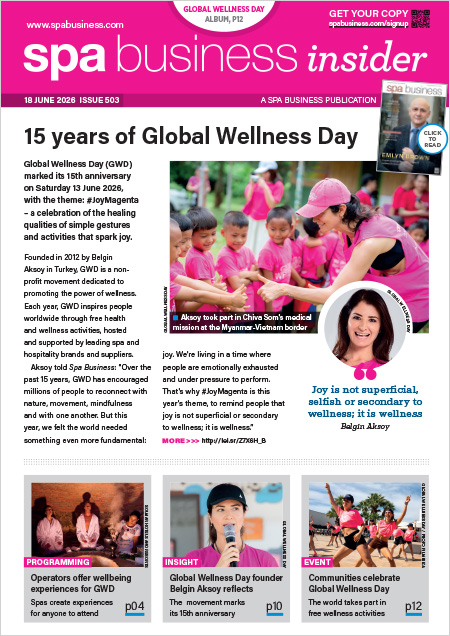
Global Wellness Day (GWD) marked its 15th anniversary on Saturday 13 June 2026, with the
theme: #JoyMagenta – a celebration of the healing qualities of simple gestures and activities
that spark joy.
Global luxury hospitality brand, Six Senses, has partnered with longevity healthcare provider,
HUM2N, to launch a clinic at Six Senses London, at The Whiteley.
As part of its first hotel partnership, Mayrlife – the medical health resort company known for its
site in Altaussee, Austria – has launched a day clinic at the Rosewood Vienna.
Premium London health club, KX Chelsea, will imminently unveil its most significant
redevelopment since its launch in 2002 to create an integrated wellness model combining
training, recovery and relaxation.
Rosewood Le Guanahani St Barth, on the northeast coast of Saint Barthélemy in the French
West Indies, is offering a programme of ocean-inspired yoga classes between 8-14 June to
celebrate Global Wellness Day (GWD).
Hotel de France, located on the British Isle of Jersey, has created a wellness retreat package
that includes a hot yoga session that will take place in Jersey Zoo’s butterfly sanctuary.
The Ritz-Carlton, Langkawi, in Malaysia, has revealed a schedule for Global Wellness Day
(GWD) that includes guided rainforest walks, mindful movement and guided coastal meditation
experiences.
Le Atelier by C.O.D.E. doesn't offer a standard bespoke service, it provides a highly
customised approach to designing massage beds and loungers in high-end wellness
environments. [more...]
In today’s premium spa environment, every detail shapes the guest experience – right down to
the softness of towels and the freshness of linens. [more...]
+ More featured suppliers
COMPANY PROFILES
Elemis Elemis was founded in London in 1989 by Linda Steiner whose vision was to create a skincare range as [more...]