Yes! Send me the FREE digital editions of Spa Business and Spa Business insider magazines and the FREE weekly Spa Business and Spa Business insider ezines and breaking news alerts!
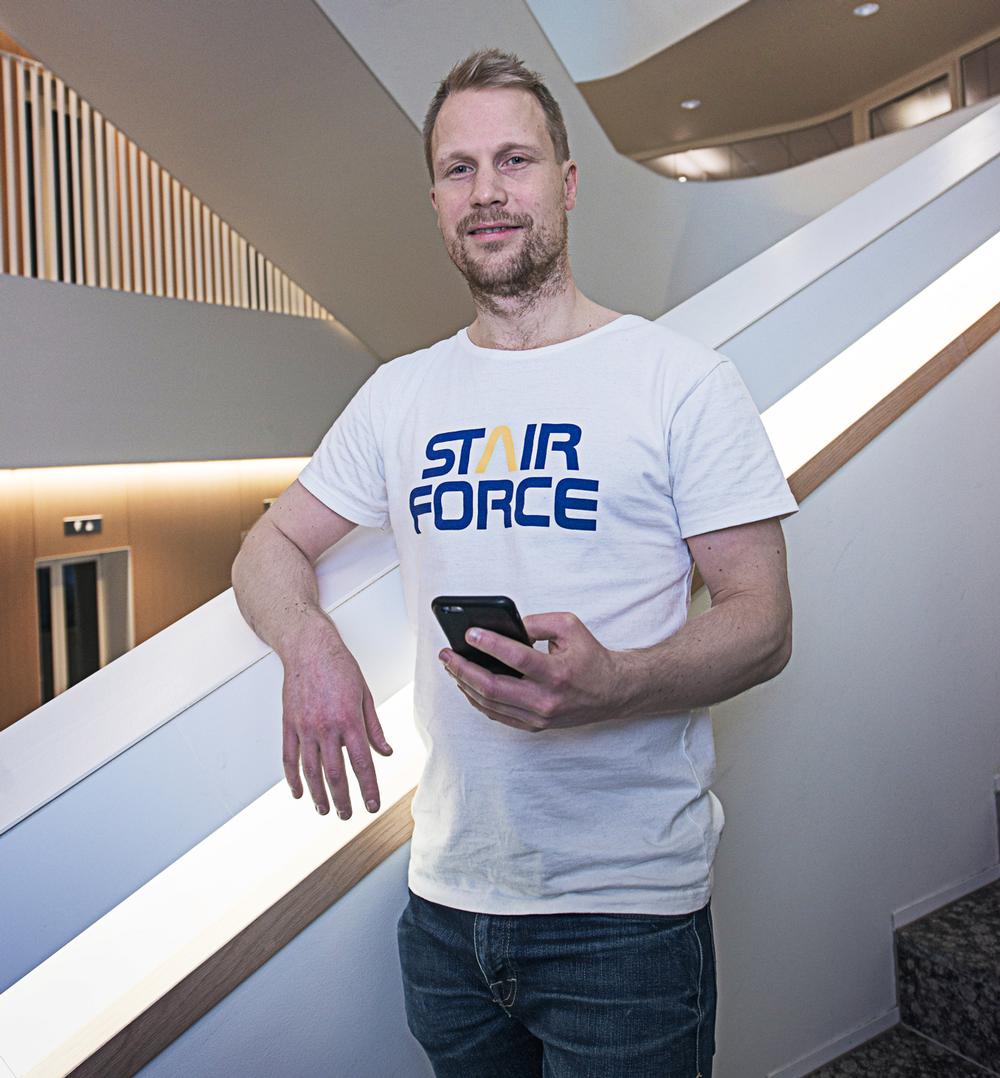
Leppanen got the idea for Stairforce climbing the six flights to his office
Tell us about Stairforce – what is it? Stairforce is an iPhone app designed to encourage incidental exercise by rewarding users for taking the stairs instead of an elevator. The app visualises the vertical distance climbed on the stairs as a slow and steady ascent into space. The idea is to boost incidental exercise by gamifying climbing as human-powered space travel. Stairforce offers more than 60 different milestones, such as climbing the equivalent of the Eiffel Tower or the Empire State Building, and users of the app can also compete against their Facebook friends.
How did the idea come about? I work at Palmu, one of the biggest design agencies in Finland. While climbing the stairs to our sixth-floor office I started visualising myself climbing a stairway into space. This struck me as a cool way to encourage people to stop taking elevators. At the same time, I was reading a number of different books about forming habits and how redesigning habits may help encourage people towards healthier choices. Prompted by this, I shared my idea with the owners of Palmu who liked it so much they helped to fund its development, along with AVEK’s – The Promotion Centre for Audiovisual Culture Finland – DigiDemo programme.
What’s your professional background? I graduated from the University of Art and Design Helsinki with a Master of Arts and have since worked in advertising (branding, storytelling, marketing) and service design (concept and user-centred product design). Working on the Stairforce project has been a great way of combining these skills. But as Stairforce is an app, and I’m not a programmer, I’ve joined forces with a couple of programmers, including our chief technology officer Tapio Heiskanen, to bring the concept to life.
What is the attitude to physical activity like in your native Finland? People don’t do enough, and as a result, half of the adults are overweight, and one in five adults is obese. The weight of Finnish men has been increasing since the 1970s, and women since the 1980s, so it’s a real cause for concern.
What is your ultimate goal with Stairforce? Everybody agrees that exercise offers many health benefits; however, the challenge is finding a way to get stressed-out, desk-bound employees to exercise more often. Our goal with Stairforce is to add physical activity into our users’ daily lives without too much inconvenience. We want to make the world a better place, one step at a time. We launched the first version of the app last summer, so we’re still at the beginning. We’re trying to find our tribe and understand more about what our users want from Stairforce.
We’re looking for funding and firms we can partner with to execute our vision, such as a player in the healthcare sector or an app/game company.
In the fast-paced world of fitness and wellness, where high-intensity workouts push us to
our limits and the sweat pours, the importance of efficient recovery cannot be overstated. [more...]
Leppanen got the idea for Stairforce climbing the six flights to his office
Tell us about Stairforce – what is it? Stairforce is an iPhone app designed to encourage incidental exercise by rewarding users for taking the stairs instead of an elevator. The app visualises the vertical distance climbed on the stairs as a slow and steady ascent into space. The idea is to boost incidental exercise by gamifying climbing as human-powered space travel. Stairforce offers more than 60 different milestones, such as climbing the equivalent of the Eiffel Tower or the Empire State Building, and users of the app can also compete against their Facebook friends.
How did the idea come about? I work at Palmu, one of the biggest design agencies in Finland. While climbing the stairs to our sixth-floor office I started visualising myself climbing a stairway into space. This struck me as a cool way to encourage people to stop taking elevators. At the same time, I was reading a number of different books about forming habits and how redesigning habits may help encourage people towards healthier choices. Prompted by this, I shared my idea with the owners of Palmu who liked it so much they helped to fund its development, along with AVEK’s – The Promotion Centre for Audiovisual Culture Finland – DigiDemo programme.
What’s your professional background? I graduated from the University of Art and Design Helsinki with a Master of Arts and have since worked in advertising (branding, storytelling, marketing) and service design (concept and user-centred product design). Working on the Stairforce project has been a great way of combining these skills. But as Stairforce is an app, and I’m not a programmer, I’ve joined forces with a couple of programmers, including our chief technology officer Tapio Heiskanen, to bring the concept to life.
What is the attitude to physical activity like in your native Finland? People don’t do enough, and as a result, half of the adults are overweight, and one in five adults is obese. The weight of Finnish men has been increasing since the 1970s, and women since the 1980s, so it’s a real cause for concern.
What is your ultimate goal with Stairforce? Everybody agrees that exercise offers many health benefits; however, the challenge is finding a way to get stressed-out, desk-bound employees to exercise more often. Our goal with Stairforce is to add physical activity into our users’ daily lives without too much inconvenience. We want to make the world a better place, one step at a time. We launched the first version of the app last summer, so we’re still at the beginning. We’re trying to find our tribe and understand more about what our users want from Stairforce.
We’re looking for funding and firms we can partner with to execute our vision, such as a player in the healthcare sector or an app/game company.
Longevitix, a clinical platform for preventive and longevity medicine, has launched its AI-
powered intelligence system to help physicians deliver continuous, personalised longevity-
focused care at scale.
Atmantan Wellness Centre, an integrative wellness destination in Mulshi, near Pune in India, is
expanding its portfolio by adding a new centre in Hyderabad that will launch between 2028 and
2029.
A recent survey by the UK Spa Association (UKSA) into the industry’s approach to cancer care
has revealed that almost half of participating respondents (46 per cent) are unaware that
cancer is a disability and guests with a cancer diagnosis must be given
Mexican operator, Solmar Hotels and Resorts, is hosting a series of events in celebration of
Global Wellness Day, including a Temazcal ceremony at its Playa Grande Resort and Spa in Los
Cabos.
Mandarin Oriental has announced a standalone residence brand, Mansions, which will debut at
Emirates Palace, Mandarin Oriental Mansions, Abu Dhabi, in 2029.
Four Seasons Resort The Nam Hai in Hoi An, Vietnam, has put together a Global Wellness Day
(GWD) agenda with activations rooted in nature and shaped by four pillars of Joy – in
alignment with the day’s theme #JoyMagenta.
The Global Wellness Summit (GWS) will celebrate its 20th anniversary at the 2026 event in
Phuket, Thailand, later this year with the theme: The Science, Art and Soul of Wellness.
Auko, an all-inclusive development, is opening in Phong Nha in Vietnam in Q3 2026, with a
series of 30 tented eco-lodges and wellness hospitality operations by Lumina Wellbeing.
In the fast-paced world of fitness and wellness, where high-intensity workouts push us to
our limits and the sweat pours, the importance of efficient recovery cannot be overstated. [more...]