Higher earners are more likely to act like ‘weekend warriors’ – cramming physical activity into fewer days – than those on a lower income, a study finds
Higher earners are 60 per cent more likely to meet WHO guidelines on activity / photo: shutterstock.com
Research has previously shown that income and exercise levels are related, with high earners more likely to meet physical activity guidelines than low earners.
However, a new study published in the journal Preventative Medicine suggests that while finding the time to exercise is problematic for both high and low earners, individuals with the highest income levels overcome this hurdle by doing the recommended amount of weekly activity in just a few days a week.
Led by Kerem Shuval of the American Cancer Society, a team of US researchers used accelerometers to track and analyse the physical activity levels of 5,206 US adults over a seven-day period. Participants were then classified according to their self-reported annual household income: less than $20,000; $20,000 to $44,999; $45,000 to $74,999; and at least $75,000.
Waiting for the weekend The study found that those earning at least $75,000 per year completed, on average, 4.6 more daily minutes of moderate to vigorous intensity physical activity than participants who earned less than $20,000 per year.
More interesting, perhaps, was the discovery that those in the highest income group were 60 per cent more likely to meet the World Health Organization’s (WHO) weekly physical activity guideline of at least 150 minutes of moderate or vigorous intensity physical activity over a two-day period than those in the lowest income group.
Compared with the lowest earners, the highest earners were also 90 per cent more likely to meet the guidelines over a 7-day period.
Despite being more likely to meet activity guidelines than low-income individuals, those earning at least $75,000 spent more time on sedentary activities. Specifically, the highest-income group did 9.3 fewer minutes of light intensity activity and spent 11.8 more minutes sedentary each day, compared with the lowest-income group.
Limited time workouts Shuval told Health Club Management: “The reason we chose income is that it’s a strong predictor of health behaviours and outcomes. Lower income individuals have a higher risk of obesity and other chronic conditions (e.g. diabetes) and are also less physically active.
“If they increase their physical activity levels, their risk for chronic conditions will be significantly lower. Therefore, it’s important to find effective strategies to help lower income individuals to increase their physical activity levels.”
He added that the current findings imply “that higher income individuals are aware of their limited time and therefore attempt to get the required exercise in less time,” but advised that “this strategy can be attempted by lower income individuals too, since they are similarly pressed for time (e.g. having two jobs)”.
* Shuval, K et al. Income, physical activity, sedentary behaviour and the ‘weekend warrior’ among U.S. adults.
Higher earners are more likely to act like ‘weekend warriors’ – cramming physical activity into fewer days – than those on a lower income, a study finds
Higher earners are 60 per cent more likely to meet WHO guidelines on activity / photo: shutterstock.com
Research has previously shown that income and exercise levels are related, with high earners more likely to meet physical activity guidelines than low earners.
However, a new study published in the journal Preventative Medicine suggests that while finding the time to exercise is problematic for both high and low earners, individuals with the highest income levels overcome this hurdle by doing the recommended amount of weekly activity in just a few days a week.
Led by Kerem Shuval of the American Cancer Society, a team of US researchers used accelerometers to track and analyse the physical activity levels of 5,206 US adults over a seven-day period. Participants were then classified according to their self-reported annual household income: less than $20,000; $20,000 to $44,999; $45,000 to $74,999; and at least $75,000.
Waiting for the weekend The study found that those earning at least $75,000 per year completed, on average, 4.6 more daily minutes of moderate to vigorous intensity physical activity than participants who earned less than $20,000 per year.
More interesting, perhaps, was the discovery that those in the highest income group were 60 per cent more likely to meet the World Health Organization’s (WHO) weekly physical activity guideline of at least 150 minutes of moderate or vigorous intensity physical activity over a two-day period than those in the lowest income group.
Compared with the lowest earners, the highest earners were also 90 per cent more likely to meet the guidelines over a 7-day period.
Despite being more likely to meet activity guidelines than low-income individuals, those earning at least $75,000 spent more time on sedentary activities. Specifically, the highest-income group did 9.3 fewer minutes of light intensity activity and spent 11.8 more minutes sedentary each day, compared with the lowest-income group.
Limited time workouts Shuval told Health Club Management: “The reason we chose income is that it’s a strong predictor of health behaviours and outcomes. Lower income individuals have a higher risk of obesity and other chronic conditions (e.g. diabetes) and are also less physically active.
“If they increase their physical activity levels, their risk for chronic conditions will be significantly lower. Therefore, it’s important to find effective strategies to help lower income individuals to increase their physical activity levels.”
He added that the current findings imply “that higher income individuals are aware of their limited time and therefore attempt to get the required exercise in less time,” but advised that “this strategy can be attempted by lower income individuals too, since they are similarly pressed for time (e.g. having two jobs)”.
* Shuval, K et al. Income, physical activity, sedentary behaviour and the ‘weekend warrior’ among U.S. adults.
The UK spa review and discovery platform for consumers, the Good Spa Guide, has announced
it will host the Good Spa Guide Awards 2026 during an event on 16 November at Sopwell House
Hotel in St Albans, UK.
Eighty-four per cent of consumers now say wellness is a top priority in their lives, with this
percentage increasing year on year, according to a preview presentation of McKinsey’s Future of
Wellness 2026 research report.
Mass protests have been taking place since Monday 1 June in Albania over the development of
a luxury resort by Donald Trump’s daughter Ivanka Trump and her husband Jared Kushner.
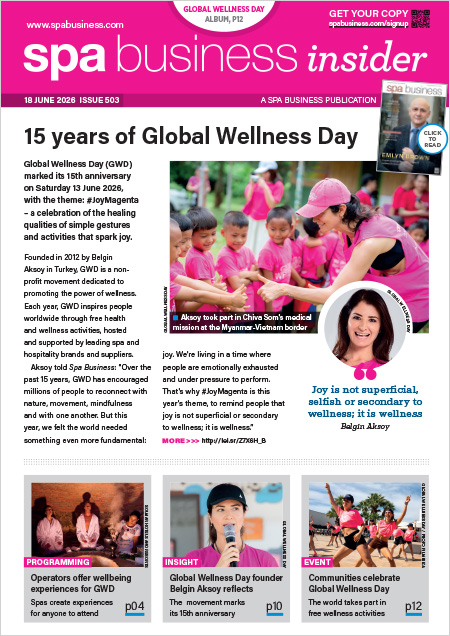
Global Wellness Day (GWD) marked its 15th anniversary on Saturday 13 June 2026, with the
theme: #JoyMagenta – a celebration of the healing qualities of simple gestures and activities
that spark joy.
Global luxury hospitality brand, Six Senses, has partnered with longevity healthcare provider,
HUM2N, to launch a clinic at Six Senses London, at The Whiteley.
As part of its first hotel partnership, Mayrlife – the medical health resort company known for its
site in Altaussee, Austria – has launched a day clinic at the Rosewood Vienna.
Premium London health club, KX Chelsea, will imminently unveil its most significant
redevelopment since its launch in 2002 to create an integrated wellness model combining
training, recovery and relaxation.
Rosewood Le Guanahani St Barth, on the northeast coast of Saint Barthélemy in the French
West Indies, is offering a programme of ocean-inspired yoga classes between 8-14 June to
celebrate Global Wellness Day (GWD).
Hotel de France, located on the British Isle of Jersey, has created a wellness retreat package
that includes a hot yoga session that will take place in Jersey Zoo’s butterfly sanctuary.
The Ritz-Carlton, Langkawi, in Malaysia, has revealed a schedule for Global Wellness Day
(GWD) that includes guided rainforest walks, mindful movement and guided coastal meditation
experiences.