The Singapore Sports Hub, with its motto ‘where Singapore comes to play’, includes the republic’s new 55,000-capacity National Stadium and a host of other world class venues. Tom Walker takes a closer look at the S$1.3bn project
By Tom Walker | Published in Leisure Management 2014 issue 4
Opened in June 2014, the S$1.87bn (US$1.49bn, £878m, €1.07bn) Singapore Sports Hub – a fully integrated sports, entertainment and lifestyle complex – is set to become one of South East Asia’s premium sports venues. Billed as the region’s largest ever public-private partnership project, the aim was to create a world-class facility in which Singaporeans can watch, play and learn about sports – while creating opportunities for local sports and tourism businesses.
As well as international competitions and other spectator events, the hub offers community programming, “experience sport” initiatives and public facilities for everyday use. The impressive range of sporting facilities is supported by clusters of hospitality, retail and other support services – including a retail mall, restaurants, a library and a sports museum.
ALL ABOUT THE VISION The idea of creating the sports hub was first mooted in June 2001, when the Committee on Sporting Singapore (CoSS) delivered the central government a report consisting of 40 recommendations on how to grow the country’s sporting sector. The sports industry had been identified as a key growth market and one in which Singapore could become a leader within the South East Asia region.
The impact of the CoSS proposals was immediate and it transformed the way the government perceived and invested in sport over the next decade. To implement the report’s proposals, the government ring-fenced S$500m (US$490m, E400m, €237m) worth of funding, which it planned to invest over a five-year period. Among the first projects to receive funding were the planning process of the flagship Sports Hub and the creation of a Singapore Sports School (SSS).
The SSS was the first project to be completed (in 2004) and at the time was the region’s first higher education institution to offer an integrated academic and sports programme.
Following the planning stage and a tender process, the government awarded the development contract of the Sports Hub to Singapore Sports Hub Consortium (SSHC), led by Dragages Singapore Pte. SSHC was given a 25-year contract with the Singapore Sports Council to design, build, finance and operate the facility.
Work on the stadium (and the hub) was initially scheduled to begin in 2008, but the global economic crisis and the resulting increases in construction costs delayed the project. Construction work finally began in 2010.
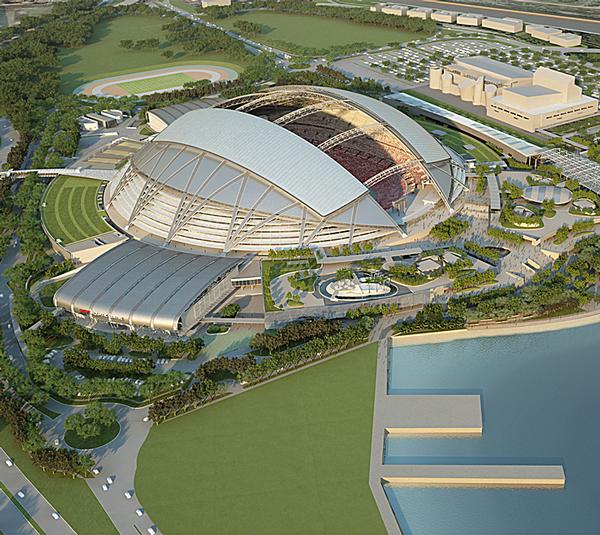
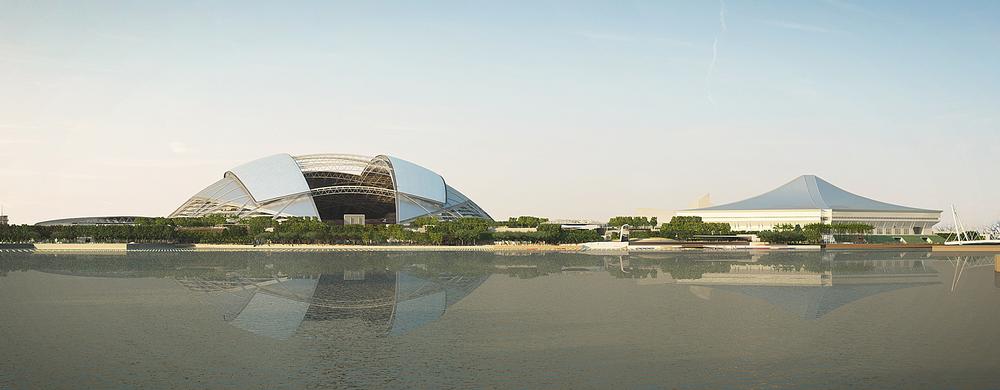
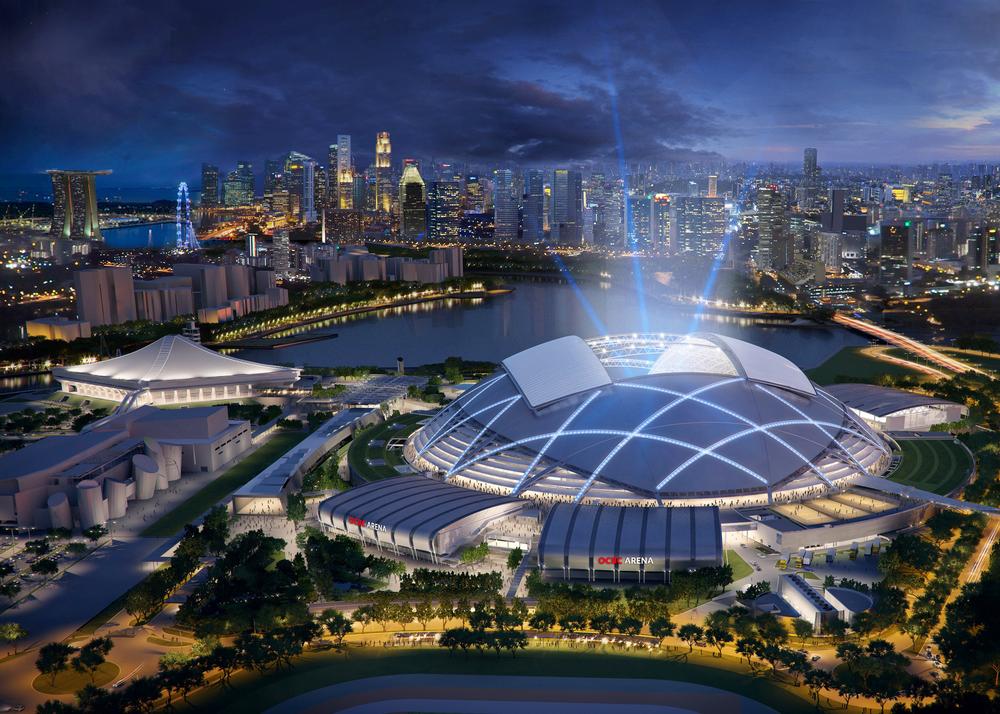
THE MAIN EVENT Located on a 35-hectare site in Kallang, the hub is well connected to Singapore’s Mass Rapid Transit Network and as a result benefits from low-cost, hassle-free access to each venue. The centrepiece of the hub is the new 55,000-capacity National Stadium that offers spectacular views of the waterfront and city skyline. Masterplanned by AECOM, the venue was designed in partnership by global sports architects Arup Sports and local firm DP Architects. The site is situated at the old National Stadium, which was closed in 2007 and demolished in 2010.
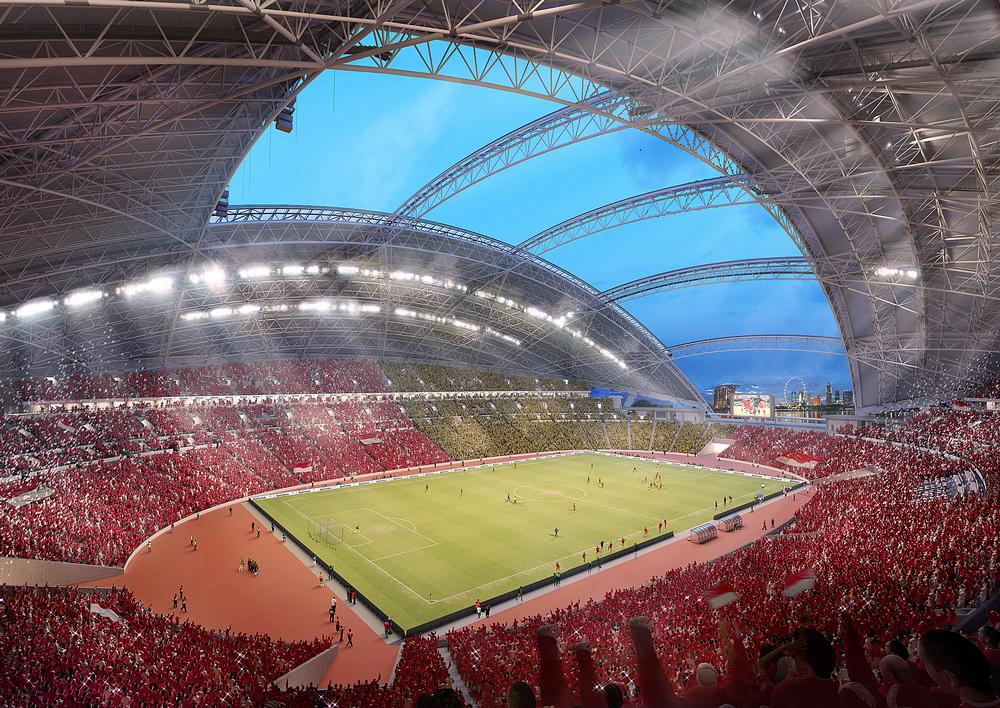
The multi-use stadium can be configurated to host a range of sports, and the venue is being marketed as the only major venue capable of hosting international football, rugby, cricket and athletics. For this, the lower spectator tiers are movable and can be adjusted by up to 12.5m back to provide extra playing surface.
Sustainability is at the heart of the stadium’s design. The stadium’s retractable roof has been made out of Ethylene tetrafluoroethylene (ETFE) and the energy efficient bowl cooling technology used is among the first of its kind in the world.
Clive Lewis, Arup’s design leader for the project, says: “It’s common for sports stadia to be on the outskirts of cities, accessible only by motorways. As part of its long-term plans to encourage sports across Singapore, the government wanted the new national stadium to be a part of everyday life. To make this a reality, the stadium is set in a 35-hectare sports precinct next to the city centre.
“We designed the stadium as a dome spanning 310m. Not only is it wide, the ultra-thin shell roof is also energy-efficient. The stadium is a model for tropical climate design. It features an innovative energy-efficient spectator cooling system that delivers cooled air to every seat in the stadium. These pockets of cooled air will reduce energy use significantly, compared to a more conventional cooling system.”
SUPPORTING ACTS The two other major venues close to the stadium are the OCBC Arena and the Indoor Stadium. Both are existing venues which have undergone significant upgrades and redevelopments. First opened in 1989 at a cost of S$90m (US$72m, €53m, £43m), the 12,000-capacity Singapore Indoor Stadium served as part of the government’s first urban re-generation project in the late 1980s. The plan was to revitalise the urban landscape in Kallang as well as provide a world-class venue to meet the leisure needs of the people. Designed by Japanese architect Kenzo Tange, it has gone through a radical transformation to bring it up to modern requirements.
Redevelopment work on the Indoor Stadium – completed in 2013 – has made it more adaptable and it now has a new flexible configuration that scales from 4,000 to 12,000 spectators. This solution allows the venue to host anything from national sports events to high-profile international events.
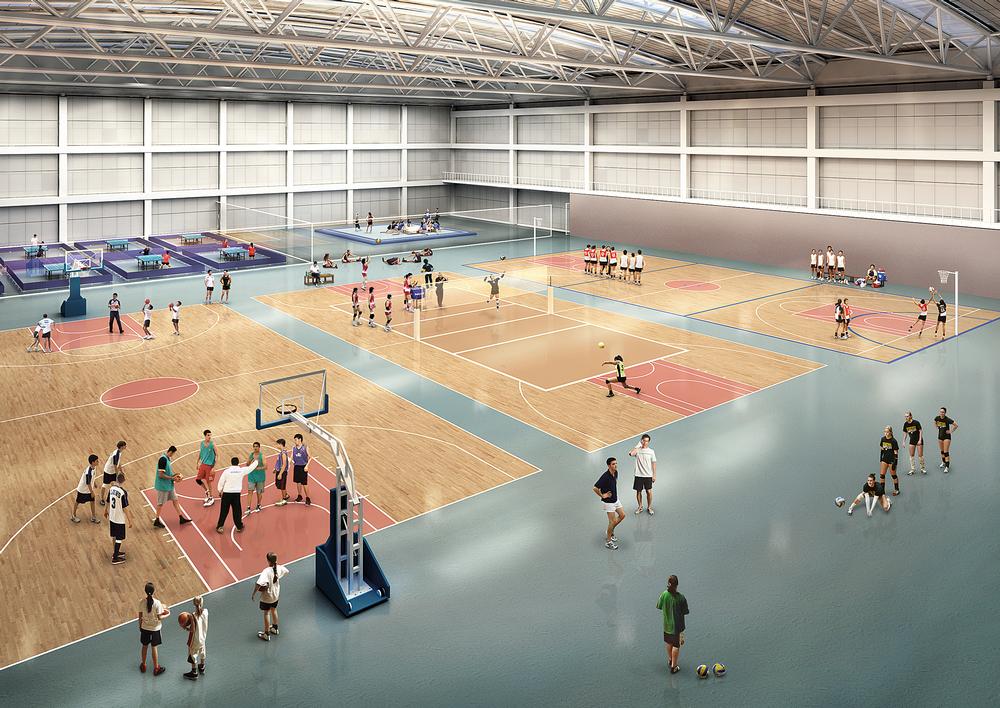
Within a short walk from the National Stadium is the OCBC Arena, dedicated to community sport and smaller-scale regional and national competitions. The arena consists of six halls over two levels that are designed to be scalable in size and will cater for an array of indoor sports events for both NGBs and the general public. Laid out as two multi-purpose modules flanking a central public atrium, the design allows for simultaneous use of the six sports halls. When in competition figuration, it will have a capacity of 3,000.
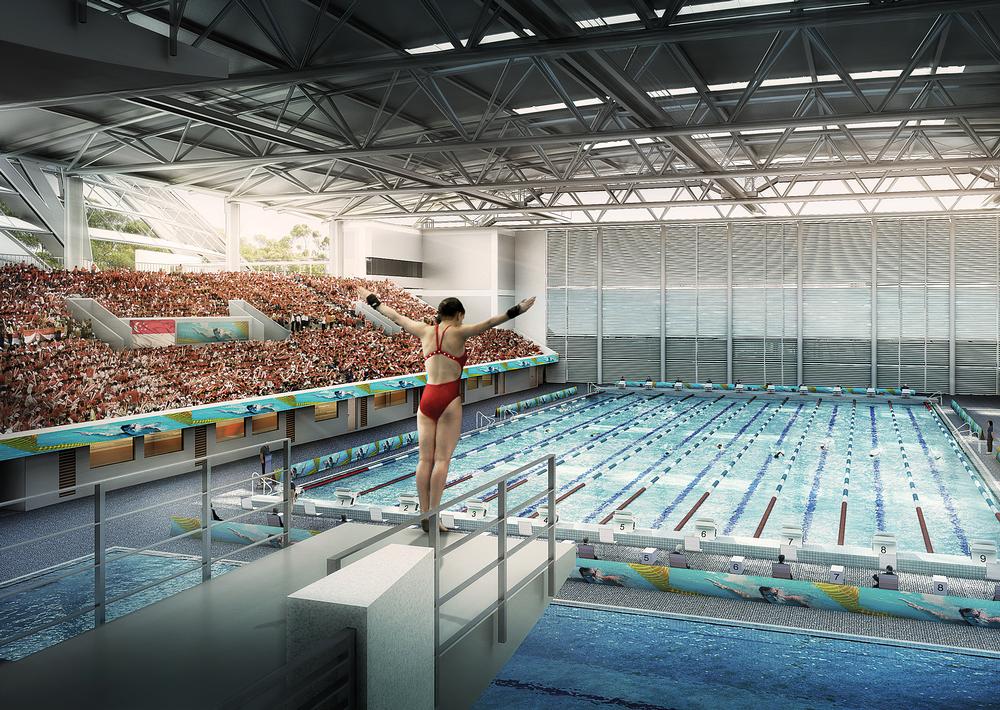
WATERY PURSUITS The hub houses two new water sports centres – the indoor OCBC Aquatic Centre and the outdoor Water Sports Centre. The newly built aquatic centre, designed by Arup, includes two Olympic-size, 50m swimming pools and a diving centre. On non-event days, it’s open to the public and includes a water leisure area with learn-to-swim pools and a surf pool. The aim is to host international championships as well as local and regional events.
The Water Sports Centre, offering canoeing, kayaking and dragon boating, is set to become the new HQ for all of Singapore’s elite boating teams and will also house the relevant NGBs.
SPORTING LIFESTYLE What makes the complex unique is the number of sports-themed entertainment and leisure options that support the events venues. The Sports Promenade features a 900m sports and recreational space around the National Stadium and is Singapore’s largest, fully sheltered civic space. Open to the public all day, the elevated platform acts as an urban park and connects the hub’s venues.
The promenade is surrounded by a number of community areas which provide a myriad of sports and activities – a number of hard courts for racquet sports and basketball; a skate park; lawn ball areas; climbing walls; beach volleyball and cycling paths. Elsewhere, the visitor centre – which also houses a sports library and sports museum – is located outside the main transport station. Across the promenade from the visitor centre is the main, 41,000sq m retail and food zone.
Lawrence Wong, minister for culture, community and youth, is confident that the hub will catch the public’s imagination. “It is a place for all Singaporeans to enjoy and to live better through sports,” he says.
This feature first appeared in Sports Management, Issue 2 2014
In today’s premium spa environment, every detail shapes the guest experience – right down to
the softness of towels and the freshness of linens. [more...]
In the fast-paced world of fitness and wellness, where high-intensity workouts push us to
our limits and the sweat pours, the importance of efficient recovery cannot be overstated. [more...]
+ More featured suppliers
COMPANY PROFILES
Robosculptor
Since its
inception in 2019, roboSculptor has grown
into an advanced, AI-powered platform
that de [more...]
Sothys Paris
Founded in 1946, Sothys is owned by the
Mas family. Chief executive Christian Mas
oversees the com [more...]
The Singapore Sports Hub, with its motto ‘where Singapore comes to play’, includes the republic’s new 55,000-capacity National Stadium and a host of other world class venues. Tom Walker takes a closer look at the S$1.3bn project
By Tom Walker | Published in Leisure Management 2014 issue 4
Opened in June 2014, the S$1.87bn (US$1.49bn, £878m, €1.07bn) Singapore Sports Hub – a fully integrated sports, entertainment and lifestyle complex – is set to become one of South East Asia’s premium sports venues. Billed as the region’s largest ever public-private partnership project, the aim was to create a world-class facility in which Singaporeans can watch, play and learn about sports – while creating opportunities for local sports and tourism businesses.
As well as international competitions and other spectator events, the hub offers community programming, “experience sport” initiatives and public facilities for everyday use. The impressive range of sporting facilities is supported by clusters of hospitality, retail and other support services – including a retail mall, restaurants, a library and a sports museum.
ALL ABOUT THE VISION The idea of creating the sports hub was first mooted in June 2001, when the Committee on Sporting Singapore (CoSS) delivered the central government a report consisting of 40 recommendations on how to grow the country’s sporting sector. The sports industry had been identified as a key growth market and one in which Singapore could become a leader within the South East Asia region.
The impact of the CoSS proposals was immediate and it transformed the way the government perceived and invested in sport over the next decade. To implement the report’s proposals, the government ring-fenced S$500m (US$490m, E400m, €237m) worth of funding, which it planned to invest over a five-year period. Among the first projects to receive funding were the planning process of the flagship Sports Hub and the creation of a Singapore Sports School (SSS).
The SSS was the first project to be completed (in 2004) and at the time was the region’s first higher education institution to offer an integrated academic and sports programme.
Following the planning stage and a tender process, the government awarded the development contract of the Sports Hub to Singapore Sports Hub Consortium (SSHC), led by Dragages Singapore Pte. SSHC was given a 25-year contract with the Singapore Sports Council to design, build, finance and operate the facility.
Work on the stadium (and the hub) was initially scheduled to begin in 2008, but the global economic crisis and the resulting increases in construction costs delayed the project. Construction work finally began in 2010.
THE MAIN EVENT Located on a 35-hectare site in Kallang, the hub is well connected to Singapore’s Mass Rapid Transit Network and as a result benefits from low-cost, hassle-free access to each venue. The centrepiece of the hub is the new 55,000-capacity National Stadium that offers spectacular views of the waterfront and city skyline. Masterplanned by AECOM, the venue was designed in partnership by global sports architects Arup Sports and local firm DP Architects. The site is situated at the old National Stadium, which was closed in 2007 and demolished in 2010.
The multi-use stadium can be configurated to host a range of sports, and the venue is being marketed as the only major venue capable of hosting international football, rugby, cricket and athletics. For this, the lower spectator tiers are movable and can be adjusted by up to 12.5m back to provide extra playing surface.
Sustainability is at the heart of the stadium’s design. The stadium’s retractable roof has been made out of Ethylene tetrafluoroethylene (ETFE) and the energy efficient bowl cooling technology used is among the first of its kind in the world.
Clive Lewis, Arup’s design leader for the project, says: “It’s common for sports stadia to be on the outskirts of cities, accessible only by motorways. As part of its long-term plans to encourage sports across Singapore, the government wanted the new national stadium to be a part of everyday life. To make this a reality, the stadium is set in a 35-hectare sports precinct next to the city centre.
“We designed the stadium as a dome spanning 310m. Not only is it wide, the ultra-thin shell roof is also energy-efficient. The stadium is a model for tropical climate design. It features an innovative energy-efficient spectator cooling system that delivers cooled air to every seat in the stadium. These pockets of cooled air will reduce energy use significantly, compared to a more conventional cooling system.”
SUPPORTING ACTS The two other major venues close to the stadium are the OCBC Arena and the Indoor Stadium. Both are existing venues which have undergone significant upgrades and redevelopments. First opened in 1989 at a cost of S$90m (US$72m, €53m, £43m), the 12,000-capacity Singapore Indoor Stadium served as part of the government’s first urban re-generation project in the late 1980s. The plan was to revitalise the urban landscape in Kallang as well as provide a world-class venue to meet the leisure needs of the people. Designed by Japanese architect Kenzo Tange, it has gone through a radical transformation to bring it up to modern requirements.
Redevelopment work on the Indoor Stadium – completed in 2013 – has made it more adaptable and it now has a new flexible configuration that scales from 4,000 to 12,000 spectators. This solution allows the venue to host anything from national sports events to high-profile international events.
Within a short walk from the National Stadium is the OCBC Arena, dedicated to community sport and smaller-scale regional and national competitions. The arena consists of six halls over two levels that are designed to be scalable in size and will cater for an array of indoor sports events for both NGBs and the general public. Laid out as two multi-purpose modules flanking a central public atrium, the design allows for simultaneous use of the six sports halls. When in competition figuration, it will have a capacity of 3,000.
WATERY PURSUITS The hub houses two new water sports centres – the indoor OCBC Aquatic Centre and the outdoor Water Sports Centre. The newly built aquatic centre, designed by Arup, includes two Olympic-size, 50m swimming pools and a diving centre. On non-event days, it’s open to the public and includes a water leisure area with learn-to-swim pools and a surf pool. The aim is to host international championships as well as local and regional events.
The Water Sports Centre, offering canoeing, kayaking and dragon boating, is set to become the new HQ for all of Singapore’s elite boating teams and will also house the relevant NGBs.
SPORTING LIFESTYLE What makes the complex unique is the number of sports-themed entertainment and leisure options that support the events venues. The Sports Promenade features a 900m sports and recreational space around the National Stadium and is Singapore’s largest, fully sheltered civic space. Open to the public all day, the elevated platform acts as an urban park and connects the hub’s venues.
The promenade is surrounded by a number of community areas which provide a myriad of sports and activities – a number of hard courts for racquet sports and basketball; a skate park; lawn ball areas; climbing walls; beach volleyball and cycling paths. Elsewhere, the visitor centre – which also houses a sports library and sports museum – is located outside the main transport station. Across the promenade from the visitor centre is the main, 41,000sq m retail and food zone.
Lawrence Wong, minister for culture, community and youth, is confident that the hub will catch the public’s imagination. “It is a place for all Singaporeans to enjoy and to live better through sports,” he says.
This feature first appeared in Sports Management, Issue 2 2014
People taking GLP-1 weight loss medications such as Ozempic, Wegovy, Mounjaro and Zepbound
may be losing weight, but they’re also becoming less physically active, according to new
research presented at the ENDO 2026 annual meeting of the Endocrine Society
Abu Dhabi-based investment firm Mubadala Capital has made a binding, fully financed
€1 billion
offer to acquire Pierre and Vacances SA, the European holiday resort operator behind the
continental European Center Parcs business.
Global retreat trade show, Synergy The Retreat Show, has launched a resource called The
Source, which hosts an open-access online Transformation Series programme.
The Standards Authority for Touch in Cancer Care (SATCC) charity has announced its first five-
day Living with Cancer and Beyond retreat, which will be held at Carden Park Hotel and Spa in
Cheshire, UK, between 1 and 5 September.
Patmos Aktis, a Luxury Collection Resort and Spa, has opened in Greece, with a renovated and
rebranded wellness offering called Ansana Wellness and Spa.
The Mauna Kea Beach Hotel, an Autograph Collection property in Hawaii, US, has opened its
22,000 sq ft indoor-outdoor Spa at Mauna Kea as the final step in the property’s overall
renovation, which has cost more than US$180 million (€166 million, £140 mill
The UK spa review and discovery platform for consumers, the Good Spa Guide, has announced
it will host the Good Spa Guide Awards 2026 during an event on 16 November at Sopwell House
Hotel in St Albans, UK.
Eighty-four per cent of consumers now say wellness is a top priority in their lives, with this
percentage increasing year on year, according to a preview presentation of McKinsey’s Future of
Wellness 2026 research report.
Mass protests have been taking place since Monday 1 June in Albania over the development of
a luxury resort by Donald Trump’s daughter Ivanka Trump and her husband Jared Kushner.
Global Wellness Day (GWD) marked its 15th anniversary on Saturday 13 June 2026, with the
theme: #JoyMagenta – a celebration of the healing qualities of simple gestures and activities
that spark joy.
In today’s premium spa environment, every detail shapes the guest experience – right down to
the softness of towels and the freshness of linens. [more...]
In the fast-paced world of fitness and wellness, where high-intensity workouts push us to
our limits and the sweat pours, the importance of efficient recovery cannot be overstated. [more...]
+ More featured suppliers
COMPANY PROFILES
Robosculptor Since its
inception in 2019, roboSculptor has grown
into an advanced, AI-powered platform
that de [more...]