Jamie Capel-Davies outlines the process and benefits relating to the International Tennis Federation’s (ITF) independent assessment of quality tennis courts
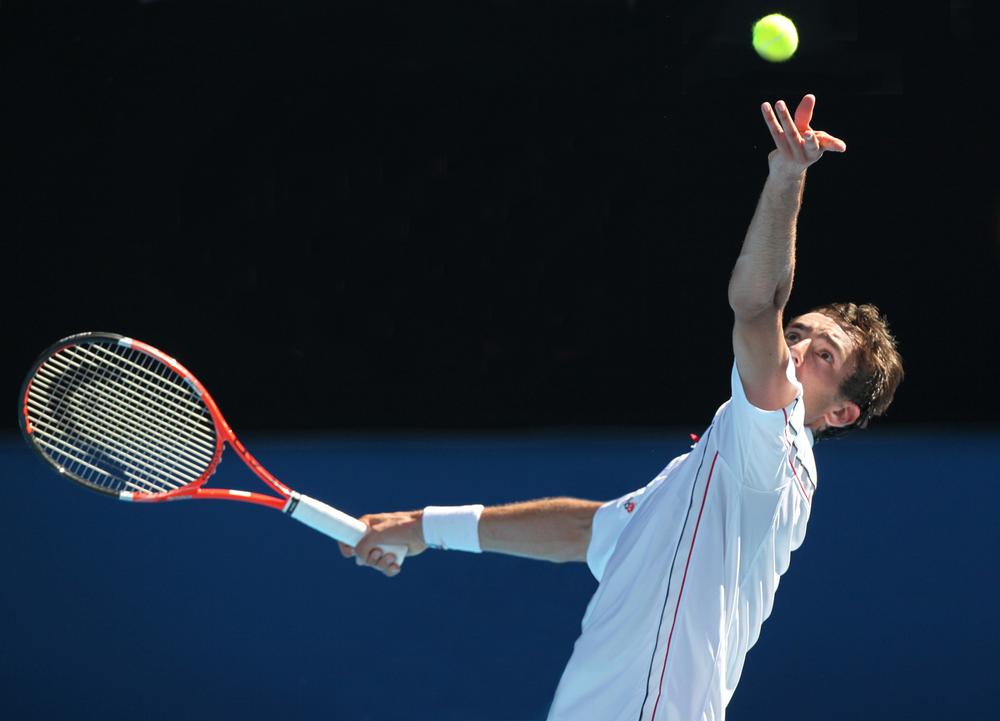
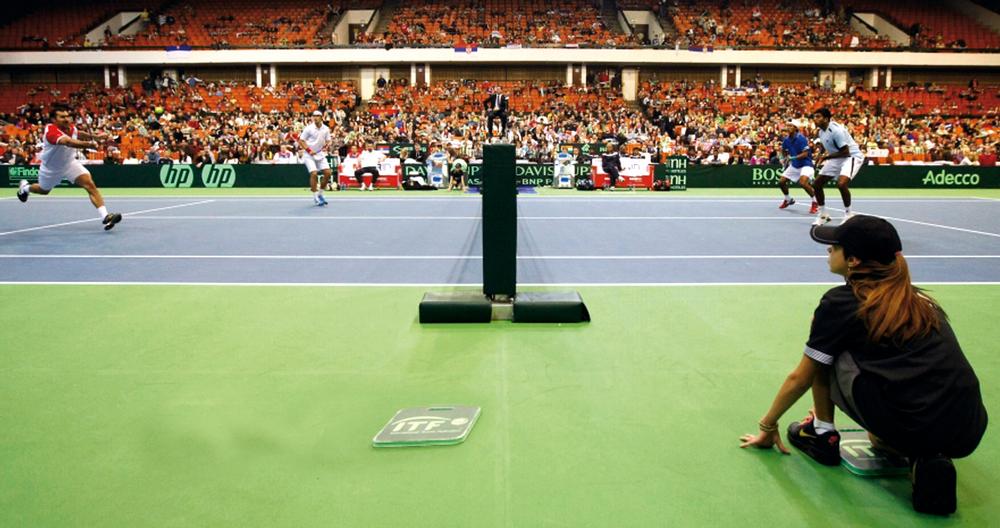
Marin Cilic of Croatia in the Quarter Final during the 2010 Australian Open tennis tournament
With an estimated *US$30bn (£19.6bn) having been invested in tennis court construction worldwide, it is understandable that investors and players are keen to know the quality of construction and, increasingly, how fast or slow a court plays.
In response to this need, the International Tennis Federation’s (ITF) science and technical department has established ITF Recognition to provide end-users with an independent assessment of the quality of their court, and offers contractors an opportunity to demonstrate the calibre of their products and installation skills.
WHAT IS ITF RECOGNITION? ITF Recognition is a test-based programme. To receive One-Star Recognition, the court’s key installation properties must meet ITF recommendations.
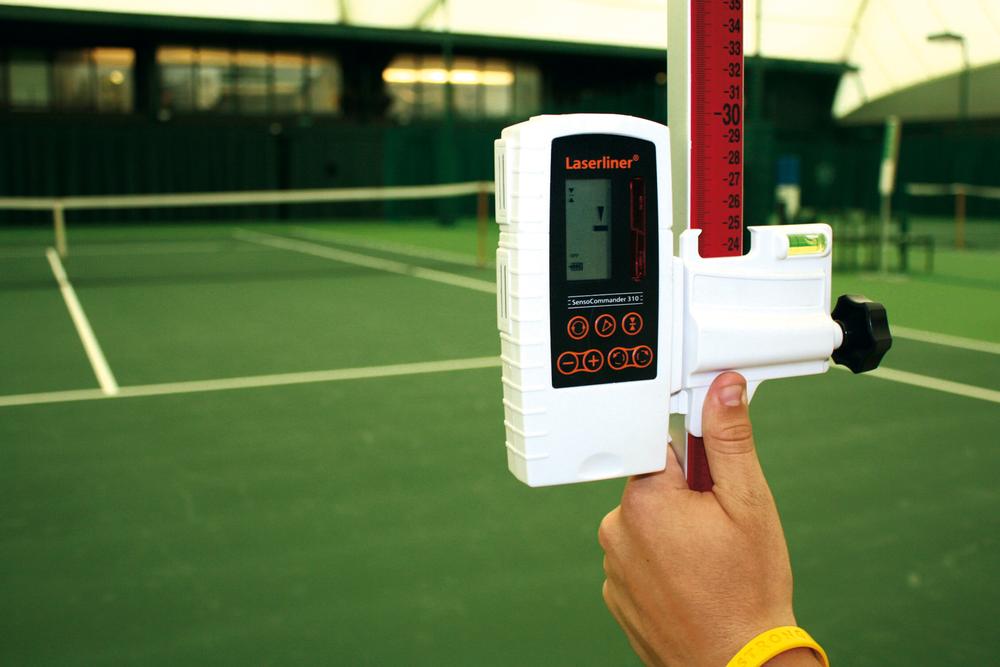
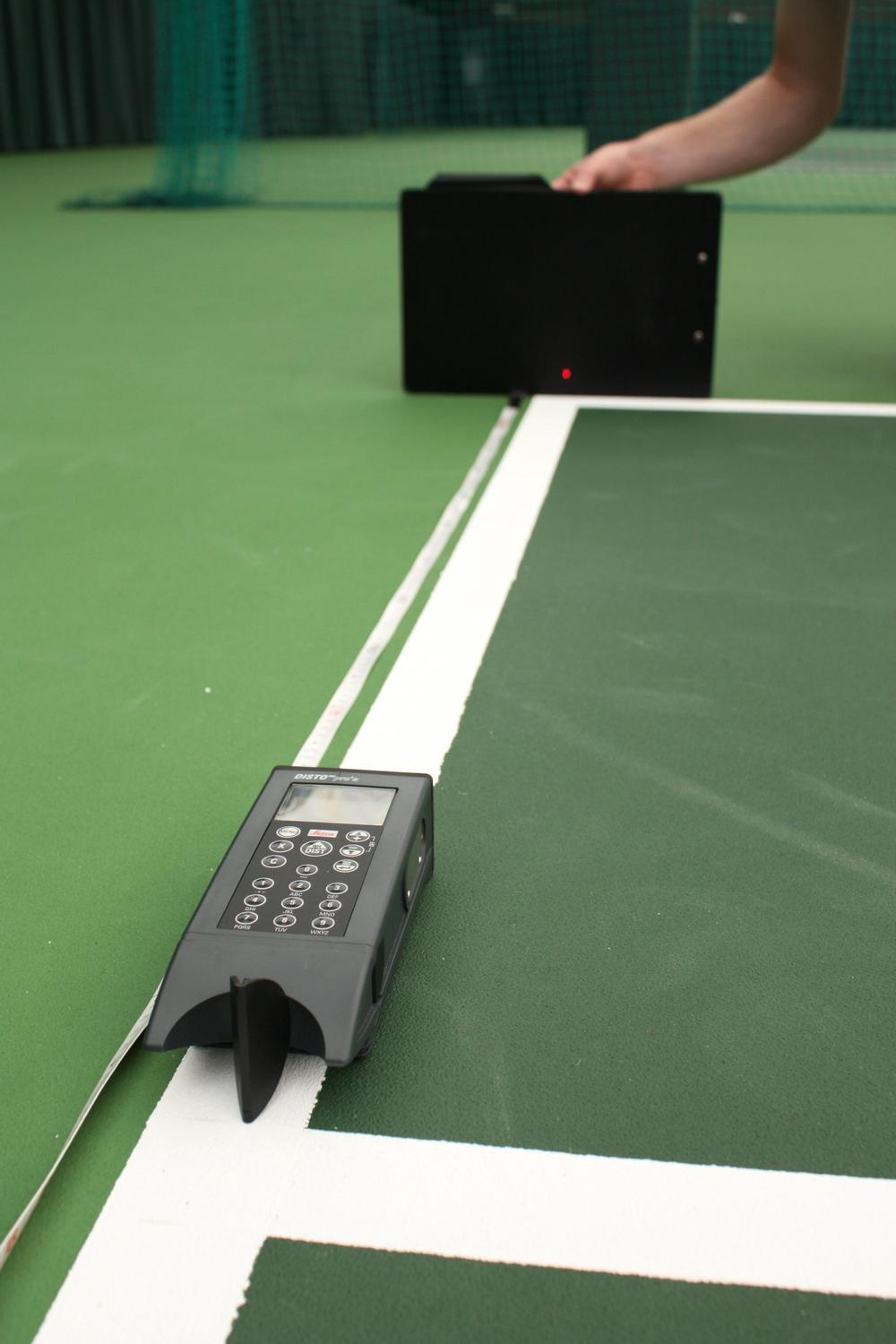
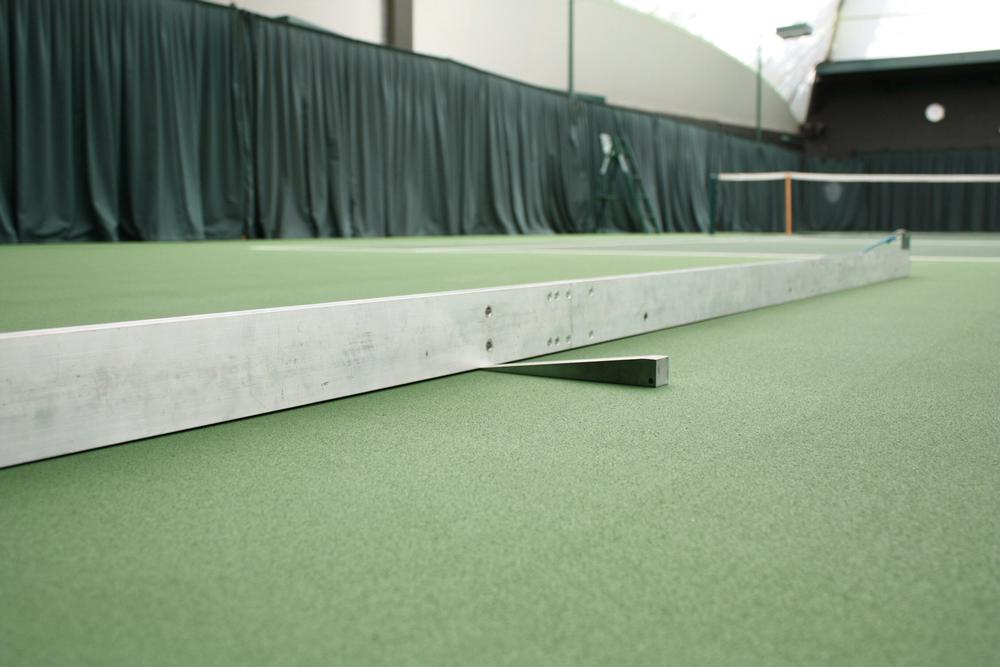
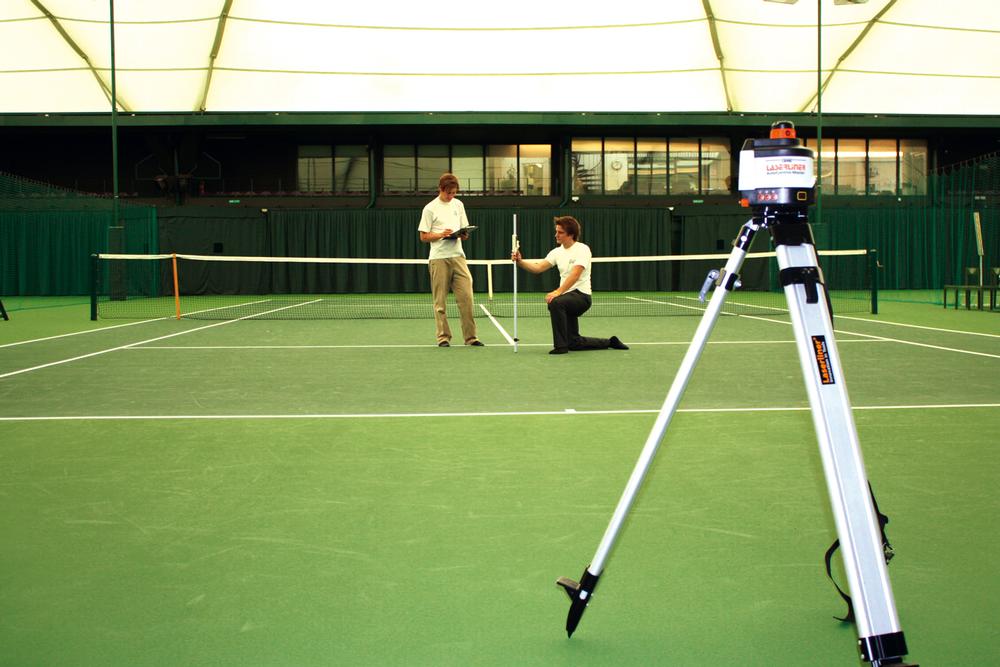
Testing begins with a visual inspection to identify any cracks or gaps in the surface and ensure a uniform appearance. Next, an evenness test measures the size of any bumps or dips in the surface with the use of a straight edge, and the slope and planarity of the court are established with a laser level. Finally, the position of the court markings and net are checked to ensure they are within tolerance.
Two-Star Recognition requires the court pace rating (CPR) to be compared with the ITF-classified value for the surface product, in addition to the One-Star tests described above.
The pace is quantified by firing a ball at the court and recording its speed before and after the bounce. Rougher surfaces, which generate more friction between the ball and the court, reduce the speed of the ball parallel to the ground making a court ‘slower’. Surfaces that have a higher bounce also appear slower because players have more time to reach the ball.
There are currently more than 200 surface products classified by the ITF. Surfaces are classified into one of five categories: slow, medium-slow, medium, medium-fast and fast, and listed on the ITF website: www.itftennis.com/technical/equipment/courts/courtlist.asp
WHO CAN APPLY FOR ITF RECOGNITION? ITF Recognition is targeted at venues where the standard of play is high and the quality of the court is therefore most important. These include the Davis Cup by BNP Paribas and Fed Cup by BNP Paribas venues as well as national tennis centres. To date, One-Star ITF Recognition has been issued to the centre court at the La Caja Magica (Magic Box) stadium in Madrid (home of the Madrid Masters tennis tournament) and two indoor courts at the UK’s Lawn Tennis Association’s National Tennis Centre in Roehampton.
Two-Star ITF Recognition has been awarded to all nine match courts installed by Spade Oak at the Eton Manor site in the Olympic Park, and four courts at the Tennis Park club in Moscow, installed by Concept 90.
An application for ITF Recognition can be submitted by any party associated with the tennis facility, for example the owner, the organiser of a tournament held at that facility, or the supplier or installer of the court.
One-Star tests are carried out by an ITF-approved test organisation, such as a surveying company, or an ITF-accredited laboratory. Two-Star tests are conducted by an ITF-accredited laboratory, which are listed on the ITF website: www.itftennis.com/technical/research/recognition/labs.asp
The ITF charges a US$500 (£391) administration fee to add a facility (any number of courts at the same location) that meets the relevant specifications to the official ITF Recognition list. The cost of testing is determined by the laboratory and is available on application.
FACILITIES GUIDE AND DIRECTORY The ITF has established a working group of facilities experts from major tennis-playing nations to design and develop an international Facilities Guide, which represents ‘best practice’ from around the world. It’s a simple reference for those wanting to build a tennis court and offers information about layout design and choosing and maintaining surfaces: www.itftennis.com/technical/facilities
The Suppliers’ Directory allows users to search for tennis facility products and services and identify ITF-Recognised suppliers: http://tds.itftennis.com
For more information, please email [email protected] or visit the ITF website: www.itftennis.com
* US$30bn (£18.9bn) is a ballpark figure produced from an estimate of 750,000 courts worldwide at an average cost of US$40,000 (£25,000) per court. The number of courts is based on a survey of the ITF member nations in 2004/2005.
Jamie Capel-Davies is science and technical manager at the ITF
HOW TO GET ITF RECOGNITION 1. Submit an application for One- or Two-Star Recognition* to the ITF and pay the administration fee. 2. Select an ITF-accredited laboratory/ITF-approved surveyor and arrange a test date and test fee payment. 3. Have the court(s) tested and the report(s) sent to the ITF. 4. Receive an ITF Recognition certificate from the ITF and website listing for the court(s)**.
* Two-Star Recognition cannot be awarded without comparison against an ITF-classified surface product. If the surface product is not classified, the product supplier can apply for classification using the results of the CPR test on-site.
** Subject to meeting the relevant specifications.
CASE STUDY Tennis Park, Moscow Four double, indoor courts at the Tennis Park in Moscow, Russia, installed by Concept 90, have been awarded Two-Star ITF Recognition.
Concept 90 is an active member of the International Tennis foundation (ITF) and the Russian Tennis Federation (RTF). Investing into continuous tennis surface research and development, the company has developed court surfaces that offer players a good standard of play with a minimum chance of injury.
These indoor and outdoor surfaces are suitable for tournament, training and recreational use and include acrylic RuKort, PVC RuKort, artificial turf RuKortGrass and red artificial turf RuKortXClay, which is an imitation of clay court and RuKortTenisit.
The surface installed at the Tennis Park in Moscow is RukortTour, a hard, acrylic surface on 55mm rubber matting. It is ITF certified and used for tennis tournaments across Russia, Croatia and Kazakhstan.
The company designed, built and installed a 138m x 37.5m air hall encompassing 10 courts (four double and six single). The air structure took 25 days to build and the tennis surfacing 15 days. Part of this process involved adjusting the dimensions and marking some of the standard-sized courts to allow for children’s competitions within the facility, in accordance with ITF Tennis 10s rules.
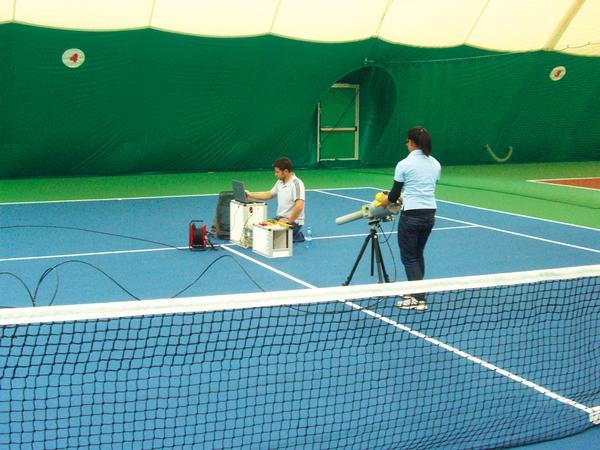
Upon completion, the four double court surfaces received ITF Two-Star Recognition after a testing process that took two days. This process involved a team of ITF technicians who visually checked that the court surfaces were uniform, free of gaps and cracks and that there was no deviation of evenness, slope and planarity. Tests were also conducted at key spots across the courts and ball pace was measured.
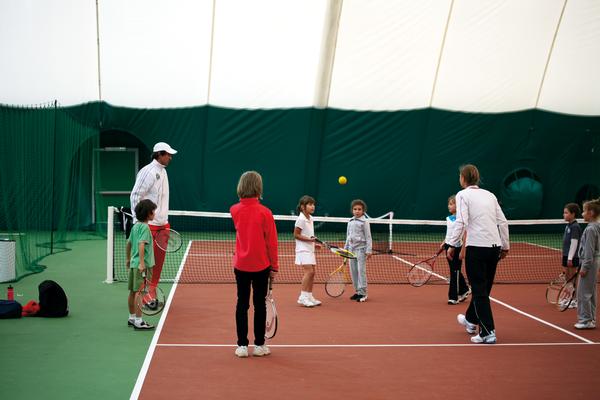
The Tennis Park markets these courts for use by children, young adults and disabled players. As well as hosting tennis coaching sessions and fun activities, the facility operator also organises regular tennis tournaments for young players. These include the All Russia Tennis Tournament, which involves 120 players aged between nine and 12 years old and a monthly Tennis 10s tournament for six- to seven-year-olds. An Amateur tennis tournament and the Russia Cup is also hosted at the facility.
Using its links with the Russian Tennis Federation, the Tennis Park is currently planning a children’s tennis camp at Tennis Centre Makarska in Croatia.
The Tennis Park offers children’s tennis lessons and tournaments.
The court testing process took a team of ITF technicians two days to complete
A laser level is used to establish the slope and planarity of the court, during the testing of a court against ITF standards
Court pace is deemed slow or fast depending on the surface smoothness
An evenness test measures the size of bumps or dips in the tennis court surface, using a straight line edge
An evenness test measures the size of bumps or dips in the tennis court surface, using a straight line edge
The position of the court markings and net are checked to ensure
that they are within tolerance
In today’s premium spa environment, every detail shapes the guest experience – right down to
the softness of towels and the freshness of linens. [more...]
The Spa Life UK Convention returns from 21–23 June 2026 at Whittlebury Park Hotel, Spa &
Golf Resort, bringing together spa managers, directors and owners for two days of focused
education, meaningful connection and commercial insight. [more...]
+ More featured suppliers
COMPANY PROFILES
Subtle Energies
With 30 years of clinical research, Subtle Energies is widely recognised for its
authentic wellness [more...]
Spa Supply Solutions
Founded in 2014 by spa management expert Julie Bevilacqua, Spa Supply Solutions is a leader in spa p [more...]
Jamie Capel-Davies outlines the process and benefits relating to the International Tennis Federation’s (ITF) independent assessment of quality tennis courts
Marin Cilic of Croatia in the Quarter Final during the 2010 Australian Open tennis tournament
With an estimated *US$30bn (£19.6bn) having been invested in tennis court construction worldwide, it is understandable that investors and players are keen to know the quality of construction and, increasingly, how fast or slow a court plays.
In response to this need, the International Tennis Federation’s (ITF) science and technical department has established ITF Recognition to provide end-users with an independent assessment of the quality of their court, and offers contractors an opportunity to demonstrate the calibre of their products and installation skills.
WHAT IS ITF RECOGNITION? ITF Recognition is a test-based programme. To receive One-Star Recognition, the court’s key installation properties must meet ITF recommendations.
Testing begins with a visual inspection to identify any cracks or gaps in the surface and ensure a uniform appearance. Next, an evenness test measures the size of any bumps or dips in the surface with the use of a straight edge, and the slope and planarity of the court are established with a laser level. Finally, the position of the court markings and net are checked to ensure they are within tolerance.
Two-Star Recognition requires the court pace rating (CPR) to be compared with the ITF-classified value for the surface product, in addition to the One-Star tests described above.
The pace is quantified by firing a ball at the court and recording its speed before and after the bounce. Rougher surfaces, which generate more friction between the ball and the court, reduce the speed of the ball parallel to the ground making a court ‘slower’. Surfaces that have a higher bounce also appear slower because players have more time to reach the ball.
There are currently more than 200 surface products classified by the ITF. Surfaces are classified into one of five categories: slow, medium-slow, medium, medium-fast and fast, and listed on the ITF website: www.itftennis.com/technical/equipment/courts/courtlist.asp
WHO CAN APPLY FOR ITF RECOGNITION? ITF Recognition is targeted at venues where the standard of play is high and the quality of the court is therefore most important. These include the Davis Cup by BNP Paribas and Fed Cup by BNP Paribas venues as well as national tennis centres. To date, One-Star ITF Recognition has been issued to the centre court at the La Caja Magica (Magic Box) stadium in Madrid (home of the Madrid Masters tennis tournament) and two indoor courts at the UK’s Lawn Tennis Association’s National Tennis Centre in Roehampton.
Two-Star ITF Recognition has been awarded to all nine match courts installed by Spade Oak at the Eton Manor site in the Olympic Park, and four courts at the Tennis Park club in Moscow, installed by Concept 90.
An application for ITF Recognition can be submitted by any party associated with the tennis facility, for example the owner, the organiser of a tournament held at that facility, or the supplier or installer of the court.
One-Star tests are carried out by an ITF-approved test organisation, such as a surveying company, or an ITF-accredited laboratory. Two-Star tests are conducted by an ITF-accredited laboratory, which are listed on the ITF website: www.itftennis.com/technical/research/recognition/labs.asp
The ITF charges a US$500 (£391) administration fee to add a facility (any number of courts at the same location) that meets the relevant specifications to the official ITF Recognition list. The cost of testing is determined by the laboratory and is available on application.
FACILITIES GUIDE AND DIRECTORY The ITF has established a working group of facilities experts from major tennis-playing nations to design and develop an international Facilities Guide, which represents ‘best practice’ from around the world. It’s a simple reference for those wanting to build a tennis court and offers information about layout design and choosing and maintaining surfaces: www.itftennis.com/technical/facilities
The Suppliers’ Directory allows users to search for tennis facility products and services and identify ITF-Recognised suppliers: http://tds.itftennis.com
For more information, please email [email protected] or visit the ITF website: www.itftennis.com
* US$30bn (£18.9bn) is a ballpark figure produced from an estimate of 750,000 courts worldwide at an average cost of US$40,000 (£25,000) per court. The number of courts is based on a survey of the ITF member nations in 2004/2005.
Jamie Capel-Davies is science and technical manager at the ITF
HOW TO GET ITF RECOGNITION 1. Submit an application for One- or Two-Star Recognition* to the ITF and pay the administration fee. 2. Select an ITF-accredited laboratory/ITF-approved surveyor and arrange a test date and test fee payment. 3. Have the court(s) tested and the report(s) sent to the ITF. 4. Receive an ITF Recognition certificate from the ITF and website listing for the court(s)**.
* Two-Star Recognition cannot be awarded without comparison against an ITF-classified surface product. If the surface product is not classified, the product supplier can apply for classification using the results of the CPR test on-site.
** Subject to meeting the relevant specifications.
CASE STUDY Tennis Park, Moscow Four double, indoor courts at the Tennis Park in Moscow, Russia, installed by Concept 90, have been awarded Two-Star ITF Recognition.
Concept 90 is an active member of the International Tennis foundation (ITF) and the Russian Tennis Federation (RTF). Investing into continuous tennis surface research and development, the company has developed court surfaces that offer players a good standard of play with a minimum chance of injury.
These indoor and outdoor surfaces are suitable for tournament, training and recreational use and include acrylic RuKort, PVC RuKort, artificial turf RuKortGrass and red artificial turf RuKortXClay, which is an imitation of clay court and RuKortTenisit.
The surface installed at the Tennis Park in Moscow is RukortTour, a hard, acrylic surface on 55mm rubber matting. It is ITF certified and used for tennis tournaments across Russia, Croatia and Kazakhstan.
The company designed, built and installed a 138m x 37.5m air hall encompassing 10 courts (four double and six single). The air structure took 25 days to build and the tennis surfacing 15 days. Part of this process involved adjusting the dimensions and marking some of the standard-sized courts to allow for children’s competitions within the facility, in accordance with ITF Tennis 10s rules.
Upon completion, the four double court surfaces received ITF Two-Star Recognition after a testing process that took two days. This process involved a team of ITF technicians who visually checked that the court surfaces were uniform, free of gaps and cracks and that there was no deviation of evenness, slope and planarity. Tests were also conducted at key spots across the courts and ball pace was measured.
The Tennis Park markets these courts for use by children, young adults and disabled players. As well as hosting tennis coaching sessions and fun activities, the facility operator also organises regular tennis tournaments for young players. These include the All Russia Tennis Tournament, which involves 120 players aged between nine and 12 years old and a monthly Tennis 10s tournament for six- to seven-year-olds. An Amateur tennis tournament and the Russia Cup is also hosted at the facility.
Using its links with the Russian Tennis Federation, the Tennis Park is currently planning a children’s tennis camp at Tennis Centre Makarska in Croatia.
The Tennis Park offers children’s tennis lessons and tournaments.
The court testing process took a team of ITF technicians two days to complete
A laser level is used to establish the slope and planarity of the court, during the testing of a court against ITF standards
Court pace is deemed slow or fast depending on the surface smoothness
An evenness test measures the size of bumps or dips in the tennis court surface, using a straight line edge
An evenness test measures the size of bumps or dips in the tennis court surface, using a straight line edge
The position of the court markings and net are checked to ensure
that they are within tolerance
Global Wellness Day (GWD) will mark its 15th anniversary on Saturday 13 June 2026, with the
theme: #JoyMagenta – a celebration of the healing qualities of simple gestures and activities
that spark joy.
Global luxury hospitality brand, Six Senses, has partnered with longevity healthcare provider,
HUM2N, to launch a clinic at Six Senses London, at The Whiteley.
As part of its first hotel partnership, Mayrlife – the medical health resort company known for its
site in Altaussee, Austria – has launched a day clinic at the Rosewood Vienna.
Premium London health club, KX Chelsea, will imminently unveil its most significant
redevelopment since its launch in 2002 to create an integrated wellness model combining
training, recovery and relaxation.
Rosewood Le Guanahani St Barth, on the northeast coast of Saint Barthélemy in the French
West Indies, is offering a programme of ocean-inspired yoga classes between 8-14 June to
celebrate Global Wellness Day (GWD).
Hotel de France, located on the British Isle of Jersey, has created a wellness retreat package
that includes a hot yoga session that will take place in Jersey Zoo’s butterfly sanctuary.
The Ritz-Carlton, Langkawi, in Malaysia, has revealed a schedule for Global Wellness Day
(GWD) that includes guided rainforest walks, mindful movement and guided coastal meditation
experiences.
Longevitix, a clinical platform for preventive and longevity medicine, has launched its AI-
powered intelligence system to help physicians deliver continuous, personalised longevity-
focused care at scale.
Atmantan Wellness Centre, an integrative wellness destination in Mulshi, near Pune in India, is
expanding its portfolio by adding a new centre in Hyderabad that will launch between 2028 and
2029.
A recent survey by the UK Spa Association (UKSA) into the industry’s approach to cancer care
has revealed that almost half of participating respondents (46 per cent) are unaware that
cancer is a disability and guests with a cancer diagnosis must be given
In today’s premium spa environment, every detail shapes the guest experience – right down to
the softness of towels and the freshness of linens. [more...]
The Spa Life UK Convention returns from 21–23 June 2026 at Whittlebury Park Hotel, Spa &
Golf Resort, bringing together spa managers, directors and owners for two days of focused
education, meaningful connection and commercial insight. [more...]
+ More featured suppliers
COMPANY PROFILES
Subtle Energies With 30 years of clinical research, Subtle Energies is widely recognised for its
authentic wellness [more...]