Yes! Send me the FREE digital editions of Spa Business and Spa Business insider magazines and the FREE weekly Spa Business and Spa Business insider ezines and breaking news alerts!
As part of Health Club Management’s series on behaviour change, Dr Tim Anstiss offers practical advice for delivering health coaching: questions, tools and strategies
By Dr Tim Anstiss | Published in Health Club Management 2013 issue 6
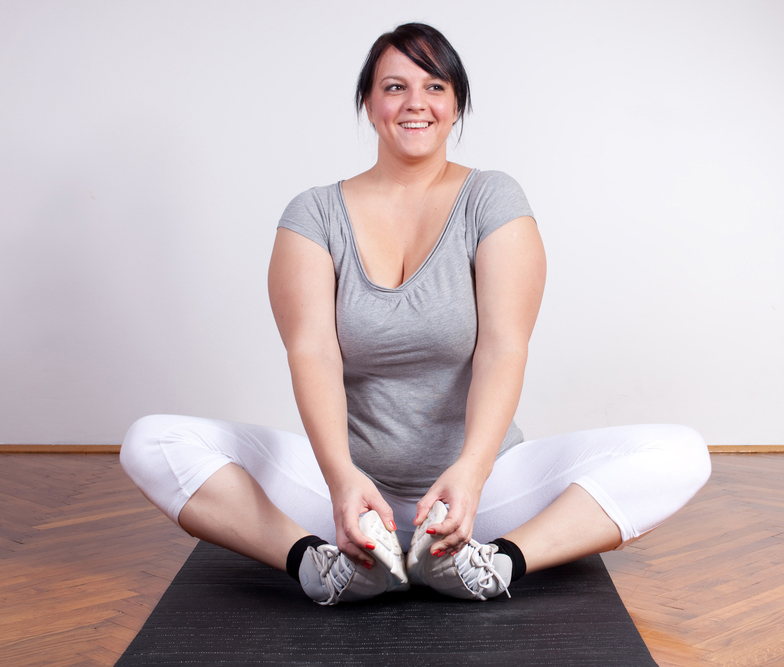
Coaching can help unlock a person's full potential
More and more people are developing and living with long-term conditions such as diabetes, obesity, heart disease, cancer and arthritis. That’s partly because we are living longer, partly due to better medical care keeping us alive with health problems that used to kill us, and partly due to unhealthy lifestyles such as poor diet, lack of exercise, smoking and so on.
So how might we best help individuals who are experiencing poor health and wellbeing, including those who are already receiving good medical care? And how can we help healthy people to stay that way? Health coaching is one approach that’s becoming popular.
What is health coaching? The first part of Health Club Management’s behaviour change series looked at the individual as expert (see HCM May 13, p46). Health coaching sits very much alongside this: it’s an approach to helping someone that involves guiding them and supporting them, rather than instructing them on what to do.
Coaching has been defined by The Association for Coaching as “a collaborative, solution-focused, results-orientated and systematic process in which the coach facilitates the enhancement of work performance, life experience, self-directed learning and personal growth of the coachee”. Other definitions of coaching include “unlocking a person’s potential to maximise their own performance. It is helping them to learn rather than teaching them” (Whitmore, 2003).
Health coaching, by extension, is the application of coaching psychology to help a person change their behaviour and aspects of their lifestyle in ways that are likely to be associated with improved health, reduced risk of disease or disease complications, and enhanced functional capacity (their ability to do things). One definition of health coaching might be: “A collaborative conversation style for strengthening a person’s own motivation and commitment to change, coupled with guidance and support in helping them make changes likely to result in improved health” (adapted from Miller and Rollnick, 2013).
A large and growing body of research links this way of talking to people with better outcomes in a range of different behaviours and settings. It helps people to eat better, lose weight, stop smoking, become more active and drink less. So how do you do health coaching?
Undertaking health coaching Firstly, it helps to have the right mindset and assumptions about behaviour change. The effective health coach: • Has an optimistic view of people’s ability to change • Knows that if the person being coached tells you the reasons why they want to change, and how they might do it, it’s much more powerful than the coach telling them • Accepts that the other person is the ultimate decision-maker, not the coach • Works in partnership with the other person, doing coaching with them, not to them • Creates the right conditions for the person to think things through for themselves
The effective health coach uses empathic listening to help the other person feel listened to, heard and understood. This is a very active form of listening involving accurately paraphrasing and reflecting back what a person says, but using different words that capture the same meaning. It helps to get the person talking more and perhaps understanding themselves better. These ‘reflections’ are combined with summaries that draw together several things the person has said into a few sentences – summaries that are used occasionally throughout the session to check understanding, to move the conversation along, and to bring the conversation to a close.
A nice summary might – of course depending on what the person has said – sound something like: “The main reasons you want to lose weight are to feel better about yourself, get into some of your favourite clothes, and get more involved in activities with your two young children. Joining the club is something you’ve been thinking about for a long time, and you’re really looking forward to attending the classes and getting support from other people. You think you will be able to attend three times a week, and you and I will talk again in two weeks’ time to see how it’s going.”
It cannot be emphasised enough how important empathy – trying to understand the world from the other person’s perspective, and communicating this effort – is for change and good relationships. It probably accounts for 30 per cent of the power in a typical health coaching conversation.
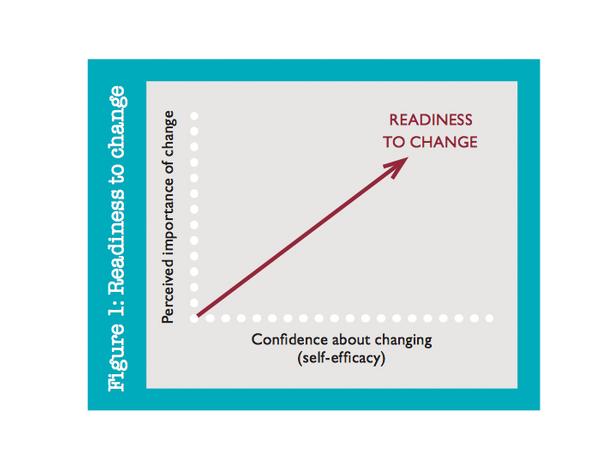
Readiness for change The health coach knows that a person’s readiness to change their behaviour is related to how important they think changing the behaviour is, combined with their self-efficacy – that is, how confident they are that they can change (see Figure 1) To build perceived importance for change, the health coach asks open questions such as: • Why might you want to make this change? • What are your three best reasons? • How do you hope things will be in four to five months’ time, once you have changed your behaviour? • How do you think things will be if you stay the same?
These questions are combined with reflections to help the person think more deeply and talk about why they want to change.
To build self-efficacy or confidence about changing, the health coach might use a scaling question such as: “How confident are you that you can eat better and keep this up for six months, where 0 is not at all confident and 10 is very confident?” Let’s assume the person says 4 (the number is not that important to be honest) – the coach then asks: “Why 4 – why not 1 or 2? Where do you get your confidence from?” and lets the person talk.
Once the person has explained why they have some degree of confidence, the coach asks: “And what would have to happen for your confidence to become 6?” This gets the person thinking a little more deeply about what they need to do in order to change and stay changed, and also the help they need to be successful.
If they are stuck, the coach might suggest some further proven behaviour change techniques such as goal setting, self-monitoring, using social support and periodic follow-up. If the person shows interest, the coach explores how these might fit into the client’s behaviour change plan.
Tapping inner resources The skillful health coach knows that it’s better to discover what a person already knows about something than it is to jump in with information. They use open questions such as “what do you know about how much physical activity is required for health?” and “what do you know about the benefits of strength training?” If the person doesn’t know much, or has some wrong information, the coach might first ask to share some additional information. Once they have shared it, they then ask: “What do you make of what I have just said?” This little sequence – Ask-Share-Ask – is respectful of the other person, helps the coach understand their knowledge first, prevents information overload, and helps check understanding.
Throughout the conversation, the health coach uses an ‘evoking’ style to draw information from within the person, rather than filling them with facts and information from the outside. This style is much more likely to lead to engagement in the conversation and to the person owning any behaviour change plan, rather than making them feel as though it’s been imposed on them.
Key to engagement and evoking is the use of open rather than closed questions. Rather than asking questions such as “could you go for a walk at lunchtime?” or “have you thought about eating more fruit?”, the skillful health coach asks questions that are hard to answer with just one word, such as:
• How might you go about taking 30 minutes of moderate activity a day?
• What do you think would happen if you were able to eat more fruit and vegetables each day?
• What’s the first step you could take to help you reach your goal?
• How can I help you to succeed?
It can also be helpful to have a model or framework in your head that will help to guide the coaching conversation, such as the GROW model. In this model, the coach starts by enquiring about the person's own Goals. Then you explore with them how things are now: their Reality. Then you explore and share Options for change. And finally you agree a Way forward.
Summary Health coaching is a powerful approach to helping people change their health behaviour. As noted by Debbie Lawrence in last month’s feature, however, many people working in the health and fitness sector will have to ‘unlearn’ some of their own behaviours (such as telling people why and how to change) before they can really start to become an effective health coach.
Nevertheless, if all health and fitness professionals were trained in proven methods of health coaching such as motivational interviewing, more members would achieve their health goals, retention figures would climb – and the health of the nation might just improve.
Next month I will share my top tips for wellbeing coaching, which will build on the concepts covered in this article.
Tim Anstiss is a medical doctor who has been training health professionals in the use of behaviour change techniques for over 20 years. He helped develop the training materials for the Let’s Get Moving national programme for physical activity, and co-authored a National Obesity Observatory report on weight loss. He is currently training cancer clinicians in health coaching as part of the National Cancer Survivorship Initiative, and is developing a health coaching qualification in conjunction with SkillsActive. He is also a former international polevaulter and Gladiators contender.
In the fast-paced world of fitness and wellness, where high-intensity workouts push us to
our limits and the sweat pours, the importance of efficient recovery cannot be overstated. [more...]
+ More featured suppliers
COMPANY PROFILES
Living Earth Crafts
For over 50 years, LEC has been manufacturing award-winning spa equipment for the world’s finest spas [more...]
Trybe
Trybe was founded back in 2020, and the past five years has seen Trybe become the fastest growing al [more...]
As part of Health Club Management’s series on behaviour change, Dr Tim Anstiss offers practical advice for delivering health coaching: questions, tools and strategies
By Dr Tim Anstiss | Published in Health Club Management 2013 issue 6
Coaching can help unlock a person's full potential
More and more people are developing and living with long-term conditions such as diabetes, obesity, heart disease, cancer and arthritis. That’s partly because we are living longer, partly due to better medical care keeping us alive with health problems that used to kill us, and partly due to unhealthy lifestyles such as poor diet, lack of exercise, smoking and so on.
So how might we best help individuals who are experiencing poor health and wellbeing, including those who are already receiving good medical care? And how can we help healthy people to stay that way? Health coaching is one approach that’s becoming popular.
What is health coaching? The first part of Health Club Management’s behaviour change series looked at the individual as expert (see HCM May 13, p46). Health coaching sits very much alongside this: it’s an approach to helping someone that involves guiding them and supporting them, rather than instructing them on what to do.
Coaching has been defined by The Association for Coaching as “a collaborative, solution-focused, results-orientated and systematic process in which the coach facilitates the enhancement of work performance, life experience, self-directed learning and personal growth of the coachee”. Other definitions of coaching include “unlocking a person’s potential to maximise their own performance. It is helping them to learn rather than teaching them” (Whitmore, 2003).
Health coaching, by extension, is the application of coaching psychology to help a person change their behaviour and aspects of their lifestyle in ways that are likely to be associated with improved health, reduced risk of disease or disease complications, and enhanced functional capacity (their ability to do things). One definition of health coaching might be: “A collaborative conversation style for strengthening a person’s own motivation and commitment to change, coupled with guidance and support in helping them make changes likely to result in improved health” (adapted from Miller and Rollnick, 2013).
A large and growing body of research links this way of talking to people with better outcomes in a range of different behaviours and settings. It helps people to eat better, lose weight, stop smoking, become more active and drink less. So how do you do health coaching?
Undertaking health coaching Firstly, it helps to have the right mindset and assumptions about behaviour change. The effective health coach: • Has an optimistic view of people’s ability to change • Knows that if the person being coached tells you the reasons why they want to change, and how they might do it, it’s much more powerful than the coach telling them • Accepts that the other person is the ultimate decision-maker, not the coach • Works in partnership with the other person, doing coaching with them, not to them • Creates the right conditions for the person to think things through for themselves
The effective health coach uses empathic listening to help the other person feel listened to, heard and understood. This is a very active form of listening involving accurately paraphrasing and reflecting back what a person says, but using different words that capture the same meaning. It helps to get the person talking more and perhaps understanding themselves better. These ‘reflections’ are combined with summaries that draw together several things the person has said into a few sentences – summaries that are used occasionally throughout the session to check understanding, to move the conversation along, and to bring the conversation to a close.
A nice summary might – of course depending on what the person has said – sound something like: “The main reasons you want to lose weight are to feel better about yourself, get into some of your favourite clothes, and get more involved in activities with your two young children. Joining the club is something you’ve been thinking about for a long time, and you’re really looking forward to attending the classes and getting support from other people. You think you will be able to attend three times a week, and you and I will talk again in two weeks’ time to see how it’s going.”
It cannot be emphasised enough how important empathy – trying to understand the world from the other person’s perspective, and communicating this effort – is for change and good relationships. It probably accounts for 30 per cent of the power in a typical health coaching conversation.
Readiness for change The health coach knows that a person’s readiness to change their behaviour is related to how important they think changing the behaviour is, combined with their self-efficacy – that is, how confident they are that they can change (see Figure 1) To build perceived importance for change, the health coach asks open questions such as: • Why might you want to make this change? • What are your three best reasons? • How do you hope things will be in four to five months’ time, once you have changed your behaviour? • How do you think things will be if you stay the same?
These questions are combined with reflections to help the person think more deeply and talk about why they want to change.
To build self-efficacy or confidence about changing, the health coach might use a scaling question such as: “How confident are you that you can eat better and keep this up for six months, where 0 is not at all confident and 10 is very confident?” Let’s assume the person says 4 (the number is not that important to be honest) – the coach then asks: “Why 4 – why not 1 or 2? Where do you get your confidence from?” and lets the person talk.
Once the person has explained why they have some degree of confidence, the coach asks: “And what would have to happen for your confidence to become 6?” This gets the person thinking a little more deeply about what they need to do in order to change and stay changed, and also the help they need to be successful.
If they are stuck, the coach might suggest some further proven behaviour change techniques such as goal setting, self-monitoring, using social support and periodic follow-up. If the person shows interest, the coach explores how these might fit into the client’s behaviour change plan.
Tapping inner resources The skillful health coach knows that it’s better to discover what a person already knows about something than it is to jump in with information. They use open questions such as “what do you know about how much physical activity is required for health?” and “what do you know about the benefits of strength training?” If the person doesn’t know much, or has some wrong information, the coach might first ask to share some additional information. Once they have shared it, they then ask: “What do you make of what I have just said?” This little sequence – Ask-Share-Ask – is respectful of the other person, helps the coach understand their knowledge first, prevents information overload, and helps check understanding.
Throughout the conversation, the health coach uses an ‘evoking’ style to draw information from within the person, rather than filling them with facts and information from the outside. This style is much more likely to lead to engagement in the conversation and to the person owning any behaviour change plan, rather than making them feel as though it’s been imposed on them.
Key to engagement and evoking is the use of open rather than closed questions. Rather than asking questions such as “could you go for a walk at lunchtime?” or “have you thought about eating more fruit?”, the skillful health coach asks questions that are hard to answer with just one word, such as:
• How might you go about taking 30 minutes of moderate activity a day?
• What do you think would happen if you were able to eat more fruit and vegetables each day?
• What’s the first step you could take to help you reach your goal?
• How can I help you to succeed?
It can also be helpful to have a model or framework in your head that will help to guide the coaching conversation, such as the GROW model. In this model, the coach starts by enquiring about the person's own Goals. Then you explore with them how things are now: their Reality. Then you explore and share Options for change. And finally you agree a Way forward.
Summary Health coaching is a powerful approach to helping people change their health behaviour. As noted by Debbie Lawrence in last month’s feature, however, many people working in the health and fitness sector will have to ‘unlearn’ some of their own behaviours (such as telling people why and how to change) before they can really start to become an effective health coach.
Nevertheless, if all health and fitness professionals were trained in proven methods of health coaching such as motivational interviewing, more members would achieve their health goals, retention figures would climb – and the health of the nation might just improve.
Next month I will share my top tips for wellbeing coaching, which will build on the concepts covered in this article.
Tim Anstiss is a medical doctor who has been training health professionals in the use of behaviour change techniques for over 20 years. He helped develop the training materials for the Let’s Get Moving national programme for physical activity, and co-authored a National Obesity Observatory report on weight loss. He is currently training cancer clinicians in health coaching as part of the National Cancer Survivorship Initiative, and is developing a health coaching qualification in conjunction with SkillsActive. He is also a former international polevaulter and Gladiators contender.
Global Wellness Day (GWD) marked its 15th anniversary on Saturday 13 June 2026, with the
theme: #JoyMagenta – a celebration of the healing qualities of simple gestures and activities
that spark joy.
Global luxury hospitality brand, Six Senses, has partnered with longevity healthcare provider,
HUM2N, to launch a clinic at Six Senses London, at The Whiteley.
As part of its first hotel partnership, Mayrlife – the medical health resort company known for its
site in Altaussee, Austria – has launched a day clinic at the Rosewood Vienna.
Premium London health club, KX Chelsea, will imminently unveil its most significant
redevelopment since its launch in 2002 to create an integrated wellness model combining
training, recovery and relaxation.
Rosewood Le Guanahani St Barth, on the northeast coast of Saint Barthélemy in the French
West Indies, is offering a programme of ocean-inspired yoga classes between 8-14 June to
celebrate Global Wellness Day (GWD).
Hotel de France, located on the British Isle of Jersey, has created a wellness retreat package
that includes a hot yoga session that will take place in Jersey Zoo’s butterfly sanctuary.
The Ritz-Carlton, Langkawi, in Malaysia, has revealed a schedule for Global Wellness Day
(GWD) that includes guided rainforest walks, mindful movement and guided coastal meditation
experiences.
Longevitix, a clinical platform for preventive and longevity medicine, has launched its AI-
powered intelligence system to help physicians deliver continuous, personalised longevity-
focused care at scale.
Atmantan Wellness Centre, an integrative wellness destination in Mulshi, near Pune in India, is
expanding its portfolio by adding a new centre in Hyderabad that will launch between 2028 and
2029.
In the fast-paced world of fitness and wellness, where high-intensity workouts push us to
our limits and the sweat pours, the importance of efficient recovery cannot be overstated. [more...]
+ More featured suppliers
COMPANY PROFILES
Living Earth Crafts For over 50 years, LEC has been manufacturing award-winning spa equipment for the world’s finest spas [more...]