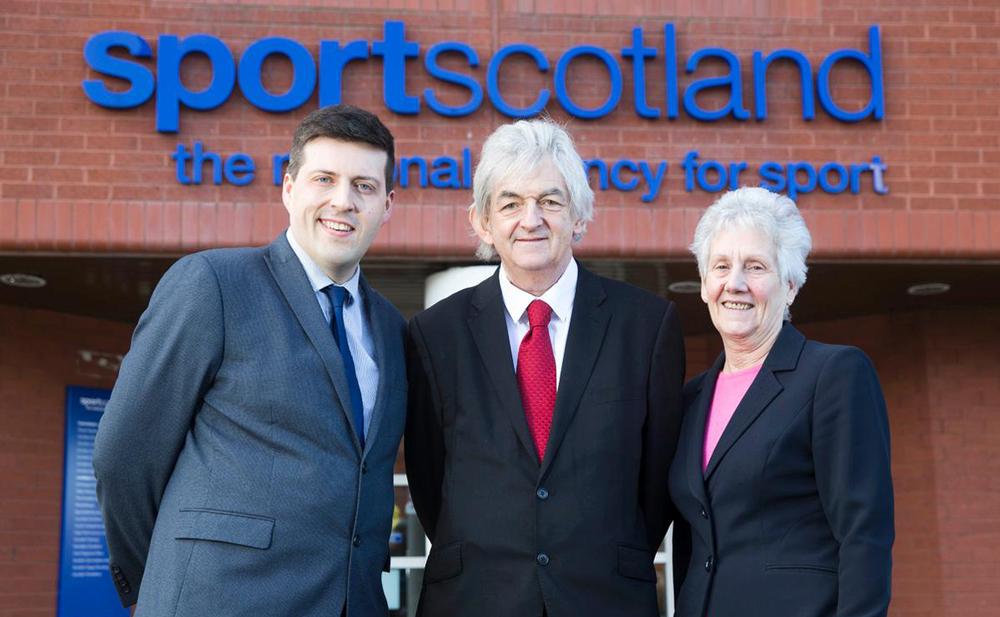
Young (centre) stands with Louise Martin (right), who served as sportscotland chair for eight years, and former Scottish sports minister Jamie Hepburn (left)
If you want to talk to someone about using sport for social good, you could do worse than strike up a conversation with Mel Young. Described as a social entrepreneur, Young was the founder of the Homeless World Cup, which has been the springboard for hundreds of young homeless people to improve their lives.
He also co-founded The Big Issue in Scotland, and with his recent appointment as chair of grassroots funding organisation sportscotland, he is now in a position to create a sporting landscape that positively impacts the lives of everyone.
After appointing Young to replace Louise Martin as chair in June 2016, former Scottish sports minister Jamie Hepburn commented that Young understands sport’s role in “improving people’s lives, particularly if they come from disadvantaged backgrounds”.
Last month, sportscotland joined forces with the Lawn Tennis Association (LTA) to plough £15m into the development of more than 100 indoor tennis facilities, doubling the current number of 112 to 225 over the next five to 10 years.
Young says he wanted the scheme – which is the biggest capital investment sportscotland has ever made in tennis – to bring venues to areas of the country with hard-to-reach demographics.
Providing opportunities “We’ll look at some existing sporting facilities that don’t have indoor tennis facilities and bolt that on, and we’ll have a look at areas that don’t have any at all,” he tells Sports Management. “I’m interested in poorer areas of big cities that don’t have anything and where kids don’t get the opportunity. We’re also looking at rural areas where people might want to play tennis but have no facilities.”
Getting children, particularly from poorer backgrounds, to take part in regular physical activity is something of a priority in Scotland, with rising levels of obesity and lower life-expectancy.
In fact, the Healthy Lifestyle Strategy published by the Scottish Conservative Party earlier this month – alongside SportsAid Scotland and Youth Link Scotland – showed a 12-year gap in life expectancy between those living in the wealthiest parts of Scotland, and those in the poorest.
A Health and Sport Committee set up by the Scottish Parliament will investigate the barriers to entry that people in Scotland face when trying to participate in sport, meaning Young’s goals should be taken with encouragement. Building new facilities, however, is only half the battle.
Young explains that while it is great that grassroots sporting venues are being built, they must be affordable for everyone in society or the opportunity is lost.
He says: “It’s all about how much it costs to get in. If people don’t have the money they won’t use the facility. So it’s all about us working out a way in which everyone can get a shot at this if they want.
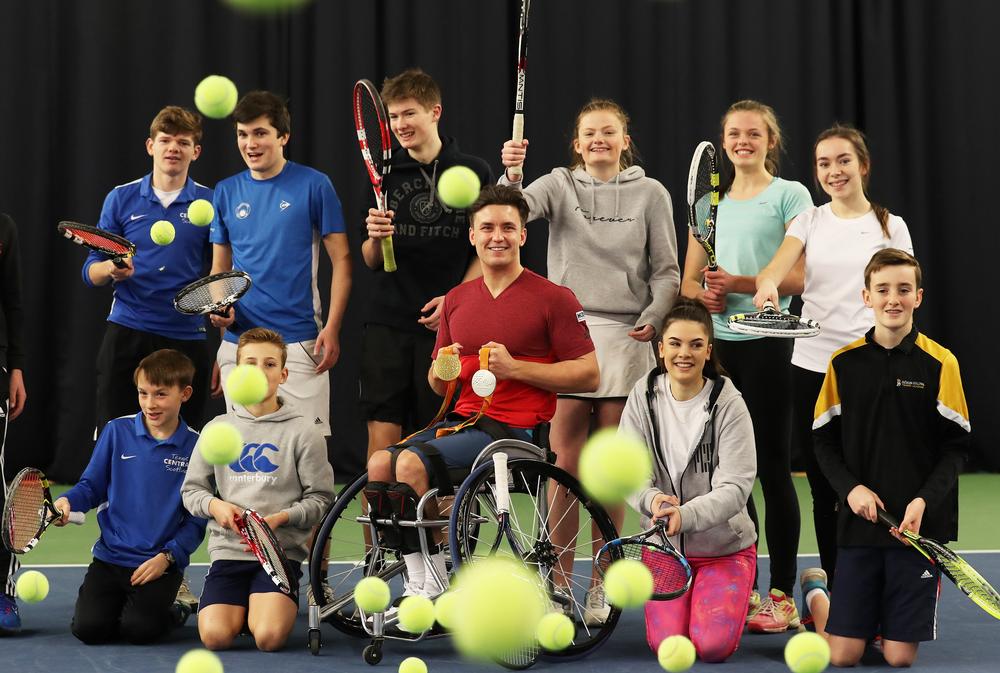
“We’re targeting school kids; both primary school and secondary school age. If we can also get good coaches in place, I’m convinced people will join in with tennis.”
Facilities pipeline Sportscotland is on the hunt for local authority and leisure trusts partners to work alongside the tennis scheme, which they hope can provide extra finance, then all the better, says Young.
He reveals that there are similar projects for other sports in the pipeline, and said some of the work sportscotland was doing on impressive national facilities demonstrated the body’s commitment to increasing opportunities.
Last year, the ribbon was cut on the £33m Oriam Centre on the Edinburgh campus of Heriot-Watt University. The facilities includes a Hampden Park-standard grass pitch, an outdoor synthetic pitch, a 12-court sports hall, a 3G indoor pitch, Scotland’s only glass-back squash court and a 120-station fitness suite.
The Reiach and Hall-designed National Centre Inverclyde is due for completion soon. Young dubs it “one of the best facilities for disability sports in Britain”.
Costing £12m to construct, the venue will be used to host para-sport events, and will house sports equipment, facilities and accommodation under one roof.
“There’s a lot going on,” says Young enthusiastically. “It’s an exciting time.
“We have the ambition to make Scotland a really sporty nation. We want to win lots of medals at international events, but I think it’s critical that everyone is involved.
“There are loads of issues around inactivity in Scotland, so I want everyone out there playing and having fun.”
In the fast-paced world of fitness and wellness, where high-intensity workouts push us to
our limits and the sweat pours, the importance of efficient recovery cannot be overstated. [more...]
+ More featured suppliers
COMPANY PROFILES
Hydrafacial
Founded in 1997, Hydrafacial has grown to become one of the world’s leading skin health brands. [more...]
Barr + Wray Ltd
Barr + Wray has more than 60 years’ experience in the design and delivery of world-class spa and wel [more...]
Young (centre) stands with Louise Martin (right), who served as sportscotland chair for eight years, and former Scottish sports minister Jamie Hepburn (left)
If you want to talk to someone about using sport for social good, you could do worse than strike up a conversation with Mel Young. Described as a social entrepreneur, Young was the founder of the Homeless World Cup, which has been the springboard for hundreds of young homeless people to improve their lives.
He also co-founded The Big Issue in Scotland, and with his recent appointment as chair of grassroots funding organisation sportscotland, he is now in a position to create a sporting landscape that positively impacts the lives of everyone.
After appointing Young to replace Louise Martin as chair in June 2016, former Scottish sports minister Jamie Hepburn commented that Young understands sport’s role in “improving people’s lives, particularly if they come from disadvantaged backgrounds”.
Last month, sportscotland joined forces with the Lawn Tennis Association (LTA) to plough £15m into the development of more than 100 indoor tennis facilities, doubling the current number of 112 to 225 over the next five to 10 years.
Young says he wanted the scheme – which is the biggest capital investment sportscotland has ever made in tennis – to bring venues to areas of the country with hard-to-reach demographics.
Providing opportunities “We’ll look at some existing sporting facilities that don’t have indoor tennis facilities and bolt that on, and we’ll have a look at areas that don’t have any at all,” he tells Sports Management. “I’m interested in poorer areas of big cities that don’t have anything and where kids don’t get the opportunity. We’re also looking at rural areas where people might want to play tennis but have no facilities.”
Getting children, particularly from poorer backgrounds, to take part in regular physical activity is something of a priority in Scotland, with rising levels of obesity and lower life-expectancy.
In fact, the Healthy Lifestyle Strategy published by the Scottish Conservative Party earlier this month – alongside SportsAid Scotland and Youth Link Scotland – showed a 12-year gap in life expectancy between those living in the wealthiest parts of Scotland, and those in the poorest.
A Health and Sport Committee set up by the Scottish Parliament will investigate the barriers to entry that people in Scotland face when trying to participate in sport, meaning Young’s goals should be taken with encouragement. Building new facilities, however, is only half the battle.
Young explains that while it is great that grassroots sporting venues are being built, they must be affordable for everyone in society or the opportunity is lost.
He says: “It’s all about how much it costs to get in. If people don’t have the money they won’t use the facility. So it’s all about us working out a way in which everyone can get a shot at this if they want.
“We’re targeting school kids; both primary school and secondary school age. If we can also get good coaches in place, I’m convinced people will join in with tennis.”
Facilities pipeline Sportscotland is on the hunt for local authority and leisure trusts partners to work alongside the tennis scheme, which they hope can provide extra finance, then all the better, says Young.
He reveals that there are similar projects for other sports in the pipeline, and said some of the work sportscotland was doing on impressive national facilities demonstrated the body’s commitment to increasing opportunities.
Last year, the ribbon was cut on the £33m Oriam Centre on the Edinburgh campus of Heriot-Watt University. The facilities includes a Hampden Park-standard grass pitch, an outdoor synthetic pitch, a 12-court sports hall, a 3G indoor pitch, Scotland’s only glass-back squash court and a 120-station fitness suite.
The Reiach and Hall-designed National Centre Inverclyde is due for completion soon. Young dubs it “one of the best facilities for disability sports in Britain”.
Costing £12m to construct, the venue will be used to host para-sport events, and will house sports equipment, facilities and accommodation under one roof.
“There’s a lot going on,” says Young enthusiastically. “It’s an exciting time.
“We have the ambition to make Scotland a really sporty nation. We want to win lots of medals at international events, but I think it’s critical that everyone is involved.
“There are loads of issues around inactivity in Scotland, so I want everyone out there playing and having fun.”
Global Wellness Day (GWD) marked its 15th anniversary on Saturday 13 June 2026, with the
theme: #JoyMagenta – a celebration of the healing qualities of simple gestures and activities
that spark joy.
Global luxury hospitality brand, Six Senses, has partnered with longevity healthcare provider,
HUM2N, to launch a clinic at Six Senses London, at The Whiteley.
As part of its first hotel partnership, Mayrlife – the medical health resort company known for its
site in Altaussee, Austria – has launched a day clinic at the Rosewood Vienna.
Premium London health club, KX Chelsea, will imminently unveil its most significant
redevelopment since its launch in 2002 to create an integrated wellness model combining
training, recovery and relaxation.
Rosewood Le Guanahani St Barth, on the northeast coast of Saint Barthélemy in the French
West Indies, is offering a programme of ocean-inspired yoga classes between 8-14 June to
celebrate Global Wellness Day (GWD).
Hotel de France, located on the British Isle of Jersey, has created a wellness retreat package
that includes a hot yoga session that will take place in Jersey Zoo’s butterfly sanctuary.
The Ritz-Carlton, Langkawi, in Malaysia, has revealed a schedule for Global Wellness Day
(GWD) that includes guided rainforest walks, mindful movement and guided coastal meditation
experiences.
Longevitix, a clinical platform for preventive and longevity medicine, has launched its AI-
powered intelligence system to help physicians deliver continuous, personalised longevity-
focused care at scale.
Atmantan Wellness Centre, an integrative wellness destination in Mulshi, near Pune in India, is
expanding its portfolio by adding a new centre in Hyderabad that will launch between 2028 and
2029.
In the fast-paced world of fitness and wellness, where high-intensity workouts push us to
our limits and the sweat pours, the importance of efficient recovery cannot be overstated. [more...]
+ More featured suppliers
COMPANY PROFILES
Hydrafacial Founded in 1997, Hydrafacial has grown to become one of the world’s leading skin health brands. [more...]