Latest
issue
Uniting the world of spa & wellness
Get Spa Business and Spa Business insider digital magazines FREE
Sign up here ▸
News   Features   Products   Company profilesProfiles   Press releasesProfiles   Magazine   Handbook   Advertise    Subscribe  
NEWS
Active Uprising delegates told to “just do it” and not wait for government
POSTED 10 Mar 2025 . BY Kath Hudson
Team GB weight lifter, Emily Campbell, provided an inspiring finish to the day Credit: UK Active
Active Uprising strikes an upbeat tone
Fitness professionals were encouraged to just do it, not wait for the NHS or the government
The answer is in every locality, not just Whitehall
The sector can learn a lot from McDonald’s
Don’t wait for the government, or the NHS, to provide the solutions or the budget, just get on with it was a key takeaway from this year's Active Uprising conference.

The annual conference from trade body, UK Active, took place in London’s Queen Elizabeth II Centre on Thursday 6 March, welcoming health and business leaders. Talks and panel discussions included the sector’s potential to drive economic growth, careers, Gen Z, forming partnerships with the NHS and loyalty schemes.

As people continue to prioritise their spend on wellness, there was an optimistic tone. However, as the government faces a challenging economic situation and the NHS is facing serious challenges, many speakers called on the sector to be the solution, rather than wait for the NHS or the government to provide the lead.

The message was that partnerships made on a local level; being creative about setting up projects and then evaluating them and communicating their success are the key to making the breakthroughs the industry wants when it comes to partnering with the NHS and unlocking economic growth.

The NHS has no money

Speaking as part of a panel discussion on strengthening links with the NHS, William Roberts, CEO of Royal Society of Public Health, said it like it is: “There is no money and no social prescribing budget – the NHS is overspent by £3.9 billion at the moment. There are never any savings even if waiting lists get reduced.”

Strategic advisor to the Secretary of State for Health and Social Care, Paul Corrigan, who was interviewed by outgoing UK Active chair, Mike Farrar, said the same: “Social prescribing can keep someone from getting more ill, but how do you turn that into cash?”

Corrigan explained that a major hurdle to overcome is the financial model of the NHS, where GPs operate as small businesses and hospitals are their own separate entities. So while an intervention from a GP might keep someone out of hospital, it doesn’t generate any income for the GP to reinvest.

“The saving doesn’t come back to the cost,” he said.

Corrigan also warned of an approaching wave of doom: “The ageing population will grow considerably in the next 10 years. If we keep doing the same the NHS will collapse, it might already be collapsing. It needs some radical changes or we’ll be in big trouble.

“There is the aspiration to move out of firefighter mode, but we can’t do it alone. It’s not a vision which can just be delivered in Whitehall, the answer lies in every locality.”

When asked whether the sector should be flagging up the value it delivers to the economy via employment, he raised eyebrows with his statement that people working in the sector don't think of it as being a 'proper' job, saying, "Your industry attracts a whole bunch of people into jobs because they're interested in the process in their leisure time.

"They don't think about it as a job, they see it as an activity."

Many delegates were left feeling that there is work to do explaining the high levels of expertise that exist in the sector to the various branches of government and its agencies.

The government gets too many reports

UK Active board member and UK competitiveness director at CBI, Jordan Cummins, told delegates that the government gets numerous reports from multiple industries claiming they can unlock savings, so a fresh approach is needed in order for the sector to be heard.

“The industry needs to get MPs as excited about treadmills as they are about hard hats,” he said. “Treat health like we’ve been treating climate change: set a framework for measuring change – such as health expectancy or working years – and focus on two or three things which are doable in this parliamentary term to make a change. Whittle the priorities down and simplify the message.”

Cummins said that while some sectors struggle with the pitch, fitness offers tangible results and the sector has the advantage of being able to talk to numerous government departments.

Evidence and evaluation

We kept hearing that evidence is crucial. Priya Oomhadat, deputy director of rehabilitation NHS England, raised this point, as did Adam Memon, director of strategy NHS England. “Quality of evaluation is important. We want more and better data, as well as examples of innovative models of care, such as how we can re-do physiotherapy,” he said.

“We want to hear about projects that have a health and economic outcome; which have been evaluated and tested. We’re also interested in projects where there is robust data but it has not yet been operationalised.”

It’s advisable to start evaluation early, because many academic institutions have a very slow turnaround, he said.

Generation Anxious

“Life is pretty crap for young people. There is less joy than for previous generations,” said Laura-Jane Rawlings, CEO of Youth Employment UK who was part of the No Growth without Health panel discussion. “This generation have grown up with the pandemic, which caused deep isolation, and calls to Childline went through the roof because so many weren’t safe at home.”

In the last three years there has been a 42 per cent increase in NEETS (young people not in education, employment or training) which was up to 987,000 in the fourth quarter of 2024. Rawlings said the fitness industry can help by being a good employer: “It needs to be done without government. Think outside of the policy box and create belonging.”

She called on employers to offer roles for 15-year-olds so they can learn the important employability skills and to accept the fact that times have changed – people might only stay for 18 months to two years, and that’s okay.

In a panel discussion on Generation Z – a generation of anxious people – Hayley Jarvis, head of physical activity at Mind, the UK's National Association for Mental Health, reiterated the difficulties facing young people. In 2017 one in nine were struggling with their mental health and by 2023 it was one in five. This mental health epidemic is disproportionately impacting girls and only one third are getting help.

An alarming statistic is that 82 per cent are worried about what’s going on in the world. “According to Mind insights, many young people know that physical activity can help, but they don’t feel it will solve the underlying issue or issues causing them anxiety,” said Jarvis. “It’s important to make the gym environment safe, familiar and easy to access.”

McDonald’s was praised

Rawlings said that as an employer, McDonald’s is good because it doesn’t expect its employees to stay for more than two years, but is happy to invest in them and feels that once they leave they are still making a wider contribution to the economy and society.

Adam Wilson, quantitative insight director at Beano Brain, said the fitness sector could learn a lot from the fast food chain in the wider sense in terms of how it reaches out to the next generation: “It offers low barriers to entry cost-wise and it’s the first place they can go without their parents. They’re made welcome, they can use digital screens to place their order, it's affordable, they can stay for a long time, they’re treated as a customer and they feel as though they belong.”

The aspiration is for gyms to do the same, but to go deeper with the engagement.

Just do it

“It takes times and perseverance, but just do it,” said Dr Hussain Al-Zubaidi, a GP who has pioneered the use of physical activity to improve the health of “frequent flyers” – people registered with his practice who were visiting the GPs 50 times a year.

CEO of Wave Active, Duncan Kerr – who is interviewed in the upcoming edition HCM said he’s achieved success through being a door kicker: “The pandemic has opened up more opportunities for collaboration with the NHS, but you need to have relentless resilience, keep trying to engage and pay due respect to their challenges.”

Wave Active employs health coaches and offers programmes of eight sessions for free, which is funded by those who choose to stay on as a paying member afterwards.

“Just do it. Be creative on funding and go for lots of different pots. Don’t be afraid to change,” says Karl Hayes, managing director of Impulse Leisure. The charitable trust has succeeded in getting funding from a variety of sources, including cultural budgets, is taking programmes out into the community and is creating stickiness by running coffee mornings for carers.

Make Britain Strong

The day ended with a fireside chat with weightlifter, Emily Campbell, who took bronze in the +81kg category of the Paris Olympics. She was interviewed by Alliance Leisure CEO, Sarah Watts.

Campbell, who came from a Nottingham estate and whose sister swam for Jamaica at the Paris Olympics, is on a mission to get the UK more healthy through strength training. She appeared on Sky News Breakfast on the morning of the conference, along with UK Active CEO, Huw Edwards, talking about her ambition to inspire the nation to start lifting.

To read HCM's interview with Duncan Kerr, CEO of Wave Active, click herehere to sign up for your complimentary digital subscription.

There was an upbeat tone at Active Uprising Credit: UK Active
RELATED STORIES
  UK Active seeking new chair as Mike Farrar announces departure


Mike Farrar is stepping down as chair of UK Active, after being appointed interim Permanent Secretary of the Department of Health in Northern Ireland.
  UK Active polling shows the growing appetite for health and fitness


Brits are choosing to spend more of their disposable income on health and fitness than eating out and drinking socially according to a new survey from UK Active.
MORE NEWS
Barons Eden rebrands to Hiddenwell ahead of spa hotel portfolio expansion
Barons Eden, the UK parent company that operates luxury destination properties in England, has rebranded to become Hiddenwell.
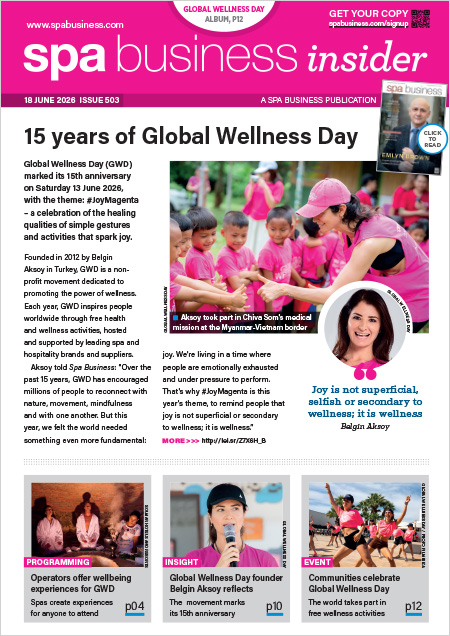
Belgin Aksoy marks 15 years of Global Wellness Day
Global Wellness Day (GWD) marked its 15th anniversary on Saturday 13 June 2026, with the theme: #JoyMagenta – a celebration of the healing qualities of simple gestures and activities that spark joy.
HUM2N launches longevity clinic at Six Senses London
Global luxury hospitality brand, Six Senses, has partnered with longevity healthcare provider, HUM2N, to launch a clinic at Six Senses London, at The Whiteley.
Mayrlife opens first hotel day clinic in partnership with Rosewood Vienna
As part of its first hotel partnership, Mayrlife – the medical health resort company known for its site in Altaussee, Austria – has launched a day clinic at the Rosewood Vienna.
+ More news   

FEATURED SUPPLIERS

Why future-ready in-house laundry is the new luxury spa essential
In today’s premium spa environment, every detail shapes the guest experience – right down to the softness of towels and the freshness of linens. [more...]

Longevity in spas: a strategic choice, not a default setting
Longevity has become one of the most debated concepts in contemporary wellness. [more...]
+ More featured suppliers  
COMPANY PROFILES
TAC | The Assistant Company

Founded in 2001, TAC is an owner-managed company with more than 110 employees and four locations: in [more...]
We Work Well Inc

In 2019 Monica Helmstetter and Lucy Hugo founded the American hosted buyer event company We Work Wel [more...]
+ More profiles  
CATALOGUE GALLERY
 

+ More catalogues  

DIRECTORY
+ More directory  
DIARY


21-23 Jun 2026

Spa Life International (UK)

Midlands (Venue TBA), Liphook, United Kingdom
22-22 Jun 2026

World Bathing Day

Worldwide,
+ More diary  
 
ABOUT LEISURE MEDIA
LEISURE MEDIA MAGAZINES
LEISURE MEDIA HANDBOOKS
LEISURE MEDIA WEBSITES
LEISURE MEDIA PRODUCT SEARCH
 
SPA BUSINESS
SPA OPPORTUNITIES
SPA BUSINESS HANDBOOK
PRINT SUBSCRIPTIONS
FREE DIGITAL SUBSCRIPTIONS
ADVERTISE . CONTACT US

Leisure Media
Tel: +44 (0)1462 431385

©Cybertrek 2026
Uniting the world of spa & wellness
Get Spa Business and Spa Business insider digital magazines FREE
Sign up here ▸
News   Products   Magazine   Subscribe
NEWS
Active Uprising delegates told to “just do it” and not wait for government
POSTED 10 Mar 2025 . BY Kath Hudson
Team GB weight lifter, Emily Campbell, provided an inspiring finish to the day Credit: UK Active
Active Uprising strikes an upbeat tone
Fitness professionals were encouraged to just do it, not wait for the NHS or the government
The answer is in every locality, not just Whitehall
The sector can learn a lot from McDonald’s
Don’t wait for the government, or the NHS, to provide the solutions or the budget, just get on with it was a key takeaway from this year's Active Uprising conference.

The annual conference from trade body, UK Active, took place in London’s Queen Elizabeth II Centre on Thursday 6 March, welcoming health and business leaders. Talks and panel discussions included the sector’s potential to drive economic growth, careers, Gen Z, forming partnerships with the NHS and loyalty schemes.

As people continue to prioritise their spend on wellness, there was an optimistic tone. However, as the government faces a challenging economic situation and the NHS is facing serious challenges, many speakers called on the sector to be the solution, rather than wait for the NHS or the government to provide the lead.

The message was that partnerships made on a local level; being creative about setting up projects and then evaluating them and communicating their success are the key to making the breakthroughs the industry wants when it comes to partnering with the NHS and unlocking economic growth.

The NHS has no money

Speaking as part of a panel discussion on strengthening links with the NHS, William Roberts, CEO of Royal Society of Public Health, said it like it is: “There is no money and no social prescribing budget – the NHS is overspent by £3.9 billion at the moment. There are never any savings even if waiting lists get reduced.”

Strategic advisor to the Secretary of State for Health and Social Care, Paul Corrigan, who was interviewed by outgoing UK Active chair, Mike Farrar, said the same: “Social prescribing can keep someone from getting more ill, but how do you turn that into cash?”

Corrigan explained that a major hurdle to overcome is the financial model of the NHS, where GPs operate as small businesses and hospitals are their own separate entities. So while an intervention from a GP might keep someone out of hospital, it doesn’t generate any income for the GP to reinvest.

“The saving doesn’t come back to the cost,” he said.

Corrigan also warned of an approaching wave of doom: “The ageing population will grow considerably in the next 10 years. If we keep doing the same the NHS will collapse, it might already be collapsing. It needs some radical changes or we’ll be in big trouble.

“There is the aspiration to move out of firefighter mode, but we can’t do it alone. It’s not a vision which can just be delivered in Whitehall, the answer lies in every locality.”

When asked whether the sector should be flagging up the value it delivers to the economy via employment, he raised eyebrows with his statement that people working in the sector don't think of it as being a 'proper' job, saying, "Your industry attracts a whole bunch of people into jobs because they're interested in the process in their leisure time.

"They don't think about it as a job, they see it as an activity."

Many delegates were left feeling that there is work to do explaining the high levels of expertise that exist in the sector to the various branches of government and its agencies.

The government gets too many reports

UK Active board member and UK competitiveness director at CBI, Jordan Cummins, told delegates that the government gets numerous reports from multiple industries claiming they can unlock savings, so a fresh approach is needed in order for the sector to be heard.

“The industry needs to get MPs as excited about treadmills as they are about hard hats,” he said. “Treat health like we’ve been treating climate change: set a framework for measuring change – such as health expectancy or working years – and focus on two or three things which are doable in this parliamentary term to make a change. Whittle the priorities down and simplify the message.”

Cummins said that while some sectors struggle with the pitch, fitness offers tangible results and the sector has the advantage of being able to talk to numerous government departments.

Evidence and evaluation

We kept hearing that evidence is crucial. Priya Oomhadat, deputy director of rehabilitation NHS England, raised this point, as did Adam Memon, director of strategy NHS England. “Quality of evaluation is important. We want more and better data, as well as examples of innovative models of care, such as how we can re-do physiotherapy,” he said.

“We want to hear about projects that have a health and economic outcome; which have been evaluated and tested. We’re also interested in projects where there is robust data but it has not yet been operationalised.”

It’s advisable to start evaluation early, because many academic institutions have a very slow turnaround, he said.

Generation Anxious

“Life is pretty crap for young people. There is less joy than for previous generations,” said Laura-Jane Rawlings, CEO of Youth Employment UK who was part of the No Growth without Health panel discussion. “This generation have grown up with the pandemic, which caused deep isolation, and calls to Childline went through the roof because so many weren’t safe at home.”

In the last three years there has been a 42 per cent increase in NEETS (young people not in education, employment or training) which was up to 987,000 in the fourth quarter of 2024. Rawlings said the fitness industry can help by being a good employer: “It needs to be done without government. Think outside of the policy box and create belonging.”

She called on employers to offer roles for 15-year-olds so they can learn the important employability skills and to accept the fact that times have changed – people might only stay for 18 months to two years, and that’s okay.

In a panel discussion on Generation Z – a generation of anxious people – Hayley Jarvis, head of physical activity at Mind, the UK's National Association for Mental Health, reiterated the difficulties facing young people. In 2017 one in nine were struggling with their mental health and by 2023 it was one in five. This mental health epidemic is disproportionately impacting girls and only one third are getting help.

An alarming statistic is that 82 per cent are worried about what’s going on in the world. “According to Mind insights, many young people know that physical activity can help, but they don’t feel it will solve the underlying issue or issues causing them anxiety,” said Jarvis. “It’s important to make the gym environment safe, familiar and easy to access.”

McDonald’s was praised

Rawlings said that as an employer, McDonald’s is good because it doesn’t expect its employees to stay for more than two years, but is happy to invest in them and feels that once they leave they are still making a wider contribution to the economy and society.

Adam Wilson, quantitative insight director at Beano Brain, said the fitness sector could learn a lot from the fast food chain in the wider sense in terms of how it reaches out to the next generation: “It offers low barriers to entry cost-wise and it’s the first place they can go without their parents. They’re made welcome, they can use digital screens to place their order, it's affordable, they can stay for a long time, they’re treated as a customer and they feel as though they belong.”

The aspiration is for gyms to do the same, but to go deeper with the engagement.

Just do it

“It takes times and perseverance, but just do it,” said Dr Hussain Al-Zubaidi, a GP who has pioneered the use of physical activity to improve the health of “frequent flyers” – people registered with his practice who were visiting the GPs 50 times a year.

CEO of Wave Active, Duncan Kerr – who is interviewed in the upcoming edition HCM said he’s achieved success through being a door kicker: “The pandemic has opened up more opportunities for collaboration with the NHS, but you need to have relentless resilience, keep trying to engage and pay due respect to their challenges.”

Wave Active employs health coaches and offers programmes of eight sessions for free, which is funded by those who choose to stay on as a paying member afterwards.

“Just do it. Be creative on funding and go for lots of different pots. Don’t be afraid to change,” says Karl Hayes, managing director of Impulse Leisure. The charitable trust has succeeded in getting funding from a variety of sources, including cultural budgets, is taking programmes out into the community and is creating stickiness by running coffee mornings for carers.

Make Britain Strong

The day ended with a fireside chat with weightlifter, Emily Campbell, who took bronze in the +81kg category of the Paris Olympics. She was interviewed by Alliance Leisure CEO, Sarah Watts.

Campbell, who came from a Nottingham estate and whose sister swam for Jamaica at the Paris Olympics, is on a mission to get the UK more healthy through strength training. She appeared on Sky News Breakfast on the morning of the conference, along with UK Active CEO, Huw Edwards, talking about her ambition to inspire the nation to start lifting.

To read HCM's interview with Duncan Kerr, CEO of Wave Active, click herehere to sign up for your complimentary digital subscription.

There was an upbeat tone at Active Uprising Credit: UK Active
RELATED STORIES
UK Active seeking new chair as Mike Farrar announces departure


Mike Farrar is stepping down as chair of UK Active, after being appointed interim Permanent Secretary of the Department of Health in Northern Ireland.
UK Active polling shows the growing appetite for health and fitness


Brits are choosing to spend more of their disposable income on health and fitness than eating out and drinking socially according to a new survey from UK Active.
MORE NEWS
Barons Eden rebrands to Hiddenwell ahead of spa hotel portfolio expansion
Barons Eden, the UK parent company that operates luxury destination properties in England, has rebranded to become Hiddenwell.
Belgin Aksoy marks 15 years of Global Wellness Day
Global Wellness Day (GWD) marked its 15th anniversary on Saturday 13 June 2026, with the theme: #JoyMagenta – a celebration of the healing qualities of simple gestures and activities that spark joy.
HUM2N launches longevity clinic at Six Senses London
Global luxury hospitality brand, Six Senses, has partnered with longevity healthcare provider, HUM2N, to launch a clinic at Six Senses London, at The Whiteley.
Mayrlife opens first hotel day clinic in partnership with Rosewood Vienna
As part of its first hotel partnership, Mayrlife – the medical health resort company known for its site in Altaussee, Austria – has launched a day clinic at the Rosewood Vienna.
KX Chelsea invests £15 million to upgrade its wellness offering
Premium London health club, KX Chelsea, will imminently unveil its most significant redevelopment since its launch in 2002 to create an integrated wellness model combining training, recovery and relaxation.
Rosewood Le Guanahani St Barth offers ocean-themed yoga for Global Wellness Day
Rosewood Le Guanahani St Barth, on the northeast coast of Saint Barthélemy in the French West Indies, is offering a programme of ocean-inspired yoga classes between 8-14 June to celebrate Global Wellness Day (GWD).
+ More news   
 
FEATURED SUPPLIERS

Why future-ready in-house laundry is the new luxury spa essential
In today’s premium spa environment, every detail shapes the guest experience – right down to the softness of towels and the freshness of linens. [more...]

Longevity in spas: a strategic choice, not a default setting
Longevity has become one of the most debated concepts in contemporary wellness. [more...]
+ More featured suppliers  
COMPANY PROFILES
TAC | The Assistant Company

Founded in 2001, TAC is an owner-managed company with more than 110 employees and four locations: in [more...]
+ More profiles  
CATALOGUE GALLERY
+ More catalogues  

DIRECTORY
+ More directory  
DIARY


21-23 Jun 2026

Spa Life International (UK)

Midlands (Venue TBA), Liphook, United Kingdom
22-22 Jun 2026

World Bathing Day

Worldwide,
+ More diary  


ADVERTISE . CONTACT US

Leisure Media
Tel: +44 (0)1462 431385

©Cybertrek 2026

ABOUT LEISURE MEDIA
LEISURE MEDIA MAGAZINES
LEISURE MEDIA HANDBOOKS
LEISURE MEDIA WEBSITES
LEISURE MEDIA PRODUCT SEARCH
PRINT SUBSCRIPTIONS
FREE DIGITAL SUBSCRIPTIONS