Yes! Send me the FREE digital editions of Spa Business and Spa Business insider magazines and the FREE weekly Spa Business and Spa Business insider ezines and breaking news alerts!
The TEA/AECOM Theme Index signals healthy attendance growth
at parks around the world, especially in Asia and North America.
In Europe, we analyse attendance dynamics over the past 10 years
OCT Parks China is a fast-emerging major Asian operator which is rapidly climbing up the theme park ranks
The TEA/AECOM Theme Index and Museum Index is a collaboration of the Themed Entertainment Association (TEA) and the Economics practice at AECOM. This calendar-year study of global attractions attendance is a free resource for park operators, land developers and the leisure industry. Top worldwide theme parks, amusement parks, waterparks, museums and theme park group operators are ranked by attendance and industry trends are identified. The global market is studied as a whole, and each main region – Americas, Europe, Middle East and Africa (EMEA), and Asia-Pacific (APAC) – is also studied separately.
The big picture The attractions industry witnessed another year of solid global growth in 2015. With aggregate attendance across the top 10 operator groups increasing by 7.2 per cent during 2015 to around 420 million visits, the level of growth seen this year is strong and encouraging for what is typically considered a well-established sector.
The shifting composition of the world’s top theme park groups is largely driven by a combination of longstanding US operators – most notably Disney and Universal – and fast-emerging major Asian operators, such as OCT Parks China, Chimelong, Fantawild and Songcheng, which are rapidly climbing up the ranks.
European operator Merlin Entertainments is paying close attention to building up its portfolio of midway attractions. The launch of seven new such attractions in 2015 – including Shrek’s Adventure in London and Sea Life in Auburn Hills – ensured group numbers remained buoyant in second place despite the difficulties faced by their resort theme park arm following the devastating crash at Alton Towers last year.
Asia strengthens Generally speaking, the geographic distribution of the world’s top 25 parks has moved eastwards since 2005, with APAC capturing the market share (+7%) to the detriment of the USA (–5%) and EMEA (–2%). Strong demographic fundamentals and a widespread operator focus on park additions and expansions in APAC signal a medium term continuation of this trend.
Furthermore, there is a development focus on second-tier cities, although predominantly in China with a notable shift in the development of new parks from primary seafront cities to inland cities in central and northwest China.
That said, Florida remains dominant as the world’s leading theme park destination, home to no fewer than seven of the top 25 theme parks, with a combined attendance of more than 77 million visitors in 2015 – around one-third of aggregate attendance to the world’s 25 most visited parks.
Europe’s ups and downs The European theme park market witnessed a second year of modest post-recession growth in 2015, with attendance levels edging up 3.2 per cent following the 3.4 per cent increase in 2014. Visitation to EMEA’s top 20 theme parks reached 61.2 million, up from 55.6 million in 2014.
Disneyland Paris enjoyed a rebound year, reporting an attendance upswing for the first time since 2012, underpinned by an improved economic climate in France and significant capital investments, including new IP-branded experiences revolving around Star Wars and Frozen. Marking its 40th anniversary in 2015, Europa Park posted an impressive 10 per cent increase in visitation, once again proving that this family-owned attraction in Germany can also move from strength to strength despite tough competition from dominant international operators.
Attendance levels at Alton Towers and Thorpe Park in the UK were severely suppressed in the aftermath of a tragic accident that occurred on the Smiler ride at the beginning of last year’s peak season. The decline in attendance at these two popular parks has impacted the overall picture for the region and to get a clearer view on what the sector may have looked like without this tragic incident, we’ve assumed the average growth of the other Merlin parks for this year for these two parks, which would have resulted in growth of 4.9 per cent instead of the reported 3.2 per cent for EMEA’s top 20 parks. This not only highlights the impact of this tragic incident but also, and most importantly, that the underlying picture for the European market overall is very healthy.
Decade of growth In AECOM’s 10 years of closely tracking attendance levels in the themed entertainment sector, we’ve seen marked improvements in attendance (despite a global recession), the adoption of exciting new technologies and the continued internationalisation of the industry. Attendance at major European theme parks has grown steadily during that time – predominantly organically rather than with the addition of new parks.
Europe represents a mature, relatively stable marketplace, thus growth prospects are likely stronger in Asia and the Middle East – both regions benefiting from booming populations and increasing disposable incomes. While 10 years ago European parks captured a 13 per cent share of global attendance, by 2015 this had slipped to 11 per cent as the larger APAC market came into its own.
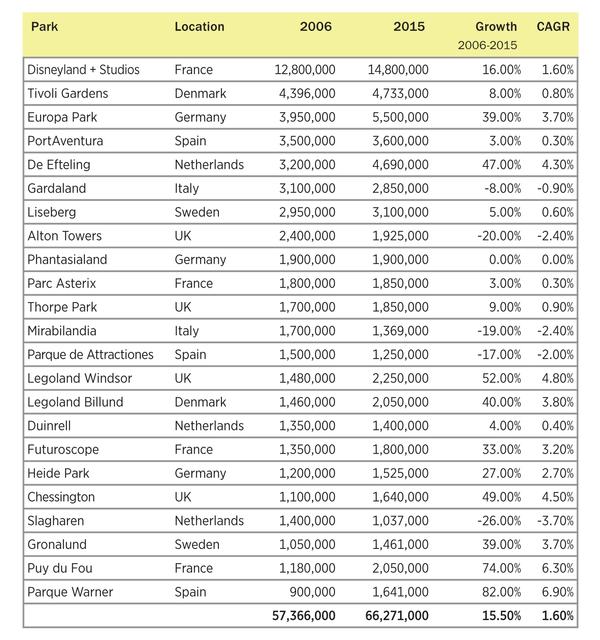
The TEA/AECOM Theme Index’s 10-year anniversary allows us to take a more extensive reflection and so we have assembled a table of data tracking attendance at the 24 most familiar European theme parks within the Index. Assuming stable attendance for Slagharen this year and having combined attendance of the two parks in Marne-la-Vallee, France, we can see that there are some clear winners and losers (disregarding Alton Towers’ results as we hope 2015 will have been an anomaly for them). We observe outstanding, solid performance over that time period from Puy du Fou and Parque Warner, both achieving compound annual growth rates (average year-on-year growth) of more than six per cent. In the middle field there are some great performances from Europa Park, De Efteling, Legoland Windsor, Legoland Billund, Futuroscope, Chessington and Grona Lund with growth rates between three and five per cent. The majority of the lesser performing parks seem to be in Southern Europe, where recovery from the latest recession has been slower; indeed, Mirabilandia and Parque de Attractiones have both slowly slipped from the top 20 over time, but may bounce back soon.
Looking ahead The UAE theme park sector is seeing massive waves of investment in the lead up to Expo 2020. Mega developments, like Dubai Parks & Resorts and IMG World of Adventure, are being launched with such huge ambition that some cautiously question their ability to deliver the projected attendance figures in this somewhat immature market.
However, the creation of an entertainment destination in a sunny climate may well prove a success for the entire region. The industry’s growth prospects in the Middle East are very much underpinned by ambitious tourism projections, in line with Dubai’s mandate to attract 20 million visitors by 2020, coupled with a perceived lack of entertainment provision in the market, strong international accessibility, a developed tourism infrastructure and the presence of international landmarks. For now, we will wait and see; however, it is clear that the UAE not only wants to compete on a local or regional level but also on a global level.
Trends to watch Throughout the EMEA region we’re seeing increasing interest in smaller themed attractions like family entertainment centres (FECs). This sub-market is currently undergoing a period of significant growth, and, interestingly, doing so in mature markets such as the UK, France and Spain.
Attraction operators are tapping into secondary cities, working with shopping centre operators to introduce leisure as a key diversifier to help mitigate the pressures on the retail sector caused by changing shopping behaviour. Retail is emerging as a leisure activity. This merge with other leisure activities is a logical extension of the development of shopping destinations. IP providers are eyeing up this market and its potential.
Technological advancement is shaping the industry like never before. Augmented reality equips leisure developers with the ability to create virtual content within applications that blend in with the real world. A seamless guest experience, from sofa to rollercoaster, is already being adopted by some parks through the creation of dedicated mobile applications, for example. We can expect to see visual effects (VFX) simulations of new rides, the transformation of attractions from passive amusements into engaging, immersive adventures and more high-tech show-orientated experiences tied to seasonal events.
Outlook As geopolitical tensions mount in Europe, heightened by Brexit, we anticipate continued macroeconomic uncertainty over the next year and thus a high likelihood of short-term volatility in the sector. How this translates into tourism volumes, leisure spending and, ultimately, attendance at attractions remains to be seen. Concerns around London trading and the pace of the Alton Towers’ recovery are also weighing negatively on sentiment. However, we’re still looking on the bright side, following two years of growth in the sector, the increased focus on, and proliferation of, smaller attraction concepts, and continued diversification across geographic markets among leading international IP providers and attraction operators. Life is a rollercoaster! ?
In the fast-paced world of fitness and wellness, where high-intensity workouts push us to
our limits and the sweat pours, the importance of efficient recovery cannot be overstated. [more...]
+ More featured suppliers
COMPANY PROFILES
Myrtha Wellness
Founded in Italy in 1961 by visionary Giorgio Colletto, Myrtha Wellness has become a global pioneer [more...]
Elemis
Elemis was founded in London in 1989 by Linda Steiner whose vision was to create a skincare range as [more...]
The TEA/AECOM Theme Index signals healthy attendance growth
at parks around the world, especially in Asia and North America.
In Europe, we analyse attendance dynamics over the past 10 years
OCT Parks China is a fast-emerging major Asian operator which is rapidly climbing up the theme park ranks
The TEA/AECOM Theme Index and Museum Index is a collaboration of the Themed Entertainment Association (TEA) and the Economics practice at AECOM. This calendar-year study of global attractions attendance is a free resource for park operators, land developers and the leisure industry. Top worldwide theme parks, amusement parks, waterparks, museums and theme park group operators are ranked by attendance and industry trends are identified. The global market is studied as a whole, and each main region – Americas, Europe, Middle East and Africa (EMEA), and Asia-Pacific (APAC) – is also studied separately.
The big picture The attractions industry witnessed another year of solid global growth in 2015. With aggregate attendance across the top 10 operator groups increasing by 7.2 per cent during 2015 to around 420 million visits, the level of growth seen this year is strong and encouraging for what is typically considered a well-established sector.
The shifting composition of the world’s top theme park groups is largely driven by a combination of longstanding US operators – most notably Disney and Universal – and fast-emerging major Asian operators, such as OCT Parks China, Chimelong, Fantawild and Songcheng, which are rapidly climbing up the ranks.
European operator Merlin Entertainments is paying close attention to building up its portfolio of midway attractions. The launch of seven new such attractions in 2015 – including Shrek’s Adventure in London and Sea Life in Auburn Hills – ensured group numbers remained buoyant in second place despite the difficulties faced by their resort theme park arm following the devastating crash at Alton Towers last year.
Asia strengthens Generally speaking, the geographic distribution of the world’s top 25 parks has moved eastwards since 2005, with APAC capturing the market share (+7%) to the detriment of the USA (–5%) and EMEA (–2%). Strong demographic fundamentals and a widespread operator focus on park additions and expansions in APAC signal a medium term continuation of this trend.
Furthermore, there is a development focus on second-tier cities, although predominantly in China with a notable shift in the development of new parks from primary seafront cities to inland cities in central and northwest China.
That said, Florida remains dominant as the world’s leading theme park destination, home to no fewer than seven of the top 25 theme parks, with a combined attendance of more than 77 million visitors in 2015 – around one-third of aggregate attendance to the world’s 25 most visited parks.
Europe’s ups and downs The European theme park market witnessed a second year of modest post-recession growth in 2015, with attendance levels edging up 3.2 per cent following the 3.4 per cent increase in 2014. Visitation to EMEA’s top 20 theme parks reached 61.2 million, up from 55.6 million in 2014.
Disneyland Paris enjoyed a rebound year, reporting an attendance upswing for the first time since 2012, underpinned by an improved economic climate in France and significant capital investments, including new IP-branded experiences revolving around Star Wars and Frozen. Marking its 40th anniversary in 2015, Europa Park posted an impressive 10 per cent increase in visitation, once again proving that this family-owned attraction in Germany can also move from strength to strength despite tough competition from dominant international operators.
Attendance levels at Alton Towers and Thorpe Park in the UK were severely suppressed in the aftermath of a tragic accident that occurred on the Smiler ride at the beginning of last year’s peak season. The decline in attendance at these two popular parks has impacted the overall picture for the region and to get a clearer view on what the sector may have looked like without this tragic incident, we’ve assumed the average growth of the other Merlin parks for this year for these two parks, which would have resulted in growth of 4.9 per cent instead of the reported 3.2 per cent for EMEA’s top 20 parks. This not only highlights the impact of this tragic incident but also, and most importantly, that the underlying picture for the European market overall is very healthy.
Decade of growth In AECOM’s 10 years of closely tracking attendance levels in the themed entertainment sector, we’ve seen marked improvements in attendance (despite a global recession), the adoption of exciting new technologies and the continued internationalisation of the industry. Attendance at major European theme parks has grown steadily during that time – predominantly organically rather than with the addition of new parks.
Europe represents a mature, relatively stable marketplace, thus growth prospects are likely stronger in Asia and the Middle East – both regions benefiting from booming populations and increasing disposable incomes. While 10 years ago European parks captured a 13 per cent share of global attendance, by 2015 this had slipped to 11 per cent as the larger APAC market came into its own.
The TEA/AECOM Theme Index’s 10-year anniversary allows us to take a more extensive reflection and so we have assembled a table of data tracking attendance at the 24 most familiar European theme parks within the Index. Assuming stable attendance for Slagharen this year and having combined attendance of the two parks in Marne-la-Vallee, France, we can see that there are some clear winners and losers (disregarding Alton Towers’ results as we hope 2015 will have been an anomaly for them). We observe outstanding, solid performance over that time period from Puy du Fou and Parque Warner, both achieving compound annual growth rates (average year-on-year growth) of more than six per cent. In the middle field there are some great performances from Europa Park, De Efteling, Legoland Windsor, Legoland Billund, Futuroscope, Chessington and Grona Lund with growth rates between three and five per cent. The majority of the lesser performing parks seem to be in Southern Europe, where recovery from the latest recession has been slower; indeed, Mirabilandia and Parque de Attractiones have both slowly slipped from the top 20 over time, but may bounce back soon.
Looking ahead The UAE theme park sector is seeing massive waves of investment in the lead up to Expo 2020. Mega developments, like Dubai Parks & Resorts and IMG World of Adventure, are being launched with such huge ambition that some cautiously question their ability to deliver the projected attendance figures in this somewhat immature market.
However, the creation of an entertainment destination in a sunny climate may well prove a success for the entire region. The industry’s growth prospects in the Middle East are very much underpinned by ambitious tourism projections, in line with Dubai’s mandate to attract 20 million visitors by 2020, coupled with a perceived lack of entertainment provision in the market, strong international accessibility, a developed tourism infrastructure and the presence of international landmarks. For now, we will wait and see; however, it is clear that the UAE not only wants to compete on a local or regional level but also on a global level.
Trends to watch Throughout the EMEA region we’re seeing increasing interest in smaller themed attractions like family entertainment centres (FECs). This sub-market is currently undergoing a period of significant growth, and, interestingly, doing so in mature markets such as the UK, France and Spain.
Attraction operators are tapping into secondary cities, working with shopping centre operators to introduce leisure as a key diversifier to help mitigate the pressures on the retail sector caused by changing shopping behaviour. Retail is emerging as a leisure activity. This merge with other leisure activities is a logical extension of the development of shopping destinations. IP providers are eyeing up this market and its potential.
Technological advancement is shaping the industry like never before. Augmented reality equips leisure developers with the ability to create virtual content within applications that blend in with the real world. A seamless guest experience, from sofa to rollercoaster, is already being adopted by some parks through the creation of dedicated mobile applications, for example. We can expect to see visual effects (VFX) simulations of new rides, the transformation of attractions from passive amusements into engaging, immersive adventures and more high-tech show-orientated experiences tied to seasonal events.
Outlook As geopolitical tensions mount in Europe, heightened by Brexit, we anticipate continued macroeconomic uncertainty over the next year and thus a high likelihood of short-term volatility in the sector. How this translates into tourism volumes, leisure spending and, ultimately, attendance at attractions remains to be seen. Concerns around London trading and the pace of the Alton Towers’ recovery are also weighing negatively on sentiment. However, we’re still looking on the bright side, following two years of growth in the sector, the increased focus on, and proliferation of, smaller attraction concepts, and continued diversification across geographic markets among leading international IP providers and attraction operators. Life is a rollercoaster! ?
People taking GLP-1 weight loss medications such as Ozempic, Wegovy, Mounjaro and Zepbound
may be losing weight, but they’re also becoming less physically active, according to new
research presented at the ENDO 2026 annual meeting of the Endocrine Society
Abu Dhabi-based investment firm Mubadala Capital has made a binding, fully financed
€1 billion
offer to acquire Pierre and Vacances SA, the European holiday resort operator behind the
continental European Center Parcs business.
Global retreat trade show, Synergy The Retreat Show, has launched a resource called The
Source, which hosts an open-access online Transformation Series programme.
The Standards Authority for Touch in Cancer Care (SATCC) charity has announced its first five-
day Living with Cancer and Beyond retreat, which will be held at Carden Park Hotel and Spa in
Cheshire, UK, between 1 and 5 September.
Patmos Aktis, a Luxury Collection Resort and Spa, has opened in Greece, with a renovated and
rebranded wellness offering called Ansana Wellness and Spa.
The Mauna Kea Beach Hotel, an Autograph Collection property in Hawaii, US, has opened its
22,000 sq ft indoor-outdoor Spa at Mauna Kea as the final step in the property’s overall
renovation, which has cost more than US$180 million (€166 million, £140 mill
The UK spa review and discovery platform for consumers, the Good Spa Guide, has announced
it will host the Good Spa Guide Awards 2026 during an event on 16 November at Sopwell House
Hotel in St Albans, UK.
Eighty-four per cent of consumers now say wellness is a top priority in their lives, with this
percentage increasing year on year, according to a preview presentation of McKinsey’s Future of
Wellness 2026 research report.
Mass protests have been taking place since Monday 1 June in Albania over the development of
a luxury resort by Donald Trump’s daughter Ivanka Trump and her husband Jared Kushner.
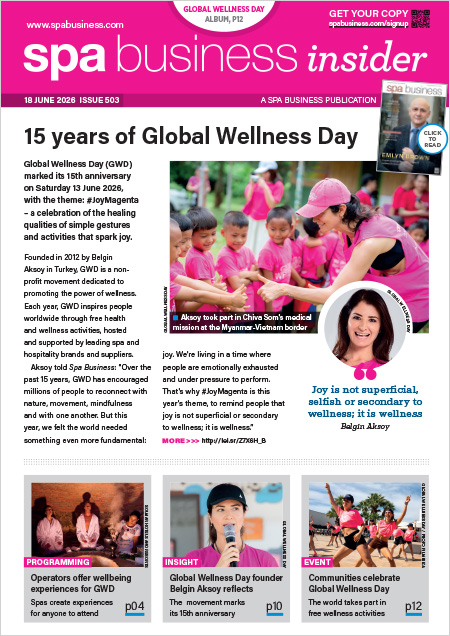
Global Wellness Day (GWD) marked its 15th anniversary on Saturday 13 June 2026, with the
theme: #JoyMagenta – a celebration of the healing qualities of simple gestures and activities
that spark joy.
In the fast-paced world of fitness and wellness, where high-intensity workouts push us to
our limits and the sweat pours, the importance of efficient recovery cannot be overstated. [more...]
+ More featured suppliers
COMPANY PROFILES
Myrtha Wellness Founded in Italy in 1961 by visionary Giorgio Colletto, Myrtha Wellness has become a global pioneer [more...]