Yes! Send me the FREE digital editions of Spa Business and Spa Business insider magazines and the FREE weekly Spa Business and Spa Business insider ezines and breaking news alerts!
The recession has given operators the freedom to re-engineer the employment terms of staff. Many more are now part-time and receive few, if any, benefits
By Liz Terry | Published in Spa Business 2013 issue 4
This year’s market research numbers have just been published for the US spa market, showing continuing signs of recovery.
ISPA’s 2013 US Spa Industry Study, PricewaterhouseCoopers (PwC), found the five main measures of trading: visits to spas, spend per visit, total revenues, staff levels and total number of spas, have experienced growth (see our report on page 48).
The PwC team found total revenues were up us$1.2bn – 4.7 per cent – to a healthy us$14bn (€10.1bn, £8.7bn) against a pre-recessionary peak of us$12.8bn (€9.3bn, £7.9bn).
As at May 2013, there were 19,960 spas in the US: an increase of 1.1 per cent over the previous year and a great deal healthier than 2009-10, when closures outpaced new locations for two years.
Hard on the heels of the ISPA report came Trends in the Hotel Spa Industry from PKF Consulting USA (PKF).The two reports make interesting reading – especially when considered together. This is especially true around the area of staffing.
The ISPA research found that although employment increased by 1.2 per cent – up a percentage point on the previous year – there was a “marked shift” from full-time employment – which declined by 7.2 per cent – to part time employment, which was up 13.2 per cent. PwC says this could be an indication of “wider changes in American working practices,” or that it “reflects the spa industry’s commitment to maintaining a flexible workforce.”
The industry’s approach to employment is highlighted by the PKF report, which found that while payroll expenses for hotel employees average 29.6 per cent, spa is running at 22.8 per cent – a whopping 6.8 per cent less. They attribute this to the fact that “many spa technicians work as independent contractors and therefore are not eligible to receive a full package of benefits.”
The recession has given operators unusual freedom to re-engineer the employment terms of staff and they’ve done so in ways that enable them to gain many commercial advantages.
Although profitability is vital, if we’re to build a reputation as a credible industry that offers good careers and practices what it preaches, we need to be mindful of the need to balance these two demands.
Read more from this issue of Spa Business magazine
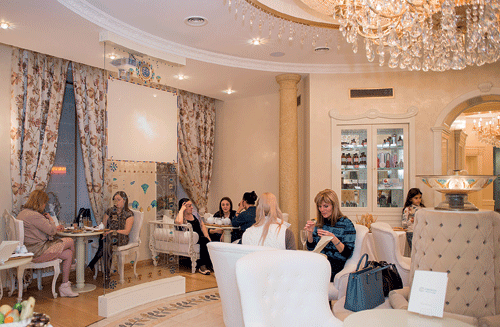
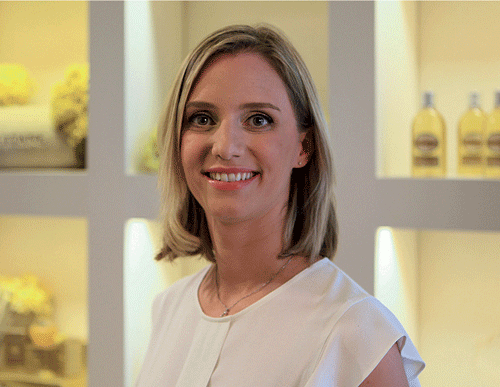
Interview: Helene Goetzelmann
L'Occitane's international spa director tells Rhianon Howells how the consumer retail company has become a spa operator with 60 facilities
Ask an expert: Profit & Loss
Hotel spas need to fight capital expenditure allocation said an investor panel at this year's Global Spa & Wellness Summit
Research: All rise
There's been an increase in the five top key performance indicators in the US spa industry shows the 2013 ISPA study
Company Profile Promotion: ESPA promotion
As ESPA's 20th
anniversary year draws
to a close, founder and
CEO Sue Harmsworth
explains how and why the
company is still evolving
Safari Spa: Animal instinct
Safari spas are the staple for Amani, one of South Africa's largest spa chains. Lisa Starr talks to MD Ronleigh Gordon
Trends: Brief encounters
We take a look at some of the most innovative spa pop-ups, a growing trend across the leisure sector
Interview: Paul Smyth
Something & Son designer shares his insights on creating pop-up spa facilities. Magali Robathan reports
Summit review: Upping the ante
Katie Barnes reveals the takeaway messages from the 2013 Global Spa & Wellness Summit in New Delhi, India, attended by 375 industry leaders
Research: Local news
Domestic travellers dominate the global wellness tourism market which has an economic impact of US$1.3 trillion. SRI's Ophelia Yeung reports
Research: Thai up
Prantik Bordoloi analyses a 2013 Thai spa industry study based on both spa consumer and spa operator opinions
Software news: Tech talk
The latest developments and news from spa software suppliers from around the world
The Spa Life UK Convention returns from 21–23 June 2026 at Whittlebury Park Hotel, Spa &
Golf Resort, bringing together spa managers, directors and owners for two days of focused
education, meaningful connection and commercial insight. [more...]
+ More featured suppliers
COMPANY PROFILES
Bioline Jatò
Bioline Jatò is a family Italian company
operating in the professional skincare
industry since 197 [more...]
The recession has given operators the freedom to re-engineer the employment terms of staff. Many more are now part-time and receive few, if any, benefits
By Liz Terry | Published in Spa Business 2013 issue 4
This year’s market research numbers have just been published for the US spa market, showing continuing signs of recovery.
ISPA’s 2013 US Spa Industry Study, PricewaterhouseCoopers (PwC), found the five main measures of trading: visits to spas, spend per visit, total revenues, staff levels and total number of spas, have experienced growth (see our report on page 48).
The PwC team found total revenues were up us$1.2bn – 4.7 per cent – to a healthy us$14bn (€10.1bn, £8.7bn) against a pre-recessionary peak of us$12.8bn (€9.3bn, £7.9bn).
As at May 2013, there were 19,960 spas in the US: an increase of 1.1 per cent over the previous year and a great deal healthier than 2009-10, when closures outpaced new locations for two years.
Hard on the heels of the ISPA report came Trends in the Hotel Spa Industry from PKF Consulting USA (PKF).The two reports make interesting reading – especially when considered together. This is especially true around the area of staffing.
The ISPA research found that although employment increased by 1.2 per cent – up a percentage point on the previous year – there was a “marked shift” from full-time employment – which declined by 7.2 per cent – to part time employment, which was up 13.2 per cent. PwC says this could be an indication of “wider changes in American working practices,” or that it “reflects the spa industry’s commitment to maintaining a flexible workforce.”
The industry’s approach to employment is highlighted by the PKF report, which found that while payroll expenses for hotel employees average 29.6 per cent, spa is running at 22.8 per cent – a whopping 6.8 per cent less. They attribute this to the fact that “many spa technicians work as independent contractors and therefore are not eligible to receive a full package of benefits.”
The recession has given operators unusual freedom to re-engineer the employment terms of staff and they’ve done so in ways that enable them to gain many commercial advantages.
Although profitability is vital, if we’re to build a reputation as a credible industry that offers good careers and practices what it preaches, we need to be mindful of the need to balance these two demands.
Read more from this issue of Spa Business magazine
Interview: Helene Goetzelmann
L'Occitane's international spa director tells Rhianon Howells how the consumer retail company has become a spa operator with 60 facilities
Ask an expert: Profit & Loss
Hotel spas need to fight capital expenditure allocation said an investor panel at this year's Global Spa & Wellness Summit
Research: All rise
There's been an increase in the five top key performance indicators in the US spa industry shows the 2013 ISPA study
Company Profile Promotion: ESPA promotion
As ESPA's 20th
anniversary year draws
to a close, founder and
CEO Sue Harmsworth
explains how and why the
company is still evolving
Safari Spa: Animal instinct
Safari spas are the staple for Amani, one of South Africa's largest spa chains. Lisa Starr talks to MD Ronleigh Gordon
Trends: Brief encounters
We take a look at some of the most innovative spa pop-ups, a growing trend across the leisure sector
Interview: Paul Smyth
Something & Son designer shares his insights on creating pop-up spa facilities. Magali Robathan reports
Summit review: Upping the ante
Katie Barnes reveals the takeaway messages from the 2013 Global Spa & Wellness Summit in New Delhi, India, attended by 375 industry leaders
Research: Local news
Domestic travellers dominate the global wellness tourism market which has an economic impact of US$1.3 trillion. SRI's Ophelia Yeung reports
Research: Thai up
Prantik Bordoloi analyses a 2013 Thai spa industry study based on both spa consumer and spa operator opinions
Software news: Tech talk
The latest developments and news from spa software suppliers from around the world
Global Wellness Day (GWD) will mark its 15th anniversary on Saturday 13 June 2026, with the
theme: #JoyMagenta – a celebration of the healing qualities of simple gestures and activities
that spark joy.
Global luxury hospitality brand, Six Senses, has partnered with longevity healthcare provider,
HUM2N, to launch a clinic at Six Senses London, at The Whiteley.
As part of its first hotel partnership, Mayrlife – the medical health resort company known for its
site in Altaussee, Austria – has launched a day clinic at the Rosewood Vienna.
Premium London health club, KX Chelsea, will imminently unveil its most significant
redevelopment since its launch in 2002 to create an integrated wellness model combining
training, recovery and relaxation.
Rosewood Le Guanahani St Barth, on the northeast coast of Saint Barthélemy in the French
West Indies, is offering a programme of ocean-inspired yoga classes between 8-14 June to
celebrate Global Wellness Day (GWD).
Hotel de France, located on the British Isle of Jersey, has created a wellness retreat package
that includes a hot yoga session that will take place in Jersey Zoo’s butterfly sanctuary.
The Ritz-Carlton, Langkawi, in Malaysia, has revealed a schedule for Global Wellness Day
(GWD) that includes guided rainforest walks, mindful movement and guided coastal meditation
experiences.
Longevitix, a clinical platform for preventive and longevity medicine, has launched its AI-
powered intelligence system to help physicians deliver continuous, personalised longevity-
focused care at scale.
Atmantan Wellness Centre, an integrative wellness destination in Mulshi, near Pune in India, is
expanding its portfolio by adding a new centre in Hyderabad that will launch between 2028 and
2029.
A recent survey by the UK Spa Association (UKSA) into the industry’s approach to cancer care
has revealed that almost half of participating respondents (46 per cent) are unaware that
cancer is a disability and guests with a cancer diagnosis must be given
The Spa Life UK Convention returns from 21–23 June 2026 at Whittlebury Park Hotel, Spa &
Golf Resort, bringing together spa managers, directors and owners for two days of focused
education, meaningful connection and commercial insight. [more...]
+ More featured suppliers
COMPANY PROFILES
Bioline Jatò Bioline Jatò is a family Italian company
operating in the professional skincare
industry since 197 [more...]