Yes! Send me the FREE digital editions of Spa Business and Spa Business insider magazines and the FREE weekly Spa Business and Spa Business insider ezines and breaking news alerts!
What’s the future of pilates? Should it only ever involve the exercises designed by Joseph Pilates, or can his philosophy be applied while keeping the product moving with the times? We ask health and fitness industry experts worldwide
By Kate Cracknell | Published in Spa Business 2012 issue 1
Top team: Peninsula Hotels
Kath Hudson talks to key figures behind the leading Asian hotel chain about how they run their spas and exciting future plans
Profile: Cynthia Chua
The Singapore entrepreneur behind Ministry of Waxing and Browhaus has revolutionised personal grooming worldwide. She talks to Katie Barnes about the business of beauty and integration with spas
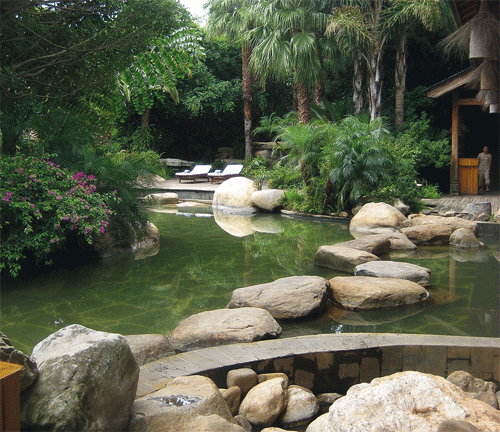
Hot springs: Chinese-style!
Lisa Starr tries out two hot spring spas - one catering to international visitors and the other to the domestic market - in China's Yunnan province
Bath time: The Chinese bathhouse
Lee David Stephens gives an insight into a traditional Chinese bathhouse and how Chinese people like to spa
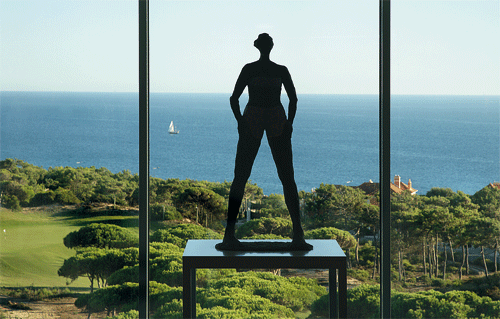
Resort Spa: Sands of time
The Oitavos hotel and spa on Portugal's Estoril coast is 90 years in the making. Tom Walker pays a visit
Interview: Gary Henkin
The president and founder of WTS International - the US-based spa management and consultancy firm - talks to Rhianon Howells about expanding globally
Ask an expert: Crisis control
The Arab Spring, the Japanese tsunami and bombings in Mumbai - what's the best way of dealing with a crisis? We ask those who have first-hand experience of the events
New Zealand thermal spa: Pooling resources
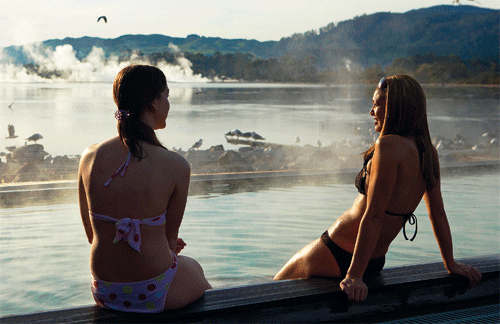
The Polynesian Spa in the geothermal town of Rotorua in New Zealand boasts 25 thermal pools and is one of the longest running attractions in the country. Chris McBeath takes a look
Tourism: Booming Baku
Terry Stevens reports on the Azerbaijan capital which has seen a surge of international hotel openings in the past two years
Fitness: Pilates pure vs applied
Pure vs applied - should pilates only ever involve the exercises designed by Joseph Pilates, or can his philosophy be applied while keeping the product moving with the times?
The contemporary STOTT PILATES method has evolved from the original teachings of Joseph Pilates to include modern principles of exercise science. As we learn more about the human body, and discover new applications for pilates, it’s important that we keep the original philosophy of the method moving forward and apply current research about the biomechanics of the body.
Once known as the secret weapon of dancers, over the years pilates has become popular as a form of functional fitness, and is now used by the general public for cross-training, rehabilitation, sports conditioning and general fitness purposes.
Our method caters to different body types and abilities by offering various preparatory exercises and modifications, as well as incorporating props. It’s vital that we continue to enhance, develop and improve on the knowledge we’ve acquired to enable people of all ages and fitness levels to reap the benefits. However, we never lose sight of the foundations and the principles on which our method is based.
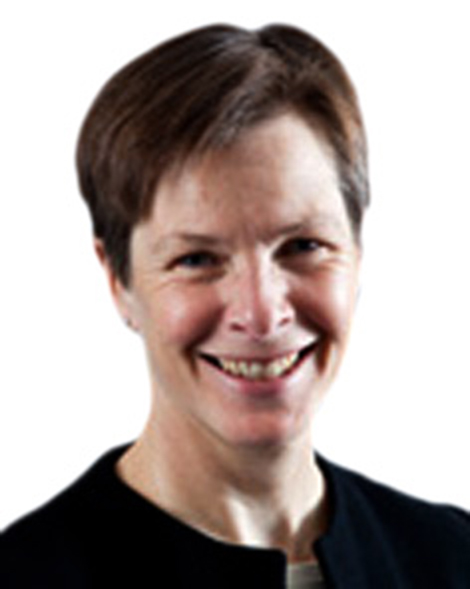
Della Pia is programme director, education & master instructor trainer at Merrithew – a Toronto-based company which operates under the STOTT PILATES name and develops and promotes pilates fitness programmes worldwide.
Details: www.stottpilates.com
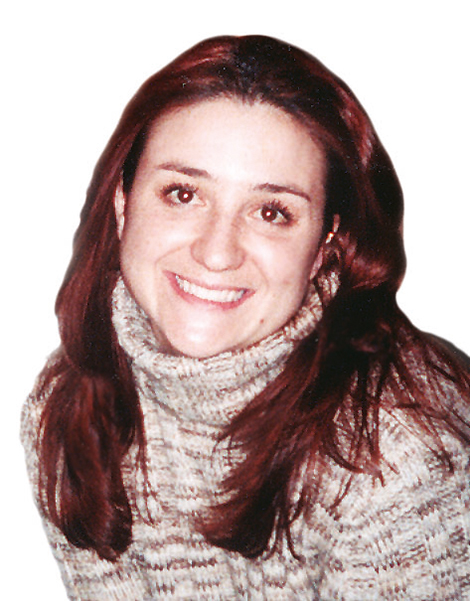
Alyson TannerPilates Foundation
Alyson Tanner
As with most exercise systems, pilates has changed as scientific knowledge about our bodies has grown. In fact, even Joe Pilates’ own practice changed over time.
The Pilates Foundation has developed an evolutionary approach to Joe’s work. We teach the classic repertoire that Joe would recognise, but realise that most of our clients need to work through some evolved, adjusted exercises before they get there. The principles of his philosophy are central to understanding how the exercises should be taught, but we draw on modern thinking to adjust the exercises to make them accessible to almost every student.
As scientific knowledge increases, there will be new trends and directions in pilates. The beauty of pilates is that the fundamentals can be adapted and refined, learning from other movement regimes to develop a range of exercise variations and approaches suitable for each individual body.
Commercial pressures are also important. Studio classes of one or two people using expensive equipment are fantastic, but the benefits are only available to a privileged few; matwork classes have brought the benefits of pilates to many more people. In the future, fitness centres and gyms are likely to invest in pilates equipment for group classes, providing the benefits of resistance work while still being commercially viable. Manufacturers are stepping up to the challenge by designing equipment that can be stacked and stored away.
“Matwork classes have brought the benefits of pilates to many more people”, says Tanner
Tanner is the chair of The Pilates Foundation which has been the governing body for pilates in the UK for 15 years.
Details: www.pilatesfoundation.com
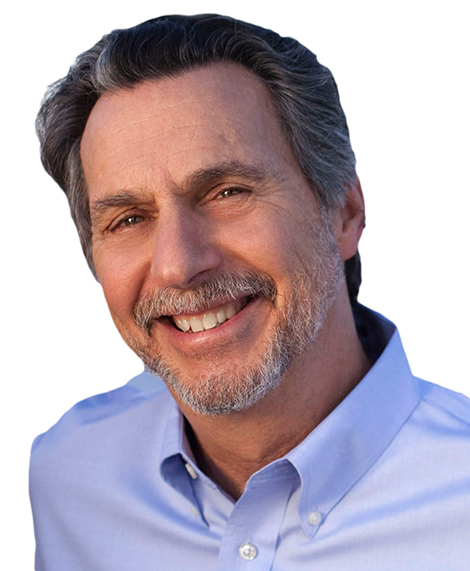
Ken EndelmanBalanced Body
Ken Endelman
What you’re calling ‘pure versus applied’ pilates, we call ‘classical versus contemporary’, and many people feel very strongly about their particular approach. One side feels the original measurements and designs that Joseph Pilates made on his first-generation equipment were done for a reason and should be kept that way. The other thinks combining a current understanding of human biomechanics with the pilates principle is best.
The truth is there’s merit on both sides. The important thing is how the exercise makes you feel: the end result should be experiencing the great ‘mindful movement’ benefits of a strong core and the increased flexibility that pilates provides. That’s what Joseph wanted, so if one approach really resonates over the other for you, that’s fine. It’s why we carry lines of equipment for both.
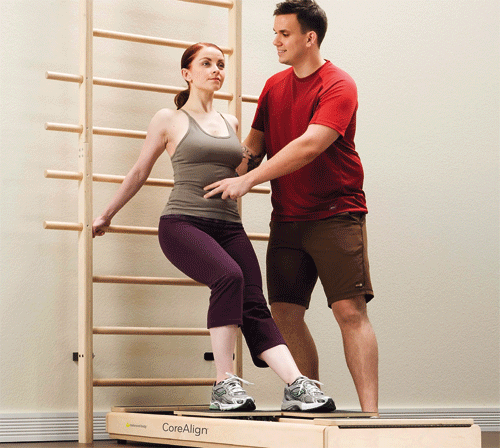
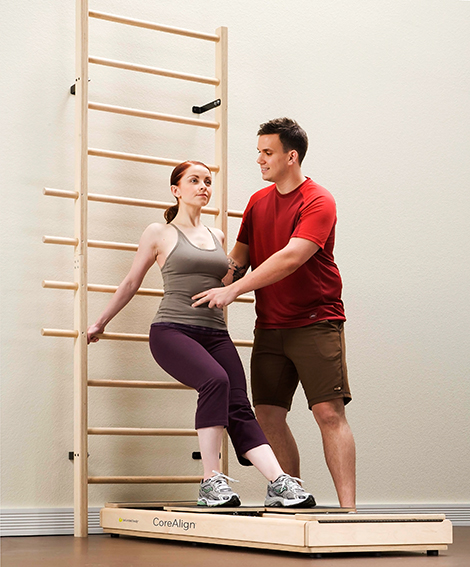
In the future, we really see a ‘mindful movement’ fitness revolution approaching, with pilates as a central player. With the continued ageing of the affluent baby boomer demographic, and uncertainty in healthcare reform, people are taking their health into their own hands. But many can’t take the pounding of weight-bearing exercise. So we’re seeing fitness facilities come up with all kinds of incredible programming ideas like combining pilates with cardio equipment or props like kettlebells. In addition, we’ve been developing equipment – like our CoreAlign – that, while not pilates per se, combines strength training with a mind-body approach, which makes for a unique group programming option.
Pilates has also taken off in the world of physiotherapy, but there’s a big difference between pilates for fitness and pilates for rehabilitation. If fitness facilities are offering any pilates-based rehabilitation services, they should be done by someone appropriately trained to handle those specific populations.
Endelman is the CEO and founder of Balanced Body, which is based in California and is one of the world’s largest manufacturer of pilates equipment.
Details: www.pilates.com
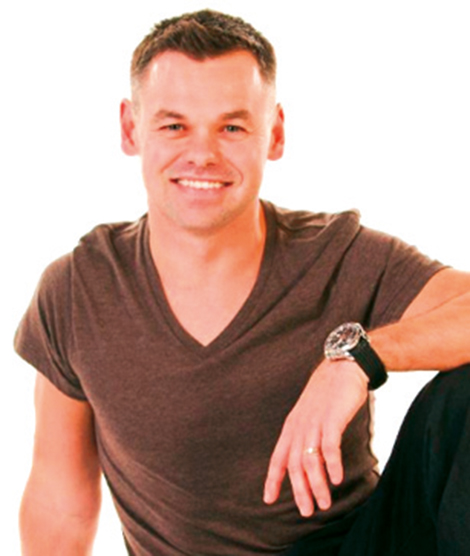
Glenn WithersAustralian Physiotherapy and Pilates Institute (APPI) Healthgroup
Glenn Withers
Questions have been asked by the public and the media about the validity and evidence behind pilates and I believe the profession has to become more accountable. Pilates effectively has two arms now – rehab and fitness – and we must provide more evidence of the benefits in both arenas. Training must also be delivered at an exceptional standard to guarantee professionalism.
The evolution of pilates to embrace rehab is in line with Joseph Pilates’ original message. Analysing his 1947 book, Return to Life Through Contrology, the message is about making permanent life changes. That’s been lost along the way, in favour of trying to find the perfect pilates body and perfecting a person’s movement on a mat. The real challenge should be linking pilates exercises to functional change – a means of chronic pain medicine. That’s what our method is all about, and rather than digressing from Joe’s vision, it’s in fact very closely aligned – just with a lot more evidence.
How does this translate to fitness centres in spas? Trainers need to ensure that they’re adequately trained, and also that they focus on what guests/clients take away from the sessions, not just what they do in the sessions. Population- or age-specific classes designed to change lifestyle are also an option.
Of course, pilates is also a technique that defines and shapes the body, and this does not necessarily need to change. It just needs to be applied by suitably trained professionals.
Withers is physiotherapist and founding director for APPI. APPI is a provider of private healthcare and education in the UK. It developed its rehabilitation-based pilates programme over 10 years ago
Details: www.appihealthgroup.com
Kevin BowenPeak Pilates
Kevin Bowen
Contrology – or, as we now refer to it, the pilates method – has been the subject of much discussion for years. There are those who claim that, if it’s not taught exactly as Joe taught it, then it’s not pilates; others feel that, if Joe were still alive, he would have evolved his teaching and technique.
Pilates has three guiding principles: whole body health, whole body commitment and breath. These principles – along with movement principles such as balanced muscle development, concentration, control, centering and precision – all work together to produce the goals and benefits of the pilates method: benefits such as improved co-ordination, strength, mobility, posture and quality of life. The pilates method offers health for life. In my opinion, it therefore laid the foundation for the functional fitness craze of today.
Pilates participation has grown exponentially and internationally it’s still experiencing strong growth. However, that growth seems to be levelling off in the US. New fitness crazes that have rallied behind the success of pilates, using pilates terminology and references, may be diluting the message and importance. Fitness facilities would be best served by maintaining a strong commitment to pilates, with well-trained instructors who understand the depth and breadth of the method and who can champion long-term participation.
“The pilates profession has to become more accountable, whether in the area of rehab or fitness,” says Withers
Bowen is director of education at Peak Pilates, USA, which provides turnkey solutions for the fitness, spa and rehabilitation sectors. It is committed to preserving the original Joseph Pilates method.
Details: www.peakpilates.com
Nikki Chrysostomou Tranquility pilates studio
Nikki Chrysostomou
The future of pilates is bright. Through innovation and experience, the pilates method and associated studio equipment has evolved to a higher level, incorporating scientific research and refined engineering techniques while adhering closely to Joseph Pilates’ original principles.
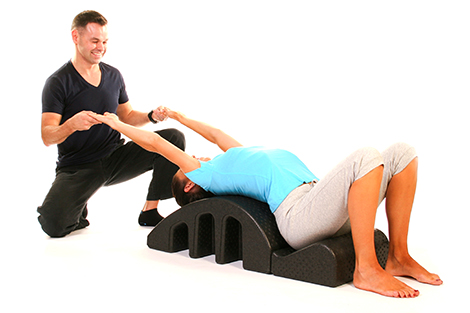
Pilates is always evolving. Rings, rollers, bands and small balls have been around for years, and now new tools such as the Arc [a semi-circle shaped barrel with handles], Orbit [a padded board on wheels] and CoreAlign mean instructors can push the boundaries of where pilates can go and who it can benefit.
While the pilates community has become somewhat fractured over the years, it can unite and strengthen going forward around the twin themes of instructor excellence and client focus. By setting the highest standards in instructor training, equipment and continuing professional development, we will make our instructors the best they can be, which will enable them to carry pilates forward in order to enthuse and help more people.
Chrysostomou is the founder of Tranquility, a London-based pilates studio which also acts as a teacher training centre.
Details: www.tran-quility.co.uk
Equipment such as CoreAlign can, says Endelman, make for unique group programming options
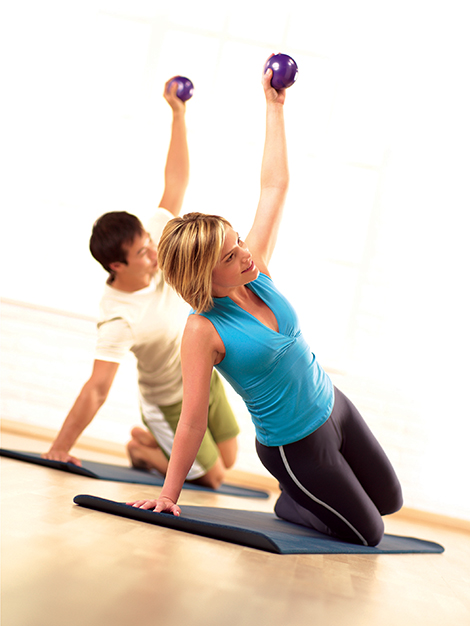
New equipment can keep pilates fresh, as well as enabling instructors to push the boundaries and help more people
What’s the future of pilates? Should it only ever involve the exercises designed by Joseph Pilates, or can his philosophy be applied while keeping the product moving with the times? We ask health and fitness industry experts worldwide
By Kate Cracknell | Published in Spa Business 2012 issue 1
Top team: Peninsula Hotels
Kath Hudson talks to key figures behind the leading Asian hotel chain about how they run their spas and exciting future plans
Profile: Cynthia Chua
The Singapore entrepreneur behind Ministry of Waxing and Browhaus has revolutionised personal grooming worldwide. She talks to Katie Barnes about the business of beauty and integration with spas
Hot springs: Chinese-style!
Lisa Starr tries out two hot spring spas - one catering to international visitors and the other to the domestic market - in China's Yunnan province
Bath time: The Chinese bathhouse
Lee David Stephens gives an insight into a traditional Chinese bathhouse and how Chinese people like to spa
Resort Spa: Sands of time
The Oitavos hotel and spa on Portugal's Estoril coast is 90 years in the making. Tom Walker pays a visit
Interview: Gary Henkin
The president and founder of WTS International - the US-based spa management and consultancy firm - talks to Rhianon Howells about expanding globally
Ask an expert: Crisis control
The Arab Spring, the Japanese tsunami and bombings in Mumbai - what's the best way of dealing with a crisis? We ask those who have first-hand experience of the events
New Zealand thermal spa: Pooling resources
The Polynesian Spa in the geothermal town of Rotorua in New Zealand boasts 25 thermal pools and is one of the longest running attractions in the country. Chris McBeath takes a look
Tourism: Booming Baku
Terry Stevens reports on the Azerbaijan capital which has seen a surge of international hotel openings in the past two years
Fitness: Pilates pure vs applied
Pure vs applied - should pilates only ever involve the exercises designed by Joseph Pilates, or can his philosophy be applied while keeping the product moving with the times?
The contemporary STOTT PILATES method has evolved from the original teachings of Joseph Pilates to include modern principles of exercise science. As we learn more about the human body, and discover new applications for pilates, it’s important that we keep the original philosophy of the method moving forward and apply current research about the biomechanics of the body.
Once known as the secret weapon of dancers, over the years pilates has become popular as a form of functional fitness, and is now used by the general public for cross-training, rehabilitation, sports conditioning and general fitness purposes.
Our method caters to different body types and abilities by offering various preparatory exercises and modifications, as well as incorporating props. It’s vital that we continue to enhance, develop and improve on the knowledge we’ve acquired to enable people of all ages and fitness levels to reap the benefits. However, we never lose sight of the foundations and the principles on which our method is based.
Della Pia is programme director, education & master instructor trainer at Merrithew – a Toronto-based company which operates under the STOTT PILATES name and develops and promotes pilates fitness programmes worldwide.
Details: www.stottpilates.com
Alyson TannerPilates Foundation
Alyson Tanner
As with most exercise systems, pilates has changed as scientific knowledge about our bodies has grown. In fact, even Joe Pilates’ own practice changed over time.
The Pilates Foundation has developed an evolutionary approach to Joe’s work. We teach the classic repertoire that Joe would recognise, but realise that most of our clients need to work through some evolved, adjusted exercises before they get there. The principles of his philosophy are central to understanding how the exercises should be taught, but we draw on modern thinking to adjust the exercises to make them accessible to almost every student.
As scientific knowledge increases, there will be new trends and directions in pilates. The beauty of pilates is that the fundamentals can be adapted and refined, learning from other movement regimes to develop a range of exercise variations and approaches suitable for each individual body.
Commercial pressures are also important. Studio classes of one or two people using expensive equipment are fantastic, but the benefits are only available to a privileged few; matwork classes have brought the benefits of pilates to many more people. In the future, fitness centres and gyms are likely to invest in pilates equipment for group classes, providing the benefits of resistance work while still being commercially viable. Manufacturers are stepping up to the challenge by designing equipment that can be stacked and stored away.
“Matwork classes have brought the benefits of pilates to many more people”, says Tanner
Tanner is the chair of The Pilates Foundation which has been the governing body for pilates in the UK for 15 years.
Details: www.pilatesfoundation.com
Ken EndelmanBalanced Body
Ken Endelman
What you’re calling ‘pure versus applied’ pilates, we call ‘classical versus contemporary’, and many people feel very strongly about their particular approach. One side feels the original measurements and designs that Joseph Pilates made on his first-generation equipment were done for a reason and should be kept that way. The other thinks combining a current understanding of human biomechanics with the pilates principle is best.
The truth is there’s merit on both sides. The important thing is how the exercise makes you feel: the end result should be experiencing the great ‘mindful movement’ benefits of a strong core and the increased flexibility that pilates provides. That’s what Joseph wanted, so if one approach really resonates over the other for you, that’s fine. It’s why we carry lines of equipment for both.
In the future, we really see a ‘mindful movement’ fitness revolution approaching, with pilates as a central player. With the continued ageing of the affluent baby boomer demographic, and uncertainty in healthcare reform, people are taking their health into their own hands. But many can’t take the pounding of weight-bearing exercise. So we’re seeing fitness facilities come up with all kinds of incredible programming ideas like combining pilates with cardio equipment or props like kettlebells. In addition, we’ve been developing equipment – like our CoreAlign – that, while not pilates per se, combines strength training with a mind-body approach, which makes for a unique group programming option.
Pilates has also taken off in the world of physiotherapy, but there’s a big difference between pilates for fitness and pilates for rehabilitation. If fitness facilities are offering any pilates-based rehabilitation services, they should be done by someone appropriately trained to handle those specific populations.
Endelman is the CEO and founder of Balanced Body, which is based in California and is one of the world’s largest manufacturer of pilates equipment.
Details: www.pilates.com
Glenn WithersAustralian Physiotherapy and Pilates Institute (APPI) Healthgroup
Glenn Withers
Questions have been asked by the public and the media about the validity and evidence behind pilates and I believe the profession has to become more accountable. Pilates effectively has two arms now – rehab and fitness – and we must provide more evidence of the benefits in both arenas. Training must also be delivered at an exceptional standard to guarantee professionalism.
The evolution of pilates to embrace rehab is in line with Joseph Pilates’ original message. Analysing his 1947 book, Return to Life Through Contrology, the message is about making permanent life changes. That’s been lost along the way, in favour of trying to find the perfect pilates body and perfecting a person’s movement on a mat. The real challenge should be linking pilates exercises to functional change – a means of chronic pain medicine. That’s what our method is all about, and rather than digressing from Joe’s vision, it’s in fact very closely aligned – just with a lot more evidence.
How does this translate to fitness centres in spas? Trainers need to ensure that they’re adequately trained, and also that they focus on what guests/clients take away from the sessions, not just what they do in the sessions. Population- or age-specific classes designed to change lifestyle are also an option.
Of course, pilates is also a technique that defines and shapes the body, and this does not necessarily need to change. It just needs to be applied by suitably trained professionals.
Withers is physiotherapist and founding director for APPI. APPI is a provider of private healthcare and education in the UK. It developed its rehabilitation-based pilates programme over 10 years ago
Details: www.appihealthgroup.com
Kevin BowenPeak Pilates
Kevin Bowen
Contrology – or, as we now refer to it, the pilates method – has been the subject of much discussion for years. There are those who claim that, if it’s not taught exactly as Joe taught it, then it’s not pilates; others feel that, if Joe were still alive, he would have evolved his teaching and technique.
Pilates has three guiding principles: whole body health, whole body commitment and breath. These principles – along with movement principles such as balanced muscle development, concentration, control, centering and precision – all work together to produce the goals and benefits of the pilates method: benefits such as improved co-ordination, strength, mobility, posture and quality of life. The pilates method offers health for life. In my opinion, it therefore laid the foundation for the functional fitness craze of today.
Pilates participation has grown exponentially and internationally it’s still experiencing strong growth. However, that growth seems to be levelling off in the US. New fitness crazes that have rallied behind the success of pilates, using pilates terminology and references, may be diluting the message and importance. Fitness facilities would be best served by maintaining a strong commitment to pilates, with well-trained instructors who understand the depth and breadth of the method and who can champion long-term participation.
“The pilates profession has to become more accountable, whether in the area of rehab or fitness,” says Withers
Bowen is director of education at Peak Pilates, USA, which provides turnkey solutions for the fitness, spa and rehabilitation sectors. It is committed to preserving the original Joseph Pilates method.
Details: www.peakpilates.com
Nikki Chrysostomou Tranquility pilates studio
Nikki Chrysostomou
The future of pilates is bright. Through innovation and experience, the pilates method and associated studio equipment has evolved to a higher level, incorporating scientific research and refined engineering techniques while adhering closely to Joseph Pilates’ original principles.
Pilates is always evolving. Rings, rollers, bands and small balls have been around for years, and now new tools such as the Arc [a semi-circle shaped barrel with handles], Orbit [a padded board on wheels] and CoreAlign mean instructors can push the boundaries of where pilates can go and who it can benefit.
While the pilates community has become somewhat fractured over the years, it can unite and strengthen going forward around the twin themes of instructor excellence and client focus. By setting the highest standards in instructor training, equipment and continuing professional development, we will make our instructors the best they can be, which will enable them to carry pilates forward in order to enthuse and help more people.
Chrysostomou is the founder of Tranquility, a London-based pilates studio which also acts as a teacher training centre.
Details: www.tran-quility.co.uk
Equipment such as CoreAlign can, says Endelman, make for unique group programming options
New equipment can keep pilates fresh, as well as enabling instructors to push the boundaries and help more people
Synergy – The Retreat Show, the global trade show for retreats, has launched a global research
initiative that will provide insights into the retreat sector from both consumer and industry
perspectives.
The Wellness Tourism Association (WTA) has published a non-regulatory global industry
framework designed to ensure the retreat market offers responsible experiences.
A new survey of UK and international spa practitioners shows that stress, burnout and
wellbeing concerns have caused one in three respondents to consider leaving the industry.
The UK's four Chief Medical Officers have published a refreshed edition of Physical activity
guidelines: UK Chief Medical Officers' report, updating the evidence that underpins the nation's
physical activity recommendations and placing greater emphasis on strength, balance, reducing
sedentary behaviour and, for the first time, supporting people taking weight loss medications.
Anna Bjurstam has left her role as Wellness Pioneer at Six Senses Hotels and Resorts and
launched a new wellness, longevity and “consciousness consultancy” called Wahayla.
Fairmont Cheshire, The Mere, has opened today (10 July) in the Northwest of England
with a
1,715sq m Fairmont Spa that has been designed using a ‘Wellness without Walls’
concept.
Wellness hotels generating less than US$1 million (€932,700, £785,200) – or 10 per cent of
total revenue from wellness and leisure – recorded the strongest RevPAR and TRevPAR growth
in 2025 across categories when compared with 2024, according to the latest Wellness Real
Estate Report by RLA Global, produced in partnership with P and L benchmarking firm HotStats.
Lefay Resorts, the portfolio of two luxury wellness properties in Italy, has added emotional
dance classes and group cold plunge sessions in response to market demand for social
connection.