Nuffield Health and Access Sport are working together / Photo: Access Sport/Nuffield
Lower socio-economic status (SES) is a determinant of many of the health problems which emerge at older ages, according to research published in 2020, led by Professor Andrew Steptoe from University College London. The study also found low SES is associated with a faster decline in age-related functions, including grip strength and gait speed, sensory function, physiological function, cognitive performance, emotional wellbeing and social function.
Those with lower SES are at increased risk of premature mortality; the development of serious conditions such as coronary heart disease, diabetes and depression, disability and dementia, as a result of chronic allostatic load (the cumulative burden of chronic stress and life events); sustained inflammation and lifestyle factors, including smoking and sedentary behaviour.
The Next Fitness Consumer report found affluent people are more likely to exercise than those in lower socio-economic groups. American households with incomes of at least $150,000 (£144,000, €136,000) a year are more likely to be active than those from households with an income of less than $50,000 (£38,000, €45000) a year.
These stats are also borne out in the UK, where Sport England’s Active Lives survey shows a significant disparity between different socio-economic groups and their engagement in sport and physical activity. Lower socio-economic groups are the most likely to be inactive (33 per cent) and the least likely to be active (54 per cent).
Empower communities In its report Understanding and addressing inequalities in physical activity, Public Health England recommends diversity training which challenges bias should be mandatory for all workforces and that a range of accessible communication tools are needed across all languages, braille and sign language. Best practice should then be shared across communities, regions, organisations and sectors.
The report said interventions for younger children should focus on encouraging a positive social environment for physical activity and adolescents should be involved in designing interventions. Partnership working with families is important – showing, rather than telling, families how to change behaviours – and designing interventions which help with engagement.
Providing a fun and social taster session for families could be a good starting point, ideally offering a variety of activities and being as low cost as possible, for example peer-to-peer support, free swimming programmes and family-based walks.
It is important that solutions are sought in partnership with communities, so they are needs-driven and individuals can take ownership of what is being delivered. In order to empower communities and foster autonomy, there should be opportunities for role models and peer to peer influencing.
Agents of change A good example of this is Street Games, which takes sport into disadvantaged areas and engages communities to get active. Working in partnership with an open network of more than 1,500 locally trusted organisations, Street Games puts young people at the centre of their work, empowering them to be leaders and amplifying their voices. They have given access to activity in more than 4,000 poverty-hit localities across the UK.
The organisation is set to receive £10.5m from Sport England over the next five years to co-deliver change at local and national level. Sport England CEO Tim Hollingsworth says this is about long term change and Street Games is one of many partners helping to do this.
Street Games’ CEO, Mark Lawrie, says opportunities to get involved in sport and activity are currently too dependent on background, gender, bank balance and postcode.
“As we continue to build back from the impact of the pandemic, it is more important than ever that young people in underserved communities are given the chance to access the many benefits which sport and physical activity brings,” he says. “Key to achieving this is working with partners to develop a greater understanding of what young people in these communities want and how to cater for their needs.”
Manchester project Nuffield Health has teamed up with Access Sport in a ground-breaking project to tackle the stark health inequalities across Greater Manchester. The partners are combining resources and expertise to improve the lives of 15,000 disadvantaged local young people and their families over the next two years.
The partnership aims to bring young people into community sport and provide access to Nuffield Health’s Manchester Institute of Health & Performance to allow them to experience sporting opportunities, learn to cycle and inspire the next generation of community leaders.
Compared with the rest of England, Manchester has almost double the number of children under 16 living in poverty and a significantly higher percentage of children aged 10 to 11 who have excess weight.
The partnership will build upon Access Sport’s community sport development model while utilising Nuffield Health’s facilities, experts and educational resources.
Helen Rowbotham, CEO of Access Sport, said this will reach many young people who are currently excluded from community sport. Nuffield Health’s head of charity, Brendan Street, says improving health inequalities will also lead to better employability skills and social mobility.
In the fast-paced world of fitness and wellness, where high-intensity workouts push us to
our limits and the sweat pours, the importance of efficient recovery cannot be overstated. [more...]
+ More featured suppliers
COMPANY PROFILES
Aquaform
With a rich heritage in the spa industry, Aquaform offers a diverse array of water wellness experien [more...]
Capsix
Founded in 2016 by Carole Eyssautier, PhD in AI, François Eyssautier, robotics engineer, and Stéphan [more...]
Nuffield Health and Access Sport are working together / Photo: Access Sport/Nuffield
Lower socio-economic status (SES) is a determinant of many of the health problems which emerge at older ages, according to research published in 2020, led by Professor Andrew Steptoe from University College London. The study also found low SES is associated with a faster decline in age-related functions, including grip strength and gait speed, sensory function, physiological function, cognitive performance, emotional wellbeing and social function.
Those with lower SES are at increased risk of premature mortality; the development of serious conditions such as coronary heart disease, diabetes and depression, disability and dementia, as a result of chronic allostatic load (the cumulative burden of chronic stress and life events); sustained inflammation and lifestyle factors, including smoking and sedentary behaviour.
The Next Fitness Consumer report found affluent people are more likely to exercise than those in lower socio-economic groups. American households with incomes of at least $150,000 (£144,000, €136,000) a year are more likely to be active than those from households with an income of less than $50,000 (£38,000, €45000) a year.
These stats are also borne out in the UK, where Sport England’s Active Lives survey shows a significant disparity between different socio-economic groups and their engagement in sport and physical activity. Lower socio-economic groups are the most likely to be inactive (33 per cent) and the least likely to be active (54 per cent).
Empower communities In its report Understanding and addressing inequalities in physical activity, Public Health England recommends diversity training which challenges bias should be mandatory for all workforces and that a range of accessible communication tools are needed across all languages, braille and sign language. Best practice should then be shared across communities, regions, organisations and sectors.
The report said interventions for younger children should focus on encouraging a positive social environment for physical activity and adolescents should be involved in designing interventions. Partnership working with families is important – showing, rather than telling, families how to change behaviours – and designing interventions which help with engagement.
Providing a fun and social taster session for families could be a good starting point, ideally offering a variety of activities and being as low cost as possible, for example peer-to-peer support, free swimming programmes and family-based walks.
It is important that solutions are sought in partnership with communities, so they are needs-driven and individuals can take ownership of what is being delivered. In order to empower communities and foster autonomy, there should be opportunities for role models and peer to peer influencing.
Agents of change A good example of this is Street Games, which takes sport into disadvantaged areas and engages communities to get active. Working in partnership with an open network of more than 1,500 locally trusted organisations, Street Games puts young people at the centre of their work, empowering them to be leaders and amplifying their voices. They have given access to activity in more than 4,000 poverty-hit localities across the UK.
The organisation is set to receive £10.5m from Sport England over the next five years to co-deliver change at local and national level. Sport England CEO Tim Hollingsworth says this is about long term change and Street Games is one of many partners helping to do this.
Street Games’ CEO, Mark Lawrie, says opportunities to get involved in sport and activity are currently too dependent on background, gender, bank balance and postcode.
“As we continue to build back from the impact of the pandemic, it is more important than ever that young people in underserved communities are given the chance to access the many benefits which sport and physical activity brings,” he says. “Key to achieving this is working with partners to develop a greater understanding of what young people in these communities want and how to cater for their needs.”
Manchester project Nuffield Health has teamed up with Access Sport in a ground-breaking project to tackle the stark health inequalities across Greater Manchester. The partners are combining resources and expertise to improve the lives of 15,000 disadvantaged local young people and their families over the next two years.
The partnership aims to bring young people into community sport and provide access to Nuffield Health’s Manchester Institute of Health & Performance to allow them to experience sporting opportunities, learn to cycle and inspire the next generation of community leaders.
Compared with the rest of England, Manchester has almost double the number of children under 16 living in poverty and a significantly higher percentage of children aged 10 to 11 who have excess weight.
The partnership will build upon Access Sport’s community sport development model while utilising Nuffield Health’s facilities, experts and educational resources.
Helen Rowbotham, CEO of Access Sport, said this will reach many young people who are currently excluded from community sport. Nuffield Health’s head of charity, Brendan Street, says improving health inequalities will also lead to better employability skills and social mobility.
People taking GLP-1 weight loss medications such as Ozempic, Wegovy, Mounjaro and Zepbound
may be losing weight, but they’re also becoming less physically active, according to new
research presented at the ENDO 2026 annual meeting of the Endocrine Society
Abu Dhabi-based investment firm Mubadala Capital has made a binding, fully financed
€1 billion
offer to acquire Pierre and Vacances SA, the European holiday resort operator behind the
continental European Center Parcs business.
Global retreat trade show, Synergy The Retreat Show, has launched a resource called The
Source, which hosts an open-access online Transformation Series programme.
The Standards Authority for Touch in Cancer Care (SATCC) charity has announced its first five-
day Living with Cancer and Beyond retreat, which will be held at Carden Park Hotel and Spa in
Cheshire, UK, between 1 and 5 September.
Patmos Aktis, a Luxury Collection Resort and Spa, has opened in Greece, with a renovated and
rebranded wellness offering called Ansana Wellness and Spa.
The Mauna Kea Beach Hotel, an Autograph Collection property in Hawaii, US, has opened its
22,000 sq ft indoor-outdoor Spa at Mauna Kea as the final step in the property’s overall
renovation, which has cost more than US$180 million (€166 million, £140 mill
The UK spa review and discovery platform for consumers, the Good Spa Guide, has announced
it will host the Good Spa Guide Awards 2026 during an event on 16 November at Sopwell House
Hotel in St Albans, UK.
Eighty-four per cent of consumers now say wellness is a top priority in their lives, with this
percentage increasing year on year, according to a preview presentation of McKinsey’s Future of
Wellness 2026 research report.
Mass protests have been taking place since Monday 1 June in Albania over the development of
a luxury resort by Donald Trump’s daughter Ivanka Trump and her husband Jared Kushner.
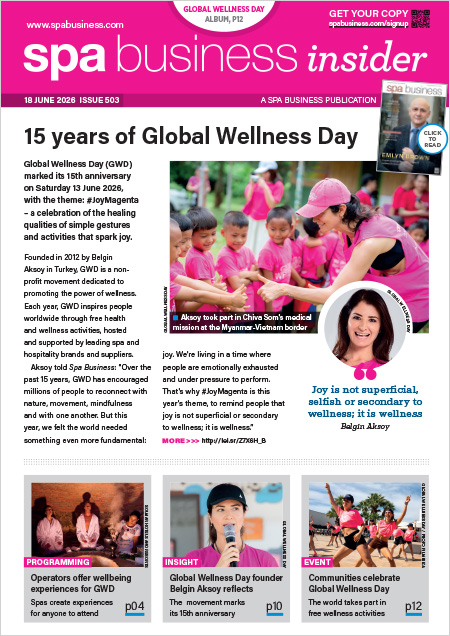
Global Wellness Day (GWD) marked its 15th anniversary on Saturday 13 June 2026, with the
theme: #JoyMagenta – a celebration of the healing qualities of simple gestures and activities
that spark joy.
In the fast-paced world of fitness and wellness, where high-intensity workouts push us to
our limits and the sweat pours, the importance of efficient recovery cannot be overstated. [more...]
+ More featured suppliers
COMPANY PROFILES
Aquaform With a rich heritage in the spa industry, Aquaform offers a diverse array of water wellness experien [more...]