Yes! Send me the FREE digital editions of Spa Business and Spa Business insider magazines and the FREE weekly Spa Business and Spa Business insider ezines and breaking news alerts!
As the Imperial War Museum
London prepares to tell
hitherto unheard stories from
World War 2, Magali Robathan
speaks to the designers about
the museum’s new galleries
Five years in the making, Imperial War Museums’ new Second World War Galleries and Holocaust Galleries will bring together unseen objects and unheard voices, when they open on 20 October 2021.
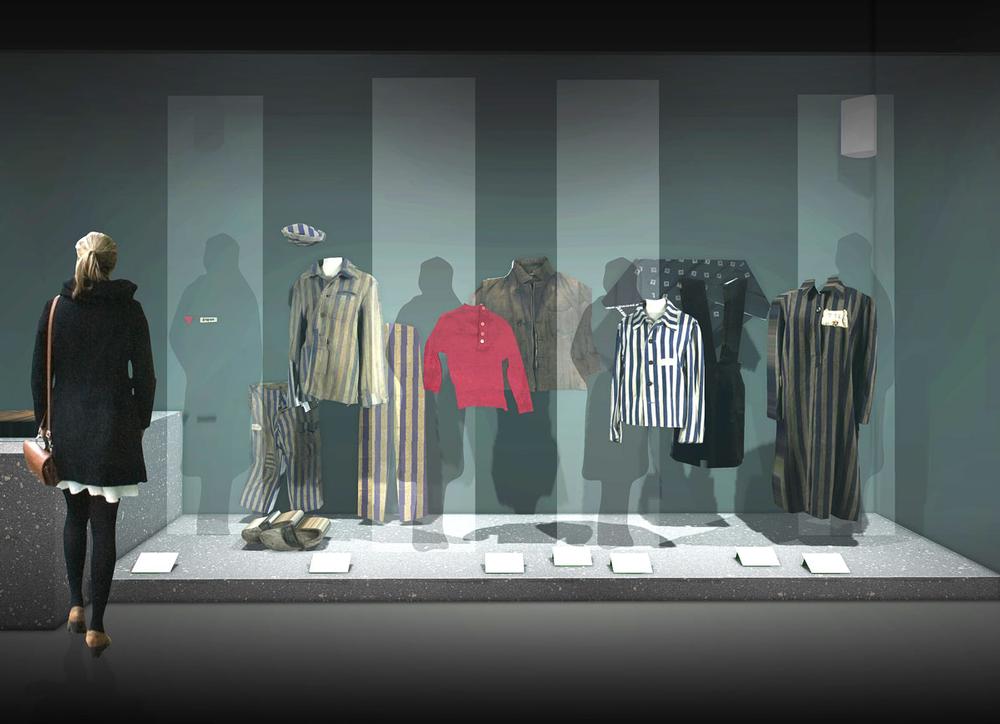
IWM London’s £30.5m transformation project will make it the first museum in the world to house dedicated Second World War and Holocaust Galleries under the same roof, telling the story of this period in history for a 21st century audience. The galleries span two floors; The Second World War Galleries were designed by Ralph Appelbaum Associates (RAA), while the Holocaust Galleries were designed by Casson Mann.
Drawing heavily upon the personal stories contained in the IWM’s collections, the new galleries will aim to show visitors the realities of the Second World War, the Holocaust and the resulting impact on the world.
Diane Lees, IWM Director-General, said: “At the centre of the brutal and barbaric conflict was the state sponsored mass murder of 6 million Jewish men, women and children. This is why we’re placing IWM’s new Holocaust Galleries at the central chronological fulcrum of our iconic London museum and linking them, architecturally and conceptually, to our new Second World War Galleries.”
Here we speak to Phillip Tefft, founding director of Ralph Appelbaum Associates London, about this moving and emotional project.
What’s the aim of the Second World War Galleries and why is it so important to tell this story right now? Imperial War Museums (IWM) and Ralph Appelbaum Associates (RAA)’s shared vision for the Second World War Galleries is to help people, as global citizens, make sense of today by having a deeper understanding of the connections between past conflict and the contemporary world. This is about exploring the way war has shaped the local and the global; about appreciating diverse views; and about challenging audiences to become ready to engage in difficult decisions for themselves, their communities and their world.
Though this conflict will soon pass out of living memory, leaving us without the first-hand testimony of its veterans, eyewitnesses and survivors, these monumental new Galleries will help ensure that the experiences of those generations are never forgotten. This has been one of the Museum group’s most ambitious projects to date, and along with Imperial War Museums, we are very much looking forward to sharing the fascinating stories that these Galleries will tell.
How did you approach this project? Early on in the Galleries’ development, it was important for us to focus on striking a balance between telling powerful, often personal stories, with the challenge of evoking place in the gallery space. We worked closely with and listened to IWM’s team, ensuring our design and planning upheld and reflected their narrative and design principles consistently throughout the entirety of the time we worked together.
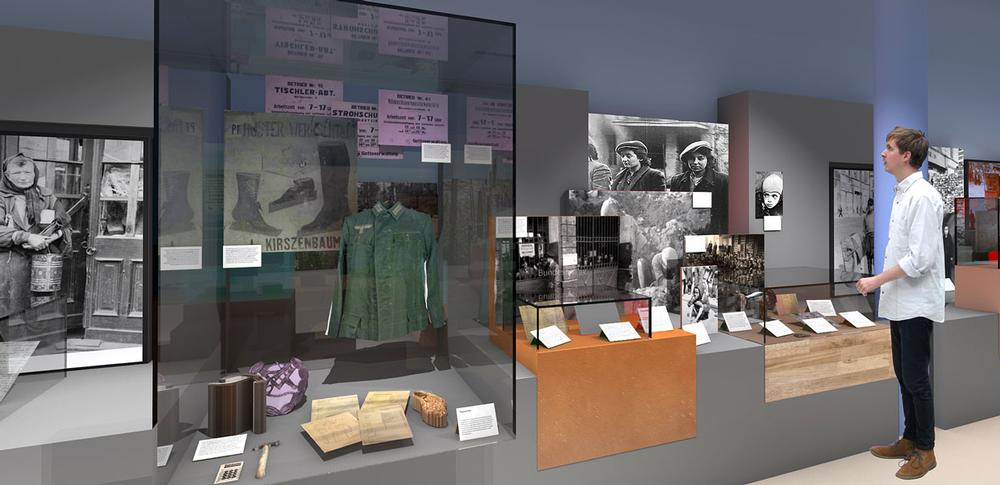
RAA have used design and media to contextualise the stories being told throughout the exhibition’s six Galleries. We wanted to give IWM freedom to tell their stories in the way they wanted, while seeking a design solution that makes the Gallery spaces easy to navigate for visitors.
In the early stages of planning, our design team looked at a wide array of storytelling devices in narrative environments, drawing inspiration from different industries such as the latest scenographic techniques used in the world of theatre and set design.
We also drew inspiration from the successes of past exhibition design and planning projects that have dealt with other significant historical narratives during the twentieth century. The ‘First World War in the Air’ exhibition that RAA designed for London’s RAF Museum is an example of how the subject of battle fought in the air has been opened up to wider audiences through emotive people stories, dramatic displays and a graphic system making technical information accessible for all.
How would you sum up your philosophy when it comes to designing exhibitions? RAA’s design philosophy centres on connecting our clients’ content and messages to the needs and desires of contemporary audiences. We believe that evocative and compelling interpretation in exhibition design has the power to transport visitors to another place and time, while deepening understanding of relevant issues.
We always work in step with our clients, considering their requirements carefully to ensure we have a comprehensive understanding of each project’s aim and aspirations. Exploring opportunities and testing ideas collaboratively with clients and their communities helps us find design solutions that create powerful, memorable or impactful impressions on audiences.
Our design work is shaped by the search for the most emotively engaging experiences and stories, drawing from collections and highly personalised narratives. Where appropriate, we have increasingly integrated advanced media and immersion technologies to enhance and contextualise narratives within our designs.
How important is it to connect emotionally with visitors coming to the Second World War Galleries? We believe in the importance of connecting emotionally with visitors. For audiences visiting the Second World War Galleries, the use of personal stories from everyday people living through the war help visitors to connect emotionally with the content. Immersive media such as the overhead Battle of Britain AV in Gallery 3: ‘What did war mean for Britain?’, will make visitors feel like they’re in the midst of the action in London, a city now under attack from the night sky.
How do the new Galleries tell the global story of the Second World War? As well as telling the global story of the Second World War, the Galleries aim to engage a new generation of museum visitors with this complex and formative period of history. The Galleries incorporate well-known, familiar collections alongside material displayed by Imperial War Museums for the first time.
The word ‘collections’ encompasses more than just physical objects. A variety of assets including visual material such as photographs and media from the Imperial War Museums’ vast archive will be displayed alongside large collections, such as aircraft and weaponry.
The Museums’ archive of imagery and film is tapped into and utilised throughout the entire exhibition experience, edited into narrative film installations which are critical in helping the visitor understand the stories from multiple global perspectives.
Globally significant artefacts in Gallery 4: How did the war turn global?, include a piece of the SS Arizona that was bombed at Pearl Harbor. In Gallery 5: How was the war won and lost?, a stack of glass bowls found in Hiroshima are displayed, fused together from heat as a result of the devastating atomic bombings.
Can you pick out some of the key display techniques used to tell the story of WWII? Key display techniques include the use of AV media. This is perhaps most powerful in the expansive overhead media telling the story of the Battle of Britain. The huge scale gives visitors a different perspective of the war overhead, letting them see and hear the sky in daylight and at night.
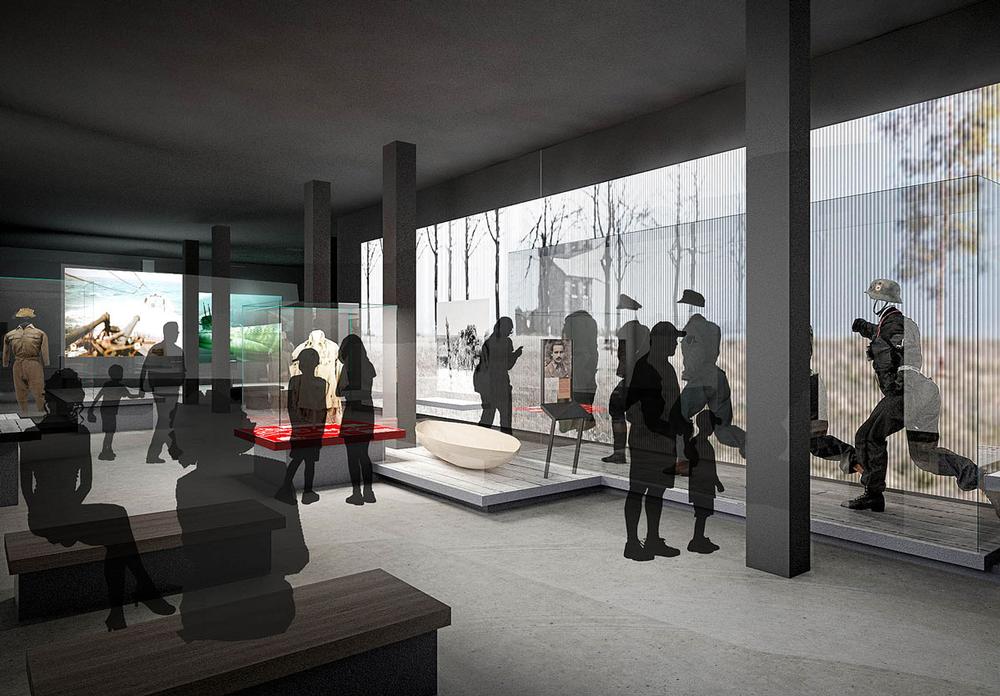
Ambient projections of landscapes span vast surfaces in the exhibition, evoking distant places where battle took place. Footage of wind gently running through blades of grass in fields far away is set behind the objects in display cases, helping put them in the context of place.
Remarkably, much of the footage used was captured during lockdowns with local film crews continuing filming across three different continents.
What’s been the biggest challenge of this project? One major challenge of the project was its length. The development of the Galleries has played out over the course of more than five years. Our team worked hard to maintain design continuity and consistency as well as narrative coherency, over this extended period of time.
The COVID-19 pandemic brought the unexpected challenge of working remotely in the final stages of the project. Checking display case layouts, internal setworks and ordering materials were all tasks that were more complicated to coordinate during a pandemic, but along with the Museum, RAA rose to the challenge of creating a new exhibition under unusual circumstances.
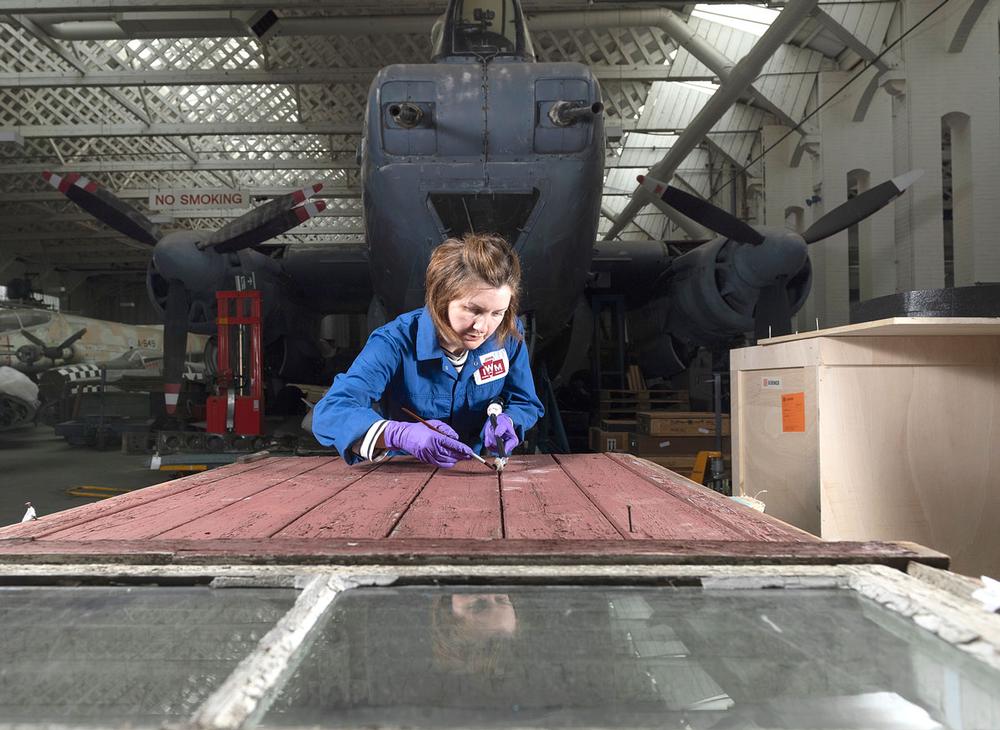
‘The Imperial War Museum building itself offered some structural and technical challenges; the renovation of its existing gallery spaces to host the new exhibits brought some surprising discoveries that needed to be addressed by specialist teams and collaborative problem solving.
A final challenge was the one of telling a human story through inanimate objects. We brought The Imperial War Museums’ extensive collection of artefacts to life – connecting collections to stories through bold design moves across the series of Gallery spaces.
Have you found this an emotional project to work on? Learning about the everyday people who lived through a global war on an unprecedented scale connected emotionally. Hearing the huge number of personal stories of loss and devastation that came out of tragic events was incredibly moving. At the same time, it could be uplifting to hear about stories of human resilience in the face of adversity. Visitors will hear about ways people coped with the extreme conditions war inflicted on their lives.
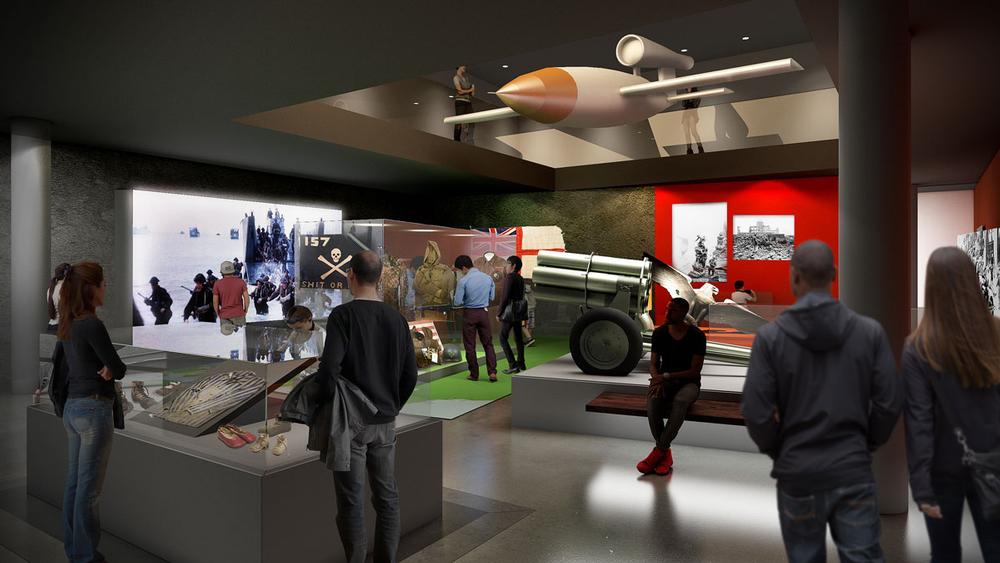
What relationship do the Second World War Galleries and The Holocaust Galleries have? How closely did you work with the designers of The Holocaust Galleries? IWM and RAA have developed the Second World War Galleries in parallel with IWM’s new The Holocaust Galleries, ensuring the vital connection between the events of the Holocaust and the wider course of the war is fully understood. The two separate exhibitions touch base physically in Gallery 5: ‘How was the war won and lost?’, where visitors’ eyes are drawn upwards to look at a V1 flying bomb. Manufactured by slave labourers in Nazi-run concentration camps and intended to lay waste to Britain’s home front, it is dramatically suspended in the opening where above sit The Holocaust Galleries.
What’s next for Ralph Applebaum Associates? ■ The John Randle Centre for Yoruba culture and history in Lagos, Nigeria opens in spring 2022
■ The upcoming blockbuster exhibition at the British Museum, opens spring 2022
■ A new visitor attraction at Battersea Power Station, London, opens in summer 2022
■ The Intelligence Factory, a new permanent exhibition opening at Bletchley Park, UK, opens in spring 2022
THE WORLD WAR II GALLERIES
THE Visitor Journey
The exhibition narrative is expressed through six Galleries, arranged in a roughly chronological sequence, beginning in 1930 and ending after the war in 1949:
1. How did the Second World War begin?
2. How did war spread across Europe?
3. What did war mean for Britain?
4. How did the war turn global?
5. How was the war won and lost?
6. How did the war change the world?
A particular area that stands out is Gallery 4: How did the war turn global? Here, large scale projections cast behind display cases filled with objects, create a spectacular theatrical impression.
In Gallery 5: How was the war won and lost?, huge floor graphics of maps sprawl out onto nearby surfaces, interacting seamlessly with display cases containing collections in the space.
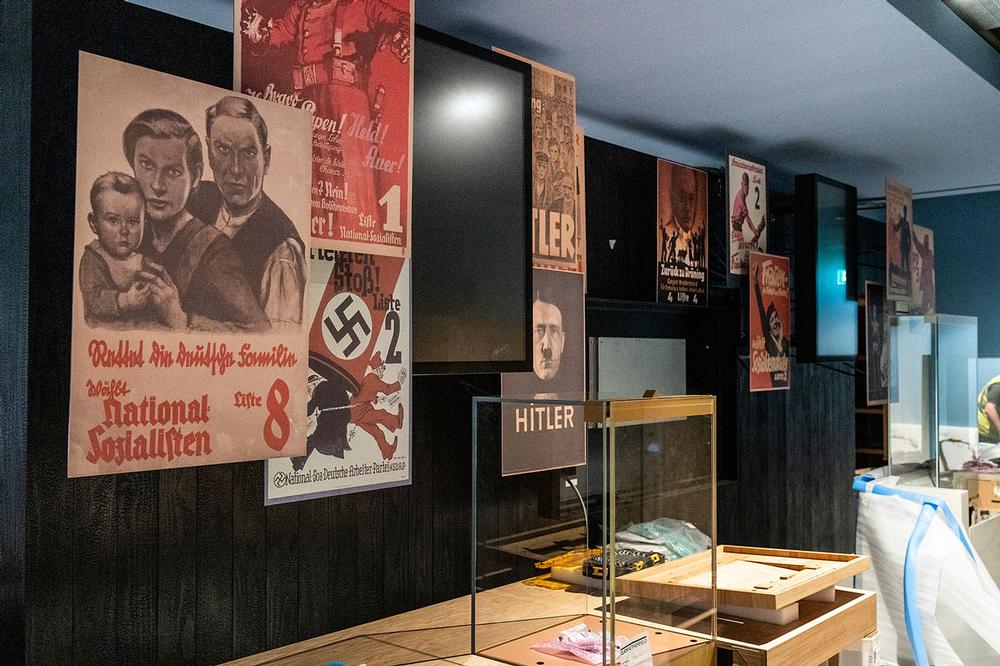
A deconstructed 1940s house in Gallery 3: What did war mean for Britain? will be popular with visitors, transporting them back in time and helping them experience what it was like to be at home in Britain during the decade.
Photo: RAA
Phillip Tefft, founding director of Ralph Applebaum Associates
Read more from this issue of Spa Business magazine
View contents of Spa Business 2021 issue 3
Editor's letter: Time for action
With COP26 upcoming, now’s the time for attractions leaders to commit to carbon reduction, says Liz Terry
AM People: Daniel Hemsley
Immersive entertainment company Swamp Motel is launching a new live show. AM finds out more
AM People: Kengo Kuma
The H.C. Andersen House has opened in Denmark. Designed by Kengo Kuma, it celebrates storytelling
New opening: The deepest dive
Featuring post-apocalyptic underwater environments and the world’s deepest pool, Deep Dive Dubai is making waves
Sustainability: A brighter future
With a zero-emission hotel and plans for a huge photovoltaic plant, PortAventura World is moving towards a new energy model
Museums: Play on
Using emotion, technology and special effects, Ravinia Music Box is bringing the music of Leonard Bernstein to new audiences
Tourism: Local heroes and global nomads
From globally-renowned art galleries to community-run attractions, a new breed of visionaries are reimagining tourism in this rural idyll
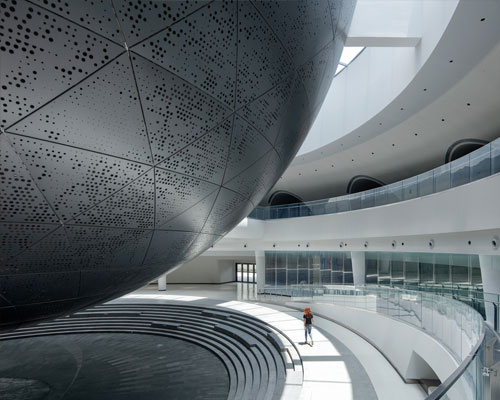
Planetariums: Thomas J Wong
As the world’s largest museum of astronomy opens in Shanghai, we speak to the architect who helped make the vision a reality
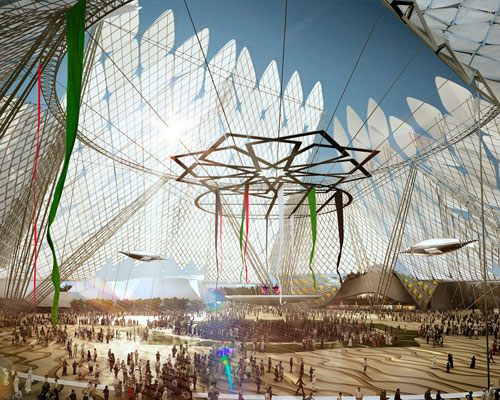
World Expo: Expo 2020 Dubai launches
It was delayed by a year due to COVID-19, but the Expo has now opened with more than 200 exhibitors and a masterplan designed by HOK, Arup and Populous
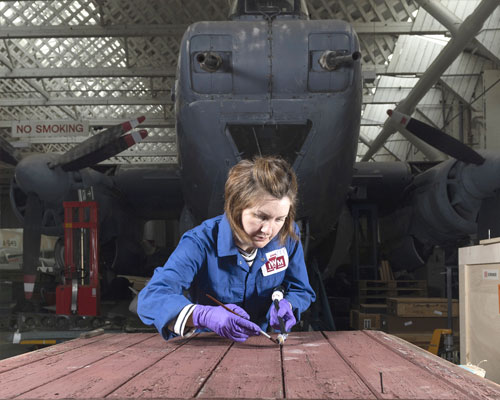
Museums: Phillip Tefft
The Imperial War Museum is bringing untold stories to life with its Second World War and Holocaust Galleries. Exhibition designer Phillip Tefft shares the journey
In today’s premium spa environment, every detail shapes the guest experience – right down to
the softness of towels and the freshness of linens. [more...]
Le Atelier by C.O.D.E. doesn't offer a standard bespoke service, it provides a highly
customised approach to designing massage beds and loungers in high-end wellness
environments. [more...]
+ More featured suppliers
COMPANY PROFILES
Beautylizer
Beautylizer brings
its deep aesthetic expertise and
strong R&D focus to holistic wellness,
offeri [more...]
Sommerhuber GmbH
Sommerhuber specialises in the manufacturing of heat-storing ceramics for spas. [more...]
As the Imperial War Museum
London prepares to tell
hitherto unheard stories from
World War 2, Magali Robathan
speaks to the designers about
the museum’s new galleries
Five years in the making, Imperial War Museums’ new Second World War Galleries and Holocaust Galleries will bring together unseen objects and unheard voices, when they open on 20 October 2021.
IWM London’s £30.5m transformation project will make it the first museum in the world to house dedicated Second World War and Holocaust Galleries under the same roof, telling the story of this period in history for a 21st century audience. The galleries span two floors; The Second World War Galleries were designed by Ralph Appelbaum Associates (RAA), while the Holocaust Galleries were designed by Casson Mann.
Drawing heavily upon the personal stories contained in the IWM’s collections, the new galleries will aim to show visitors the realities of the Second World War, the Holocaust and the resulting impact on the world.
Diane Lees, IWM Director-General, said: “At the centre of the brutal and barbaric conflict was the state sponsored mass murder of 6 million Jewish men, women and children. This is why we’re placing IWM’s new Holocaust Galleries at the central chronological fulcrum of our iconic London museum and linking them, architecturally and conceptually, to our new Second World War Galleries.”
Here we speak to Phillip Tefft, founding director of Ralph Appelbaum Associates London, about this moving and emotional project.
What’s the aim of the Second World War Galleries and why is it so important to tell this story right now? Imperial War Museums (IWM) and Ralph Appelbaum Associates (RAA)’s shared vision for the Second World War Galleries is to help people, as global citizens, make sense of today by having a deeper understanding of the connections between past conflict and the contemporary world. This is about exploring the way war has shaped the local and the global; about appreciating diverse views; and about challenging audiences to become ready to engage in difficult decisions for themselves, their communities and their world.
Though this conflict will soon pass out of living memory, leaving us without the first-hand testimony of its veterans, eyewitnesses and survivors, these monumental new Galleries will help ensure that the experiences of those generations are never forgotten. This has been one of the Museum group’s most ambitious projects to date, and along with Imperial War Museums, we are very much looking forward to sharing the fascinating stories that these Galleries will tell.
How did you approach this project? Early on in the Galleries’ development, it was important for us to focus on striking a balance between telling powerful, often personal stories, with the challenge of evoking place in the gallery space. We worked closely with and listened to IWM’s team, ensuring our design and planning upheld and reflected their narrative and design principles consistently throughout the entirety of the time we worked together.
RAA have used design and media to contextualise the stories being told throughout the exhibition’s six Galleries. We wanted to give IWM freedom to tell their stories in the way they wanted, while seeking a design solution that makes the Gallery spaces easy to navigate for visitors.
In the early stages of planning, our design team looked at a wide array of storytelling devices in narrative environments, drawing inspiration from different industries such as the latest scenographic techniques used in the world of theatre and set design.
We also drew inspiration from the successes of past exhibition design and planning projects that have dealt with other significant historical narratives during the twentieth century. The ‘First World War in the Air’ exhibition that RAA designed for London’s RAF Museum is an example of how the subject of battle fought in the air has been opened up to wider audiences through emotive people stories, dramatic displays and a graphic system making technical information accessible for all.
How would you sum up your philosophy when it comes to designing exhibitions? RAA’s design philosophy centres on connecting our clients’ content and messages to the needs and desires of contemporary audiences. We believe that evocative and compelling interpretation in exhibition design has the power to transport visitors to another place and time, while deepening understanding of relevant issues.
We always work in step with our clients, considering their requirements carefully to ensure we have a comprehensive understanding of each project’s aim and aspirations. Exploring opportunities and testing ideas collaboratively with clients and their communities helps us find design solutions that create powerful, memorable or impactful impressions on audiences.
Our design work is shaped by the search for the most emotively engaging experiences and stories, drawing from collections and highly personalised narratives. Where appropriate, we have increasingly integrated advanced media and immersion technologies to enhance and contextualise narratives within our designs.
How important is it to connect emotionally with visitors coming to the Second World War Galleries? We believe in the importance of connecting emotionally with visitors. For audiences visiting the Second World War Galleries, the use of personal stories from everyday people living through the war help visitors to connect emotionally with the content. Immersive media such as the overhead Battle of Britain AV in Gallery 3: ‘What did war mean for Britain?’, will make visitors feel like they’re in the midst of the action in London, a city now under attack from the night sky.
How do the new Galleries tell the global story of the Second World War? As well as telling the global story of the Second World War, the Galleries aim to engage a new generation of museum visitors with this complex and formative period of history. The Galleries incorporate well-known, familiar collections alongside material displayed by Imperial War Museums for the first time.
The word ‘collections’ encompasses more than just physical objects. A variety of assets including visual material such as photographs and media from the Imperial War Museums’ vast archive will be displayed alongside large collections, such as aircraft and weaponry.
The Museums’ archive of imagery and film is tapped into and utilised throughout the entire exhibition experience, edited into narrative film installations which are critical in helping the visitor understand the stories from multiple global perspectives.
Globally significant artefacts in Gallery 4: How did the war turn global?, include a piece of the SS Arizona that was bombed at Pearl Harbor. In Gallery 5: How was the war won and lost?, a stack of glass bowls found in Hiroshima are displayed, fused together from heat as a result of the devastating atomic bombings.
Can you pick out some of the key display techniques used to tell the story of WWII? Key display techniques include the use of AV media. This is perhaps most powerful in the expansive overhead media telling the story of the Battle of Britain. The huge scale gives visitors a different perspective of the war overhead, letting them see and hear the sky in daylight and at night.
Ambient projections of landscapes span vast surfaces in the exhibition, evoking distant places where battle took place. Footage of wind gently running through blades of grass in fields far away is set behind the objects in display cases, helping put them in the context of place.
Remarkably, much of the footage used was captured during lockdowns with local film crews continuing filming across three different continents.
What’s been the biggest challenge of this project? One major challenge of the project was its length. The development of the Galleries has played out over the course of more than five years. Our team worked hard to maintain design continuity and consistency as well as narrative coherency, over this extended period of time.
The COVID-19 pandemic brought the unexpected challenge of working remotely in the final stages of the project. Checking display case layouts, internal setworks and ordering materials were all tasks that were more complicated to coordinate during a pandemic, but along with the Museum, RAA rose to the challenge of creating a new exhibition under unusual circumstances.
‘The Imperial War Museum building itself offered some structural and technical challenges; the renovation of its existing gallery spaces to host the new exhibits brought some surprising discoveries that needed to be addressed by specialist teams and collaborative problem solving.
A final challenge was the one of telling a human story through inanimate objects. We brought The Imperial War Museums’ extensive collection of artefacts to life – connecting collections to stories through bold design moves across the series of Gallery spaces.
Have you found this an emotional project to work on? Learning about the everyday people who lived through a global war on an unprecedented scale connected emotionally. Hearing the huge number of personal stories of loss and devastation that came out of tragic events was incredibly moving. At the same time, it could be uplifting to hear about stories of human resilience in the face of adversity. Visitors will hear about ways people coped with the extreme conditions war inflicted on their lives.
What relationship do the Second World War Galleries and The Holocaust Galleries have? How closely did you work with the designers of The Holocaust Galleries? IWM and RAA have developed the Second World War Galleries in parallel with IWM’s new The Holocaust Galleries, ensuring the vital connection between the events of the Holocaust and the wider course of the war is fully understood. The two separate exhibitions touch base physically in Gallery 5: ‘How was the war won and lost?’, where visitors’ eyes are drawn upwards to look at a V1 flying bomb. Manufactured by slave labourers in Nazi-run concentration camps and intended to lay waste to Britain’s home front, it is dramatically suspended in the opening where above sit The Holocaust Galleries.
What’s next for Ralph Applebaum Associates? ■ The John Randle Centre for Yoruba culture and history in Lagos, Nigeria opens in spring 2022
■ The upcoming blockbuster exhibition at the British Museum, opens spring 2022
■ A new visitor attraction at Battersea Power Station, London, opens in summer 2022
■ The Intelligence Factory, a new permanent exhibition opening at Bletchley Park, UK, opens in spring 2022
THE WORLD WAR II GALLERIES
THE Visitor Journey
The exhibition narrative is expressed through six Galleries, arranged in a roughly chronological sequence, beginning in 1930 and ending after the war in 1949:
1. How did the Second World War begin?
2. How did war spread across Europe?
3. What did war mean for Britain?
4. How did the war turn global?
5. How was the war won and lost?
6. How did the war change the world?
A particular area that stands out is Gallery 4: How did the war turn global? Here, large scale projections cast behind display cases filled with objects, create a spectacular theatrical impression.
In Gallery 5: How was the war won and lost?, huge floor graphics of maps sprawl out onto nearby surfaces, interacting seamlessly with display cases containing collections in the space.
A deconstructed 1940s house in Gallery 3: What did war mean for Britain? will be popular with visitors, transporting them back in time and helping them experience what it was like to be at home in Britain during the decade.
Photo: RAA
Phillip Tefft, founding director of Ralph Applebaum Associates
Read more from this issue of Spa Business magazine
View contents of Spa Business 2021 issue 3
Editor's letter: Time for action
With COP26 upcoming, now’s the time for attractions leaders to commit to carbon reduction, says Liz Terry
AM People: Daniel Hemsley
Immersive entertainment company Swamp Motel is launching a new live show. AM finds out more
AM People: Kengo Kuma
The H.C. Andersen House has opened in Denmark. Designed by Kengo Kuma, it celebrates storytelling
New opening: The deepest dive
Featuring post-apocalyptic underwater environments and the world’s deepest pool, Deep Dive Dubai is making waves
Sustainability: A brighter future
With a zero-emission hotel and plans for a huge photovoltaic plant, PortAventura World is moving towards a new energy model
Museums: Play on
Using emotion, technology and special effects, Ravinia Music Box is bringing the music of Leonard Bernstein to new audiences
Tourism: Local heroes and global nomads
From globally-renowned art galleries to community-run attractions, a new breed of visionaries are reimagining tourism in this rural idyll
Planetariums: Thomas J Wong
As the world’s largest museum of astronomy opens in Shanghai, we speak to the architect who helped make the vision a reality
World Expo: Expo 2020 Dubai launches
It was delayed by a year due to COVID-19, but the Expo has now opened with more than 200 exhibitors and a masterplan designed by HOK, Arup and Populous
Museums: Phillip Tefft
The Imperial War Museum is bringing untold stories to life with its Second World War and Holocaust Galleries. Exhibition designer Phillip Tefft shares the journey
Rosewood Le Guanahani St Barth, on the northeast coast of Saint Barthélemy in the French
West Indies, is offering a programme of ocean-inspired yoga classes between 8-14 June to
celebrate Global Wellness Day (GWD).
Hotel de France, located on the British Isle of Jersey, has created a wellness retreat package
that includes a hot yoga session that will take place in Jersey Zoo’s butterfly sanctuary.
The Ritz-Carlton, Langkawi, in Malaysia, has revealed a schedule for Global Wellness Day
(GWD) that includes guided rainforest walks, mindful movement and guided coastal meditation
experiences.
Longevitix, a clinical platform for preventive and longevity medicine, has launched its AI-
powered intelligence system to help physicians deliver continuous, personalised longevity-
focused care at scale.
Atmantan Wellness Centre, an integrative wellness destination in Mulshi, near Pune in India, is
expanding its portfolio by adding a new centre in Hyderabad that will launch between 2028 and
2029.
A recent survey by the UK Spa Association (UKSA) into the industry’s approach to cancer care
has revealed that almost half of participating respondents (46 per cent) are unaware that
cancer is a disability and guests with a cancer diagnosis must be given
Mexican operator, Solmar Hotels and Resorts, is hosting a series of events in celebration of
Global Wellness Day, including a Temazcal ceremony at its Playa Grande Resort and Spa in Los
Cabos.
Mandarin Oriental has announced a standalone residence brand, Mansions, which will debut at
Emirates Palace, Mandarin Oriental Mansions, Abu Dhabi, in 2029.
Four Seasons Resort The Nam Hai in Hoi An, Vietnam, has put together a Global Wellness Day
(GWD) agenda with activations rooted in nature and shaped by four pillars of Joy – in
alignment with the day’s theme #JoyMagenta.
In today’s premium spa environment, every detail shapes the guest experience – right down to
the softness of towels and the freshness of linens. [more...]
Le Atelier by C.O.D.E. doesn't offer a standard bespoke service, it provides a highly
customised approach to designing massage beds and loungers in high-end wellness
environments. [more...]
+ More featured suppliers
COMPANY PROFILES
Beautylizer Beautylizer brings
its deep aesthetic expertise and
strong R&D focus to holistic wellness,
offeri [more...]