Yes! Send me the FREE digital editions of Spa Business and Spa Business insider magazines and the FREE weekly Spa Business and Spa Business insider ezines and breaking news alerts!
Total spa industry revenue in the US has reached an all-time high of US$16.8bn, according to the latest research from ISPA and PricewaterhouseCoopers. Research author Colin McIlheney outlines the findings
By Colin McIlheney | Published in Spa Business 2017 issue 4
More than three in five US spas (61%) report service provider vacancies
It’s been another year of steady growth for the US spa industry, according to the International Spa Association’s (ISPA) 2017 US Spa Industry Study, which was carried out in collaboration with PricewaterhouseCoopers (PwC).
The report is a nationwide overview of the spa industry and looks at data for 2016 through spring 2017. The findings are the result of a large-scale survey of spa operators across the US. Criteria examined include financial performance, employment and growth, as well as the regional distribution of spas, ownership structures, number of visits, product and service offerings, compensation and other topical areas of interest.
With growth in the US economy in 2016 seeing overall GDP continuing to rise and unemployment falling further, this year’s estimates show that the spa industry grew in tandem with the wider economy. Revenues, visits, employment and locations all increased, marking further progress for the industry and representing a seventh year of positive growth following the decline that resulted from the Great Recession in 2008-2009.
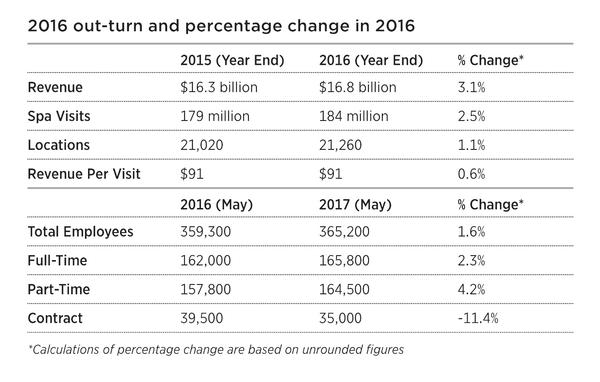
Five key statistics In this year’s study, each of the ‘Big Five’ statistics increased on the previous year’s figures, underscoring the industry’s continued growth. Total spa industry revenue in the US is estimated to have reached US$16.8bn in 2016 – an all-time record figure. Growth in the overall US economy slowed slightly in 2016, with GDP growth falling from 2.6 per cent in 2015 to 1.6 per cent in 2016, and this trend was matched in the spa industry, with revenue growth slowing from 5 per cent in 2015 to 3.1 per cent in 2016. In addition to revenue, record-high figures for the industry were also recorded in relation to visits, locations and revenue per visit. With 5 million additional visits made to spas in 2016, the number of visits grew to 184 million in 2016, representing a 2.5 per cent increase on the figure from the previous year. These increases in both revenues and visits helped revenue per visit rise by 0.6 per cent to US$91.30.
With employment in the wider US economy increasing by 1.8 per cent in 2016, the spa industry kept pace with a 1.6 per cent increase in employment, meaning that 365,200 people now work in US spas. There was steady growth in both the number of full-time (+2.3 per cent) and part-time (+4.1 per cent) employees, coupled with a further fall in the number of contractors (-11.4 per cent). In recent years the part-time workforce has seen a more rapid rate of growth than full-time employment, meaning that the number of part-time employees in spas is now just shy of the number of full-time employees.
There was a net increase of 240 new spas on the landscape in 2016, equating to more than four new spas opening each week, meaning there are now 21,260 spa establishments in the US (+1.1 per cent). This is just shy of the record of 21,300 spa establishments documented in 2008. Almost four in five spas in the US are day spas (79.6 per cent), followed by resort/hotel spas (8.6 per cent) and medical spas (8.3 per cent), which remains largely unchanged from the previous year.
Demand for talent Compensation remains a hot topic in the US spa industry. The number of unfilled vacancies still stands out, with more than three in five (61 per cent) spas reporting service provider vacancies. The number of service provider vacancies in 2016 is estimated at 32,390, a 13 per cent fall on the previous year’s figure, and perhaps a sign of progress in a key area for the industry’s future growth. Nevertheless, the number of unfilled director and manager vacancies has remained static at 1,230 – the majority of these being vacancies for spa managers (1,030). This shows that as the industry’s growth continues, so does the demand for talent across all job roles.
Looking ahead With the industry striving for further expansion, many spas reported that they are actively taking steps to keep up with emerging trends and ensure future growth. Technology is unsurprisingly at the forefront, with more than four in five spas (83 per cent) saying they had offered social media promotions in 2016, and over three in five (62 per cent) US spas offering online booking options.
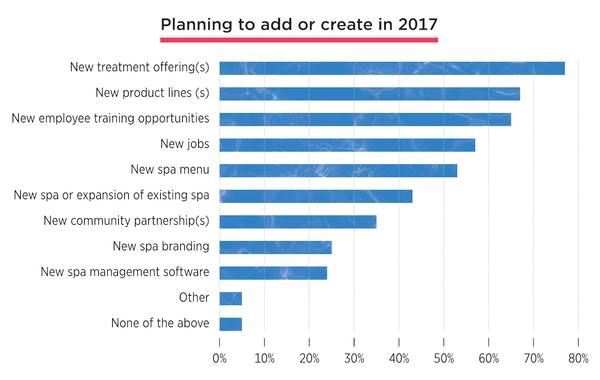
Looking to the future, the vast majority said they plan to add or create a range of enhancements to their business (95 per cent), with over three-quarters (77 per cent) intending to add new treatment offerings and two-thirds (67 per cent) planning to introduce new product lines. From a personnel perspective, almost two in three spas (65 per cent) plan to add or create new training opportunities, and over half (57 per cent) plan to create new jobs.
Respondents were asked to comment on what they believe will be the next big thing to shape the industry. Wellness, health and fitness remains the most frequently cited trend, mentioned by almost one in three spas (32 per cent). Some distance behind, the second-most popular choice was the use of organic/natural products (12 per cent), often linked to themes around sustainability and local sourcing.
Read more from this issue of Spa Business magazine
Promotional feature: Anne Semonin
Katherine Connolly, newly appointed global
director of retail and spa operations at Anne
Semonin, discusses her plans for the brand
Promotional feature: Thalion
Thalion is the first company to develop highly
specialised mineral therapies for clients, says
training manager Sophie Alemany
Research: Finishing touch
A new study shows that massage can
help muscle re-growth after an injury –
even when applied to the opposite limb
Research findings in detail ISPA is a professional organisation, representing providers in more than 70 countries and encompassing all aspects of the spa experience, from facilities through to instructors, professional practitioners and product suppliers. Its role is to advance the industry by providing educational and networking opportunities, promoting spas and fostering professionalism and growth.
To gain more in-depth industry understanding, ISPA commissioned the first US study in 2000, followed by updates in 2002, 2004, 2006, 2007, and every year from 2010 onwards. Shorter tracking studies documented performance in 2003, 2005, 2008 and 2009.
Topics covered in detail in the full ISPA 2017 US Spa Industry Study prepared by PwC include: • Overall industry size and growth • Industry profile – size and type of spa by geography and year of start-up • Services, facilities and products offered across the spectrum of spa types • Compensation - differences by type of spa, type of employment and role
The full ISPA 2017 US Spa Industry Study, with technical appendix, is available at experienceispa.com. ISPA members may download a complimentary copy and non-members may purchase the report through this site.
The 2017 US Spa Industry Study was released at ISPA’s 2017 conference, which took place 16-18 October in Las Vegas.
Colin McIlheney
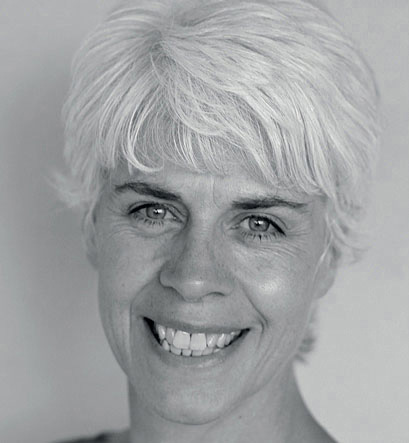
Colin McIlheney is the global research director at PricewaterhouseCoopers, and in his 33-year career, he’s designed more than 200 international surveys. He’s also the research advisor for ISPA, and was the lead manager on the 2017 US Spa Industry Study.
In the fast-paced world of fitness and wellness, where high-intensity workouts push us to
our limits and the sweat pours, the importance of efficient recovery cannot be overstated. [more...]
Total spa industry revenue in the US has reached an all-time high of US$16.8bn, according to the latest research from ISPA and PricewaterhouseCoopers. Research author Colin McIlheney outlines the findings
By Colin McIlheney | Published in Spa Business 2017 issue 4
More than three in five US spas (61%) report service provider vacancies
It’s been another year of steady growth for the US spa industry, according to the International Spa Association’s (ISPA) 2017 US Spa Industry Study, which was carried out in collaboration with PricewaterhouseCoopers (PwC).
The report is a nationwide overview of the spa industry and looks at data for 2016 through spring 2017. The findings are the result of a large-scale survey of spa operators across the US. Criteria examined include financial performance, employment and growth, as well as the regional distribution of spas, ownership structures, number of visits, product and service offerings, compensation and other topical areas of interest.
With growth in the US economy in 2016 seeing overall GDP continuing to rise and unemployment falling further, this year’s estimates show that the spa industry grew in tandem with the wider economy. Revenues, visits, employment and locations all increased, marking further progress for the industry and representing a seventh year of positive growth following the decline that resulted from the Great Recession in 2008-2009.
Five key statistics In this year’s study, each of the ‘Big Five’ statistics increased on the previous year’s figures, underscoring the industry’s continued growth. Total spa industry revenue in the US is estimated to have reached US$16.8bn in 2016 – an all-time record figure. Growth in the overall US economy slowed slightly in 2016, with GDP growth falling from 2.6 per cent in 2015 to 1.6 per cent in 2016, and this trend was matched in the spa industry, with revenue growth slowing from 5 per cent in 2015 to 3.1 per cent in 2016. In addition to revenue, record-high figures for the industry were also recorded in relation to visits, locations and revenue per visit. With 5 million additional visits made to spas in 2016, the number of visits grew to 184 million in 2016, representing a 2.5 per cent increase on the figure from the previous year. These increases in both revenues and visits helped revenue per visit rise by 0.6 per cent to US$91.30.
With employment in the wider US economy increasing by 1.8 per cent in 2016, the spa industry kept pace with a 1.6 per cent increase in employment, meaning that 365,200 people now work in US spas. There was steady growth in both the number of full-time (+2.3 per cent) and part-time (+4.1 per cent) employees, coupled with a further fall in the number of contractors (-11.4 per cent). In recent years the part-time workforce has seen a more rapid rate of growth than full-time employment, meaning that the number of part-time employees in spas is now just shy of the number of full-time employees.
There was a net increase of 240 new spas on the landscape in 2016, equating to more than four new spas opening each week, meaning there are now 21,260 spa establishments in the US (+1.1 per cent). This is just shy of the record of 21,300 spa establishments documented in 2008. Almost four in five spas in the US are day spas (79.6 per cent), followed by resort/hotel spas (8.6 per cent) and medical spas (8.3 per cent), which remains largely unchanged from the previous year.
Demand for talent Compensation remains a hot topic in the US spa industry. The number of unfilled vacancies still stands out, with more than three in five (61 per cent) spas reporting service provider vacancies. The number of service provider vacancies in 2016 is estimated at 32,390, a 13 per cent fall on the previous year’s figure, and perhaps a sign of progress in a key area for the industry’s future growth. Nevertheless, the number of unfilled director and manager vacancies has remained static at 1,230 – the majority of these being vacancies for spa managers (1,030). This shows that as the industry’s growth continues, so does the demand for talent across all job roles.
Looking ahead With the industry striving for further expansion, many spas reported that they are actively taking steps to keep up with emerging trends and ensure future growth. Technology is unsurprisingly at the forefront, with more than four in five spas (83 per cent) saying they had offered social media promotions in 2016, and over three in five (62 per cent) US spas offering online booking options.
Looking to the future, the vast majority said they plan to add or create a range of enhancements to their business (95 per cent), with over three-quarters (77 per cent) intending to add new treatment offerings and two-thirds (67 per cent) planning to introduce new product lines. From a personnel perspective, almost two in three spas (65 per cent) plan to add or create new training opportunities, and over half (57 per cent) plan to create new jobs.
Respondents were asked to comment on what they believe will be the next big thing to shape the industry. Wellness, health and fitness remains the most frequently cited trend, mentioned by almost one in three spas (32 per cent). Some distance behind, the second-most popular choice was the use of organic/natural products (12 per cent), often linked to themes around sustainability and local sourcing.
Read more from this issue of Spa Business magazine
Promotional feature: Anne Semonin
Katherine Connolly, newly appointed global
director of retail and spa operations at Anne
Semonin, discusses her plans for the brand
Promotional feature: Thalion
Thalion is the first company to develop highly
specialised mineral therapies for clients, says
training manager Sophie Alemany
Research: Finishing touch
A new study shows that massage can
help muscle re-growth after an injury –
even when applied to the opposite limb
Research findings in detail ISPA is a professional organisation, representing providers in more than 70 countries and encompassing all aspects of the spa experience, from facilities through to instructors, professional practitioners and product suppliers. Its role is to advance the industry by providing educational and networking opportunities, promoting spas and fostering professionalism and growth.
To gain more in-depth industry understanding, ISPA commissioned the first US study in 2000, followed by updates in 2002, 2004, 2006, 2007, and every year from 2010 onwards. Shorter tracking studies documented performance in 2003, 2005, 2008 and 2009.
Topics covered in detail in the full ISPA 2017 US Spa Industry Study prepared by PwC include: • Overall industry size and growth • Industry profile – size and type of spa by geography and year of start-up • Services, facilities and products offered across the spectrum of spa types • Compensation - differences by type of spa, type of employment and role
The full ISPA 2017 US Spa Industry Study, with technical appendix, is available at experienceispa.com. ISPA members may download a complimentary copy and non-members may purchase the report through this site.
The 2017 US Spa Industry Study was released at ISPA’s 2017 conference, which took place 16-18 October in Las Vegas.
Colin McIlheney
Colin McIlheney is the global research director at PricewaterhouseCoopers, and in his 33-year career, he’s designed more than 200 international surveys. He’s also the research advisor for ISPA, and was the lead manager on the 2017 US Spa Industry Study.
Bel Hotel Oléron Thalasso and Spa, MGallery Collection has opened on the French island Île
d'Oléron off the country’s western coast with a 27-treatment-room spa.
Manipulating the gut microbiome could become a powerful tool for preserving brain health and
resilience as people age, according to research led by Professor Paola Tognini, a neuroscientist
at the Sant'Anna School of Advanced Studies in Pisa, Italy.
Jessica Sloyan, a wellness operations and training expert, has established an independent
private training academy to provide professional qualifications for practitioners looking to offer
immersive wellness experiences.
The International Spa Association (ISPA) has published its full 2026 US Spa Industry Study,
providing further insights into the region’s total US$1 billion (€855 million, £780 million)
industry revenue increase from 2024 to 2025.
Ameyalli, the 78-acre wellbeing resort and residential community in Midway in Utah, US, has
broken ground on phase two of the hot spring development – the Ameyalli Resort and Spa –
which is due to open in 2028.
TLee Spas and Wellness has revealed the design concept for a high-tech spa with body
mapping scanners to improve public health, for AI company Midjourney.
Gran Hotel Taoro in northern Tenerife, Spain, has completed the final phase of its three-year
renovation with the debut of its Sandára Wellness Centre.
Hand and Stone Massage and Facial Spa, the spa business with more than 650 locations across
the US and Canada, has appointed franchise expert Carrie Walsh as CEO as the company plans
to expand.
Synergy – The Retreat Show, the global trade show for retreats, has launched a global research
initiative that will provide insights into the retreat sector from both consumer and industry
perspectives.
In the fast-paced world of fitness and wellness, where high-intensity workouts push us to
our limits and the sweat pours, the importance of efficient recovery cannot be overstated. [more...]