More adults are interested in enhancing their wellbeing than their wellness / Freepik / Rawpixel
These revelations led the authors to question:
1) if adults with similar demographic profiles in two other important origin markets outside the US (the UK and Germany) shared the same understanding and interests
and
2) the extent to which the psychological profiles and social values of adults in the three markets differed. The authors designed and conducted WELLSurvey 2.0 to answer these questions.
A total of 2,648 respondents, 51 per cent female/49 per cent male, participated in WELLSurvey 2.0: 1,026 from the US, 804 from the UK, 818 from Germany. Each was between the ages of 25 and 74 and lived in a household with an annual income in the top half of all households in their country of residence. The survey was fielded online in November 2025.
Many of the attitudes and behaviours displayed by US respondents were evident among respondents in the UK and Germany. The survey also confirmed the existence of a market segment common to all three countries: a generational cohort the authors labelled WELLZoomers™.
Near universal engagement
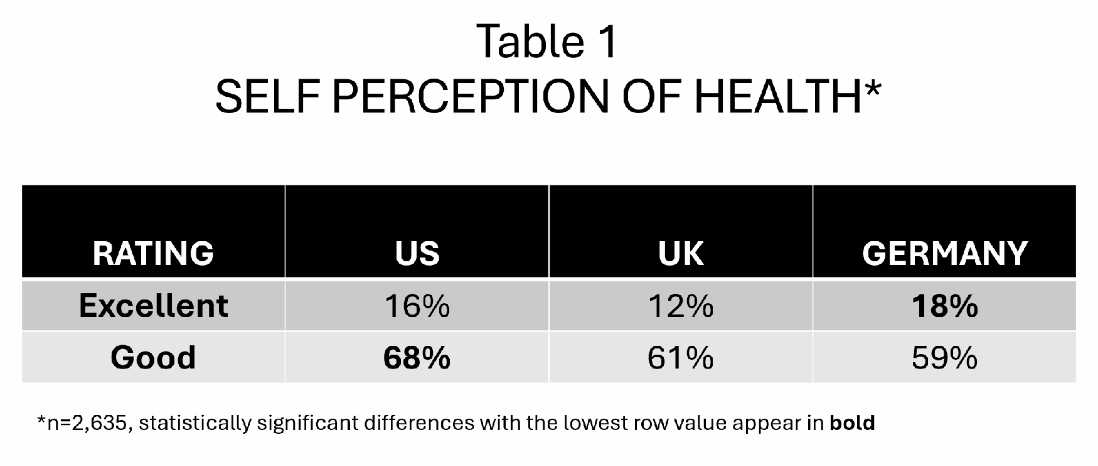
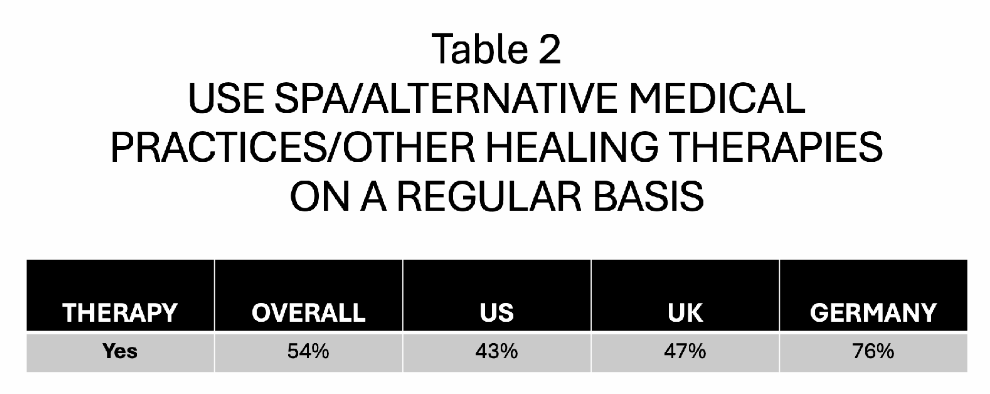
More than 70 per cent of respondents in each market rated their health “good/excellent” as revealed in Table 1 Self Perceptions of Health. Participation in health-related activities across the three markets was nearly universal: 91 per cent engaged in some physical activity (almost equally among respondents in all three countries); 70 per cent collected and monitored their health metrics; and 54 per cent used spa, wellness or preventive/alternative therapies on a regular basis (rising to just over three-quarters in Germany) as revealed in Table 2 Use Spa/Alternative Medical Practices Regularly.
Consumers in all three countries today have more access to fitness programmes, nutrition regimens, supplements, recovery technologies and longevity protocols than at any point in history. Yet access alone no longer defines the category. WELLSurvey 2.0 confirmed a high rate of participation in these activities but also revealed a shift in how health is evaluated, significant differences in the markets’ understanding and appeal of wellbeing versus wellness and increased awareness of one’s emotional health.
Emotional influence
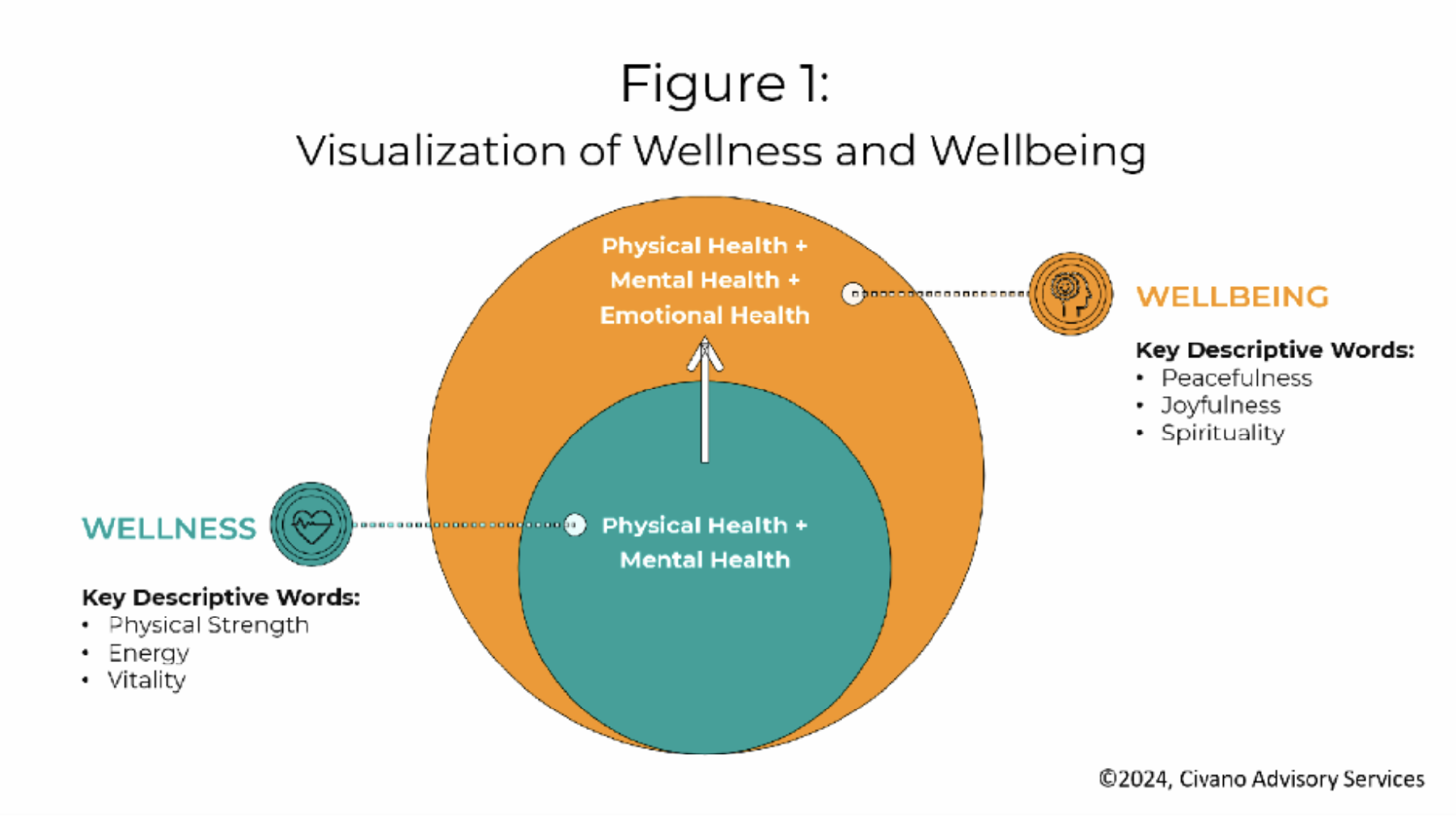
WELLSurvey 1.0 established that adults distinguish between wellness and wellbeing. Wellness is associated primarily with physical and mental health – the activities and behaviours that support prevention, performance and functional health. The concept of wellbeing is much broader. It is understood to incorporate the same elements but also include emotional health and other important dimensions of life, such as social relationships, purpose, career path, financial security and environmental concerns. Wellbeing is also more closely associated with the concepts of longevity and quality of life.
WELLSurvey 2.0 confirmed this understanding is shared by adults across the US, UK, and Germany. Wellness continued to represent functional practices. Wellbeing represented the broader, integrated condition those practices were expected to support. What has changed, however, is the salience of emotional health in the understanding of both.
Figure 1 Visualisation of Wellness and Wellbeing provides a view of the relationship between the concepts of wellness and wellbeing. It also includes the three key words of 18 tested (in ranked order) adults associated most closely with each concept. These reveal that wellness and wellbeing are understood to be descriptors of different outcomes.
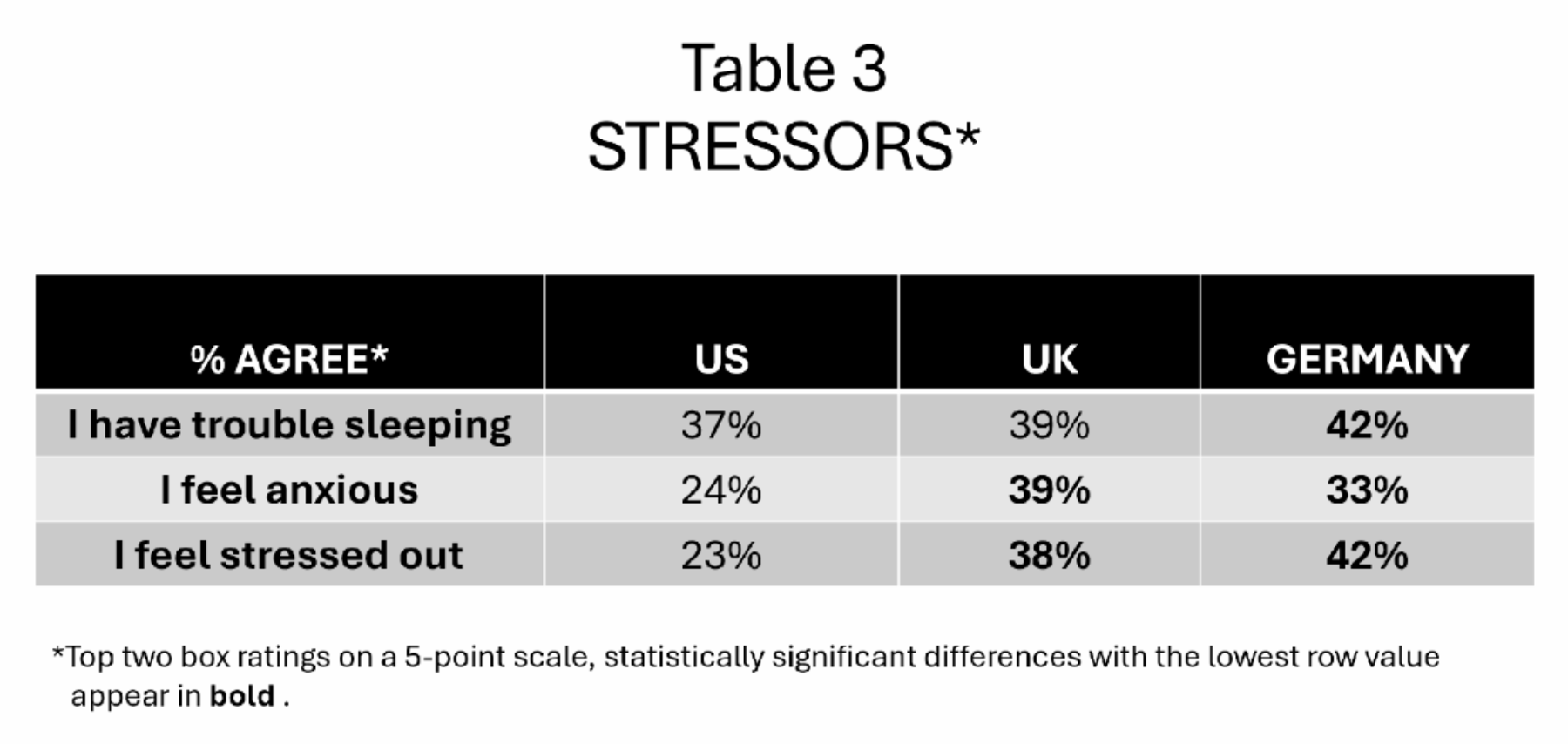
Several stressors impede the pursuit of wellbeing, as reflected in the indices appearing in Table 3 Stressors. These reinforce the importance of emotional equilibrium in how individuals assess and manage their overall health.
Several additional findings provide context:
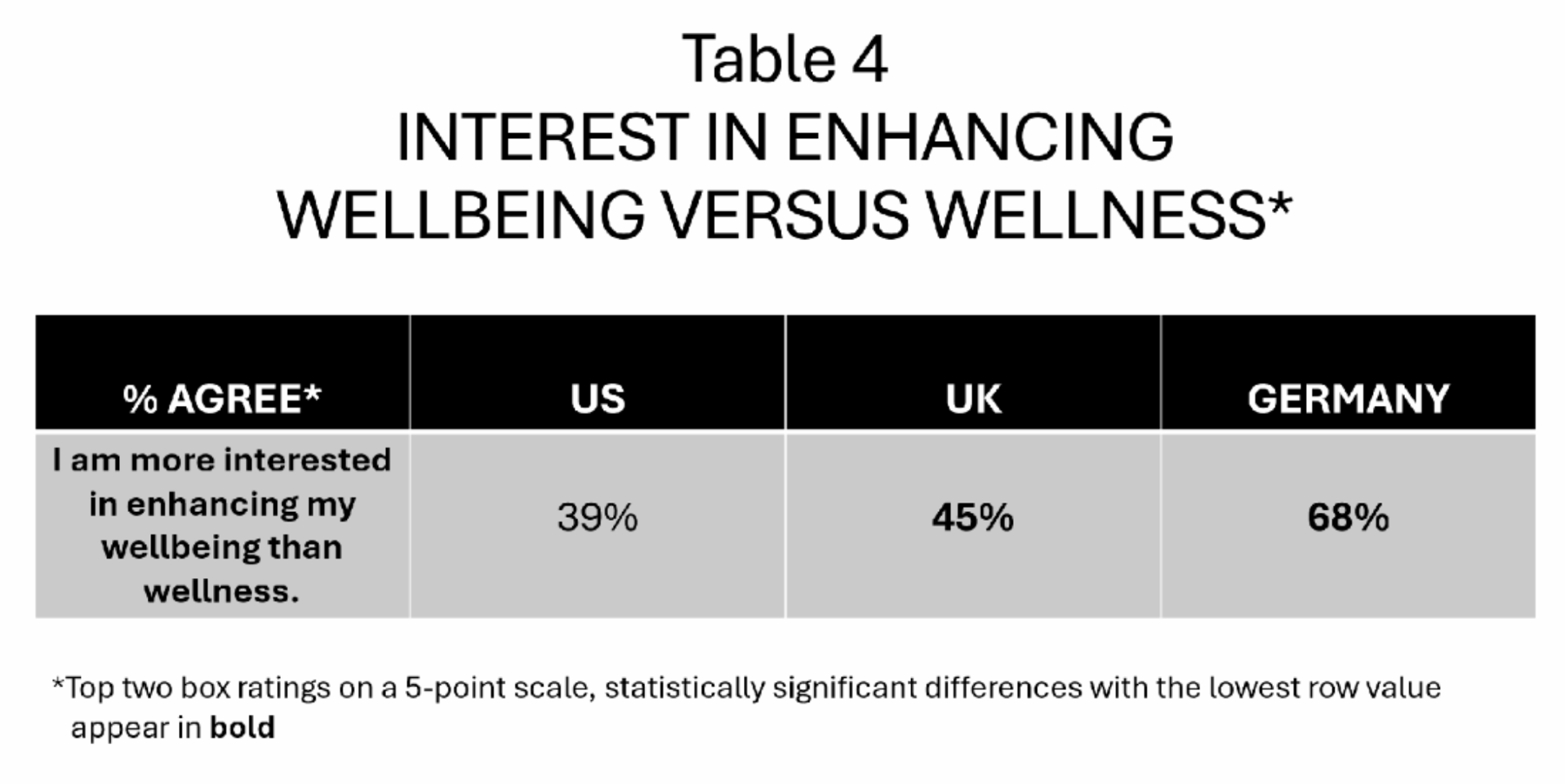
• 50 per cent of respondents across all three markets reported greater interest in enhancing their wellbeing (compared to 38 per cent interested in enhancing their wellness)
• Approximately 80 per cent associated wellbeing with longevity (while 76 per cent thought wellness implied the same association)
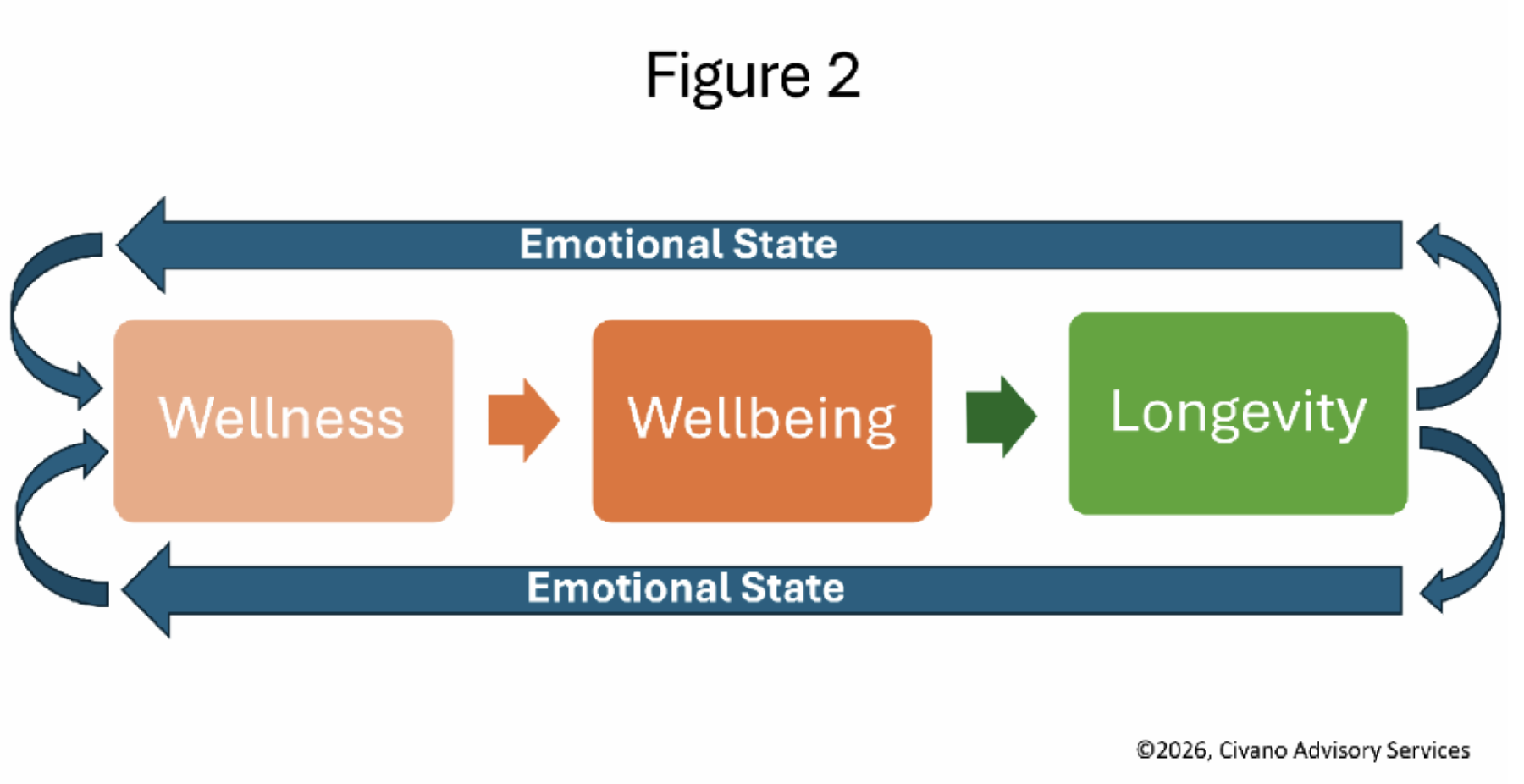
Taken together, these findings suggest that emotional health now functions as an evaluative signal across both domains. Within wellness, emotional equilibrium influences how individuals judge their physical and mental health. Within wellbeing, emotional balance remains part of the integrated condition itself. The distinction between the two constructs remains intact – wellness as practice, wellbeing as condition – but our emotional state plays a much more influential role as a feedback loop signaling the effectiveness of the associated activities and outcomes. These relationships are shown in Figure 2 Emotional State.
As stated previously, these observations suggest a clear hierarchy of interpretation. Consumers view wellness activities as inputs, wellbeing as the integrated outcome of those inputs and longevity as a measure of whether that outcome is sustained over time.
In this context, longevity is not merely life extension; it reflects durability – whether preventive behaviours, emotional balance and lifestyle choices prevail over time. It's important to emphasise that consumers are not redefining wellness and wellbeing; rather, they're increasingly attentive to whether health-related activities translate into sustained balance and enduring life quality. And market interest in the pursuit of wellbeing is robust in all three geographies, especially in Germany, as revealed in Table 4 Interest in Enhancing Wellbeing versus Wellness.
Key drivers
Respondents were asked to assign percentage weights to eight possible 'drivers' of wellbeing – physical condition, mental health, emotional state, financial security, social relationships, spiritual beliefs, career path and environmental factors. The exercise forced trade-offs (summing to 100) to reveal the relative importance of each.
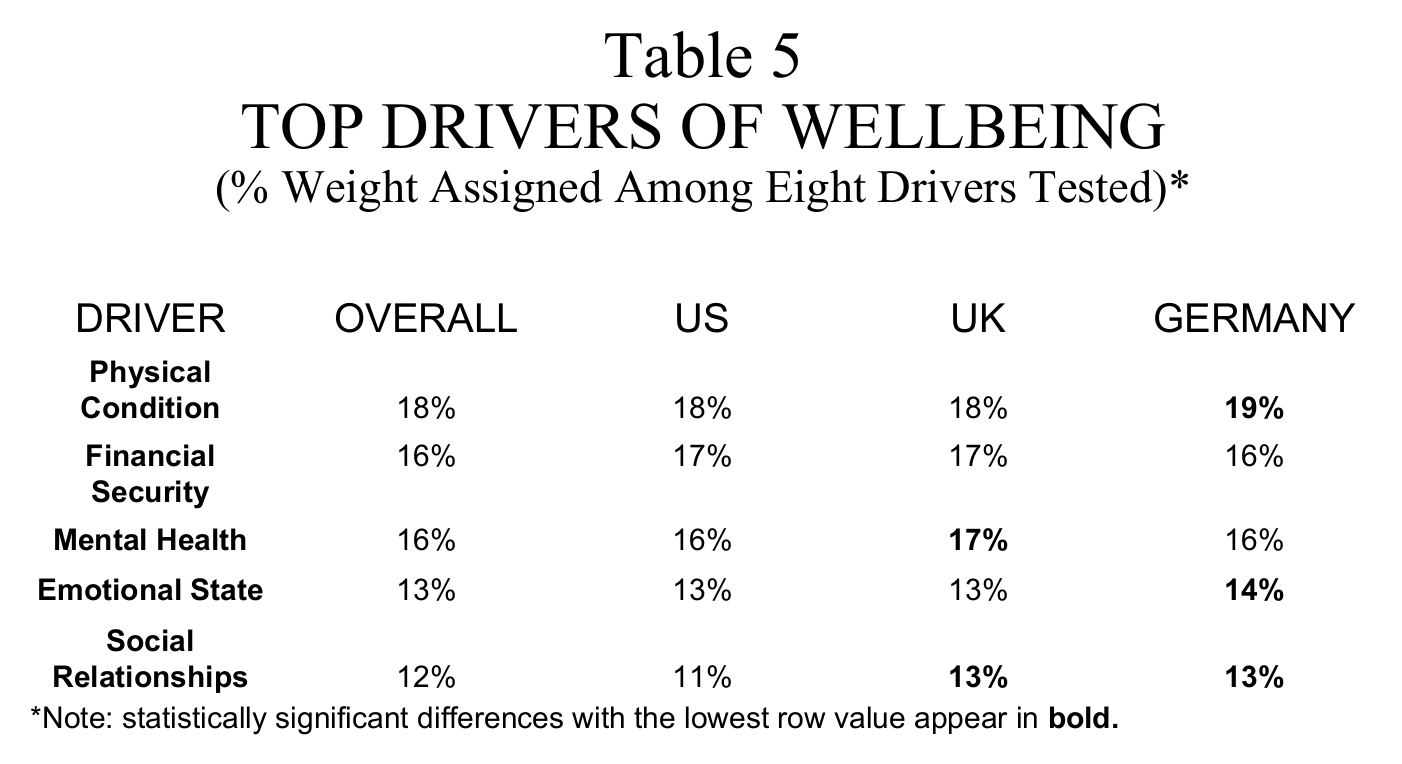
A consistent hierarchy emerged across all three geographic markets, as reflected in Table 5 Top Drivers of Wellbeing:
• Physical condition, financial security and mental health ranked highest as foundational drivers
• Emotional state and social relationships accounted for the next tier of influence
• Spiritual beliefs, career path and environmental factors followed
In WELLSurvey 1.0, emotional health was conceptually framed within wellbeing – positioned as part of a broader, self-actualised state layered above physical and mental health. Wellness, by contrast, was defined more narrowly around functional physical and mental performance. In WELLSurvey 2.0, emotional health emerged as a core driver in respondents’ evaluation of both wellness and wellbeing. Physical health, financial security and mental health define consumers’ assessment of their wellness, while emotional equilibrium and other indices of broader life fulfilment shape their assessment of wellbeing.
Perception of longevity
When respondents associate wellbeing rather than wellness more readily with longevity, they're implicitly distinguishing between activity and outcome. Wellness behaviours may contribute to health, but wellbeing is thought to describe the achievement of something on a higher plane – integrating both functional performance and lived experiences. In this context, longevity reflects the durability of that integrated state – when preventive behaviours, emotional balance and lifestyle choices coalesce into a state capable of enduring over time.
/ Pexels / Digitally altered by Ai Imaginography
Trust as a gatekeeper
As wellbeing becomes the desired outcome and longevity frames the time horizon, the credibility of claims about products, services and experiences marketed to achieve wellbeing becomes increasingly important for providers. This is especially true in a marketplace saturated with claims about the promised outcomes of fitness routines, supplements, recovery technologies, longevity protocols and alternative modalities. WELLSurvey 2.0 examined the extent to which adults in all three markets trusted the claims used by providers to promote their wares. Interestingly, ratings of the descriptors considered most reliable were consistent across all three:
• 71 per cent cited “clinically proven” as most reliable
• 67 per cent cited “recommended by a scientist/medical professional”
• 66 per cent cited “evidenced-based”
These descriptors outperformed celebrity endorsements, influencer promotion and trend-driven cues across all three markets and age cohorts. Considered least credible were claims of “naturopathic” (34 per cent), “advanced breakthrough” (38 per cent) and “recommended by an actual user” (43 per cent).
WELLSurvey 2.0 also revealed that media distribution channels tell a parallel story. Social media platforms have become nearly universal as sources of exposure (83 per cent of all respondents cited access to health-related information via social media, rising to 90 per cent in Germany), yet trust remains elusive. Fewer than half of respondents considered the information published on these platforms reliable. Among adults aged 25 to 44 – where usage was highest – perceived reliability rose modestly for platforms such as YouTube and Podcasts, ascending to just slightly above the 50 per cent threshold. Even so, less than one-third of all respondents cited confidence in the reliability of information published or available to visitors on social media platforms other than YouTube or Podcasts. Engagement is therefore high, but confidence is elusive. This contrast is instructive. Consumers clearly differentiate between visibility and legitimacy.
Message credibility reflects a deeper structural dynamic. When emotional state functions as the feedback mechanism and longevity frames the objective, misinformation is no longer abstract. Consumers are not merely purchasing products and services; they're investing in inputs they believe will influence how they hope to feel and how sustainably their health system will perform over time.
Cultural nuances also shape participation pathways. Respondents in the US demonstrated broader experimentation and greater dispersion of outcomes. Those in the UK placed more disciplined emphasis on validation and proof. German respondents exhibited one of the most diversified patterns of participation – combining high engagement across integrative modalities with greater institutional trust. These differences influence adoption, but do not alter the objective.
Collectively, the results of WELLSurvey 2.0 revealed a common conclusion across all three countries: health is increasingly evaluated as integrated functioning sustained over time. Emotional state is central to that evaluation. Longevity reflects durability. Trust determines which inputs are permitted entry into the system. And scientific evidence is the arbiter of trust.

/ Shutterstock / Ericsmandes
Strategic implications
For industry product, service and experience providers, the implications of the insights revealed in WELLSurvey 2.0 are clear. Expanded service menus and product innovation remain important – but access and engagement alone are unlikely to differentiate brands. Competitive advantage depends on how well specific offers align with customers’ broader lifestyle ecosystems. These systems require healthier options grounded in scientific evidence, communicated through trusted messages and credible platforms and designed to deliver both functional and emotional benefits. Products, services and experiences cannot exist in isolation; they must work together as part of a coherent approach capable of supporting durable wellbeing.
Brands that pursue this strategy will emerge from the increasingly congested marketplace as preferred. Those that integrate trusted inputs into a system that supports sustained balance and the enhanced quality of long-term life will be well-positioned to capitalise on the market evolution now underway. But this will require a keen understanding of the difference between wellbeing and wellness, the importance of emotional health as a driver and that effective promotional claims will derive only from trusted sources. It will also require recognition that these forces have coalesced to create a new path to vibrant health and longevity: the achievement of wellbeing.
WELLSurvey is a trademark of Civano Advisory Services, LLC

/ Shutterstock / oneinchpunch

/ Pexels / Min An