A new study unpicks consumer attitudes to wellness and wellbeing and reveals four distinct market segments ripe for innovation. Study co-author Kevin Kelly reveals more
The health and wellness industry comprises product, service and experience providers which cater to a broad yet imprecise cohort of consumers. Wares are delivered through a plethora of channels – from the hospitality sector, spas, fitness centres and spiritual arenas to lifestyle real estate, healthcare and medical institutes and nutritional/food-based businesses.
For all its vibrancy, however, the industry has grown in a decentralised manner and lacks standards, terminology and performance metrics. This has led to market confusion and makes it much harder for product and service providers to communicate genuine differentiation and establish brand loyalty. Consumers question why they should pay more or travel farther for top wellness resorts, for example, if they don’t perceive them to offer anything meaningfully different than affordable, local brands.
It’s against this backdrop that WELLSurvey, a new thought-provoking national probability study, measured the attitudes, behaviours, beliefs and intentions of US consumers towards wellness and wellbeing.
Wellness vs wellbeing WELLSurvey is co-authored by Civano Advisory Services’ CEO, Kevin Kelly, a spa figure with more than two decades of experience and Peter Yesawich, co-founder and former vice chair of leading travel and tourism marketing agency MMGY Global.
It’s based on 1,002 Americans aged 25-74 who reside in the top half of all homes defined by annual household income – with a mean of US$155,400 (€139,651, £119,249) and median of US$127,500 (€114,578, £97,840). Reflecting the sentiments of 88 million households, the survey indicates the majority of respondents describe themselves as resilient and optimistic about their future but also express concern about the direction of the country and world events. Most now incorporate health and wellness practices in their everyday lives and cite being with family members as their greatest sense of joy.
Findings reveal that US adults consider ‘wellness’ and ‘wellbeing’ complementary concepts associated with different lifestyle benefits. The former is understood to include objective, measurable activities and functions that enhance healthier living. The latter is a broader term that includes emotional health in addition to mental and physical states. It’s associated with more subjective, aspirational and relational terms (see Diagram 1). We explore the relationship between how these two concepts are viewed in more detail in a separate article – see www.spabusiness.com/wellsurvey1.
Significantly, 20.2 million affluent households in the US (23 per cent of respondents) are now more interested in enhancing their wellbeing than wellness. Meaning, that while they value the functional aspects of healthier living found in wellness programmes and services – healing touch, food, fitness, mental health, healthier routines – all of which feed into the wellbeing toolkit, they embrace a more integrated and ethereal approach to healthy living overall.
Market segments revealed With the US$5.6 trillion (€5.03 trillion, £4.30 trillion) global health and wellness marketplace projected to achieve a compound annual growth rate of 8.6 per cent through 2027, according to the Global Wellness Institute, it’s logical to conclude that one size doesn’t fit all when targeting today’s customers. Market segmentation is necessary for more effective strategic positioning, differentiation and growth.
To this end, WELLSurvey measured people’s responses to 84 attitudinal, behavioural and belief statements/variables, plus gathered details about demographics and health metrics. Significantly, it uncovered four unique consumer groups – as outlined below and in Diagram 2 – with distinctive wellness and wellbeing habits, interests and lifestyles.
While the segments have varying, and at times overlapping, characteristics, they present exciting opportunities for industry growth through the development of new products, programmes, services and experiences that reflect their preferences.
WELLSearchers – 52.8 million households The largest market segment, representing 52.8 million US households (60 per cent of the overall sample), WELLSearchers are defined by their regular use of spas, alternative medical practices and healing therapies. They are spa and wellness enthusiasts who are optimistic and prioritise their efforts to achieve and maintain a healthy lifestyle. They are significantly more likely than other adults to:
• Have a higher annual household income
• Weigh less
• Take a daily vitamin or supplement
• Have children and pets
• Live in an urban area
• Be racially diverse
• Agree with the following statements:
– I love learning
– You can accomplish anything if you’re determined
– I love spending time in nature
– My health is priority one
WELLTrackers – 27.3 million households WELLTrackers are defined by their use of wearable technology to track and monitor their health metrics and wellbeing. There are 27.3 million WELLTracker households (accounting for 31 per cent of survey respondents) and these adults are significantly more likely than other adults to:
• Collect and monitor their health metrics daily
• Rate their overall health good/excellent
• Have a four-year college degree
• Be employed full-time
• Live in an urban area
• Not have a disability that inhibits them
• Agree with the following statements:
– I love learning
– I have the energy to do the things I want to
– My family is the source of my greatest joy
WELLFanatics – 15.8 million households Defined by their exercise frequency, WELLFanatics account for 15.8 million households (18 per cent of all people surveyed). WELLFanatics are highly active physically and embrace a sense of success. They exercise 7 hours or more a week and are significantly more likely than other adults to:
• Have a higher annual household income
• Rate their health good/excellent
• Collect and monitor their health metrics
• Take fewer medications
• Agree with the following statements:
– Life’s journey is about constantly growing and improving
– Integrity is everything to me
– I feel empathy towards others
– I have a sense of purpose
WELLZoomers – 15.8 million households There are 15.8 million WELLZoomer households in the US (representing 18 per cent of survey respondents). They’re defined by their age cohort (25–34-year-olds) and attitudes about healthy living. WELLZoomers are the children of Boomers who possess an even stronger desire for healthier living and greater wellbeing. They are significantly more likely to:
• Use wearables
• Use spa, alternative medical practices, and healing therapies
• Rent versus own a home
• Feel anxious
• Consume recreational marijuana and CBD products
• Be black or Hispanic
• Agree with the following statements:
– I wish I could spend more time with my spouse/significant other
– I measure my wellbeing by how hopeful, joyful and energised I feel
– I am excited about what lies ahead
– My work has meaning
Future opportunities As competition in the marketplace increases and the integration of data, technology and health science into experiential programmes and services continues, it will be imperative to have clear standards and agreed metrics to define and differentiate unique experiences and programme premiums. Further, providers will need a deeper understanding of the profiles and expectations of diverse market segments to remain relevant, identify new business opportunities and prosper.
Consumers’ increased focus on the pursuit of healthier lifestyles, guided by the insights derived from personal information and big data, has created a remarkable opportunity for both revenue growth and brand distinction. Providers who evolve their products and services to reflect the preferences of emerging markets will be the most successful.
Read more from this issue of Spa Business magazine
View contents of Spa Business 2024 issue 3
Editor's letter: At a crossroads
As the UK prepares to host this year's Global Wellness Summit, fresh research shows its wellness industry must address a number of issues if it's to maintain levels of unprecedented growth
Spa People: Charlotte Church
The Welsh singer talks about how growing up in the media spotlight has influenced The Dreaming, her healing retreat business
Spa People: Julia Bradbury
Leading a series of Walk Yourself Happy retreats based on her best-selling book and years of TV presenting
Spa People: Samantha Dunn
Shaking up the industry with her new, affordable DIY consultancy programme for entrepreneurs
News report: Big spenders
Finn Partners’ latest research shows how China’s high-net-worth women are redefining luxury travel
News report: Step back in time
Two new GWI reports analyse the growth of the global spa and hot springs markets over the past 10 to 15 years
Interview: Dillip Rajakarier
Following a 450 per cent increase in core revenues, Minor Hotels is planning 200 more properties. Megan Whitby sits down with its CEO
New opening: Kintsugi Space
Patrizia Bortolin talks to Lisa Starr about creating a transformative women-only sanctuary in Abu Dhabi
Research: To inform and inspire
The UK Spa Association has conducted its first survey of spa businesses in the country for 18 years. GM Bobby Griffiths unveils the numbers
Research: From wellness to wellbeing
A new study uncovers four wellness consumer market segments ripe for innovation. WELLSurvey co-author Kevin Kelly reveals the findings in a Spa Business exclusive
First person: To the source
Jane Kitchen takes to the sulphurous waters of Terme di Saturnia in Italy and shares details about its exciting upcoming sister site in Milan
Promotion: L'OCCITANE en Provence – the art of recovery
With an approach to wellbeing that’s both holistic and grounded in science, the latest massage from L’OCCITANE en Provence promises to have a powerfully-beneficial effect on customers, both in the spa and at home
New opening: Surrenne at The Emory
The £15k memberships at this wellness club in London sold out in just weeks. Creator Inge Theron tells us why
First person: Playful wellness
A Stella McCartney facial and Tracy Anderson studio are just two USPs Megan Whitby finds at Surrenne
Promotion: TechnoAlpin – naturally cool design
TechnoAlpin’s snow technology is not only an effective way to introduce gentle cold therapy into the spa environment, it’s also a powerful biophilic design element that can bring the wonder of nature indoors
Promotion: Biologique Recherche – potent partnership
A new anti-senescence serum from Biologique Recherche offers transformative results and raises the bar in anti-ageing skincare when combined with its iconic collagen formula
Promotion: Comfort Zone – A longer life for skin
Created to combat the visible signs of ageing, Comfort Zone’s latest range revamp is based on the company’s pioneering research into cutaneous cellular longevity
Promotion: G.M. COLLIN – Clinical excellence in skincare
With laboratories based in Montreal, G.M. Collin’s highly researched derma-corrective treatments have been helping skincare professionals deliver exceptional and exclusive results worldwide for many decades. We talk to VP Myriam Sayer
A new study unpicks consumer attitudes to wellness and wellbeing and reveals four distinct market segments ripe for innovation. Study co-author Kevin Kelly reveals more
The health and wellness industry comprises product, service and experience providers which cater to a broad yet imprecise cohort of consumers. Wares are delivered through a plethora of channels – from the hospitality sector, spas, fitness centres and spiritual arenas to lifestyle real estate, healthcare and medical institutes and nutritional/food-based businesses.
For all its vibrancy, however, the industry has grown in a decentralised manner and lacks standards, terminology and performance metrics. This has led to market confusion and makes it much harder for product and service providers to communicate genuine differentiation and establish brand loyalty. Consumers question why they should pay more or travel farther for top wellness resorts, for example, if they don’t perceive them to offer anything meaningfully different than affordable, local brands.
It’s against this backdrop that WELLSurvey, a new thought-provoking national probability study, measured the attitudes, behaviours, beliefs and intentions of US consumers towards wellness and wellbeing.
Wellness vs wellbeing WELLSurvey is co-authored by Civano Advisory Services’ CEO, Kevin Kelly, a spa figure with more than two decades of experience and Peter Yesawich, co-founder and former vice chair of leading travel and tourism marketing agency MMGY Global.
It’s based on 1,002 Americans aged 25-74 who reside in the top half of all homes defined by annual household income – with a mean of US$155,400 (€139,651, £119,249) and median of US$127,500 (€114,578, £97,840). Reflecting the sentiments of 88 million households, the survey indicates the majority of respondents describe themselves as resilient and optimistic about their future but also express concern about the direction of the country and world events. Most now incorporate health and wellness practices in their everyday lives and cite being with family members as their greatest sense of joy.
Findings reveal that US adults consider ‘wellness’ and ‘wellbeing’ complementary concepts associated with different lifestyle benefits. The former is understood to include objective, measurable activities and functions that enhance healthier living. The latter is a broader term that includes emotional health in addition to mental and physical states. It’s associated with more subjective, aspirational and relational terms (see Diagram 1). We explore the relationship between how these two concepts are viewed in more detail in a separate article – see www.spabusiness.com/wellsurvey1.
Significantly, 20.2 million affluent households in the US (23 per cent of respondents) are now more interested in enhancing their wellbeing than wellness. Meaning, that while they value the functional aspects of healthier living found in wellness programmes and services – healing touch, food, fitness, mental health, healthier routines – all of which feed into the wellbeing toolkit, they embrace a more integrated and ethereal approach to healthy living overall.
Market segments revealed With the US$5.6 trillion (€5.03 trillion, £4.30 trillion) global health and wellness marketplace projected to achieve a compound annual growth rate of 8.6 per cent through 2027, according to the Global Wellness Institute, it’s logical to conclude that one size doesn’t fit all when targeting today’s customers. Market segmentation is necessary for more effective strategic positioning, differentiation and growth.
To this end, WELLSurvey measured people’s responses to 84 attitudinal, behavioural and belief statements/variables, plus gathered details about demographics and health metrics. Significantly, it uncovered four unique consumer groups – as outlined below and in Diagram 2 – with distinctive wellness and wellbeing habits, interests and lifestyles.
While the segments have varying, and at times overlapping, characteristics, they present exciting opportunities for industry growth through the development of new products, programmes, services and experiences that reflect their preferences.
WELLSearchers – 52.8 million households The largest market segment, representing 52.8 million US households (60 per cent of the overall sample), WELLSearchers are defined by their regular use of spas, alternative medical practices and healing therapies. They are spa and wellness enthusiasts who are optimistic and prioritise their efforts to achieve and maintain a healthy lifestyle. They are significantly more likely than other adults to:
• Have a higher annual household income
• Weigh less
• Take a daily vitamin or supplement
• Have children and pets
• Live in an urban area
• Be racially diverse
• Agree with the following statements:
– I love learning
– You can accomplish anything if you’re determined
– I love spending time in nature
– My health is priority one
WELLTrackers – 27.3 million households WELLTrackers are defined by their use of wearable technology to track and monitor their health metrics and wellbeing. There are 27.3 million WELLTracker households (accounting for 31 per cent of survey respondents) and these adults are significantly more likely than other adults to:
• Collect and monitor their health metrics daily
• Rate their overall health good/excellent
• Have a four-year college degree
• Be employed full-time
• Live in an urban area
• Not have a disability that inhibits them
• Agree with the following statements:
– I love learning
– I have the energy to do the things I want to
– My family is the source of my greatest joy
WELLFanatics – 15.8 million households Defined by their exercise frequency, WELLFanatics account for 15.8 million households (18 per cent of all people surveyed). WELLFanatics are highly active physically and embrace a sense of success. They exercise 7 hours or more a week and are significantly more likely than other adults to:
• Have a higher annual household income
• Rate their health good/excellent
• Collect and monitor their health metrics
• Take fewer medications
• Agree with the following statements:
– Life’s journey is about constantly growing and improving
– Integrity is everything to me
– I feel empathy towards others
– I have a sense of purpose
WELLZoomers – 15.8 million households There are 15.8 million WELLZoomer households in the US (representing 18 per cent of survey respondents). They’re defined by their age cohort (25–34-year-olds) and attitudes about healthy living. WELLZoomers are the children of Boomers who possess an even stronger desire for healthier living and greater wellbeing. They are significantly more likely to:
• Use wearables
• Use spa, alternative medical practices, and healing therapies
• Rent versus own a home
• Feel anxious
• Consume recreational marijuana and CBD products
• Be black or Hispanic
• Agree with the following statements:
– I wish I could spend more time with my spouse/significant other
– I measure my wellbeing by how hopeful, joyful and energised I feel
– I am excited about what lies ahead
– My work has meaning
Future opportunities As competition in the marketplace increases and the integration of data, technology and health science into experiential programmes and services continues, it will be imperative to have clear standards and agreed metrics to define and differentiate unique experiences and programme premiums. Further, providers will need a deeper understanding of the profiles and expectations of diverse market segments to remain relevant, identify new business opportunities and prosper.
Consumers’ increased focus on the pursuit of healthier lifestyles, guided by the insights derived from personal information and big data, has created a remarkable opportunity for both revenue growth and brand distinction. Providers who evolve their products and services to reflect the preferences of emerging markets will be the most successful.
Read more from this issue of Spa Business magazine
View contents of Spa Business 2024 issue 3
Editor's letter: At a crossroads
As the UK prepares to host this year's Global Wellness Summit, fresh research shows its wellness industry must address a number of issues if it's to maintain levels of unprecedented growth
Spa People: Charlotte Church
The Welsh singer talks about how growing up in the media spotlight has influenced The Dreaming, her healing retreat business
Spa People: Julia Bradbury
Leading a series of Walk Yourself Happy retreats based on her best-selling book and years of TV presenting
Spa People: Samantha Dunn
Shaking up the industry with her new, affordable DIY consultancy programme for entrepreneurs
News report: Big spenders
Finn Partners’ latest research shows how China’s high-net-worth women are redefining luxury travel
News report: Step back in time
Two new GWI reports analyse the growth of the global spa and hot springs markets over the past 10 to 15 years
Interview: Dillip Rajakarier
Following a 450 per cent increase in core revenues, Minor Hotels is planning 200 more properties. Megan Whitby sits down with its CEO
New opening: Kintsugi Space
Patrizia Bortolin talks to Lisa Starr about creating a transformative women-only sanctuary in Abu Dhabi
Research: To inform and inspire
The UK Spa Association has conducted its first survey of spa businesses in the country for 18 years. GM Bobby Griffiths unveils the numbers
Research: From wellness to wellbeing
A new study uncovers four wellness consumer market segments ripe for innovation. WELLSurvey co-author Kevin Kelly reveals the findings in a Spa Business exclusive
First person: To the source
Jane Kitchen takes to the sulphurous waters of Terme di Saturnia in Italy and shares details about its exciting upcoming sister site in Milan
Promotion: L'OCCITANE en Provence – the art of recovery
With an approach to wellbeing that’s both holistic and grounded in science, the latest massage from L’OCCITANE en Provence promises to have a powerfully-beneficial effect on customers, both in the spa and at home
New opening: Surrenne at The Emory
The £15k memberships at this wellness club in London sold out in just weeks. Creator Inge Theron tells us why
First person: Playful wellness
A Stella McCartney facial and Tracy Anderson studio are just two USPs Megan Whitby finds at Surrenne
Promotion: TechnoAlpin – naturally cool design
TechnoAlpin’s snow technology is not only an effective way to introduce gentle cold therapy into the spa environment, it’s also a powerful biophilic design element that can bring the wonder of nature indoors
Promotion: Biologique Recherche – potent partnership
A new anti-senescence serum from Biologique Recherche offers transformative results and raises the bar in anti-ageing skincare when combined with its iconic collagen formula
Promotion: Comfort Zone – A longer life for skin
Created to combat the visible signs of ageing, Comfort Zone’s latest range revamp is based on the company’s pioneering research into cutaneous cellular longevity
Promotion: G.M. COLLIN – Clinical excellence in skincare
With laboratories based in Montreal, G.M. Collin’s highly researched derma-corrective treatments have been helping skincare professionals deliver exceptional and exclusive results worldwide for many decades. We talk to VP Myriam Sayer
Gran Hotel Taoro in northern Tenerife, Spain, has completed the final phase of its three-year
renovation with the debut of its Sandára Wellness Centre.
Hand and Stone Massage and Facial Spa, the spa business with more than 650 locations across
the US and Canada, has appointed franchise expert Carrie Walsh as CEO as the company plans
to expand.
Synergy – The Retreat Show, the global trade show for retreats, has launched a global research
initiative that will provide insights into the retreat sector from both consumer and industry
perspectives.
The Wellness Tourism Association (WTA) has published a non-regulatory global industry
framework designed to ensure the retreat market offers responsible experiences.
A new survey of UK and international spa practitioners shows that stress, burnout and
wellbeing concerns have caused one in three respondents to consider leaving the industry.
The UK's four Chief Medical Officers have published a refreshed edition of Physical activity
guidelines: UK Chief Medical Officers' report, updating the evidence that underpins the nation's
physical activity recommendations and placing greater emphasis on strength, balance, reducing
sedentary behaviour and, for the first time, supporting people taking weight loss medications.
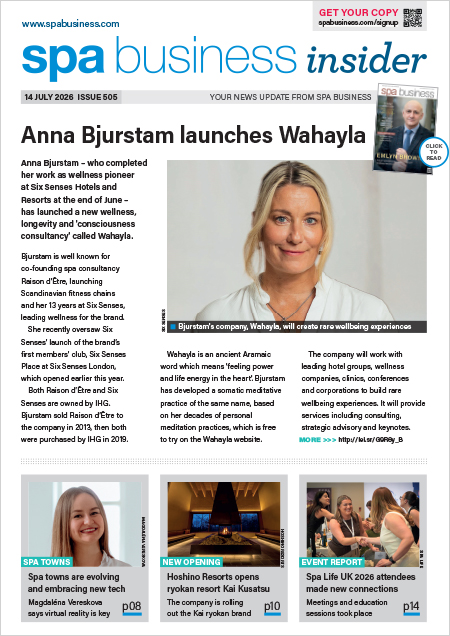
Anna Bjurstam has left her role as Wellness Pioneer at Six Senses Hotels and Resorts and
launched a new wellness, longevity and “consciousness consultancy” called Wahayla.
Fairmont Cheshire, The Mere, has opened today (10 July) in the Northwest of England
with a
1,715sq m Fairmont Spa that has been designed using a ‘Wellness without Walls’
concept.