The waters at Saturnia have been used since the time
of the Etruscans. Jane Kitchen travels to Italy to visit
one of the most iconic thermal springs in the world
The famous terraced pools of Saturnia are free to the public but often overcrowded / photo: shutterstock/leoks
We smell it before we see it: the pungent scent of sulphurous waters permeates Terme di Saturnia Resort, seeping into the lobby. It’s quite possibly the strangest first impression of a five-star hotel I’ve ever had. But it’s the waters that people come here for – we’ve driven 2 hours from Siena, down roughly paved, precariously twisty roads, to the remote landscape of Maremma, where spring waters have gushed from the centre of the earth for more than 3,000 years, since the time of the Etruscans, who called the town Aurinia and used the springs for sacred rituals in the 7th century BC.
Legend has it that the Roman god Saturn, tired of the constant warfare of men, took a thunderbolt to the earth, causing a river of hot water to gush through the valleys and envelop all things so that their spirits were quietened. The Romans renamed the town and the springs Saturnia and the first modern hotel was built on the site in 1919. Terme di Saturnia was born.
Since then, people have been coming to the resort to experience the thermal spring’s health-giving properties; the water – which contains bicarbonate, alkaline, calcium, magnesium and carbon dioxide in addition to 14 mg per litre of sulphur – is said to have beneficial effects on every system in the body, from skin and the respiratory system to bone health. It flows at 500 litres per second from underground, which means the water is naturally replenished in the resort’s pools every 4 hours. Unlike many hot springs, which often need to be cooled for bathing, Saturnia’s water is a perfect 37.5°C.
A 40-year journey We’ve come to Saturnia after a long weekend of celebrations for my cousin’s 40th birthday – a fitting time to visit, as the thermal water makes a 40-year journey underground from Mount Amiata, flowing through travertine passages lined with clay and picking up its mineral content along the way. The water bursts from the spring into the resort’s main pool, then spills over into other pools and finally to a stream that moves downhill until it reaches an old stone mill. It’s here where the iconic terraced pools of Saturnia are located with their milky blue waters. This is where my cousin heads with his wife and two young children, keen to see beautiful pools from Instagram first-hand. It’s a bonus that they’re free and open to the public. “Just think,” I tell my cousin, who’s grown up summering in Tuscany, “you’re soaking in rainwater that fell onto Mount Amiata the year you were born!”
Up at the hotel, my husband and I don our robes to check out its five thermal pools. The main pool, which houses the spring, is a deep cerulean blue and is shaded throughout with darker hues, which I only realise after a few minutes of floating are actually clusters of algae. The thermal plankton is gelatinous in texture but rich in minerals and is used in the resort’s treatments and cosmetics.
Third-generation visitors I fashion an armchair of sorts from foam noodles and simply float in the water, which is filled with small bubbles that gently caress your skin as they burst, in addition to the algae that feels incredibly silky. The pool is full of mostly Italians doing the same thing – soaking, chatting, relaxing. In fact, 75 per cent of the resort’s guests are nationals, with the average age between 35 and 50, and “younger and younger with the years passing,” says general manager Antonello Del Regno. Many are second and third-generation visitors, having first come as children and now bringing their own families. Up to 40 per cent of business is from repeat guests, says Del Regno.
“In Italy, Terme di Saturnia is recognised as the ultimate escape for wellbeing, having such a long tradition since the Romans,” he says. “Families celebrate festivities and important achievements with us – it’s like a second home … a gift from generation to generation to take care of yourself.”
I get a text from my cousin: the children are enjoying the shallow waters at the public pools, but he advises us to stay put at the tranquil resort as it’s packed where he is.
Beyond spa & beauty The hotel’s thermal area includes five outdoor thermal pools, as well as whirlpools, contrast therapy and indoor and outdoor relaxation areas. But the resort also includes a Spa & Beauty Clinic with 53 treatment rooms, where guests can have massages, mud therapy, inhale thermal vapours, medical and beauty treatments, nutritional guidance, hydrokinesis and Tecar Therapy, as well as fillers, injections, skin peels and laser treatments.
The Terme di Saturnia Method focuses on different goals – losing weight and shaping the body, elimination of toxins, stimulation of the immune system and reactivation of energy flows – and the team includes several specialised medical practitioners.
“The healing water is a treatment in itself, with so many health benefits,” says Del Regno. “Most weekend guests are happy just with that and then they’ll choose a classic massage or facial.” Midweek guests, he says, are different, choosing longer programmes and more treatments advised by doctors. Regardless, he reports that the spa capture rate is an incredible 98 per cent.
Terme di Saturnia has also recently introduced a series of programmes focused on areas such as metabolic health, qi gong and yoga. “We wanted to grow awareness of Terme di Saturnia not only as a medical spa but also as the perfect location for holistic wellness,” says Del Regno. “Prevention instead of cure is the keyword now. Nature, expertise, healing waters and medical know-how are the perfect premise for this.”
Mesmerising highlights With only one night at the resort, my husband and I dedicate our time to the original treatment of balneotherapy and taking to the waters.
At 8am the next day, I take advantage of the cooler air to go for a run down to the old mill. I have the place nearly to myself and am mesmerised as the thermal steam punctuates the morning light. I imagine this is what it used to be like before Instagram got the best of it. I’m struck that the highlights of Saturnia are the ones that can’t be captured in a photograph or reel: the pure relaxation felt by floating in perfectly warm water that’s taken 40 years to surface – and yes, that waft of sulphur. Not everyone likes it, but to me, it’s a signal of the power of the minerals in the water. It smells like true healing.
Sister site coming soon Writing this article weeks later, it’s announced that Terme Italia Holding, the operating company behind Terme di Saturnia, is scheduled to open one of the largest thermal parks in Italy in early 2025.
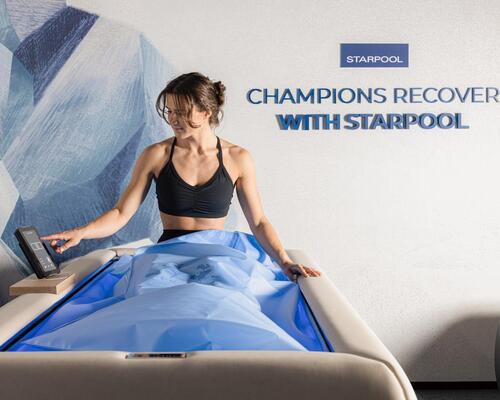
The €50 million (US$55.3 million, £42.1 million), 16,000sq m De Montel Terme di Milano will boast 10 pools ranging from 22˚C to 38˚C and accommodate up to 700 guests. Companies helping to bring it to market include bbspa_Group, Starpool and Myrtha Wellness.
The thermal park is a redevelopment project of Milan’s renowned De Montel horse racing stables. It’s also part of the Reinventing Cities initiative. Reinventing Cities is underpinned by C40 – a design competition launched by a network of mayors of 100 world-leading cities to “transform underutilised urban sites into beacons of sustainability and resilience”.
I can’t wait to return to Italy to see how the old and new thermal spas compare.
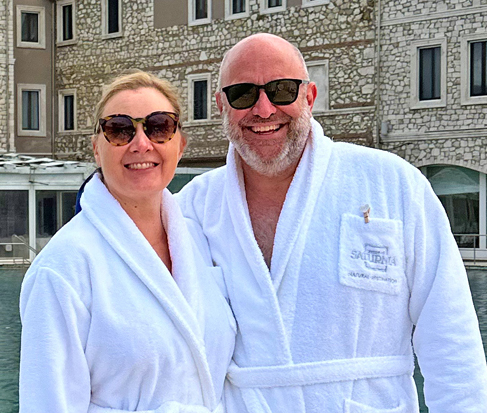
Jane Kitchen takes to the sulphurous waters with her husband Christian / photo: Jane Kitchen
"Terme di Saturnia is like
a second home to many
families ... a gift from
generation to generation
to take care of yourself" – Jane Kitchen
Read more from this issue of Spa Business magazine
View contents of Spa Business 2024 issue 3
Editor's letter: At a crossroads
As the UK prepares to host this year's Global Wellness Summit, fresh research shows its wellness industry must address a number of issues if it's to maintain levels of unprecedented growth
Spa People: Charlotte Church
The Welsh singer talks about how growing up in the media spotlight has influenced The Dreaming, her healing retreat business
Spa People: Julia Bradbury
Leading a series of Walk Yourself Happy retreats based on her best-selling book and years of TV presenting
Spa People: Samantha Dunn
Shaking up the industry with her new, affordable DIY consultancy programme for entrepreneurs
News report: Big spenders
Finn Partners’ latest research shows how China’s high-net-worth women are redefining luxury travel
News report: Step back in time
Two new GWI reports analyse the growth of the global spa and hot springs markets over the past 10 to 15 years
Interview: Dillip Rajakarier
Following a 450 per cent increase in core revenues, Minor Hotels is planning 200 more properties. Megan Whitby sits down with its CEO
New opening: Kintsugi Space
Patrizia Bortolin talks to Lisa Starr about creating a transformative women-only sanctuary in Abu Dhabi
Research: To inform and inspire
The UK Spa Association has conducted its first survey of spa businesses in the country for 18 years. GM Bobby Griffiths unveils the numbers
Research: From wellness to wellbeing
A new study uncovers four wellness consumer market segments ripe for innovation. WELLSurvey co-author Kevin Kelly reveals the findings in a Spa Business exclusive
First person: To the source
Jane Kitchen takes to the sulphurous waters of Terme di Saturnia in Italy and shares details about its exciting upcoming sister site in Milan
Promotion: L'OCCITANE en Provence – the art of recovery
With an approach to wellbeing that’s both holistic and grounded in science, the latest massage from L’OCCITANE en Provence promises to have a powerfully-beneficial effect on customers, both in the spa and at home
New opening: Surrenne at The Emory
The £15k memberships at this wellness club in London sold out in just weeks. Creator Inge Theron tells us why
First person: Playful wellness
A Stella McCartney facial and Tracy Anderson studio are just two USPs Megan Whitby finds at Surrenne
Promotion: TechnoAlpin – naturally cool design
TechnoAlpin’s snow technology is not only an effective way to introduce gentle cold therapy into the spa environment, it’s also a powerful biophilic design element that can bring the wonder of nature indoors
Promotion: Biologique Recherche – potent partnership
A new anti-senescence serum from Biologique Recherche offers transformative results and raises the bar in anti-ageing skincare when combined with its iconic collagen formula
Promotion: Comfort Zone – A longer life for skin
Created to combat the visible signs of ageing, Comfort Zone’s latest range revamp is based on the company’s pioneering research into cutaneous cellular longevity
Promotion: G.M. COLLIN – Clinical excellence in skincare
With laboratories based in Montreal, G.M. Collin’s highly researched derma-corrective treatments have been helping skincare professionals deliver exceptional and exclusive results worldwide for many decades. We talk to VP Myriam Sayer
Contrast therapy, based on the alternation of hot and cold rituals, has become one of the
most valued practices in the fields of wellness and recovery. [more...]
In the fast-paced world of fitness and wellness, where high-intensity workouts push us to
our limits and the sweat pours, the importance of efficient recovery cannot be overstated. [more...]
+ More featured suppliers
COMPANY PROFILES
Esse
Esse is a professional microbiome skincare brand founded in South Africa in 2002 by organic chemist, [more...]
Living Earth Crafts
For over 50 years, LEC has been manufacturing award-winning spa equipment for the world’s finest spas [more...]
The waters at Saturnia have been used since the time
of the Etruscans. Jane Kitchen travels to Italy to visit
one of the most iconic thermal springs in the world
The famous terraced pools of Saturnia are free to the public but often overcrowded / photo: shutterstock/leoks
We smell it before we see it: the pungent scent of sulphurous waters permeates Terme di Saturnia Resort, seeping into the lobby. It’s quite possibly the strangest first impression of a five-star hotel I’ve ever had. But it’s the waters that people come here for – we’ve driven 2 hours from Siena, down roughly paved, precariously twisty roads, to the remote landscape of Maremma, where spring waters have gushed from the centre of the earth for more than 3,000 years, since the time of the Etruscans, who called the town Aurinia and used the springs for sacred rituals in the 7th century BC.
Legend has it that the Roman god Saturn, tired of the constant warfare of men, took a thunderbolt to the earth, causing a river of hot water to gush through the valleys and envelop all things so that their spirits were quietened. The Romans renamed the town and the springs Saturnia and the first modern hotel was built on the site in 1919. Terme di Saturnia was born.
Since then, people have been coming to the resort to experience the thermal spring’s health-giving properties; the water – which contains bicarbonate, alkaline, calcium, magnesium and carbon dioxide in addition to 14 mg per litre of sulphur – is said to have beneficial effects on every system in the body, from skin and the respiratory system to bone health. It flows at 500 litres per second from underground, which means the water is naturally replenished in the resort’s pools every 4 hours. Unlike many hot springs, which often need to be cooled for bathing, Saturnia’s water is a perfect 37.5°C.
A 40-year journey We’ve come to Saturnia after a long weekend of celebrations for my cousin’s 40th birthday – a fitting time to visit, as the thermal water makes a 40-year journey underground from Mount Amiata, flowing through travertine passages lined with clay and picking up its mineral content along the way. The water bursts from the spring into the resort’s main pool, then spills over into other pools and finally to a stream that moves downhill until it reaches an old stone mill. It’s here where the iconic terraced pools of Saturnia are located with their milky blue waters. This is where my cousin heads with his wife and two young children, keen to see beautiful pools from Instagram first-hand. It’s a bonus that they’re free and open to the public. “Just think,” I tell my cousin, who’s grown up summering in Tuscany, “you’re soaking in rainwater that fell onto Mount Amiata the year you were born!”
Up at the hotel, my husband and I don our robes to check out its five thermal pools. The main pool, which houses the spring, is a deep cerulean blue and is shaded throughout with darker hues, which I only realise after a few minutes of floating are actually clusters of algae. The thermal plankton is gelatinous in texture but rich in minerals and is used in the resort’s treatments and cosmetics.
Third-generation visitors I fashion an armchair of sorts from foam noodles and simply float in the water, which is filled with small bubbles that gently caress your skin as they burst, in addition to the algae that feels incredibly silky. The pool is full of mostly Italians doing the same thing – soaking, chatting, relaxing. In fact, 75 per cent of the resort’s guests are nationals, with the average age between 35 and 50, and “younger and younger with the years passing,” says general manager Antonello Del Regno. Many are second and third-generation visitors, having first come as children and now bringing their own families. Up to 40 per cent of business is from repeat guests, says Del Regno.
“In Italy, Terme di Saturnia is recognised as the ultimate escape for wellbeing, having such a long tradition since the Romans,” he says. “Families celebrate festivities and important achievements with us – it’s like a second home … a gift from generation to generation to take care of yourself.”
I get a text from my cousin: the children are enjoying the shallow waters at the public pools, but he advises us to stay put at the tranquil resort as it’s packed where he is.
Beyond spa & beauty The hotel’s thermal area includes five outdoor thermal pools, as well as whirlpools, contrast therapy and indoor and outdoor relaxation areas. But the resort also includes a Spa & Beauty Clinic with 53 treatment rooms, where guests can have massages, mud therapy, inhale thermal vapours, medical and beauty treatments, nutritional guidance, hydrokinesis and Tecar Therapy, as well as fillers, injections, skin peels and laser treatments.
The Terme di Saturnia Method focuses on different goals – losing weight and shaping the body, elimination of toxins, stimulation of the immune system and reactivation of energy flows – and the team includes several specialised medical practitioners.
“The healing water is a treatment in itself, with so many health benefits,” says Del Regno. “Most weekend guests are happy just with that and then they’ll choose a classic massage or facial.” Midweek guests, he says, are different, choosing longer programmes and more treatments advised by doctors. Regardless, he reports that the spa capture rate is an incredible 98 per cent.
Terme di Saturnia has also recently introduced a series of programmes focused on areas such as metabolic health, qi gong and yoga. “We wanted to grow awareness of Terme di Saturnia not only as a medical spa but also as the perfect location for holistic wellness,” says Del Regno. “Prevention instead of cure is the keyword now. Nature, expertise, healing waters and medical know-how are the perfect premise for this.”
Mesmerising highlights With only one night at the resort, my husband and I dedicate our time to the original treatment of balneotherapy and taking to the waters.
At 8am the next day, I take advantage of the cooler air to go for a run down to the old mill. I have the place nearly to myself and am mesmerised as the thermal steam punctuates the morning light. I imagine this is what it used to be like before Instagram got the best of it. I’m struck that the highlights of Saturnia are the ones that can’t be captured in a photograph or reel: the pure relaxation felt by floating in perfectly warm water that’s taken 40 years to surface – and yes, that waft of sulphur. Not everyone likes it, but to me, it’s a signal of the power of the minerals in the water. It smells like true healing.
Sister site coming soon Writing this article weeks later, it’s announced that Terme Italia Holding, the operating company behind Terme di Saturnia, is scheduled to open one of the largest thermal parks in Italy in early 2025.
The €50 million (US$55.3 million, £42.1 million), 16,000sq m De Montel Terme di Milano will boast 10 pools ranging from 22˚C to 38˚C and accommodate up to 700 guests. Companies helping to bring it to market include bbspa_Group, Starpool and Myrtha Wellness.
The thermal park is a redevelopment project of Milan’s renowned De Montel horse racing stables. It’s also part of the Reinventing Cities initiative. Reinventing Cities is underpinned by C40 – a design competition launched by a network of mayors of 100 world-leading cities to “transform underutilised urban sites into beacons of sustainability and resilience”.
I can’t wait to return to Italy to see how the old and new thermal spas compare.
Jane Kitchen takes to the sulphurous waters with her husband Christian / photo: Jane Kitchen
"Terme di Saturnia is like
a second home to many
families ... a gift from
generation to generation
to take care of yourself" – Jane Kitchen
Read more from this issue of Spa Business magazine
View contents of Spa Business 2024 issue 3
Editor's letter: At a crossroads
As the UK prepares to host this year's Global Wellness Summit, fresh research shows its wellness industry must address a number of issues if it's to maintain levels of unprecedented growth
Spa People: Charlotte Church
The Welsh singer talks about how growing up in the media spotlight has influenced The Dreaming, her healing retreat business
Spa People: Julia Bradbury
Leading a series of Walk Yourself Happy retreats based on her best-selling book and years of TV presenting
Spa People: Samantha Dunn
Shaking up the industry with her new, affordable DIY consultancy programme for entrepreneurs
News report: Big spenders
Finn Partners’ latest research shows how China’s high-net-worth women are redefining luxury travel
News report: Step back in time
Two new GWI reports analyse the growth of the global spa and hot springs markets over the past 10 to 15 years
Interview: Dillip Rajakarier
Following a 450 per cent increase in core revenues, Minor Hotels is planning 200 more properties. Megan Whitby sits down with its CEO
New opening: Kintsugi Space
Patrizia Bortolin talks to Lisa Starr about creating a transformative women-only sanctuary in Abu Dhabi
Research: To inform and inspire
The UK Spa Association has conducted its first survey of spa businesses in the country for 18 years. GM Bobby Griffiths unveils the numbers
Research: From wellness to wellbeing
A new study uncovers four wellness consumer market segments ripe for innovation. WELLSurvey co-author Kevin Kelly reveals the findings in a Spa Business exclusive
First person: To the source
Jane Kitchen takes to the sulphurous waters of Terme di Saturnia in Italy and shares details about its exciting upcoming sister site in Milan
Promotion: L'OCCITANE en Provence – the art of recovery
With an approach to wellbeing that’s both holistic and grounded in science, the latest massage from L’OCCITANE en Provence promises to have a powerfully-beneficial effect on customers, both in the spa and at home
New opening: Surrenne at The Emory
The £15k memberships at this wellness club in London sold out in just weeks. Creator Inge Theron tells us why
First person: Playful wellness
A Stella McCartney facial and Tracy Anderson studio are just two USPs Megan Whitby finds at Surrenne
Promotion: TechnoAlpin – naturally cool design
TechnoAlpin’s snow technology is not only an effective way to introduce gentle cold therapy into the spa environment, it’s also a powerful biophilic design element that can bring the wonder of nature indoors
Promotion: Biologique Recherche – potent partnership
A new anti-senescence serum from Biologique Recherche offers transformative results and raises the bar in anti-ageing skincare when combined with its iconic collagen formula
Promotion: Comfort Zone – A longer life for skin
Created to combat the visible signs of ageing, Comfort Zone’s latest range revamp is based on the company’s pioneering research into cutaneous cellular longevity
Promotion: G.M. COLLIN – Clinical excellence in skincare
With laboratories based in Montreal, G.M. Collin’s highly researched derma-corrective treatments have been helping skincare professionals deliver exceptional and exclusive results worldwide for many decades. We talk to VP Myriam Sayer
Synergy – The Retreat Show, the global trade show for retreats, has launched a global research
initiative that will provide insights into the retreat sector from both consumer and industry
perspectives.
The Wellness Tourism Association (WTA) has published a non-regulatory global industry
framework designed to ensure the retreat market offers responsible experiences.
A new survey of UK and international spa practitioners shows that stress, burnout and
wellbeing concerns have caused one in three respondents to consider leaving the industry.
The UK's four Chief Medical Officers have published a refreshed edition of Physical activity
guidelines: UK Chief Medical Officers' report, updating the evidence that underpins the nation's
physical activity recommendations and placing greater emphasis on strength, balance, reducing
sedentary behaviour and, for the first time, supporting people taking weight loss medications.
Anna Bjurstam has left her role as Wellness Pioneer at Six Senses Hotels and Resorts and
launched a new wellness, longevity and “consciousness consultancy” called Wahayla.
Fairmont Cheshire, The Mere, has opened today (10 July) in the Northwest of England
with a
1,715sq m Fairmont Spa that has been designed using a ‘Wellness without Walls’
concept.
Wellness hotels generating less than US$1 million (€932,700, £785,200) – or 10 per cent of
total revenue from wellness and leisure – recorded the strongest RevPAR and TRevPAR growth
in 2025 across categories when compared with 2024, according to the latest Wellness Real
Estate Report by RLA Global, produced in partnership with P and L benchmarking firm HotStats.
Lefay Resorts, the portfolio of two luxury wellness properties in Italy, has added emotional
dance classes and group cold plunge sessions in response to market demand for social
connection.
Contrast therapy, based on the alternation of hot and cold rituals, has become one of the
most valued practices in the fields of wellness and recovery. [more...]
In the fast-paced world of fitness and wellness, where high-intensity workouts push us to
our limits and the sweat pours, the importance of efficient recovery cannot be overstated. [more...]
+ More featured suppliers
COMPANY PROFILES
Esse Esse is a professional microbiome skincare brand founded in South Africa in 2002 by organic chemist, [more...]