Latest
issue
GET SPA BUSINESS
magazine
Yes! Send me the FREE digital editions of Spa Business and Spa Business insider magazines and the FREE weekly Spa Business and Spa Business insider ezines and breaking news alerts!
Not right now, thanksclose this window I've already subscribed.
Uniting the world of spa & wellness
Get Spa Business and Spa Business insider digital magazines FREE
Sign up here ▸
News   Features   Products   Company profilesProfiles   Press releasesProfiles   Magazine   Handbook   Advertise    Subscribe  
NEWS
Hospitality leaders gather in Paris to discuss longevity
POSTED 02 Jan 2026 . BY Liz Terry
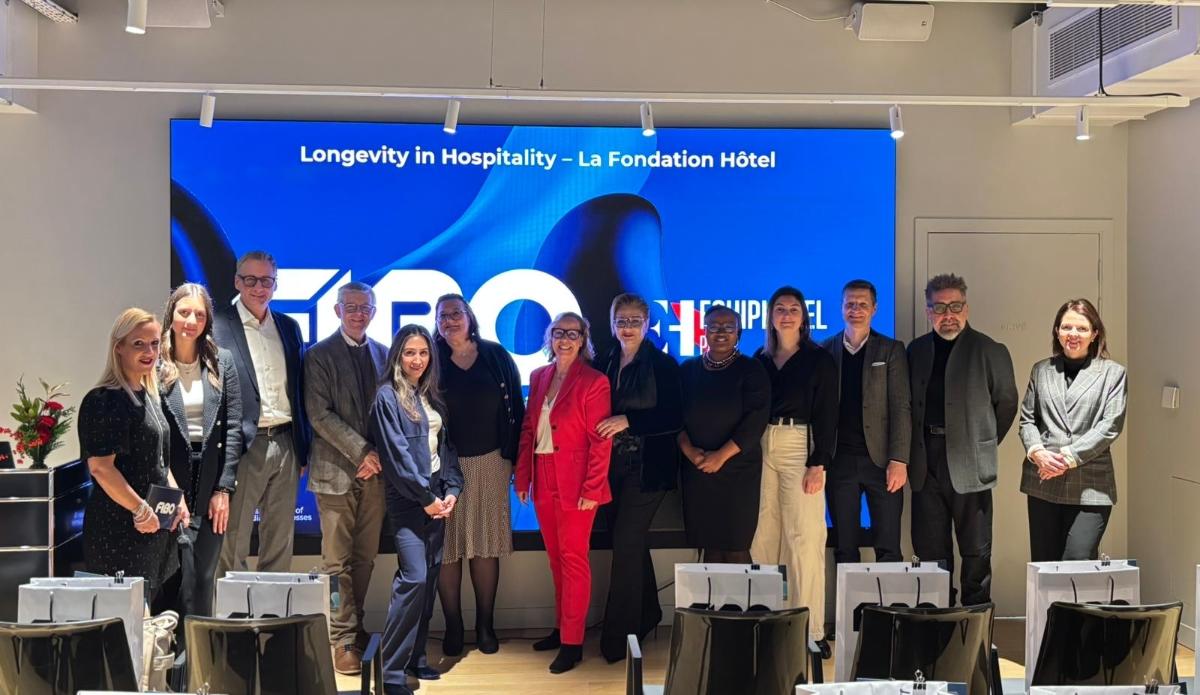
The event was held at La Fondation, a recently-opened wellness hotel in Paris Credit: RX Deutschland Gmbh FIBO
The Longevity in Hospitality Event was organised by FIBO and its parent company RX
Consultants Andrew Gibson and Franz Linser presented the conference and shared their thoughts
Speakers discussed what longevity means for design, investment and operation of hospitality settings, including spas and dining venues

FIBO and its parent company RX have convened a high-level seminar recently called Longevity in Hospitality.

The event was held at La Fondation, a recently-opened purpose-built wellness hotel in Paris, which has a climbing wall, gym, pool and spa and state-of-the-art co-working and seminar spaces. 

The day, held in December, was hosted by Anke Brendt, project manager at FIBO and Michael Köhler, CEO of RX Germany and presented by consultants Andrew Gibson and Franz Linser.

Gibson said delivering longevity in hotels is a complex matter, but that nailing the essentials – such as clean air, good sleeping conditions and access to green spaces and the support of experts should be the basis of any approach.

His definition of longevity is based on three foundations – community, agility and nourishment. 

“The best wellness or longevity retreats have 12-month waiting lists, because people book and rebook. That’s community,” he said.

“Agility is part of what you would call fitness,” he continued. “But we need to take it to the next level – it isn’t just about cardio and strength, it’s also about things such as cognition and reaction time.

“Food is an important part of nourishment, but it also includes the restoration of the body – recharge, refresh, relax, recuperate. All these words explain nourishment.

“Nourishment is also about curiosity,” said Gibson. “Hotels need to be designed to inspire people to explore and to pique their curiosity. It’s about nourishing the brain, it’s about education, contributing to community, agility and nourishment.”

Gibson called on developers to consider building wellness and longevity elements into their projects from the start, rather than trying to back-fit them shortly before opening.

He told delegates he is regularly approached to consult on new developments where the infrastructure has already been planned and is sometimes on-site.

This eliminates the opportunity to build movement into the design, to ensure bedrooms are designed to support healthy sleep, for example: “You have to start at the concept stage,” he said. “Failing this, you’re trying to apply the key pillars of wellness to a hotel that’s already existing and this isn’t optimal.”

The core of hospitality – empathy, ensuring guests eat well, sleep well and socialise well can be the core of a longevity strategy, said Linser.

If someone stays a week and they can also see experts who can help them – medical experts, psychiatrists, physical therapists and so forth – this can be very different from the way you live at home, ensuring real value is added to the stay.

Delivery depends on resources – operators might have millions to spend on medical equipment and this might work for one audience. Another might be to take a more holistic approach, with guests spending more time in nature, said Linser.

“At the Global Wellness Summit recently, one medical doctor said that more people – according to his findings and opinion – are under-rested and overworked and I think this is something we should think about,” he said.

“This can lead to a situation where people think they’re working too much, but it’s just that they don’t know how to recover and relax. They may also have a lack of stress resilience.

“Many people are living in urban areas and don’t understand the power of being in a deep natural environment or what it’s like going out of the house into a forest with clear air, where bright is brighter and dark is darker,” said Linser. “We have to get them back to the point where their workouts are harder and then the relaxation that follows is more profound and they get back to natural rhythms.

Ambition is also important, according to Linser: “It isn’t enough any more to meet minimum standards for things such as in-room humidity and air quality,” he said. “Below 30 per cent humidity, it’s not possible to sleep well, for example.

"We need to be actively promoting what we do much more as an industry. We want to enable people to work out better, eat better, relax better, sleep better and socialise better.”

Gibson said investment in longevity equipment, such as hyperbaric chambers and more medical interventions, needs to be weighed against length of stay and potential obsolescence: “If people are only staying in your hotel for a day, they’re less likely to use these services,” he said, “but if they’re staying a week, then that changes things.”

He talked about his work at the Sensei resort in Hawaii, where the longevity offering was mainly based around programming and support from specialist advisers, rather than lots of equipment, giving the example of a former US marine, who specialised in post-traumatic stress and was highly sought after by guests – high net worth individuals who already had all the standard wellness elements covered in their day to day life, so really valued the unique support he gave.

“You have to clearly understand your market,” said Gibson. “At one end will be people who will continue to smoke and eat fast food and be happy doing that. At either end are people who are fully immersed in a wellness lifestyle and have less need for longevity in hotels. The big opportunity is to be found in the middle and then you have to decide on your focus.”

Also speaking at the summit was Alexandre Pierat from Suprem Architectures who presented a range of luxury wellness, spa and longevity projects under the theme ‘From Wellness to Longevity: Rethinking Architecture's Role’, including projects for Cinq Mondes and Guerlain, as well as a concept spa for Pop Fantasy in Bali.

Regis Boudon, SVP Creative Development at BBSpa presented on the theme of Longevity in spas: a genuine opportunity or just a passing trend? He suggested investors should carefully evaluate the longevity concept they’re interested in adopting by examining the space available and the costs in areas such as staffing, where medical wellness staff can command far higher salaries, increasing the payback time and operating costs.

He presented a number of business models from 2,000sq m spas to 250sq m medical spas, saying there’s a sweet spot for investment for hotels, suggesting an investment of €250-€700k a break-even of 12-18 months and an area of 350sq m.

He also gave examples of a four-star hotel in the South of France with 80 rooms and a 400sq m spa. This property made an investment of €380k in longevity and introduced a successful four-day programme for metabolic health at a rate of €1,650 per person.

“Longevity is an opportunity for the sector,” said Boudon. “But tread carefully and make sure you make the right investments, as there are new modalities coming to market all the time and without planning, your scheme could quickly be obsolete.”

The event wrapped up with a panel discussion led by FIBO’s Emily Whigham, with Andrew Gibson, Marion Gérent – general manager at La Fondation Hotel (the venue for the event) and Dr Katharina Sepp, medical doctor at Alpinresort Sacher, which has a very high-level wellness offering called The Academy for Better Ageing.

Gibson said people who use spas in hotels spend more on F&B, stay longer and are more profitable than those who don’t, with this insight being valuable for operators seeking funding or who need to make a case for viability.

The panel agreed that most people’s priority is healthspan and living a life where they can do what they choose without limitations.

“We try not to be a hospital,” said Sepp. “Too many medical examinations can make you feel as though you're sick when you’re not. We want to give people the opportunity to do positive things for their health.

“We start with a physical examination – these days doctors rarely touch you or customise treatments. We do things differently - we personalise programmes by looking at family history and we do a physical examination so we really understand the individual.”

Alpinresort Sacher offers DNA testing so they can advise on optimum exercise and wellness routines and then evidence the impact of these wellness interventions.

“We offer all our staff the option to use the spa and longevity facilities, such as the cryotherapy," said Sepp. "That way, they can talk to the members about it.”

Sepp said Alpinresort ensures medical interventions are billed separately, so customers can charge this proportion of their stay to their insurance company.

Gérent said Interventions at La Fondation are designed to suit each person and to deliver long-term change. The hotel has already signed up 1,500 local members since it opened three months ago.

“We offer a lot of activities on site and create a lot of programmes with activities with nutrition and support from coaches and therapists giving spa treatments,” she said.

“We’re already running three aqua aerobics classes a day, due to demand,” said Gérent, although bookings in the spa treatment rooms and the climbing wall are not yet at capacity.

Gibson advised a hybrid model for operators that don’t have the capacity to invest heavily in longevity – ”Start with retreats,” said Gibson. “Run them regularly and then build from there”.

He suggested that when organising visiting practitioners for retreats, to ensure they are contracted to deliver a proportion of their classes to the in-house staff teams, advising operators to make employee wellness a cornerstone of any longevity initiative. “If the employees are happy, the guest will see that and it rubs off, so let’s start there,” he said.


MORE NEWS
The Retreat Costa Rica debuts Vida Mía Longevity Centre
Luxury wellness resort, The Retreat Costa Rica, has introduced its Vida Mía Longevity Centre at the property’s Vida Mía Healing Centre and Spa.
Almost half of spa survey respondents are unaware cancer is a disability and not adapting treatments is discrimination
A recent survey by the UK Spa Association (UKSA) into the industry’s approach to cancer care has revealed that almost half of participating respondents (46 per cent) are unaware that cancer is a disability and guests with a cancer diagnosis must be given
Solmar Hotels and Resorts offers Temazcal ceremony for Global Wellness Day
Mexican operator, Solmar Hotels and Resorts, is hosting a series of events in celebration of Global Wellness Day, including a Temazcal ceremony at its Playa Grande Resort and Spa in Los Cabos.
Mandarin Oriental announces standalone Mansions-branded residences for Abu Dhabi
Mandarin Oriental has announced a standalone residence brand, Mansions, which will debut at Emirates Palace, Mandarin Oriental Mansions, Abu Dhabi, in 2029.
+ More news   

FEATURED SUPPLIERS

Introducing Glass Act by Templespa
Introducing Glass Act, your new go-to eye serum for brighter, smoother, beautifully awakened eyes. [more...]

Aquaform is designing water as an experience
In the world of spa design, reducing water to a functional component misses the point. [more...]
+ More featured suppliers  
COMPANY PROFILES
Nilo Spa Design

Nilo SPA Design, part of the Maletti group, has led the Beauty & Wellness sector for over 35 years p [more...]
Elemental Herbology

Founded in 2008 by a Traditional Chinese Medicine Practitioner, Elemental Herbology is a spa, retail [more...]
+ More profiles  
CATALOGUE GALLERY
 

+ More catalogues  

DIRECTORY
+ More directory  
DIARY


09-11 Jun 2026

World Sauna Forum 2026

Savutuvan Apaja, Haapaniemi, Finland
09-12 Jun 2026

W3Spa EMEA

Hotel Cascais Miragem Health & Spa, Portugal
+ More diary  
 
ABOUT LEISURE MEDIA
LEISURE MEDIA MAGAZINES
LEISURE MEDIA HANDBOOKS
LEISURE MEDIA WEBSITES
LEISURE MEDIA PRODUCT SEARCH
 
SPA BUSINESS
SPA OPPORTUNITIES
SPA BUSINESS HANDBOOK
PRINT SUBSCRIPTIONS
FREE DIGITAL SUBSCRIPTIONS
ADVERTISE . CONTACT US

Leisure Media
Tel: +44 (0)1462 431385

©Cybertrek 2026
Uniting the world of spa & wellness
Get Spa Business and Spa Business insider digital magazines FREE
Sign up here ▸
News   Products   Magazine   Subscribe
NEWS
Hospitality leaders gather in Paris to discuss longevity
POSTED 02 Jan 2026 . BY Liz Terry
The event was held at La Fondation, a recently-opened wellness hotel in Paris Credit: RX Deutschland Gmbh FIBO
The Longevity in Hospitality Event was organised by FIBO and its parent company RX
Consultants Andrew Gibson and Franz Linser presented the conference and shared their thoughts
Speakers discussed what longevity means for design, investment and operation of hospitality settings, including spas and dining venues

FIBO and its parent company RX have convened a high-level seminar recently called Longevity in Hospitality.

The event was held at La Fondation, a recently-opened purpose-built wellness hotel in Paris, which has a climbing wall, gym, pool and spa and state-of-the-art co-working and seminar spaces. 

The day, held in December, was hosted by Anke Brendt, project manager at FIBO and Michael Köhler, CEO of RX Germany and presented by consultants Andrew Gibson and Franz Linser.

Gibson said delivering longevity in hotels is a complex matter, but that nailing the essentials – such as clean air, good sleeping conditions and access to green spaces and the support of experts should be the basis of any approach.

His definition of longevity is based on three foundations – community, agility and nourishment. 

“The best wellness or longevity retreats have 12-month waiting lists, because people book and rebook. That’s community,” he said.

“Agility is part of what you would call fitness,” he continued. “But we need to take it to the next level – it isn’t just about cardio and strength, it’s also about things such as cognition and reaction time.

“Food is an important part of nourishment, but it also includes the restoration of the body – recharge, refresh, relax, recuperate. All these words explain nourishment.

“Nourishment is also about curiosity,” said Gibson. “Hotels need to be designed to inspire people to explore and to pique their curiosity. It’s about nourishing the brain, it’s about education, contributing to community, agility and nourishment.”

Gibson called on developers to consider building wellness and longevity elements into their projects from the start, rather than trying to back-fit them shortly before opening.

He told delegates he is regularly approached to consult on new developments where the infrastructure has already been planned and is sometimes on-site.

This eliminates the opportunity to build movement into the design, to ensure bedrooms are designed to support healthy sleep, for example: “You have to start at the concept stage,” he said. “Failing this, you’re trying to apply the key pillars of wellness to a hotel that’s already existing and this isn’t optimal.”

The core of hospitality – empathy, ensuring guests eat well, sleep well and socialise well can be the core of a longevity strategy, said Linser.

If someone stays a week and they can also see experts who can help them – medical experts, psychiatrists, physical therapists and so forth – this can be very different from the way you live at home, ensuring real value is added to the stay.

Delivery depends on resources – operators might have millions to spend on medical equipment and this might work for one audience. Another might be to take a more holistic approach, with guests spending more time in nature, said Linser.

“At the Global Wellness Summit recently, one medical doctor said that more people – according to his findings and opinion – are under-rested and overworked and I think this is something we should think about,” he said.

“This can lead to a situation where people think they’re working too much, but it’s just that they don’t know how to recover and relax. They may also have a lack of stress resilience.

“Many people are living in urban areas and don’t understand the power of being in a deep natural environment or what it’s like going out of the house into a forest with clear air, where bright is brighter and dark is darker,” said Linser. “We have to get them back to the point where their workouts are harder and then the relaxation that follows is more profound and they get back to natural rhythms.

Ambition is also important, according to Linser: “It isn’t enough any more to meet minimum standards for things such as in-room humidity and air quality,” he said. “Below 30 per cent humidity, it’s not possible to sleep well, for example.

"We need to be actively promoting what we do much more as an industry. We want to enable people to work out better, eat better, relax better, sleep better and socialise better.”

Gibson said investment in longevity equipment, such as hyperbaric chambers and more medical interventions, needs to be weighed against length of stay and potential obsolescence: “If people are only staying in your hotel for a day, they’re less likely to use these services,” he said, “but if they’re staying a week, then that changes things.”

He talked about his work at the Sensei resort in Hawaii, where the longevity offering was mainly based around programming and support from specialist advisers, rather than lots of equipment, giving the example of a former US marine, who specialised in post-traumatic stress and was highly sought after by guests – high net worth individuals who already had all the standard wellness elements covered in their day to day life, so really valued the unique support he gave.

“You have to clearly understand your market,” said Gibson. “At one end will be people who will continue to smoke and eat fast food and be happy doing that. At either end are people who are fully immersed in a wellness lifestyle and have less need for longevity in hotels. The big opportunity is to be found in the middle and then you have to decide on your focus.”

Also speaking at the summit was Alexandre Pierat from Suprem Architectures who presented a range of luxury wellness, spa and longevity projects under the theme ‘From Wellness to Longevity: Rethinking Architecture's Role’, including projects for Cinq Mondes and Guerlain, as well as a concept spa for Pop Fantasy in Bali.

Regis Boudon, SVP Creative Development at BBSpa presented on the theme of Longevity in spas: a genuine opportunity or just a passing trend? He suggested investors should carefully evaluate the longevity concept they’re interested in adopting by examining the space available and the costs in areas such as staffing, where medical wellness staff can command far higher salaries, increasing the payback time and operating costs.

He presented a number of business models from 2,000sq m spas to 250sq m medical spas, saying there’s a sweet spot for investment for hotels, suggesting an investment of €250-€700k a break-even of 12-18 months and an area of 350sq m.

He also gave examples of a four-star hotel in the South of France with 80 rooms and a 400sq m spa. This property made an investment of €380k in longevity and introduced a successful four-day programme for metabolic health at a rate of €1,650 per person.

“Longevity is an opportunity for the sector,” said Boudon. “But tread carefully and make sure you make the right investments, as there are new modalities coming to market all the time and without planning, your scheme could quickly be obsolete.”

The event wrapped up with a panel discussion led by FIBO’s Emily Whigham, with Andrew Gibson, Marion Gérent – general manager at La Fondation Hotel (the venue for the event) and Dr Katharina Sepp, medical doctor at Alpinresort Sacher, which has a very high-level wellness offering called The Academy for Better Ageing.

Gibson said people who use spas in hotels spend more on F&B, stay longer and are more profitable than those who don’t, with this insight being valuable for operators seeking funding or who need to make a case for viability.

The panel agreed that most people’s priority is healthspan and living a life where they can do what they choose without limitations.

“We try not to be a hospital,” said Sepp. “Too many medical examinations can make you feel as though you're sick when you’re not. We want to give people the opportunity to do positive things for their health.

“We start with a physical examination – these days doctors rarely touch you or customise treatments. We do things differently - we personalise programmes by looking at family history and we do a physical examination so we really understand the individual.”

Alpinresort Sacher offers DNA testing so they can advise on optimum exercise and wellness routines and then evidence the impact of these wellness interventions.

“We offer all our staff the option to use the spa and longevity facilities, such as the cryotherapy," said Sepp. "That way, they can talk to the members about it.”

Sepp said Alpinresort ensures medical interventions are billed separately, so customers can charge this proportion of their stay to their insurance company.

Gérent said Interventions at La Fondation are designed to suit each person and to deliver long-term change. The hotel has already signed up 1,500 local members since it opened three months ago.

“We offer a lot of activities on site and create a lot of programmes with activities with nutrition and support from coaches and therapists giving spa treatments,” she said.

“We’re already running three aqua aerobics classes a day, due to demand,” said Gérent, although bookings in the spa treatment rooms and the climbing wall are not yet at capacity.

Gibson advised a hybrid model for operators that don’t have the capacity to invest heavily in longevity – ”Start with retreats,” said Gibson. “Run them regularly and then build from there”.

He suggested that when organising visiting practitioners for retreats, to ensure they are contracted to deliver a proportion of their classes to the in-house staff teams, advising operators to make employee wellness a cornerstone of any longevity initiative. “If the employees are happy, the guest will see that and it rubs off, so let’s start there,” he said.

MORE NEWS
The Retreat Costa Rica debuts Vida Mía Longevity Centre
Luxury wellness resort, The Retreat Costa Rica, has introduced its Vida Mía Longevity Centre at the property’s Vida Mía Healing Centre and Spa.
Almost half of spa survey respondents are unaware cancer is a disability and not adapting treatments is discrimination
A recent survey by the UK Spa Association (UKSA) into the industry’s approach to cancer care has revealed that almost half of participating respondents (46 per cent) are unaware that cancer is a disability and guests with a cancer diagnosis must be given
Solmar Hotels and Resorts offers Temazcal ceremony for Global Wellness Day
Mexican operator, Solmar Hotels and Resorts, is hosting a series of events in celebration of Global Wellness Day, including a Temazcal ceremony at its Playa Grande Resort and Spa in Los Cabos.
Mandarin Oriental announces standalone Mansions-branded residences for Abu Dhabi
Mandarin Oriental has announced a standalone residence brand, Mansions, which will debut at Emirates Palace, Mandarin Oriental Mansions, Abu Dhabi, in 2029.
Healing sanctuary Tulah Clinical Wellness opens in Kerala
Tulah Clinical Wellness, a holistic wellness destination, has officially opened in the hills of northern Kerala, India.
Four Seasons Resort The Nam Hai creates Global Wellness Day programme rooted in nature
Four Seasons Resort The Nam Hai in Hoi An, Vietnam, has put together a Global Wellness Day (GWD) agenda with activations rooted in nature and shaped by four pillars of Joy – in alignment with the day’s theme #JoyMagenta.
+ More news   
 
FEATURED SUPPLIERS

Introducing Glass Act by Templespa
Introducing Glass Act, your new go-to eye serum for brighter, smoother, beautifully awakened eyes. [more...]

Aquaform is designing water as an experience
In the world of spa design, reducing water to a functional component misses the point. [more...]
+ More featured suppliers  
COMPANY PROFILES
Nilo Spa Design

Nilo SPA Design, part of the Maletti group, has led the Beauty & Wellness sector for over 35 years p [more...]
+ More profiles  
CATALOGUE GALLERY
+ More catalogues  

DIRECTORY
+ More directory  
DIARY


09-11 Jun 2026

World Sauna Forum 2026

Savutuvan Apaja, Haapaniemi, Finland
09-12 Jun 2026

W3Spa EMEA

Hotel Cascais Miragem Health & Spa, Portugal
+ More diary  


ADVERTISE . CONTACT US

Leisure Media
Tel: +44 (0)1462 431385

©Cybertrek 2026

ABOUT LEISURE MEDIA
LEISURE MEDIA MAGAZINES
LEISURE MEDIA HANDBOOKS
LEISURE MEDIA WEBSITES
LEISURE MEDIA PRODUCT SEARCH
PRINT SUBSCRIPTIONS
FREE DIGITAL SUBSCRIPTIONS