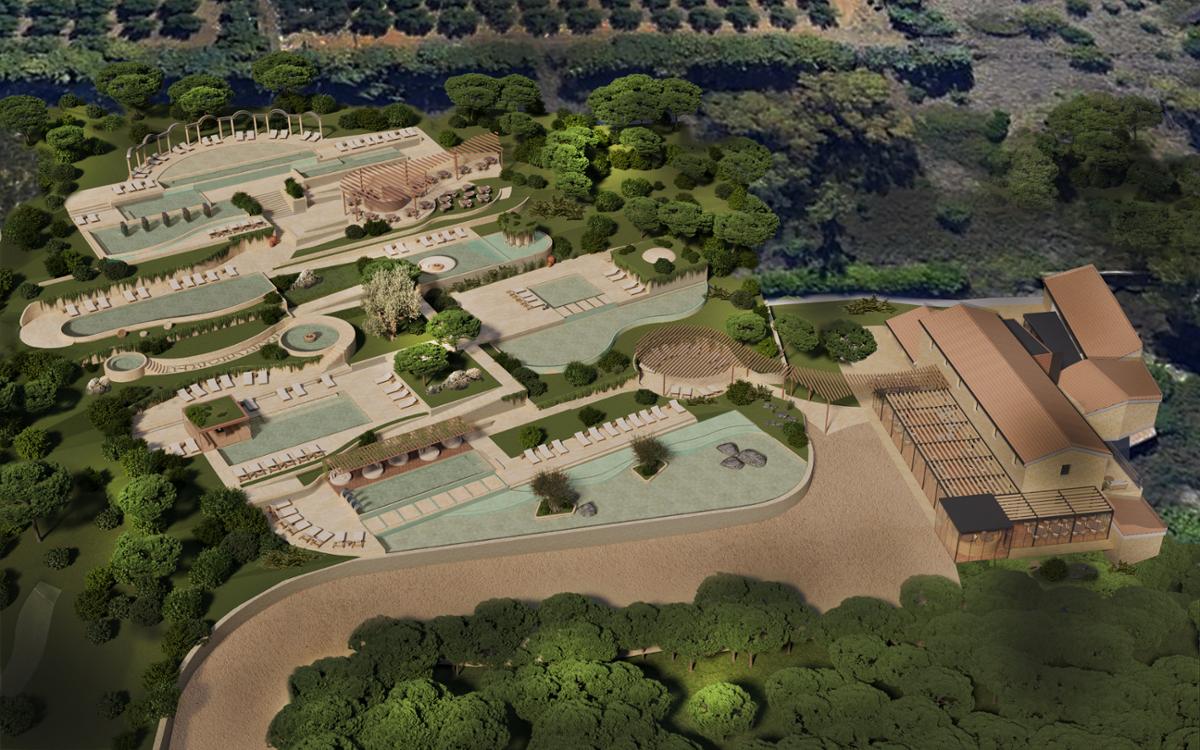
The New Thermal Park ranges approximately 26,000sq m and will have a total of 14 pools, sourced from natural thermal springs
The bathing journey will be divided into four different Roman-era-inspired zones
Thermal facilities will include various pools of differing temperatures and salinity, hammams, lounge areas, a Kneipp circuit and a Finnish sauna
The development will be marketed as a high-profile destination for global wellness tourism
Studio Apostoli has designed a thermal bathing complex called New Thermal Park in Civitavecchia, Italy, next to the ruins of a Roman bathhouse site called Terme Taurine, as part of a project to revitalise the Lazio region.
The land is owned by Terme dei Papi SpA, a company that has a thermal bathing site of the same name in Viterbo, also in the Lazio region. Terme dei Papi, which was popular with multiple Popes during the medieval era, has been operated by the Sensi family since 1993.
Studio Apostoli has worked with the Sensi family to create the New Thermal Park to attract an international clientele to both the new privately-owned facility and the publicly-owned archaeological site next-door.
The development will be marketed as a high-profile destination for global wellness tourism, taking advantage of Civitavecchia’s port and its annual traffic of more than 3.5 million visitors.
The New Thermal Park ranges approximately 26,000sq m and will feature a large outdoor area with three terraces that follow the land’s natural contours. There will also be a complex that revitalises a historic rural structure known as Casale dei Bagni.
There will be a total of 14 pools, with a total footprint of 1,440sq m, sourced from natural thermal springs. Prefabricated and adaptable construction modules will be used to reduce the environmental impact of the site and accelerate the building schedule.
The visitor experienceVisitors will start the bathing journey in the first of four Roman-era-inspired areas, Mare Nostrum. This area begins in the Casale dei Bagni structure and is linked to the upper terrace by a pergola. It has 32-degree Celsius thermal pools, ornamental fountains and a leisure zone with dramatic evening lighting.
In the Eastern Provinces zone, there will be a series of pools of varying temperatures and salinity, designed for rest, recovery and relaxation. Surrounding these pools, guests will find circular structures inspired by those associated with the Oracle of Delphi, hammams, lounge spaces and relaxation areas.
The Great North area is dedicated to contrast therapy, with a Kneipp circuit, a panoramic Finnish sauna, plus cold (16-degree Celsius) and hot (40-degree Celsius) plunge pools.
The final section is called Imperial Rome. In an homage to Roman grandeur, the space has thermal and non-thermal pools, multi-level waterfalls and a lounge bar.
SustainabilityThe development has been created with sustainability at the forefront of the design.
The park will be equipped with advanced rainwater harvesting systems and low-visibility solar panels. Structures will be built in neutral-toned materials to avoid disrupting bird migration routes and more than 500 native Mediterranean trees will be planted.
Alberto Apostoli, founder of Studio Apostoli, told
Spa Business, “During this project, I engaged with the exceptional history of Roman thermal culture. The result is a space designed as much for relaxation as for historical contemplation, making the New Thermal Park in Civitavecchia a singular project, thanks to its uniquely original spa offering. Here, visitors can relive the experiences and emotions stirred by ancient bathing culture, reinterpreted for the contemporary era.
"Together with the Sensi family, we’ve built a collaborative relationship grounded in a shared understanding of the territory and a deep commitment to wellness," he added. "Our goal was to develop a masterplan capable of synthesising all the necessary elements. The New Thermal Park is both a continuation of the area’s history and a projection of the future of wellness tourism. Throughout the process, the United Nations’ Sustainable Development Goals – outlined in the 2030 Agenda – have served as a clear and consistent framework for our decisions.”