In the last few months, I’ve encountered protestors camping outside a number of attractions, lobbying visitors in the queue lines to try to persuade them to boycott the attractions because of a specific sponsorship tie-up.
Although they’ve been peaceful protests and sometimes interesting, it’s obviously not a good thing for attractions customers to be exposed to this kind of pressure.
The industry attracts protesters for the same reason it attracts sponsors – it’s high profile and extremely engaged with its audience. The numbers are also compelling – attractions capture high levels of footfall and do so in a provable and segmented way, so sponsorship spend can be targeted and analysed to a degree that isn’t possible with many other types of sponsorships or marketing.
With a growing desire to invest in corporate social responsibility (CSR), corporations view attractions as being on a par with sport as an investment area that achieves CSR objectives, while also being safe in terms of image and powerful in terms of association.
Today, sponsorship is a global business ranging from Disney’s tie up with Coca- Cola to Sotheby’s sponsorship of MOMA in New York. The industry couldn’t run without it and commercial sponsorship of attractions – particularly the arts, culture, museums and heritage – has enabled decades of excellence that would simply not have been possible otherwise.
But times change and sponsorships which were once acceptable to the public can – over time – become less so. London’s National Portrait Gallery was once sponsored by British Tobacco, for example, but that kind of arrangement would be unthinkable today.
One of the most famous benefactions ever is the UK’s Tate – now a network of four museums – originally made possible by funds from Henry Tate, one of the founders of what later became Tate & Lyle the sugar refiner and processor.
Today, sugar is acknowledged as one of the health scourges of modern times – toxic, addictive and with little nutritional value apart from empty calories. It’s one of the major contributors to the global obesity crisis.
But associations between Tate & Lyle and the Tate galleries faded long ago in the minds of the public, so that’s one protest that has been rendered redundant by the passing of time.
In such a complex and ever changing situation, it’s important the industry keeps all sponsorship deals under review, walking a realistic line between listening to protests and giving them fair and due consideration and robustly defending sponsorship relationships where they feel the accusations are unfair or not born out when tested against public opinion.
Liz Terry, editor, twitter: @elizterry
Read more from this issue of Spa Business magazine
View contents of Spa Business 2013 issue 2
Editor's letter : Dealing with protests
The industry attracts protesters for the
same reason it attracts sponsors – it's
high profile and extremely engaged with
its audience
Profile: Tim Fisher
The CEO of Village Roadshow Theme
Parks reveals how the company's
defied the double-dip global recession
with record attendances to its existing
parks and three more due to open
Museum: The big idea
San Francisco's Exploratorium reopened
in April in a venue three times its original
size. The museum's Linda Dackman
shows how the new space is being used
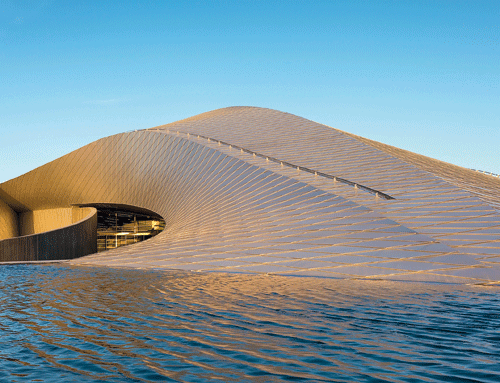
Aquarium: Den Blå Planet
The CEO and designer describe
Denmark's new aquarium, which is
shaped like a whirlpool and has 20,000
animals and up to 8,000 visitors a day
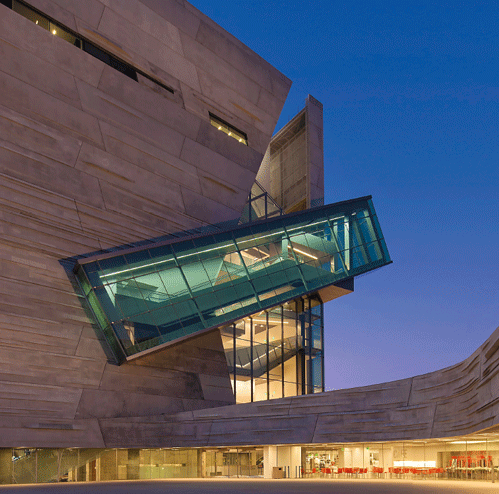
New opening: Thinking inside the box
The Perot Museum is shaped like a cube
and described as the next generation
of nature and science museums. CEO
Nicole Small explains how and why
Restoration: Home improvement
The Historic Dyess Colony: Boyhood
Home of Johnny Cash project is
restoring the famous singer's house,
educating visitors about the New
Deal era and revitalising the area
Planetarium: The sky at night
Two dome theatres are among the
highlights of Canada's new Rio Tinto
Alcan Planetarium, which shows what's
going on in the universe as it happens
Social media: Smart moves
Find out how to use digital opportunities
beyond your website in a new series
by social media expert Kelly Wheeler
In the last few months, I’ve encountered protestors camping outside a number of attractions, lobbying visitors in the queue lines to try to persuade them to boycott the attractions because of a specific sponsorship tie-up.
Although they’ve been peaceful protests and sometimes interesting, it’s obviously not a good thing for attractions customers to be exposed to this kind of pressure.
The industry attracts protesters for the same reason it attracts sponsors – it’s high profile and extremely engaged with its audience. The numbers are also compelling – attractions capture high levels of footfall and do so in a provable and segmented way, so sponsorship spend can be targeted and analysed to a degree that isn’t possible with many other types of sponsorships or marketing.
With a growing desire to invest in corporate social responsibility (CSR), corporations view attractions as being on a par with sport as an investment area that achieves CSR objectives, while also being safe in terms of image and powerful in terms of association.
Today, sponsorship is a global business ranging from Disney’s tie up with Coca- Cola to Sotheby’s sponsorship of MOMA in New York. The industry couldn’t run without it and commercial sponsorship of attractions – particularly the arts, culture, museums and heritage – has enabled decades of excellence that would simply not have been possible otherwise.
But times change and sponsorships which were once acceptable to the public can – over time – become less so. London’s National Portrait Gallery was once sponsored by British Tobacco, for example, but that kind of arrangement would be unthinkable today.
One of the most famous benefactions ever is the UK’s Tate – now a network of four museums – originally made possible by funds from Henry Tate, one of the founders of what later became Tate & Lyle the sugar refiner and processor.
Today, sugar is acknowledged as one of the health scourges of modern times – toxic, addictive and with little nutritional value apart from empty calories. It’s one of the major contributors to the global obesity crisis.
But associations between Tate & Lyle and the Tate galleries faded long ago in the minds of the public, so that’s one protest that has been rendered redundant by the passing of time.
In such a complex and ever changing situation, it’s important the industry keeps all sponsorship deals under review, walking a realistic line between listening to protests and giving them fair and due consideration and robustly defending sponsorship relationships where they feel the accusations are unfair or not born out when tested against public opinion.
Liz Terry, editor, twitter: @elizterry
Read more from this issue of Spa Business magazine
View contents of Spa Business 2013 issue 2
Editor's letter : Dealing with protests
The industry attracts protesters for the
same reason it attracts sponsors – it's
high profile and extremely engaged with
its audience
Profile: Tim Fisher
The CEO of Village Roadshow Theme
Parks reveals how the company's
defied the double-dip global recession
with record attendances to its existing
parks and three more due to open
Museum: The big idea
San Francisco's Exploratorium reopened
in April in a venue three times its original
size. The museum's Linda Dackman
shows how the new space is being used
Aquarium: Den Blå Planet
The CEO and designer describe
Denmark's new aquarium, which is
shaped like a whirlpool and has 20,000
animals and up to 8,000 visitors a day
New opening: Thinking inside the box
The Perot Museum is shaped like a cube
and described as the next generation
of nature and science museums. CEO
Nicole Small explains how and why
Restoration: Home improvement
The Historic Dyess Colony: Boyhood
Home of Johnny Cash project is
restoring the famous singer's house,
educating visitors about the New
Deal era and revitalising the area
Planetarium: The sky at night
Two dome theatres are among the
highlights of Canada's new Rio Tinto
Alcan Planetarium, which shows what's
going on in the universe as it happens
Social media: Smart moves
Find out how to use digital opportunities
beyond your website in a new series
by social media expert Kelly Wheeler
Premium London health club, KX Chelsea, will imminently unveil its most significant
redevelopment since its launch in 2002 to create an integrated wellness model combining
training, recovery and relaxation.
Rosewood Le Guanahani St Barth, on the northeast coast of Saint Barthélemy in the French
West Indies, is offering a programme of ocean-inspired yoga classes between 8-14 June to
celebrate Global Wellness Day (GWD).
Hotel de France, located on the British Isle of Jersey, has created a wellness retreat package
that includes a hot yoga session that will take place in Jersey Zoo’s butterfly sanctuary.
The Ritz-Carlton, Langkawi, in Malaysia, has revealed a schedule for Global Wellness Day
(GWD) that includes guided rainforest walks, mindful movement and guided coastal meditation
experiences.
Longevitix, a clinical platform for preventive and longevity medicine, has launched its AI-
powered intelligence system to help physicians deliver continuous, personalised longevity-
focused care at scale.
Atmantan Wellness Centre, an integrative wellness destination in Mulshi, near Pune in India, is
expanding its portfolio by adding a new centre in Hyderabad that will launch between 2028 and
2029.
A recent survey by the UK Spa Association (UKSA) into the industry’s approach to cancer care
has revealed that almost half of participating respondents (46 per cent) are unaware that
cancer is a disability and guests with a cancer diagnosis must be given
Mexican operator, Solmar Hotels and Resorts, is hosting a series of events in celebration of
Global Wellness Day, including a Temazcal ceremony at its Playa Grande Resort and Spa in Los
Cabos.
Mandarin Oriental has announced a standalone residence brand, Mansions, which will debut at
Emirates Palace, Mandarin Oriental Mansions, Abu Dhabi, in 2029.