Yes! Send me the FREE digital editions of Spa Business and Spa Business insider magazines and the FREE weekly Spa Business and Spa Business insider ezines and breaking news alerts!
A sugary diet can lead to the development of diabetes / photo: shutterstock/Africa Studio
Arecent study from Columbia University Irving Medical Centre in the US, found that dietary sugar alters the gut microbiome, which can lead to metabolic disease, pre-diabetes, and weight gain.
The findings, published in the research publication Cell, suggest that diet matters, but an optimal microbiome is important for the prevention of metabolic syndrome, diabetes and obesity.
Dietary research Although we’re aware that a high-sugar Western diet can lead to obesity, metabolic syndrome, and diabetes, it was not clear how this type of diet kickstarts unhealthy changes in the body.
This led to an investigation by Ivalyo Ivanov PhD, associate professor of microbiology and immunology at Columbia University Vagelos College of Physicians and Surgeons, and his colleagues, into the initial effects a Western-style diet had on the microbiome of mice.
After four weeks on the diet, characteristics of metabolic syndrome, such as weight gain, insulin resistance, and glucose intolerance began to emerge and the microbiomes had changed dramatically, with the amount of segmented filamentous bacteria falling sharply and other bacteria increasing in abundance.
This reduction in filamentous bacteria, the researchers found, was critical to health through its effect on Th17 immune cells. The drop in filamentous bacteria reduced the number of Th17 cells in the gut, and further tests revealed that these cells are necessary to prevent metabolic disease, diabetes, and weight gain.
“These immune cells produce molecules that slow down the absorption of ‘bad’ lipids from the intestines and they decrease intestinal inflammation, so they keep the gut healthy and protect the body from absorbing pathogenic lipids” Ivanov says.
Sugar vs fat When looking at what component of the high-fat, high-sugar diet led to these changes, Ivanov’s team found that sugar was to blame.
“Sugar eliminates the filamentous bacteria, and the protective Th17 cells disappear as a consequence,” says Ivanov. “When we used a sugar-free, high-fat diet, the intestinal Th17 cells were retained, offering protection from obesity and pre-diabetes, even though the same number of calories were consumed.”
However, eliminating sugar did not help in all cases. Where filamentous bacteria were missing to begin with, the elimination of sugar did not have a beneficial effect and obesity and diabetes developed.
“Our study suggests that for optimal health it is important not only to modify your diet but also improve your microbiome or intestinal immune system, for example, by increasing Th17 cell-inducing bacteria,” said the researchers.
Read more from this issue of Spa Business magazine
View contents of Spa Business 2022 issue 3
Editor's letter: Salus per natura
Although great buildings lie at the heart of the spa and wellness experience, operators are turning to nature to deliver healing journeys, says Liz Terry
Spa People: Thierry Malleret
We talk to the economist behind Monthly Barometer about key trends emerging in the wellness sector, such as a greater connection with nature
Spa People: Verena Lasvigne
The founder of VLF Spa Consulting shares her learnings from a career running spas on three continents
Spa People: Kim Weller
The wellbeing director of Banyan Tree tells us about the rollout of the company's new brand, Veya – for mind/body wellness
New opening: Loisium Spa
A look at the new luxurious spa situated at the heart of France's celebrated Champagne region
Interview: Neil Jacobs
The CEO of Six Senses talks about creating an eco-system around the brand to deliver hotels, clubs, residential, offices and resorts
Project preview: Next generation wellness
We take our first look at Tulah, the new clinical wellness retreat brand about to make its debut in Kerala, India, and speak to its CEO
ISPA Research: Rate of recovery
Russell Donaldson digs deeper into ISPA's 2022 US Spa Industry Study and considers the industry's resurgence since the end of pandemic lockdowns
Sponsored: Gharieni: Delivering results
Innovation is the hallmark of Gharieni experiences, meeting the rapidly
evolving needs of wellness seekers within the spa and wellness environment
New opening: Lanserhof Sylt
Lisa Starr reports on the industry's eagerly awaited wellness experience – nestled within sand dunes on the German island of Sylt
Healing: Emotional rescue
As people increasingly seek support for their emotional wellbeing, Jane Kitchen talks to the operators who are digging deeper to deliver genuine transformation
Promotion: TechnoAlpin: Powerful contrast
Spa clients can enjoy super-cool relaxation and pain-relief at Sächsische Staatsbäder in Bad Brambach thanks to a TechnoAlpin SnowRoom
Concept: Soneva Soul
The CEO and co-founder of Soneva, Sonu Shivdasani, talks about the philosophy behind the company's new wellness concept, Soneva Soul
A sugary diet can lead to the development of diabetes / photo: shutterstock/Africa Studio
Arecent study from Columbia University Irving Medical Centre in the US, found that dietary sugar alters the gut microbiome, which can lead to metabolic disease, pre-diabetes, and weight gain.
The findings, published in the research publication Cell, suggest that diet matters, but an optimal microbiome is important for the prevention of metabolic syndrome, diabetes and obesity.
Dietary research Although we’re aware that a high-sugar Western diet can lead to obesity, metabolic syndrome, and diabetes, it was not clear how this type of diet kickstarts unhealthy changes in the body.
This led to an investigation by Ivalyo Ivanov PhD, associate professor of microbiology and immunology at Columbia University Vagelos College of Physicians and Surgeons, and his colleagues, into the initial effects a Western-style diet had on the microbiome of mice.
After four weeks on the diet, characteristics of metabolic syndrome, such as weight gain, insulin resistance, and glucose intolerance began to emerge and the microbiomes had changed dramatically, with the amount of segmented filamentous bacteria falling sharply and other bacteria increasing in abundance.
This reduction in filamentous bacteria, the researchers found, was critical to health through its effect on Th17 immune cells. The drop in filamentous bacteria reduced the number of Th17 cells in the gut, and further tests revealed that these cells are necessary to prevent metabolic disease, diabetes, and weight gain.
“These immune cells produce molecules that slow down the absorption of ‘bad’ lipids from the intestines and they decrease intestinal inflammation, so they keep the gut healthy and protect the body from absorbing pathogenic lipids” Ivanov says.
Sugar vs fat When looking at what component of the high-fat, high-sugar diet led to these changes, Ivanov’s team found that sugar was to blame.
“Sugar eliminates the filamentous bacteria, and the protective Th17 cells disappear as a consequence,” says Ivanov. “When we used a sugar-free, high-fat diet, the intestinal Th17 cells were retained, offering protection from obesity and pre-diabetes, even though the same number of calories were consumed.”
However, eliminating sugar did not help in all cases. Where filamentous bacteria were missing to begin with, the elimination of sugar did not have a beneficial effect and obesity and diabetes developed.
“Our study suggests that for optimal health it is important not only to modify your diet but also improve your microbiome or intestinal immune system, for example, by increasing Th17 cell-inducing bacteria,” said the researchers.
Read more from this issue of Spa Business magazine
View contents of Spa Business 2022 issue 3
Editor's letter: Salus per natura
Although great buildings lie at the heart of the spa and wellness experience, operators are turning to nature to deliver healing journeys, says Liz Terry
Spa People: Thierry Malleret
We talk to the economist behind Monthly Barometer about key trends emerging in the wellness sector, such as a greater connection with nature
Spa People: Verena Lasvigne
The founder of VLF Spa Consulting shares her learnings from a career running spas on three continents
Spa People: Kim Weller
The wellbeing director of Banyan Tree tells us about the rollout of the company's new brand, Veya – for mind/body wellness
New opening: Loisium Spa
A look at the new luxurious spa situated at the heart of France's celebrated Champagne region
Interview: Neil Jacobs
The CEO of Six Senses talks about creating an eco-system around the brand to deliver hotels, clubs, residential, offices and resorts
Project preview: Next generation wellness
We take our first look at Tulah, the new clinical wellness retreat brand about to make its debut in Kerala, India, and speak to its CEO
ISPA Research: Rate of recovery
Russell Donaldson digs deeper into ISPA's 2022 US Spa Industry Study and considers the industry's resurgence since the end of pandemic lockdowns
Sponsored: Gharieni: Delivering results
Innovation is the hallmark of Gharieni experiences, meeting the rapidly
evolving needs of wellness seekers within the spa and wellness environment
New opening: Lanserhof Sylt
Lisa Starr reports on the industry's eagerly awaited wellness experience – nestled within sand dunes on the German island of Sylt
Healing: Emotional rescue
As people increasingly seek support for their emotional wellbeing, Jane Kitchen talks to the operators who are digging deeper to deliver genuine transformation
Promotion: TechnoAlpin: Powerful contrast
Spa clients can enjoy super-cool relaxation and pain-relief at Sächsische Staatsbäder in Bad Brambach thanks to a TechnoAlpin SnowRoom
Concept: Soneva Soul
The CEO and co-founder of Soneva, Sonu Shivdasani, talks about the philosophy behind the company's new wellness concept, Soneva Soul
Hand and Stone Massage and Facial Spa, the spa business with more than 650 locations across
the US and Canada, has appointed franchise expert Carrie Walsh as CEO as the company plans
to expand.
Synergy – The Retreat Show, the global trade show for retreats, has launched a global research
initiative that will provide insights into the retreat sector from both consumer and industry
perspectives.
The Wellness Tourism Association (WTA) has published a non-regulatory global industry
framework designed to ensure the retreat market offers responsible experiences.
A new survey of UK and international spa practitioners shows that stress, burnout and
wellbeing concerns have caused one in three respondents to consider leaving the industry.
The UK's four Chief Medical Officers have published a refreshed edition of Physical activity
guidelines: UK Chief Medical Officers' report, updating the evidence that underpins the nation's
physical activity recommendations and placing greater emphasis on strength, balance, reducing
sedentary behaviour and, for the first time, supporting people taking weight loss medications.
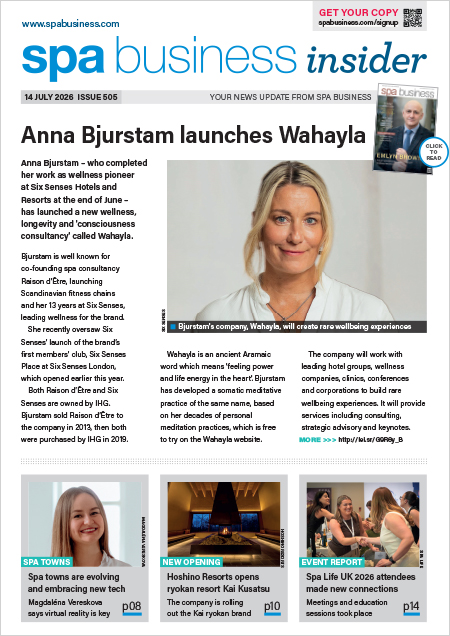
Anna Bjurstam has left her role as Wellness Pioneer at Six Senses Hotels and Resorts and
launched a new wellness, longevity and “consciousness consultancy” called Wahayla.
Fairmont Cheshire, The Mere, has opened today (10 July) in the Northwest of England
with a
1,715sq m Fairmont Spa that has been designed using a ‘Wellness without Walls’
concept.
Wellness hotels generating less than US$1 million (€932,700, £785,200) – or 10 per cent of
total revenue from wellness and leisure – recorded the strongest RevPAR and TRevPAR growth
in 2025 across categories when compared with 2024, according to the latest Wellness Real
Estate Report by RLA Global, produced in partnership with P and L benchmarking firm HotStats.