Yes! Send me the FREE digital editions of Spa Business and Spa Business insider magazines and the FREE weekly Spa Business and Spa Business insider ezines and breaking news alerts!
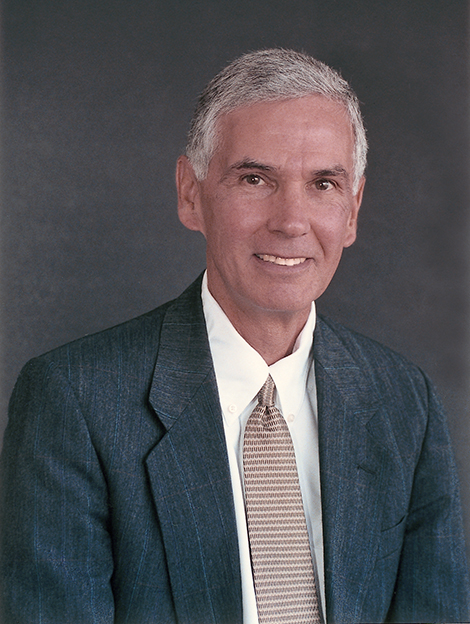
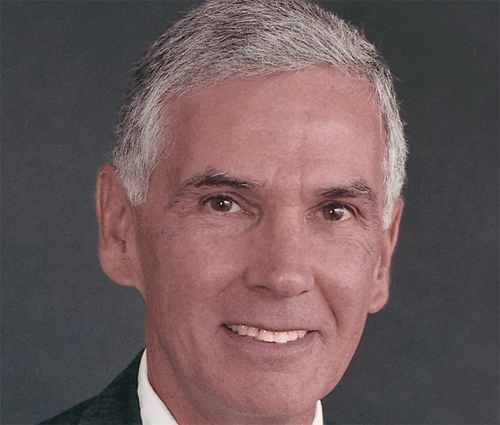
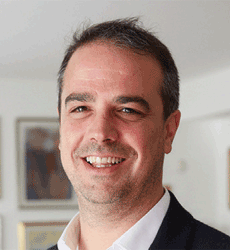
Over the past four decades, WTS International has morphed from a small, US-centric tennis services enterprise into a major player in the global spa industry. President and founder Gary Henkin charts the company’s trajectory
By Rhianon Howells | Published in Spa Business 2012 issue 1
Gary Henkin’s path to global spa business leader has been a circuitous one. As a child, his most dearly held ambition was not to run a multi-million dollar company but to follow in his father’s footsteps and become a doctor. It took him two years of medical school to realise his calling lay elsewhere.
After eventually completing a BSc, he spent the next few years indulging in his true passion: teaching tennis at country clubs in his native Washington DC, and playing competitively. It was this that planted the seed for WTS. “I was never a good enough player to make it on tour,” he says. “But I’d seen so many failed operations… I felt there was a need for a more business-like approach to managing tennis and racquets sports facilities.”
In January 1973, aged 28, Henkin founded a small company to provide turnkey management services to local tennis facilities. Its name, Washington Tennis Services, was apt but arguably unambitious and 39 years later, the moniker is no longer quite as fitting.
Now named WTS International, the privately owned company employs 2,000 people worldwide and, although it still offers tennis services, up to 65 per cent of its revenues are generated through spa management and consulting, with high-profile clients including Ritz-Carlton, Wyndham Worldwide and Trump. And while up to 80 per cent of its business currently comes from within the US, with the remainder from overseas, Henkin expects, “in the next two to three years for that to look more like 60-40 or 50-50.”
Organic growth So how exactly does a small tennis operator become a global spa business? According to Henkin, he wasn’t initially looking to diversify. “For the first 16 years we were very focused on tennis,” he says. “Then in the late 80s, fitness facilities began popping up in hotels. And we felt that our approach – hiring and training great people, financial management, marketing and promotions, programme development, maintenance and retail sales – was applicable to a different space.”
WTS’ first fitness project was the opening of a 10,000sq ft (929sq m) health club within a hotel and office complex in Washington DC. Despite the company’s lack of experience in the sector, it was a great success and proved to be a springboard to similar projects across the US.
Their move into the spa sector in the late 90s was similarly organic, beginning with the management contract for a failing spa and fitness centre at a small hotel in the US Virgin Islands. “Operationally and financially it wasn’t the easiest start,” says Henkin. “But we managed to turn it around in both areas. And with that we took on additional accounts in the US Virgin Islands, and ultimately back home.”
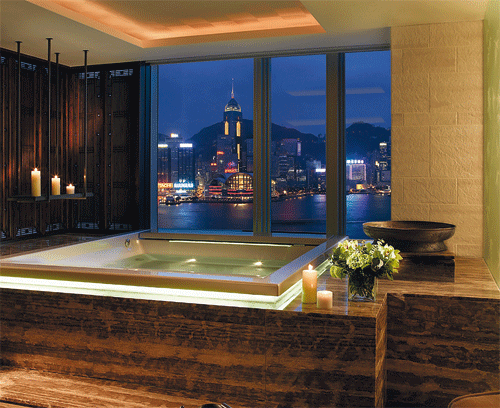
Today, WTS projects range from opening hotel spas for Trump in New York, Chicago, Las Vegas and Honolulu to developing a proprietary spa brand for Wyndham Worldwide. Henkin adds: “We also have a whole portfolio of small to moderately sized spas, some of which have just two or three treatment rooms. A spa doesn’t have to be big to be profitable, or a wonderful, relaxing space.”
Under the radar Although WTS also offers feasibility studies, plus brand and concept development, its three largest service areas are design consultation, pre-opening and management. Yet in contrast with many spa operators, the company prides itself on operating under the radar. “From an operative standpoint, we actually become an integrated part of our client’s [property],” says Henkin. “To the guest, we’re invisible.”
While WTS’ overseas growth is driven almost exclusively by new-build spas, an increasing number of its US contracts involve taking on the management of existing – and often under-performing – facilities, which according to Henkin presents unique obstacles: “It’s more challenging not only because of design constraints, but also people constraints. You’re picking up the baggage of a failing operation and there’s a whole re-education process that has to happen. It’s one thing to scale a wall and leap over it, it’s another thing to run through the wall… and sometimes transitions are like running through a wall.”
What WTS brings to these operations is a focus on profitability that was lacking when they opened. “Spas were put into hotels and resorts years ago mainly as an amenity,” says Henkin. “In today’s world, we hardly speak to a hotel or resort that isn’t interested in their spa making profit; and to make profit spas have to be operated as businesses.” To make sure facilities see black ink, WTS tracks everything from average treatment prices and revenue per treatment room to capture rates. Percentage of revenue generated by retail is particularly important, says Henkin, and for hotel spas percentage of external traffic is also crucial. “The average length of stay in urban hotels is generally less than 1.5 days, and the challenge of getting those people to go to the spa when their time is so precious is enormous,” he says. “So if you’re not proactively marketing to a non-guest clientele as well as internally, your spa may never be profitable.”
Global expansion For its first 35 years, WTS operated solely in US territory, and the decision to go abroad was initially one of necessity. “Because virtually all new-builds shut down in the US [in the economic collapse], it gently pushed us to test the waters overseas,” says Henkin. “It turned out there was a significant interest, and we’re now happily ensconced in places like Asia, Africa and the Middle East.”
China, in particular, has quickly become a key market for WTS – in just over a year, it has opened a luxury day spa near Shanghai and has a further 11 projects in the works. “The market there is thirsty for a company that can be a one-stop shop for design, pre-opening and management,” says Henkin. To be successful in the region, however, he is keenly aware of the need to be on the ground, and to this end the company will open a regional office in Shanghai early in 2012.
Elsewhere, the company has just launched its first spa in Australia – at Hayman, a luxury resort on the Great Barrier Reef – and also its first spa in Europe: the Acqua di Parma Blu Mediterraneo Spa at an exclusive yacht club in Sardinia. In coming months, WTS hopes to build its presence in Asia, Europe and Latin America in particular.
Helping to drive the company’s global expansion will be a recently announced tie-up with HVS, one of the world’s leading consulting and services organisations in the hospitality and leisure industries. Under the agreement, WTS will manage a new division called HVS Spa & Leisure Services in a straightforward strategic partnership – neither company is investing in the other, but while HVS benefits from WTS’ spa expertise, WTS benefits from HVS’ extensive global reach.
So far, so positive – but how is WTS coping with the staffing and other operational challenges that go hand in hand with rapid growth? “Yes, our spa service area is growing quickly,” says Henkin. “But we have a long history in the leisure industry… so our problem isn’t not having enough people – we have more great people who want to represent us than we have jobs. We have a reputation for being a very solid, secure brand, which is very supportive of its staff. I think [that] has been the catalyst for the hundreds of applications we process each year.” The company also recruits through recommendations from staff and clients, links with universities and participation in industry events such as ISPA.
Among WTS’ initiatives to retain staff are training opportunities such as WTS University, a business-training scheme for spa managers. Uniquely, it also encourages its management staff to support each other through a proprietary online system known as the Knowledge Network. If, for example, a spa director is looking for a fresh approach to seasonal merchandising, they only need enter a question and, within minutes, their peers will have responded with best practice examples and ideas.
Industry shake-out As the spa industry continues to grow apace, especially with the advent of inexpensive franchise models (see sb11/3 p22), Henkin believes market saturation is a real threat: “There is potential for an over-built situation, much as there was for many years in the health and fitness sector… Certain markets are seeing that even now [and] that problem will be exacerbated over time.”
In this environment, he argues, there is an even greater need for spas to deliver more than just a promise. “Five or six years ago, revenue was up, margins were up and there was very little competition,” says Henkin. “The economy was great and there was lots of order-taking. Today all that has changed. If you don’t have viable marketing and programming, and great management and staff delivering great services all of the time, your spa will not make it. Some spas are going to go out of business… it’s happening now.”
Henkin is confident, however, that WTS spas won’t be among the casualties. “I’m very blessed to [be supported by] a group of extraordinary people who work exceptionally hard,” he says. “It’s a joy for me to come to work, and I’m not sure everyone who’s been in the same business for almost four decades can say the same.”
Read more from this issue of Spa Business magazine
Top team: Peninsula Hotels
Kath Hudson talks to key figures behind the leading Asian hotel chain about how they run their spas and exciting future plans
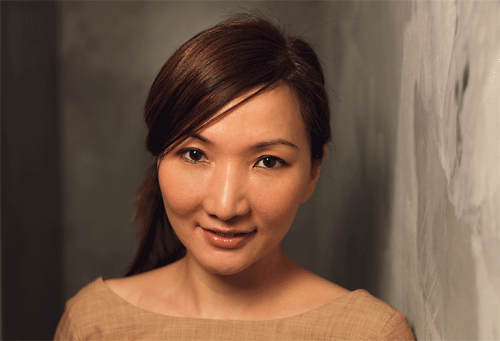
Profile: Cynthia Chua
The Singapore entrepreneur behind Ministry of Waxing and Browhaus has revolutionised personal grooming worldwide. She talks to Katie Barnes about the business of beauty and integration with spas
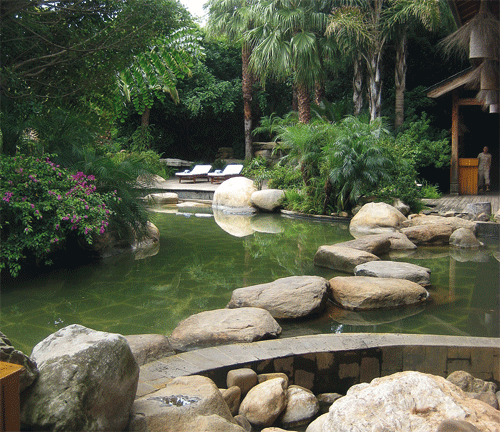
Hot springs: Chinese-style!
Lisa Starr tries out two hot spring spas - one catering to international visitors and the other to the domestic market - in China's Yunnan province
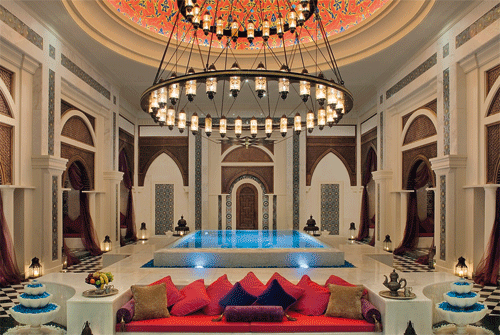
Bath time: The Chinese bathhouse
Lee David Stephens gives an insight into a traditional Chinese bathhouse and how Chinese people like to spa
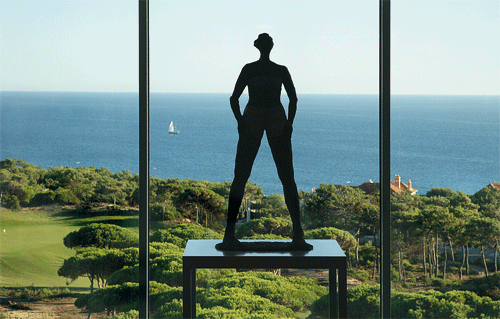
Resort Spa: Sands of time
The Oitavos hotel and spa on Portugal's Estoril coast is 90 years in the making. Tom Walker pays a visit
Interview: Gary Henkin
The president and founder of WTS International - the US-based spa management and consultancy firm - talks to Rhianon Howells about expanding globally
Ask an expert: Crisis control
The Arab Spring, the Japanese tsunami and bombings in Mumbai - what's the best way of dealing with a crisis? We ask those who have first-hand experience of the events
New Zealand thermal spa: Pooling resources
The Polynesian Spa in the geothermal town of Rotorua in New Zealand boasts 25 thermal pools and is one of the longest running attractions in the country. Chris McBeath takes a look
Tourism: Booming Baku
Terry Stevens reports on the Azerbaijan capital which has seen a surge of international hotel openings in the past two years
Fitness: Pilates pure vs applied
Pure vs applied - should pilates only ever involve the exercises designed by Joseph Pilates, or can his philosophy be applied while keeping the product moving with the times?
Although spa is currently the largest and fastest-growing division within WTS, the company offers a varied range of other leisure services through a number of divisions. These include a tennis division (the smallest arm of the company), a fitness division, a lifestyle division delivering social, recreational and educational programmes to resort and residential developments, and a recently launched university and college division known as CREW (Campus Recreation, Enrichment and Wellness).
The majority (80 per cent) of business comes from the US, but Henkin is looking to grow internationally to even out the split to 50-50 in the next two to three years
Around 65 per cent of WTS’ revenues are generated through spa management and consulting
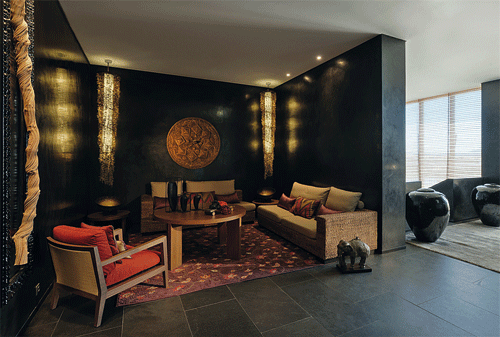
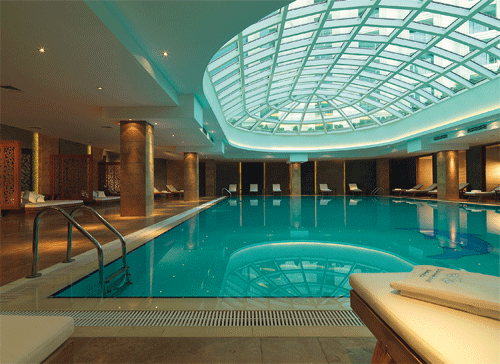
Fern Tree Spa at the Half Moon Bay resort
in Jamaica
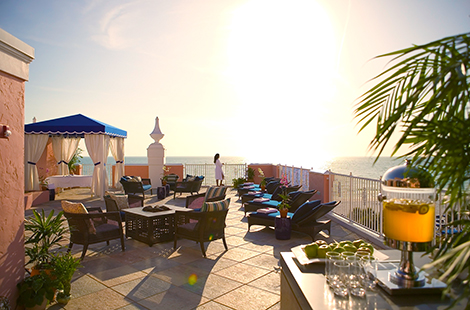
High-profile clients include Trump
As a reputable brand, WTS doesn’t suffer from staff shortages and to retain them it focuses on CPD, including WTS University – a business-training scheme for spa managers
In the fast-paced world of fitness and wellness, where high-intensity workouts push us to
our limits and the sweat pours, the importance of efficient recovery cannot be overstated. [more...]
+ More featured suppliers
COMPANY PROFILES
Pearl Tree
Pearl Tree was established in 2014 by Soraya and
Sarry Jouzy with a mission to champion
personal w [more...]
Bioline Jatò
Bioline Jatò is a family Italian company
operating in the professional skincare
industry since 197 [more...]
Over the past four decades, WTS International has morphed from a small, US-centric tennis services enterprise into a major player in the global spa industry. President and founder Gary Henkin charts the company’s trajectory
By Rhianon Howells | Published in Spa Business 2012 issue 1
Gary Henkin’s path to global spa business leader has been a circuitous one. As a child, his most dearly held ambition was not to run a multi-million dollar company but to follow in his father’s footsteps and become a doctor. It took him two years of medical school to realise his calling lay elsewhere.
After eventually completing a BSc, he spent the next few years indulging in his true passion: teaching tennis at country clubs in his native Washington DC, and playing competitively. It was this that planted the seed for WTS. “I was never a good enough player to make it on tour,” he says. “But I’d seen so many failed operations… I felt there was a need for a more business-like approach to managing tennis and racquets sports facilities.”
In January 1973, aged 28, Henkin founded a small company to provide turnkey management services to local tennis facilities. Its name, Washington Tennis Services, was apt but arguably unambitious and 39 years later, the moniker is no longer quite as fitting.
Now named WTS International, the privately owned company employs 2,000 people worldwide and, although it still offers tennis services, up to 65 per cent of its revenues are generated through spa management and consulting, with high-profile clients including Ritz-Carlton, Wyndham Worldwide and Trump. And while up to 80 per cent of its business currently comes from within the US, with the remainder from overseas, Henkin expects, “in the next two to three years for that to look more like 60-40 or 50-50.”
Organic growth So how exactly does a small tennis operator become a global spa business? According to Henkin, he wasn’t initially looking to diversify. “For the first 16 years we were very focused on tennis,” he says. “Then in the late 80s, fitness facilities began popping up in hotels. And we felt that our approach – hiring and training great people, financial management, marketing and promotions, programme development, maintenance and retail sales – was applicable to a different space.”
WTS’ first fitness project was the opening of a 10,000sq ft (929sq m) health club within a hotel and office complex in Washington DC. Despite the company’s lack of experience in the sector, it was a great success and proved to be a springboard to similar projects across the US.
Their move into the spa sector in the late 90s was similarly organic, beginning with the management contract for a failing spa and fitness centre at a small hotel in the US Virgin Islands. “Operationally and financially it wasn’t the easiest start,” says Henkin. “But we managed to turn it around in both areas. And with that we took on additional accounts in the US Virgin Islands, and ultimately back home.”
Today, WTS projects range from opening hotel spas for Trump in New York, Chicago, Las Vegas and Honolulu to developing a proprietary spa brand for Wyndham Worldwide. Henkin adds: “We also have a whole portfolio of small to moderately sized spas, some of which have just two or three treatment rooms. A spa doesn’t have to be big to be profitable, or a wonderful, relaxing space.”
Under the radar Although WTS also offers feasibility studies, plus brand and concept development, its three largest service areas are design consultation, pre-opening and management. Yet in contrast with many spa operators, the company prides itself on operating under the radar. “From an operative standpoint, we actually become an integrated part of our client’s [property],” says Henkin. “To the guest, we’re invisible.”
While WTS’ overseas growth is driven almost exclusively by new-build spas, an increasing number of its US contracts involve taking on the management of existing – and often under-performing – facilities, which according to Henkin presents unique obstacles: “It’s more challenging not only because of design constraints, but also people constraints. You’re picking up the baggage of a failing operation and there’s a whole re-education process that has to happen. It’s one thing to scale a wall and leap over it, it’s another thing to run through the wall… and sometimes transitions are like running through a wall.”
What WTS brings to these operations is a focus on profitability that was lacking when they opened. “Spas were put into hotels and resorts years ago mainly as an amenity,” says Henkin. “In today’s world, we hardly speak to a hotel or resort that isn’t interested in their spa making profit; and to make profit spas have to be operated as businesses.” To make sure facilities see black ink, WTS tracks everything from average treatment prices and revenue per treatment room to capture rates. Percentage of revenue generated by retail is particularly important, says Henkin, and for hotel spas percentage of external traffic is also crucial. “The average length of stay in urban hotels is generally less than 1.5 days, and the challenge of getting those people to go to the spa when their time is so precious is enormous,” he says. “So if you’re not proactively marketing to a non-guest clientele as well as internally, your spa may never be profitable.”
Global expansion For its first 35 years, WTS operated solely in US territory, and the decision to go abroad was initially one of necessity. “Because virtually all new-builds shut down in the US [in the economic collapse], it gently pushed us to test the waters overseas,” says Henkin. “It turned out there was a significant interest, and we’re now happily ensconced in places like Asia, Africa and the Middle East.”
China, in particular, has quickly become a key market for WTS – in just over a year, it has opened a luxury day spa near Shanghai and has a further 11 projects in the works. “The market there is thirsty for a company that can be a one-stop shop for design, pre-opening and management,” says Henkin. To be successful in the region, however, he is keenly aware of the need to be on the ground, and to this end the company will open a regional office in Shanghai early in 2012.
Elsewhere, the company has just launched its first spa in Australia – at Hayman, a luxury resort on the Great Barrier Reef – and also its first spa in Europe: the Acqua di Parma Blu Mediterraneo Spa at an exclusive yacht club in Sardinia. In coming months, WTS hopes to build its presence in Asia, Europe and Latin America in particular.
Helping to drive the company’s global expansion will be a recently announced tie-up with HVS, one of the world’s leading consulting and services organisations in the hospitality and leisure industries. Under the agreement, WTS will manage a new division called HVS Spa & Leisure Services in a straightforward strategic partnership – neither company is investing in the other, but while HVS benefits from WTS’ spa expertise, WTS benefits from HVS’ extensive global reach.
So far, so positive – but how is WTS coping with the staffing and other operational challenges that go hand in hand with rapid growth? “Yes, our spa service area is growing quickly,” says Henkin. “But we have a long history in the leisure industry… so our problem isn’t not having enough people – we have more great people who want to represent us than we have jobs. We have a reputation for being a very solid, secure brand, which is very supportive of its staff. I think [that] has been the catalyst for the hundreds of applications we process each year.” The company also recruits through recommendations from staff and clients, links with universities and participation in industry events such as ISPA.
Among WTS’ initiatives to retain staff are training opportunities such as WTS University, a business-training scheme for spa managers. Uniquely, it also encourages its management staff to support each other through a proprietary online system known as the Knowledge Network. If, for example, a spa director is looking for a fresh approach to seasonal merchandising, they only need enter a question and, within minutes, their peers will have responded with best practice examples and ideas.
Industry shake-out As the spa industry continues to grow apace, especially with the advent of inexpensive franchise models (see sb11/3 p22), Henkin believes market saturation is a real threat: “There is potential for an over-built situation, much as there was for many years in the health and fitness sector… Certain markets are seeing that even now [and] that problem will be exacerbated over time.”
In this environment, he argues, there is an even greater need for spas to deliver more than just a promise. “Five or six years ago, revenue was up, margins were up and there was very little competition,” says Henkin. “The economy was great and there was lots of order-taking. Today all that has changed. If you don’t have viable marketing and programming, and great management and staff delivering great services all of the time, your spa will not make it. Some spas are going to go out of business… it’s happening now.”
Henkin is confident, however, that WTS spas won’t be among the casualties. “I’m very blessed to [be supported by] a group of extraordinary people who work exceptionally hard,” he says. “It’s a joy for me to come to work, and I’m not sure everyone who’s been in the same business for almost four decades can say the same.”
Read more from this issue of Spa Business magazine
Top team: Peninsula Hotels
Kath Hudson talks to key figures behind the leading Asian hotel chain about how they run their spas and exciting future plans
Profile: Cynthia Chua
The Singapore entrepreneur behind Ministry of Waxing and Browhaus has revolutionised personal grooming worldwide. She talks to Katie Barnes about the business of beauty and integration with spas
Hot springs: Chinese-style!
Lisa Starr tries out two hot spring spas - one catering to international visitors and the other to the domestic market - in China's Yunnan province
Bath time: The Chinese bathhouse
Lee David Stephens gives an insight into a traditional Chinese bathhouse and how Chinese people like to spa
Resort Spa: Sands of time
The Oitavos hotel and spa on Portugal's Estoril coast is 90 years in the making. Tom Walker pays a visit
Interview: Gary Henkin
The president and founder of WTS International - the US-based spa management and consultancy firm - talks to Rhianon Howells about expanding globally
Ask an expert: Crisis control
The Arab Spring, the Japanese tsunami and bombings in Mumbai - what's the best way of dealing with a crisis? We ask those who have first-hand experience of the events
New Zealand thermal spa: Pooling resources
The Polynesian Spa in the geothermal town of Rotorua in New Zealand boasts 25 thermal pools and is one of the longest running attractions in the country. Chris McBeath takes a look
Tourism: Booming Baku
Terry Stevens reports on the Azerbaijan capital which has seen a surge of international hotel openings in the past two years
Fitness: Pilates pure vs applied
Pure vs applied - should pilates only ever involve the exercises designed by Joseph Pilates, or can his philosophy be applied while keeping the product moving with the times?
Although spa is currently the largest and fastest-growing division within WTS, the company offers a varied range of other leisure services through a number of divisions. These include a tennis division (the smallest arm of the company), a fitness division, a lifestyle division delivering social, recreational and educational programmes to resort and residential developments, and a recently launched university and college division known as CREW (Campus Recreation, Enrichment and Wellness).
The majority (80 per cent) of business comes from the US, but Henkin is looking to grow internationally to even out the split to 50-50 in the next two to three years
Around 65 per cent of WTS’ revenues are generated through spa management and consulting
Fern Tree Spa at the Half Moon Bay resort
in Jamaica
High-profile clients include Trump
As a reputable brand, WTS doesn’t suffer from staff shortages and to retain them it focuses on CPD, including WTS University – a business-training scheme for spa managers
Private hotel owner and developer HVL Hotels will open a new luxury resort and tourism
destination called Laval Hunter Valley in the second half of 2027 in Pokolbin, Australia.
The annual wellness festival dedicated to wellbeing, culture, longevity and human connection,
called Alma, will be hosted by Rocco Forte hotel, Verdura Resort in Sicily, Italy.
Capella Hotel Group has appointed Feisal Jaffer as chief development officer as the company
ramps up its global expansion of both its Capella and Patina brands.
People taking GLP-1 weight loss medications such as Ozempic, Wegovy, Mounjaro and Zepbound
may be losing weight, but they’re also becoming less physically active, according to new
research presented at the ENDO 2026 annual meeting of the Endocrine Society
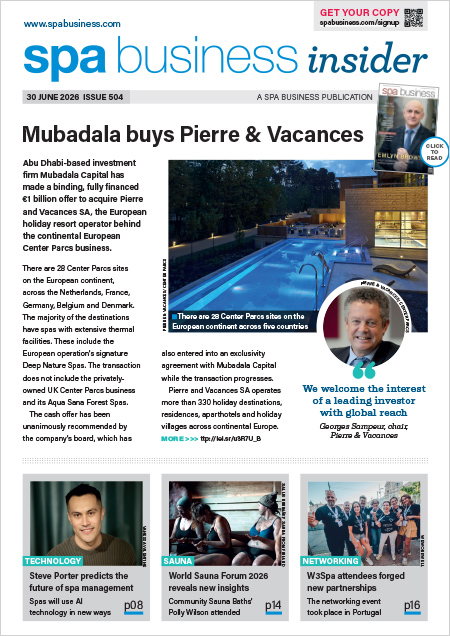
Abu Dhabi-based investment firm Mubadala Capital has made a binding, fully financed
€1 billion
offer to acquire Pierre and Vacances SA, the European holiday resort operator behind the
continental European Center Parcs business.
Global retreat trade show, Synergy The Retreat Show, has launched a resource called The
Source, which hosts an open-access online Transformation Series programme.
The Standards Authority for Touch in Cancer Care (SATCC) charity has announced its first five-
day Living with Cancer and Beyond retreat, which will be held at Carden Park Hotel and Spa in
Cheshire, UK, between 1 and 5 September.
Patmos Aktis, a Luxury Collection Resort and Spa, has opened in Greece, with a renovated and
rebranded wellness offering called Ansana Wellness and Spa.
In the fast-paced world of fitness and wellness, where high-intensity workouts push us to
our limits and the sweat pours, the importance of efficient recovery cannot be overstated. [more...]
+ More featured suppliers
COMPANY PROFILES
Pearl Tree Pearl Tree was established in 2014 by Soraya and
Sarry Jouzy with a mission to champion
personal w [more...]