Yes! Send me the FREE digital editions of Spa Business and Spa Business insider magazines and the FREE weekly Spa Business and Spa Business insider ezines and breaking news alerts!
One of the sector’s best known leaders, Dillon took CIMSPA
from last chance saloon to being an award-winning organisation.
She talks to Kath Hudson about the gruelling early years
Dillon say there was an ‘overwhelming amount’ of work to do when she took over at CIMSPA / photo: CIMSPA
The biggest challenge of my career was taking over CIMSPA. Although I’m so glad I did, I’ve never felt so isolated as I did in those early days, when I spent many nights in hotel rooms with my head in my hands.
Since it was only a short secondment initially, I had felt there was no risk, but once I got involved I realised the enormity of the challenge and felt that if I didn’t make it work I would be a public failure.
The financial situation was precarious and there was an overwhelming amount of work, which we weren’t well enough resourced to do. Initially I was beset with self doubt and imposter syndrome, I felt paranoid, exposed and watched.
Securing finances The first challenge was to secure the financial position. Funding was difficult, even though the industry had said it wanted a body to showcase the profession and standardise training.
When I approached Sport England, I was told I had no operational evidence, no money and no people and was asked why the sector wasn’t funding it. I argued the sector wasn’t awash with money and that CIMSPA needed a partner to prove a point.
Eventually, with a plan, they did give us some funding. I then went back to the sector to ask employers to match it, although they didn’t quite match it, we had enough support to get going. This was a pivotal moment; it showed willingness and collaboration from the sector.
Power of listening I drew on my professional experience. Successful organisations listen, have a strong vision and recruit well, so I aimed to do just that. It helped that I had a healthy black book and felt solidarity from the industry. The change came when I realised I wasn’t having to check cashflow every single day.
When I took over we had less than 1,000 members, but after two years we had five times as many and the support of five or six important partners.
During this time I learned it’s really important to listen to your customers, as well as your instincts, and to hold your nerve through periods of change. CIMSPA had to match the ask of the sector, which meant we had to stay true to our mission and not pivot for an easy win. There were many temptations where changing course, or entering a partnership, would have been financially beneficial but it would have impacted our integrity.
The position of CEO is a big jump up from MD and I initially found it a lonely place, however, when I learned to reach out to sector friends, I found myself well supported.
Stop whinging When I was battling for the Sport England funding I recall I did whinge a bit – moaning about other organisations which were funded – but a mentor told me to stop being a victim and work it out, which was the jolt I needed. I learned not to look for problems, but to focus on what’s going well and build on that. Be clear on the goal and keep making small steps forward.
The tough times were definitely worth it. I’m proud of the empowering culture we’ve created at CIMSPA, which is built on the foundations of equality, respect and teamwork. I implemented the policy of treating people like grown-ups – for example offering unlimited leave, having a realistic expenses policy and an open-minded approach to flexible working – and then handed the baton over to the employees.
This approach won us the Best Company award in The Times Top 100 Not for Profit category and I was voted in the top five CEOs. The organisation is making a difference, and we’re constantly striving to be the best we can be for the sector.
If anyone reading this has anything to say, I’m always listening.
About CIMSPA
The Chartered Institute of the Management of Sport and Activity (CIMSPA) is the representative body for all those working in the physical activity sector.
CIMSPA is the industry’s first chartered institute and was born out of the convergence of a number of organisations that blazed a trail, including the Association of Leisure Managers (ALM), ILAM (Institute of Leisure Management), The National Association of Sports Development (NASD), The Association of Baths and Recreation Management (ISRM) and CIMSPA’s foundational organisations, the Institute of Sport, Play and Leisure (ISPAL) and IMSPA – the Institute for Sport and Physical Activity.
CIMSPA’s formation gained industry-wide support from organisations including UK Active, Sport England, Community Leisure UK, the Chief Cultural and Leisure Officers’ Association (CLOA) and the Sport and Recreation Alliance (SRA) – formerly the CCPR (Central Council for Recreation).
In addition to advocating, setting standards for qualifications and governance, CIMSPA also took over the functions of the Register of Exercise Professionals (REPs), the body established ‘by the industry for the industry’ to regulate the registration of fitness professionals, validate their qualifications and raise standards in the sector.
The REPs merger happened in February 2020 following an agreement between CIMSPA and REPs’ owner, UK Coaching, who combined REPs with the CIMSPA Exercise and Fitness Directory, creating a single directory for all exercise and fitness professionals.
The agreement made CIMSPA the only directory with the official recognition of the sector.
One of the sector’s best known leaders, Dillon took CIMSPA
from last chance saloon to being an award-winning organisation.
She talks to Kath Hudson about the gruelling early years
Dillon say there was an ‘overwhelming amount’ of work to do when she took over at CIMSPA / photo: CIMSPA
The biggest challenge of my career was taking over CIMSPA. Although I’m so glad I did, I’ve never felt so isolated as I did in those early days, when I spent many nights in hotel rooms with my head in my hands.
Since it was only a short secondment initially, I had felt there was no risk, but once I got involved I realised the enormity of the challenge and felt that if I didn’t make it work I would be a public failure.
The financial situation was precarious and there was an overwhelming amount of work, which we weren’t well enough resourced to do. Initially I was beset with self doubt and imposter syndrome, I felt paranoid, exposed and watched.
Securing finances The first challenge was to secure the financial position. Funding was difficult, even though the industry had said it wanted a body to showcase the profession and standardise training.
When I approached Sport England, I was told I had no operational evidence, no money and no people and was asked why the sector wasn’t funding it. I argued the sector wasn’t awash with money and that CIMSPA needed a partner to prove a point.
Eventually, with a plan, they did give us some funding. I then went back to the sector to ask employers to match it, although they didn’t quite match it, we had enough support to get going. This was a pivotal moment; it showed willingness and collaboration from the sector.
Power of listening I drew on my professional experience. Successful organisations listen, have a strong vision and recruit well, so I aimed to do just that. It helped that I had a healthy black book and felt solidarity from the industry. The change came when I realised I wasn’t having to check cashflow every single day.
When I took over we had less than 1,000 members, but after two years we had five times as many and the support of five or six important partners.
During this time I learned it’s really important to listen to your customers, as well as your instincts, and to hold your nerve through periods of change. CIMSPA had to match the ask of the sector, which meant we had to stay true to our mission and not pivot for an easy win. There were many temptations where changing course, or entering a partnership, would have been financially beneficial but it would have impacted our integrity.
The position of CEO is a big jump up from MD and I initially found it a lonely place, however, when I learned to reach out to sector friends, I found myself well supported.
Stop whinging When I was battling for the Sport England funding I recall I did whinge a bit – moaning about other organisations which were funded – but a mentor told me to stop being a victim and work it out, which was the jolt I needed. I learned not to look for problems, but to focus on what’s going well and build on that. Be clear on the goal and keep making small steps forward.
The tough times were definitely worth it. I’m proud of the empowering culture we’ve created at CIMSPA, which is built on the foundations of equality, respect and teamwork. I implemented the policy of treating people like grown-ups – for example offering unlimited leave, having a realistic expenses policy and an open-minded approach to flexible working – and then handed the baton over to the employees.
This approach won us the Best Company award in The Times Top 100 Not for Profit category and I was voted in the top five CEOs. The organisation is making a difference, and we’re constantly striving to be the best we can be for the sector.
If anyone reading this has anything to say, I’m always listening.
About CIMSPA
The Chartered Institute of the Management of Sport and Activity (CIMSPA) is the representative body for all those working in the physical activity sector.
CIMSPA is the industry’s first chartered institute and was born out of the convergence of a number of organisations that blazed a trail, including the Association of Leisure Managers (ALM), ILAM (Institute of Leisure Management), The National Association of Sports Development (NASD), The Association of Baths and Recreation Management (ISRM) and CIMSPA’s foundational organisations, the Institute of Sport, Play and Leisure (ISPAL) and IMSPA – the Institute for Sport and Physical Activity.
CIMSPA’s formation gained industry-wide support from organisations including UK Active, Sport England, Community Leisure UK, the Chief Cultural and Leisure Officers’ Association (CLOA) and the Sport and Recreation Alliance (SRA) – formerly the CCPR (Central Council for Recreation).
In addition to advocating, setting standards for qualifications and governance, CIMSPA also took over the functions of the Register of Exercise Professionals (REPs), the body established ‘by the industry for the industry’ to regulate the registration of fitness professionals, validate their qualifications and raise standards in the sector.
The REPs merger happened in February 2020 following an agreement between CIMSPA and REPs’ owner, UK Coaching, who combined REPs with the CIMSPA Exercise and Fitness Directory, creating a single directory for all exercise and fitness professionals.
The agreement made CIMSPA the only directory with the official recognition of the sector.
People taking GLP-1 weight loss medications such as Ozempic, Wegovy, Mounjaro and Zepbound
may be losing weight, but they’re also becoming less physically active, according to new
research presented at the ENDO 2026 annual meeting of the Endocrine Society
Abu Dhabi-based investment firm Mubadala Capital has made a binding, fully financed
€1 billion
offer to acquire Pierre and Vacances SA, the European holiday resort operator behind the
continental European Center Parcs business.
Global retreat trade show, Synergy The Retreat Show, has launched a resource called The
Source, which hosts an open-access online Transformation Series programme.
The Standards Authority for Touch in Cancer Care (SATCC) charity has announced its first five-
day Living with Cancer and Beyond retreat, which will be held at Carden Park Hotel and Spa in
Cheshire, UK, between 1 and 5 September.
Patmos Aktis, a Luxury Collection Resort and Spa, has opened in Greece, with a renovated and
rebranded wellness offering called Ansana Wellness and Spa.
The Mauna Kea Beach Hotel, an Autograph Collection property in Hawaii, US, has opened its
22,000 sq ft indoor-outdoor Spa at Mauna Kea as the final step in the property’s overall
renovation, which has cost more than US$180 million (€166 million, £140 mill
The UK spa review and discovery platform for consumers, the Good Spa Guide, has announced
it will host the Good Spa Guide Awards 2026 during an event on 16 November at Sopwell House
Hotel in St Albans, UK.
Eighty-four per cent of consumers now say wellness is a top priority in their lives, with this
percentage increasing year on year, according to a preview presentation of McKinsey’s Future of
Wellness 2026 research report.
Mass protests have been taking place since Monday 1 June in Albania over the development of
a luxury resort by Donald Trump’s daughter Ivanka Trump and her husband Jared Kushner.
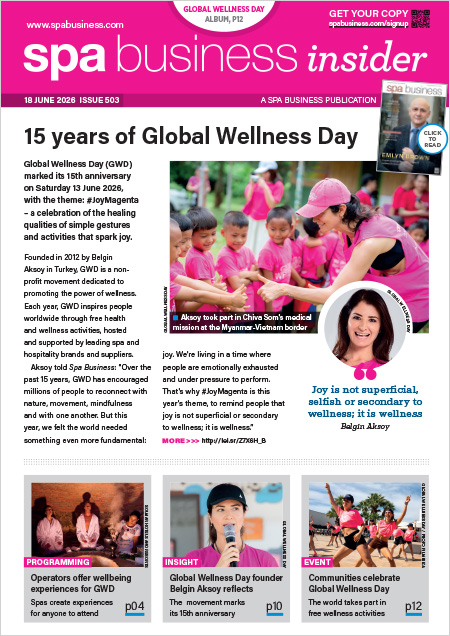
Global Wellness Day (GWD) marked its 15th anniversary on Saturday 13 June 2026, with the
theme: #JoyMagenta – a celebration of the healing qualities of simple gestures and activities
that spark joy.