Implementing a great spa design takes inspiration, patience and discipline, according to Cary Collier, principal of Blu Spas, WTS strategic partner. In the third of our WTS series, he shares his design philosophy with Spa Business
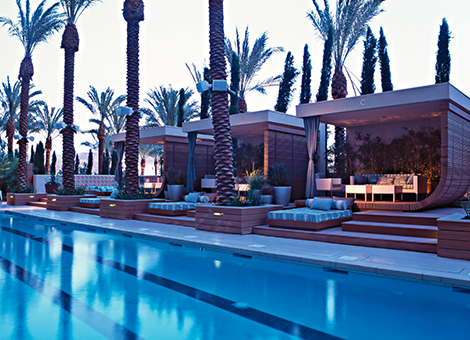
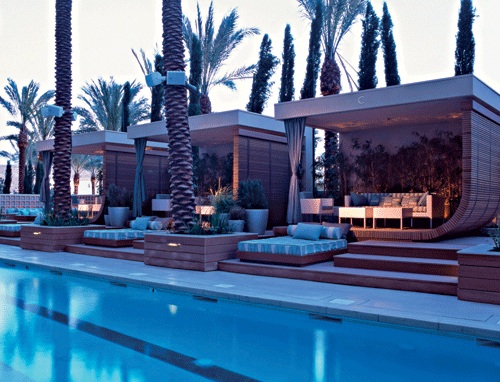
Red Rock Casino Resort & Spa Las Vegas, USA, with design by Blu Spas
How do you create unique spas? We ensure they have the ‘wow’ factor – an innovation that gives the project a competitive edge, engages customers and makes it ripe for media coverage. It could be the lighting, the treatment rooms, a theme or a special design feature, for example.
During the creative process, we listen and remain open-minded, because you never know where a good idea will come from – a focus group, housekeeper, hospitality expert, asset manager or project consultant.
I’ve learned that through patience and a willingness to listen to others’ ideas we always land on the right solutions.
Do you work alone or as part of a team? Increasingly – especially since the Blu Spas/WTS alliance was formalised – developers are requesting that we provide a full service package, including a broader range of design and technical functions. This gives us the chance to provide a ‘one stop’, to streamline the process and have a more focused impact on the concept and design by selecting designers best suited for the project.
However, we also work alongside teams of architects and interior designers who are creating hotels and resort developments. In these situations, we’re hired as the spa experts and our role is orchestrating and directing all things impacting the spa.
Has the deal strengthened the business? Access to the full breadth of resources of Blu Spas and WTS gives us greater flexibility to take on more complex projects, broadened our market penetration and created operational efficiencies. We have the experience and resources to understand most projects: wellness, medical, spas, club, fitness, lifestyle, recreation, membership, retail, food and beverage, hospitality, residential, community and more.
How much research is done at the outset? To jump-start things we harvest as much information as possible about the property and project from the client and then supplement this with our own research. We want to understand the owner’s vision and who the targeted guests are, this may include hotel guests, residents and local day guests, as well as their demographics and trends relevant to them.
We examine the anticipated guest mix and occupancy, make a study of competitor spas and explore local staffing capabilities. Armed with this information, we review documents, drawings, site plans and other information prepared by the project team.
What’s the next stage? In order to establish a foundation and add clarity to the process, we start all projects with a concept brief. This defines the facilities – how many, what size – and often includes a concept layout to help illustrate the flow, function and scale of the spa.
Why is the concept stage important? Getting the story, vision, imagery and layout correct from the beginning makes for a better process. A clear plan prevents costly, delay-inducing missteps and helps assure the same litmus test influences all furniture, fixtures and equipment choices. It also ensures that the end product’s functionality is as strong as its aesthetics.
What’s the next stage? We begin to design – this stage involves creating ‘look and feel’ images, sketches and facility descriptions to give a fuller picture of the concept. We consider and address the full range of issues that will impact guest and staff, including service offerings, service touches, accessories and retail and professional product recommendations.
Rather than being a single document, a design plan is more a process that evolves during project planning, particularly during the concept development, schematic design and design development stages.
How do you work with other disciplines? To keep a project on track with all the personalities involved takes stamina, flexibility, patience and discipline.
Throughout the process, layers of detail are added from each consultant discipline: engineers and landscapers, for example.
Ultimately we serve as air traffic controller for all disciplines, to ensure the intent for design and functionality makes sense and that the look and feel, colours and other details fall in line with the spa’s storyline.
Is there much collaboration involved? Often we find ourselves in support mode – for example, we might provide sketches on millwork or advice on wet room materials and finishes to the team which has primary responsibility for these elements.
How long does it take? Our commitment is to keep ahead of other disciplines to ensure they have the spa-related information they need.
Although we can condense the design process down if the project schedule requires, typically it takes three months for us to create a complete concept package.
While the location, complexity, size and overall development scope play a big role in how long the full development process takes, most take between two and three years. Our typical project planning consultation averages eight to 16 months – but not necessarily consecutive months.
How big does a spa need to be? While we’ve always been advocates of basing size on solid financial analysis, the last few years have seen a broader trend towards conservative sizing and more efficient footprints. Not everyone agrees with this, but six to 12 treatment rooms, sized between 5,000sq ft and 10,000sq ft, will work for the majority of hotel spas, excluding small boutique and mega-room properties.
Can you fix underperforming spas? Failing spas are usually suffering from being over-scaled, with too many treatment rooms and a poor mix and usage of rooms, or are limited by lacklustre management, including bloated payroll expenses, feeble marketing or a poor menu.
We recommend over-scaled spas and those with excessive payrolls are recalibrated by repurposing a portion of the space. There are a wide range of adjustments we can tailor to improve the performance of failing spas through this approach.
One of our strengths is our ability to give equal dignity to the often competing goals of delivering spectacular design, assuring operational functionality, infusing innovation into the concept and keeping to budget.
How has your life influenced your work? I’ve lived in Hong Kong, Jakarta and Bali, and in the US in Aspen, Dallas, Carmel and now Whitefish, Montana. All these places influence how I approach design.
Working with the rich cultures of Bali and Thailand was spa heaven. Inspired by the beauty and simplicity of local materials, we made everything ourselves. These spas had an unsullied purity in the way their concepts were expressed, from design to operation. The experience was very formative.
Read more from this issue of Spa Business magazine
Ask an expert: Cancer
The number of cancer sufferers and survivors is growing. How can spas cater for them? Kath Hudson reports
Interview: Neil Jacobs
Six Senses’ new CEO reveals the group’s spa strategy and development plans
Profile: Anna Bjurstam
The new vice president of spa and wellness at Six Senses will oversee 28 facilities worldwide
Hotel spa: Palace pampering
A E100m refurbishment of Paris’ Hôtel Le Bristol attracted footballer David Beckham for a six month-long stay. Julie Cramer pays a visit to its new Spa Le Bristol by La Prairie which is becoming a healthy profit centre
Promotional feature: Design consulting
Implementing a great spa design takes inspiration, patience and discipline, according to Cary Collier, principal of Blu Spas, WTS' strategic partner. In the third of our WTS series, he shares his design philosophy with Spa Business
Research: India's wellness consumers
Leonor Stanton analyses PwC’s latest research profiling Indian wellness consumers – an industry projected to be worth US$18bn in four years’ time
Thermal spa: Hot spot
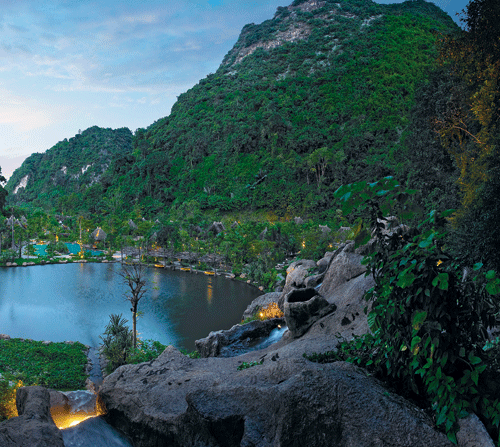
The Banjaran is Malaysia’s first and only hot springs retreat. Jennifer Harbottle examines the growth strategy
Company profile promotion: QMS Medicosmetics
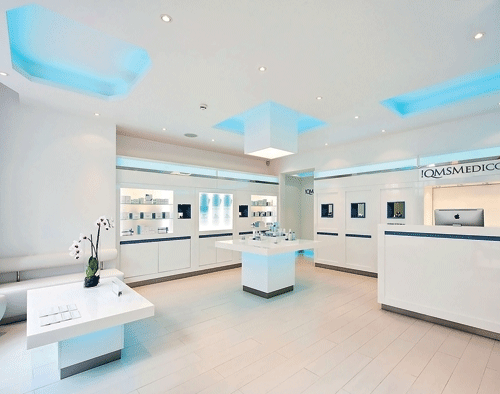
QMS Medicosmetics' revolutionary skincare system was created by a trauma surgeon from Germany. Here, the company's managing partner explains how the products' unique ingredients and actions are delivering exceptional results in spas worldwide
Hotel spa: Making a debut
Steigenberger Hotels has introduced a flagship spa concept in Frankfurt. Sophie Benge reports
Resort spa: Botanical beauty
The new Spa Botánico at Dorado Beach, a Ritz-Carlton Reserve is set in five acres of ‘purification gardens’ and has a plant and herb apothecary
Product news: Product news
Product editor, Kate Corney highlights the latest product and equipment launches from the Spa Business search engine, Spa-Kit.net
Le Atelier by C.O.D.E. doesn't offer a standard bespoke service, it provides a highly
customised approach to designing massage beds and loungers in high-end wellness
environments. [more...]
Implementing a great spa design takes inspiration, patience and discipline, according to Cary Collier, principal of Blu Spas, WTS strategic partner. In the third of our WTS series, he shares his design philosophy with Spa Business
Red Rock Casino Resort & Spa Las Vegas, USA, with design by Blu Spas
How do you create unique spas? We ensure they have the ‘wow’ factor – an innovation that gives the project a competitive edge, engages customers and makes it ripe for media coverage. It could be the lighting, the treatment rooms, a theme or a special design feature, for example.
During the creative process, we listen and remain open-minded, because you never know where a good idea will come from – a focus group, housekeeper, hospitality expert, asset manager or project consultant.
I’ve learned that through patience and a willingness to listen to others’ ideas we always land on the right solutions.
Do you work alone or as part of a team? Increasingly – especially since the Blu Spas/WTS alliance was formalised – developers are requesting that we provide a full service package, including a broader range of design and technical functions. This gives us the chance to provide a ‘one stop’, to streamline the process and have a more focused impact on the concept and design by selecting designers best suited for the project.
However, we also work alongside teams of architects and interior designers who are creating hotels and resort developments. In these situations, we’re hired as the spa experts and our role is orchestrating and directing all things impacting the spa.
Has the deal strengthened the business? Access to the full breadth of resources of Blu Spas and WTS gives us greater flexibility to take on more complex projects, broadened our market penetration and created operational efficiencies. We have the experience and resources to understand most projects: wellness, medical, spas, club, fitness, lifestyle, recreation, membership, retail, food and beverage, hospitality, residential, community and more.
How much research is done at the outset? To jump-start things we harvest as much information as possible about the property and project from the client and then supplement this with our own research. We want to understand the owner’s vision and who the targeted guests are, this may include hotel guests, residents and local day guests, as well as their demographics and trends relevant to them.
We examine the anticipated guest mix and occupancy, make a study of competitor spas and explore local staffing capabilities. Armed with this information, we review documents, drawings, site plans and other information prepared by the project team.
What’s the next stage? In order to establish a foundation and add clarity to the process, we start all projects with a concept brief. This defines the facilities – how many, what size – and often includes a concept layout to help illustrate the flow, function and scale of the spa.
Why is the concept stage important? Getting the story, vision, imagery and layout correct from the beginning makes for a better process. A clear plan prevents costly, delay-inducing missteps and helps assure the same litmus test influences all furniture, fixtures and equipment choices. It also ensures that the end product’s functionality is as strong as its aesthetics.
What’s the next stage? We begin to design – this stage involves creating ‘look and feel’ images, sketches and facility descriptions to give a fuller picture of the concept. We consider and address the full range of issues that will impact guest and staff, including service offerings, service touches, accessories and retail and professional product recommendations.
Rather than being a single document, a design plan is more a process that evolves during project planning, particularly during the concept development, schematic design and design development stages.
How do you work with other disciplines? To keep a project on track with all the personalities involved takes stamina, flexibility, patience and discipline.
Throughout the process, layers of detail are added from each consultant discipline: engineers and landscapers, for example.
Ultimately we serve as air traffic controller for all disciplines, to ensure the intent for design and functionality makes sense and that the look and feel, colours and other details fall in line with the spa’s storyline.
Is there much collaboration involved? Often we find ourselves in support mode – for example, we might provide sketches on millwork or advice on wet room materials and finishes to the team which has primary responsibility for these elements.
How long does it take? Our commitment is to keep ahead of other disciplines to ensure they have the spa-related information they need.
Although we can condense the design process down if the project schedule requires, typically it takes three months for us to create a complete concept package.
While the location, complexity, size and overall development scope play a big role in how long the full development process takes, most take between two and three years. Our typical project planning consultation averages eight to 16 months – but not necessarily consecutive months.
How big does a spa need to be? While we’ve always been advocates of basing size on solid financial analysis, the last few years have seen a broader trend towards conservative sizing and more efficient footprints. Not everyone agrees with this, but six to 12 treatment rooms, sized between 5,000sq ft and 10,000sq ft, will work for the majority of hotel spas, excluding small boutique and mega-room properties.
Can you fix underperforming spas? Failing spas are usually suffering from being over-scaled, with too many treatment rooms and a poor mix and usage of rooms, or are limited by lacklustre management, including bloated payroll expenses, feeble marketing or a poor menu.
We recommend over-scaled spas and those with excessive payrolls are recalibrated by repurposing a portion of the space. There are a wide range of adjustments we can tailor to improve the performance of failing spas through this approach.
One of our strengths is our ability to give equal dignity to the often competing goals of delivering spectacular design, assuring operational functionality, infusing innovation into the concept and keeping to budget.
How has your life influenced your work? I’ve lived in Hong Kong, Jakarta and Bali, and in the US in Aspen, Dallas, Carmel and now Whitefish, Montana. All these places influence how I approach design.
Working with the rich cultures of Bali and Thailand was spa heaven. Inspired by the beauty and simplicity of local materials, we made everything ourselves. These spas had an unsullied purity in the way their concepts were expressed, from design to operation. The experience was very formative.
Read more from this issue of Spa Business magazine
Ask an expert: Cancer
The number of cancer sufferers and survivors is growing. How can spas cater for them? Kath Hudson reports
Interview: Neil Jacobs
Six Senses’ new CEO reveals the group’s spa strategy and development plans
Profile: Anna Bjurstam
The new vice president of spa and wellness at Six Senses will oversee 28 facilities worldwide
Hotel spa: Palace pampering
A E100m refurbishment of Paris’ Hôtel Le Bristol attracted footballer David Beckham for a six month-long stay. Julie Cramer pays a visit to its new Spa Le Bristol by La Prairie which is becoming a healthy profit centre
Promotional feature: Design consulting
Implementing a great spa design takes inspiration, patience and discipline, according to Cary Collier, principal of Blu Spas, WTS' strategic partner. In the third of our WTS series, he shares his design philosophy with Spa Business
Research: India's wellness consumers
Leonor Stanton analyses PwC’s latest research profiling Indian wellness consumers – an industry projected to be worth US$18bn in four years’ time
Thermal spa: Hot spot
The Banjaran is Malaysia’s first and only hot springs retreat. Jennifer Harbottle examines the growth strategy
Company profile promotion: QMS Medicosmetics
QMS Medicosmetics' revolutionary skincare system was created by a trauma surgeon from Germany. Here, the company's managing partner explains how the products' unique ingredients and actions are delivering exceptional results in spas worldwide
Hotel spa: Making a debut
Steigenberger Hotels has introduced a flagship spa concept in Frankfurt. Sophie Benge reports
Resort spa: Botanical beauty
The new Spa Botánico at Dorado Beach, a Ritz-Carlton Reserve is set in five acres of ‘purification gardens’ and has a plant and herb apothecary
Product news: Product news
Product editor, Kate Corney highlights the latest product and equipment launches from the Spa Business search engine, Spa-Kit.net
Premium London health club, KX Chelsea, will imminently unveil its most significant
redevelopment since its launch in 2002 to create an integrated wellness model combining
training, recovery and relaxation.
Rosewood Le Guanahani St Barth, on the northeast coast of Saint Barthélemy in the French
West Indies, is offering a programme of ocean-inspired yoga classes between 8-14 June to
celebrate Global Wellness Day (GWD).
Hotel de France, located on the British Isle of Jersey, has created a wellness retreat package
that includes a hot yoga session that will take place in Jersey Zoo’s butterfly sanctuary.
The Ritz-Carlton, Langkawi, in Malaysia, has revealed a schedule for Global Wellness Day
(GWD) that includes guided rainforest walks, mindful movement and guided coastal meditation
experiences.
Longevitix, a clinical platform for preventive and longevity medicine, has launched its AI-
powered intelligence system to help physicians deliver continuous, personalised longevity-
focused care at scale.
Atmantan Wellness Centre, an integrative wellness destination in Mulshi, near Pune in India, is
expanding its portfolio by adding a new centre in Hyderabad that will launch between 2028 and
2029.
A recent survey by the UK Spa Association (UKSA) into the industry’s approach to cancer care
has revealed that almost half of participating respondents (46 per cent) are unaware that
cancer is a disability and guests with a cancer diagnosis must be given
Mexican operator, Solmar Hotels and Resorts, is hosting a series of events in celebration of
Global Wellness Day, including a Temazcal ceremony at its Playa Grande Resort and Spa in Los
Cabos.
Mandarin Oriental has announced a standalone residence brand, Mansions, which will debut at
Emirates Palace, Mandarin Oriental Mansions, Abu Dhabi, in 2029.
Le Atelier by C.O.D.E. doesn't offer a standard bespoke service, it provides a highly
customised approach to designing massage beds and loungers in high-end wellness
environments. [more...]