Yes! Send me the FREE digital editions of Spa Business and Spa Business insider magazines and the FREE weekly Spa Business and Spa Business insider ezines and breaking news alerts!
The Banjaran Hotsprings Retreat is Malaysia’s first and only hot springs destination. But despite its five-star rating and breathtaking beauty, it remains an enigma
By Jennifer Harbottle | Published in Spa Business 2013 issue 2
The vision is to create a world-class destination on a par with Chiva-Som
If you could write the recipe for the perfect destination spa retreat, the ingredients may go something like: location within two hours of a major capital city; natural hot springs; and Asian hospitality. Oh, and how about a generous helping of experienced industry professionals and a good glug of capital investment?
If it sounds like something even Ferran Adria couldn’t cook up, think again. Located in Ipoh, two hours west of Kuala Lumpur, The Banjaran Hotsprings Retreat has been prepared with all the love of a favourite national dish and is just waiting to serve people up a generous helping of wellness – Malaysian style.
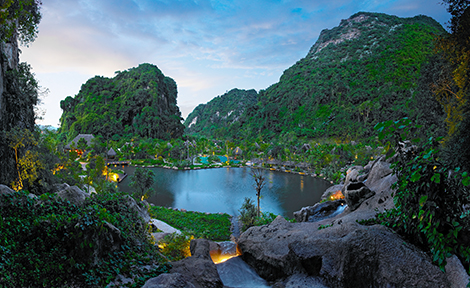
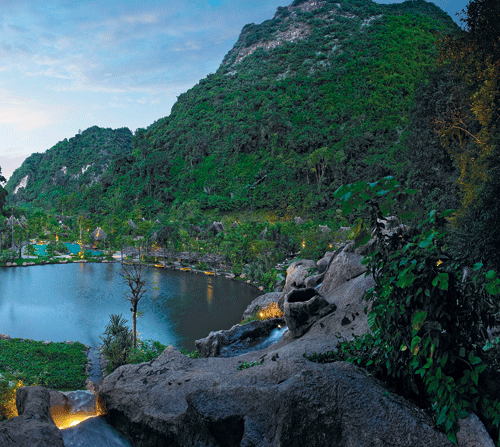
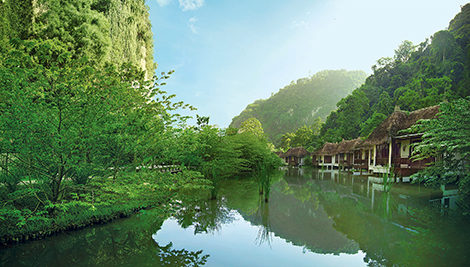
The 17-acre (7-hectare) retreat sits alongside natural geothermal hot springs, hugged by limestone cliffs with natural caves, pristine jungle and waterfalls and lends itself perfectly to spiritual time-out and rejuvenation. In short, it’s breathtaking.
Yet since its opening January 2010, The Banjaran has yet to make its mark on the Asian wellness industry – even locals don’t know about it. But that may all be about to change, with an ambitious new general manager and spa director on board.
Cheah’s dream The Banjaran is bank-rolled and owned by The Sunway Group, one of Malaysia’s largest integrated property conglomerates. Sunway has a hospitality division which manages The Banjaran as well as a number of resorts under the Sunway brand name.
Sunway founder and chairman Tan Sri Jeffrey Cheah, who was born in Ipoh, visited the original hot springs as a child. In those days, the springs were open to locals to bathe in for a small fee, but they were badly run and it became Cheah’s dream to turn them into something more upmarket. He purchased the land from the government with the idea of developing it into a tourism destination. This started with the development of a theme park called The Lost World Of Tambun on the property in 2005. Today, this is a well established and popular attraction.
However, when building his family home on another part of the plot, Cheah discovered a system of caves, which geologists say date back 280 million years. He turned one of the caves into a private wine cellar but always had bigger plans for them. Plans which came to the forefront when creating The Banjaran in an area behind the theme park, adjacent to the main hot springs.
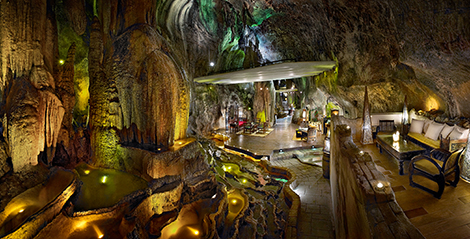
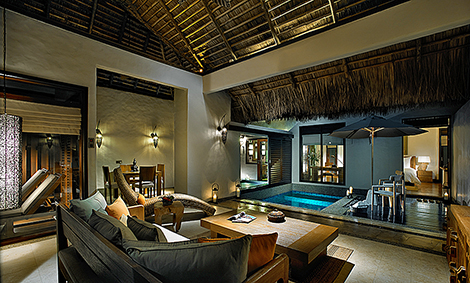
Phase one of The Banjaran is complete. Facilities include 25 Garden and Water Villas, a geothermal outdoor pool, fitness centre, all-day restaurant, a juice bar and Jeff’s Cellar – Cheah’s wine cave, which has been developed into a fully functioning bar. Each villa comes with its own sunken hot springs whirlpool, plunge pool and geothermal shower as well as a stunning outdoor lounge area.
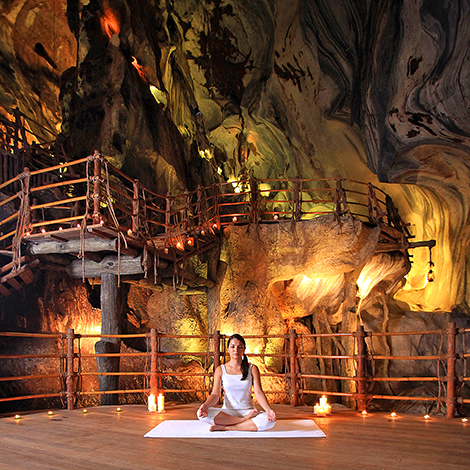
Every guest has access to the retreat’s wellness facilities which comprise a thermal steam cave, a natural granite and limestone meditation cave and a crystal cave enhanced with amethyst and quartz crystals for energy treatments like reiki. There’s also the geothermal pool and four hot springs ‘dipping pools’, which increase in temperature the closer they are to the springs. In addition, is an ice bath, reflexology walk, a garra rufa Dr Fish pool for fish pedicures, an indoor gym and an open deck for yoga and t’ai chi.
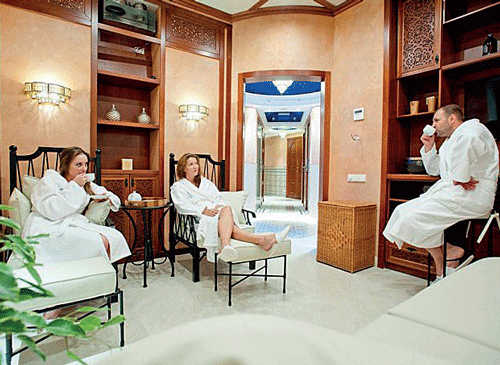
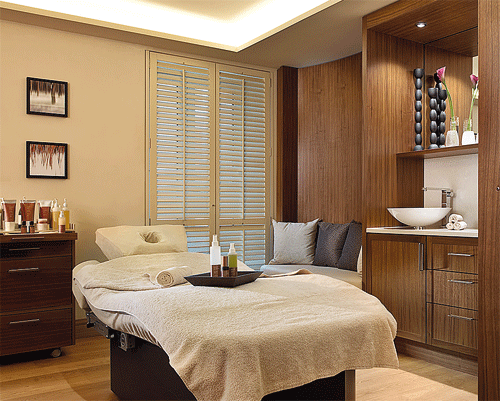
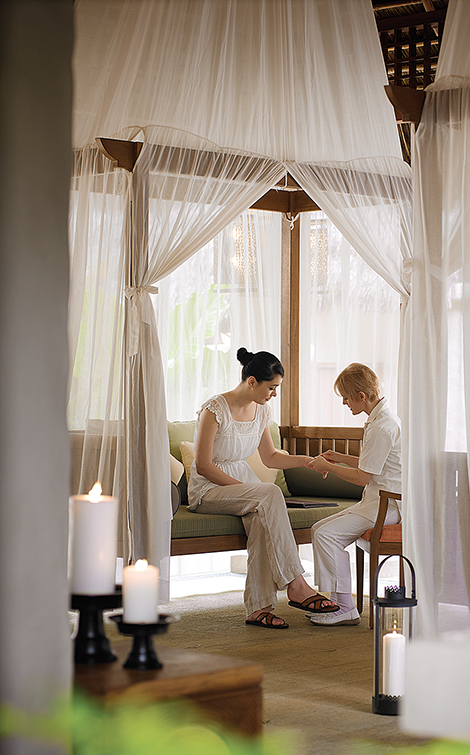
At the heart of the retreat, is The Banjaran’s 7,000sq ft (650sq m) spa and wellness centre. The simple, but homely-designed facility features 12 treatment rooms including two for hydrotherapy services and three double suites. There’s also a medi/pedi room and a relaxation pavilion.
A tale of three cultures The Banjaran’s spa is based on a fusion of the three main cultures – Malay, Chinese and Indian – in Malaysia. The spa’s Malay treatments, a mix of ayurveda and traditional Chinese (TCM) medicine, are given in one of three themed rooms, authentically decorated to represent their culture. Given the Malaysian spa industry is still in its infancy, The Banjaran has a good selection of Malay therapies which give it an edge over other destination retreats in the country. Offerings including the ayurveda specialities of shirodhara and udvartana massage and TCM’s moxibustion and gua-sha where a scraper is used on the body to remove muscle pain or prevent and treat the common cold, bronchitis and asthma. Slightly more unusual, is the 30-minute tangas (MYR75 or US$25, €19, £16), a Malaysian tradition of steaming the genitals using antibacterial herbs, to kill germs and tighten muscles.
Also on offer is a selection of wellness programmes, ranging from two to 21 days, that focus on weight loss, rejuvenation, detox, fitness and longevity or that can be tailored made to deal with specific issues such as addiction. These include a 30-minute consultation as standard with either a naturopath, nutritionist, ayurvedic practitioner, TCM doctor or personal trainer who mostly work on a freelance basis.
Heading up the spa, is Dr Santhosh John, who says he would like to see more people booking programmes. “I find it really satisfying to see people come here for leisure and leave with a thirst for wellness,” he explains. “Really, a guest needs to be here three or four days to notice a difference in the way their body behaves.”
Dr John was with Per Aquum and Devi Resorts prior to joining The Banjaran. His passion for wellness began in the medical profession in Kerala, India where he trained as a naturopath and yoga physician. In the day to day running of the spa, he oversees seven full-time therapists – all female and either Indian , Chinese or Malay. Dr John says a tie up with spa academies in Kuala Lumpur and Langkawi makes it easier to find staff.
Off to market Sitting alongside Dr John at the Banjaran management table, is Filipino-born Lybanor P Godio. She was brought in to run the retreat six months ago, after a fairly swift turnover of staff that’s seen the departure of four resort managers in just two years. She accepts that the fate of The Banjaran – both its success and failure – rests with her ability to make the numbers stack up. Currently, occupancy is about 50 per cent, with spa bookings approximately half that. Her biggest task, she says, is to increase the number of people booking programmes. “I’d like to see The Banjaran become known for wellness, not just for being a luxury brand,” she explains.
While Cheah dreams of creating a leading wellness destination in Asia – on a par with Thailand’s Chiva-Som – Godio knows some serious marketing leg work is needed first. “The Banjaran is still not known here, so my first job is to wag our tail,” she explains. She’s quietly optimistic. “I’ve been to amazing places all over the world, yet two hours from Kuala Lumpur, in the jungle, there are these hot springs. People should be queuing up to come here!”
Previous destination spas she’s helped to run, for well-known operators such as El Nido and Amanresorts, she admits practically sold themselves. The Banjaran not so. “My focus is to work on the markets that are no more than a six hour flight from Malaysia,” she explains. “Until now, our marketing has focused on the Middle East, whereas I believe Singapore, Japan, Australia and Hong Kong are where we can make the most impact”.
She thinks one of The Banjaran’s USP’s is the fact it can offer an authentic experience that mirrors Malaysia’s melting pot culture – “guests can come to The Banjaran for Indian, Chinese and Malaysian treatments, hospitality and food, rather than travelling to India and China,” she says.
The next step is to embark on the second phase of The Banjaran, which includes opening up additional caves, developing further hot springs and building more accommodation. Once that is complete, there will still be additional land available for development.
But that will only happen once revenue starts increasing. Can the new team pull it off? Godio thinks so: “This place has so much potential and the people who work here are willing it to succeed, which is always half the battle.”
Overall, The Banjaran definitely has the ingredients for a unique wellness centre. It will be interesting to see how this slow burner turns out and whether its new team has what it takes to make it a sure-fire recipe for success.
Read more from this issue of Spa Business magazine
Ask an expert: Cancer
The number of cancer sufferers and survivors is growing. How can spas cater for them? Kath Hudson reports
Interview: Neil Jacobs
Six Senses’ new CEO reveals the group’s spa strategy and development plans
Profile: Anna Bjurstam
The new vice president of spa and wellness at Six Senses will oversee 28 facilities worldwide
Hotel spa: Palace pampering
A E100m refurbishment of Paris’ Hôtel Le Bristol attracted footballer David Beckham for a six month-long stay. Julie Cramer pays a visit to its new Spa Le Bristol by La Prairie which is becoming a healthy profit centre
Promotional feature: Design consulting
Implementing a great spa design takes inspiration, patience and discipline, according to Cary Collier, principal of Blu Spas, WTS' strategic partner. In the third of our WTS series, he shares his design philosophy with Spa Business
Research: India's wellness consumers
Leonor Stanton analyses PwC’s latest research profiling Indian wellness consumers – an industry projected to be worth US$18bn in four years’ time
Thermal spa: Hot spot
The Banjaran is Malaysia’s first and only hot springs retreat. Jennifer Harbottle examines the growth strategy
Company profile promotion: QMS Medicosmetics
QMS Medicosmetics' revolutionary skincare system was created by a trauma surgeon from Germany. Here, the company's managing partner explains how the products' unique ingredients and actions are delivering exceptional results in spas worldwide
Hotel spa: Making a debut
Steigenberger Hotels has introduced a flagship spa concept in Frankfurt. Sophie Benge reports
Resort spa: Botanical beauty
The new Spa Botánico at Dorado Beach, a Ritz-Carlton Reserve is set in five acres of ‘purification gardens’ and has a plant and herb apothecary
Product news: Product news
Product editor, Kate Corney highlights the latest product and equipment launches from the Spa Business search engine, Spa-Kit.net
Aesthetically, the retreat is stunning, helped by the natural beauty is has at its fingertips. However, while I loved the setting, I was disappointed with the faux paving around the retreat and the man-made rock looked too much like a theme park for me.
I especially enjoyed the meditation cave and the ice bath and the garra rufa fish were surprisingly relaxing. The only thing I wasn’t sure about were the dipping pools, which felt a bit slimy from the build up of algae, but the overall idea of sitting in them overlooking the springs did appeal to me.
The spa is earthy without being too themed and all the therapists were blessed with the kindness and smiles so richly gifted to Asian spa therapists, which bodes well for gaining Banjaran a reputation for great service.
I liked the way my 90-minute signature massage began sitting on a stool overlooking the jungle. The massage was a fusion of Malay, Chinese and Indian techniques. It started with an Indian head massage, moved onto a traditional Malaysian massage technique intended to enhance the immune system, and ended with a Chinese pressure point foot therapy which is designed to ease stress and tension. Overall, the experience was lovely, but I didn’t like the way the foot therapy came at the end, as it woke me rather unpleasantly from a very relaxed sleep.
Dr John, in my opinion, has exactly the right vision for how to make the spa and wellness element a success. Both he and Godio know that they need to build up the offering for longer stay guests. Currently, there aren’t enough activities for fellow guests to keep people occupied for longer than a few days. I agree with both Dr John and Godio that more fitness classes and motivational speakers are needed.
And with three million litres of hot water billowing up daily from the ground, there are plenty of water-based options to explore too – I see huge potential for developing a centre for aqua rehabilitation.
In a typical chicken-and-egg scenario, Sunway needs to start recouping its costs before it goes on to develop more of the land surrounding The Banjaran. There are plenty more hot springs to utilise as well as other caves to open up on the property and increasing the size of the facilities would give more opportunity for increasing the number of things to do there.
Overall, I was really impressed by my recent visit to The Banjaran and I sincerely hope that it gets a chance to reach its full potential.
The Banjaran: weights & measures
- A Garden Villa for one night starts at MYR1,300 (US$431, €334, £284) a night - Annual occupancy is 50 per cent - Average length of stay is one night - Domestic tourists are the biggest source market, accounting for 55 per cent of guests, followed by visitors from Singapore, Japan and Hong Kong (30 per cent) and Australia, Europe and the Middle East (15 per cent) - Around 65 per cent of guests are couples and the average age is 30-50 - Treatments start from MYR80 (US$27, €21, £17) for a 45-minute Antioxidant Restoration Therapy session and go up to MYR650 (US$215, €167, £142) for a 75-minute KuuSh 24-carat Gold Facial - 60 per cent of spa goers are hotel guests, while 40 per cent are day spa visitors - The most popular wellness programmes are weight loss and detox – the biggest weight loss was by an American businessman who lost 17 kilos in 21 days - The most valuable bottle in Jeff’s Cellar belongs to Cheah’s private collection and is worth an estimated MYR50,000 (US$16,550, €12,850 £10,900)
Management believe that the wellness programmes, which require longer guest stays, are key to making numbers stack up
The 250 million-year-old caves make for unique guest facilities including Jeff’s Cellar bar
A meditation cave
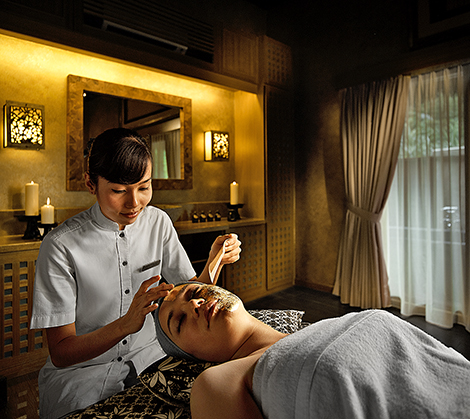
The KuuSh 24-carat Gold Facial is offered alongside traditional Malay therapies
To make more of an impact, marketing will now focus on countries that are no more than a six hour flight away
Each of the 25 Garden and Water Villas
have geothermal whirlpools
The MSpa Oslo series is a perennial bestseller in global markets. With innovative
engineering and premium performance, this completely portable spa line-up is expertly
designed to meet the needs of customers worldwide. [more...]
+ More featured suppliers
COMPANY PROFILES
Blue Rakun
Blue Rakun spaces are thoughtful, intuitive,
and designed around real human
behaviour, taking into [more...]
FIBO
FIBO is the international platform for fitness, wellness and health. During four days, FIBO connects [more...]
The Banjaran Hotsprings Retreat is Malaysia’s first and only hot springs destination. But despite its five-star rating and breathtaking beauty, it remains an enigma
By Jennifer Harbottle | Published in Spa Business 2013 issue 2
The vision is to create a world-class destination on a par with Chiva-Som
If you could write the recipe for the perfect destination spa retreat, the ingredients may go something like: location within two hours of a major capital city; natural hot springs; and Asian hospitality. Oh, and how about a generous helping of experienced industry professionals and a good glug of capital investment?
If it sounds like something even Ferran Adria couldn’t cook up, think again. Located in Ipoh, two hours west of Kuala Lumpur, The Banjaran Hotsprings Retreat has been prepared with all the love of a favourite national dish and is just waiting to serve people up a generous helping of wellness – Malaysian style.
The 17-acre (7-hectare) retreat sits alongside natural geothermal hot springs, hugged by limestone cliffs with natural caves, pristine jungle and waterfalls and lends itself perfectly to spiritual time-out and rejuvenation. In short, it’s breathtaking.
Yet since its opening January 2010, The Banjaran has yet to make its mark on the Asian wellness industry – even locals don’t know about it. But that may all be about to change, with an ambitious new general manager and spa director on board.
Cheah’s dream The Banjaran is bank-rolled and owned by The Sunway Group, one of Malaysia’s largest integrated property conglomerates. Sunway has a hospitality division which manages The Banjaran as well as a number of resorts under the Sunway brand name.
Sunway founder and chairman Tan Sri Jeffrey Cheah, who was born in Ipoh, visited the original hot springs as a child. In those days, the springs were open to locals to bathe in for a small fee, but they were badly run and it became Cheah’s dream to turn them into something more upmarket. He purchased the land from the government with the idea of developing it into a tourism destination. This started with the development of a theme park called The Lost World Of Tambun on the property in 2005. Today, this is a well established and popular attraction.
However, when building his family home on another part of the plot, Cheah discovered a system of caves, which geologists say date back 280 million years. He turned one of the caves into a private wine cellar but always had bigger plans for them. Plans which came to the forefront when creating The Banjaran in an area behind the theme park, adjacent to the main hot springs.
Phase one of The Banjaran is complete. Facilities include 25 Garden and Water Villas, a geothermal outdoor pool, fitness centre, all-day restaurant, a juice bar and Jeff’s Cellar – Cheah’s wine cave, which has been developed into a fully functioning bar. Each villa comes with its own sunken hot springs whirlpool, plunge pool and geothermal shower as well as a stunning outdoor lounge area.
Every guest has access to the retreat’s wellness facilities which comprise a thermal steam cave, a natural granite and limestone meditation cave and a crystal cave enhanced with amethyst and quartz crystals for energy treatments like reiki. There’s also the geothermal pool and four hot springs ‘dipping pools’, which increase in temperature the closer they are to the springs. In addition, is an ice bath, reflexology walk, a garra rufa Dr Fish pool for fish pedicures, an indoor gym and an open deck for yoga and t’ai chi.
At the heart of the retreat, is The Banjaran’s 7,000sq ft (650sq m) spa and wellness centre. The simple, but homely-designed facility features 12 treatment rooms including two for hydrotherapy services and three double suites. There’s also a medi/pedi room and a relaxation pavilion.
A tale of three cultures The Banjaran’s spa is based on a fusion of the three main cultures – Malay, Chinese and Indian – in Malaysia. The spa’s Malay treatments, a mix of ayurveda and traditional Chinese (TCM) medicine, are given in one of three themed rooms, authentically decorated to represent their culture. Given the Malaysian spa industry is still in its infancy, The Banjaran has a good selection of Malay therapies which give it an edge over other destination retreats in the country. Offerings including the ayurveda specialities of shirodhara and udvartana massage and TCM’s moxibustion and gua-sha where a scraper is used on the body to remove muscle pain or prevent and treat the common cold, bronchitis and asthma. Slightly more unusual, is the 30-minute tangas (MYR75 or US$25, €19, £16), a Malaysian tradition of steaming the genitals using antibacterial herbs, to kill germs and tighten muscles.
Also on offer is a selection of wellness programmes, ranging from two to 21 days, that focus on weight loss, rejuvenation, detox, fitness and longevity or that can be tailored made to deal with specific issues such as addiction. These include a 30-minute consultation as standard with either a naturopath, nutritionist, ayurvedic practitioner, TCM doctor or personal trainer who mostly work on a freelance basis.
Heading up the spa, is Dr Santhosh John, who says he would like to see more people booking programmes. “I find it really satisfying to see people come here for leisure and leave with a thirst for wellness,” he explains. “Really, a guest needs to be here three or four days to notice a difference in the way their body behaves.”
Dr John was with Per Aquum and Devi Resorts prior to joining The Banjaran. His passion for wellness began in the medical profession in Kerala, India where he trained as a naturopath and yoga physician. In the day to day running of the spa, he oversees seven full-time therapists – all female and either Indian , Chinese or Malay. Dr John says a tie up with spa academies in Kuala Lumpur and Langkawi makes it easier to find staff.
Off to market Sitting alongside Dr John at the Banjaran management table, is Filipino-born Lybanor P Godio. She was brought in to run the retreat six months ago, after a fairly swift turnover of staff that’s seen the departure of four resort managers in just two years. She accepts that the fate of The Banjaran – both its success and failure – rests with her ability to make the numbers stack up. Currently, occupancy is about 50 per cent, with spa bookings approximately half that. Her biggest task, she says, is to increase the number of people booking programmes. “I’d like to see The Banjaran become known for wellness, not just for being a luxury brand,” she explains.
While Cheah dreams of creating a leading wellness destination in Asia – on a par with Thailand’s Chiva-Som – Godio knows some serious marketing leg work is needed first. “The Banjaran is still not known here, so my first job is to wag our tail,” she explains. She’s quietly optimistic. “I’ve been to amazing places all over the world, yet two hours from Kuala Lumpur, in the jungle, there are these hot springs. People should be queuing up to come here!”
Previous destination spas she’s helped to run, for well-known operators such as El Nido and Amanresorts, she admits practically sold themselves. The Banjaran not so. “My focus is to work on the markets that are no more than a six hour flight from Malaysia,” she explains. “Until now, our marketing has focused on the Middle East, whereas I believe Singapore, Japan, Australia and Hong Kong are where we can make the most impact”.
She thinks one of The Banjaran’s USP’s is the fact it can offer an authentic experience that mirrors Malaysia’s melting pot culture – “guests can come to The Banjaran for Indian, Chinese and Malaysian treatments, hospitality and food, rather than travelling to India and China,” she says.
The next step is to embark on the second phase of The Banjaran, which includes opening up additional caves, developing further hot springs and building more accommodation. Once that is complete, there will still be additional land available for development.
But that will only happen once revenue starts increasing. Can the new team pull it off? Godio thinks so: “This place has so much potential and the people who work here are willing it to succeed, which is always half the battle.”
Overall, The Banjaran definitely has the ingredients for a unique wellness centre. It will be interesting to see how this slow burner turns out and whether its new team has what it takes to make it a sure-fire recipe for success.
Read more from this issue of Spa Business magazine
Ask an expert: Cancer
The number of cancer sufferers and survivors is growing. How can spas cater for them? Kath Hudson reports
Interview: Neil Jacobs
Six Senses’ new CEO reveals the group’s spa strategy and development plans
Profile: Anna Bjurstam
The new vice president of spa and wellness at Six Senses will oversee 28 facilities worldwide
Hotel spa: Palace pampering
A E100m refurbishment of Paris’ Hôtel Le Bristol attracted footballer David Beckham for a six month-long stay. Julie Cramer pays a visit to its new Spa Le Bristol by La Prairie which is becoming a healthy profit centre
Promotional feature: Design consulting
Implementing a great spa design takes inspiration, patience and discipline, according to Cary Collier, principal of Blu Spas, WTS' strategic partner. In the third of our WTS series, he shares his design philosophy with Spa Business
Research: India's wellness consumers
Leonor Stanton analyses PwC’s latest research profiling Indian wellness consumers – an industry projected to be worth US$18bn in four years’ time
Thermal spa: Hot spot
The Banjaran is Malaysia’s first and only hot springs retreat. Jennifer Harbottle examines the growth strategy
Company profile promotion: QMS Medicosmetics
QMS Medicosmetics' revolutionary skincare system was created by a trauma surgeon from Germany. Here, the company's managing partner explains how the products' unique ingredients and actions are delivering exceptional results in spas worldwide
Hotel spa: Making a debut
Steigenberger Hotels has introduced a flagship spa concept in Frankfurt. Sophie Benge reports
Resort spa: Botanical beauty
The new Spa Botánico at Dorado Beach, a Ritz-Carlton Reserve is set in five acres of ‘purification gardens’ and has a plant and herb apothecary
Product news: Product news
Product editor, Kate Corney highlights the latest product and equipment launches from the Spa Business search engine, Spa-Kit.net
Aesthetically, the retreat is stunning, helped by the natural beauty is has at its fingertips. However, while I loved the setting, I was disappointed with the faux paving around the retreat and the man-made rock looked too much like a theme park for me.
I especially enjoyed the meditation cave and the ice bath and the garra rufa fish were surprisingly relaxing. The only thing I wasn’t sure about were the dipping pools, which felt a bit slimy from the build up of algae, but the overall idea of sitting in them overlooking the springs did appeal to me.
The spa is earthy without being too themed and all the therapists were blessed with the kindness and smiles so richly gifted to Asian spa therapists, which bodes well for gaining Banjaran a reputation for great service.
I liked the way my 90-minute signature massage began sitting on a stool overlooking the jungle. The massage was a fusion of Malay, Chinese and Indian techniques. It started with an Indian head massage, moved onto a traditional Malaysian massage technique intended to enhance the immune system, and ended with a Chinese pressure point foot therapy which is designed to ease stress and tension. Overall, the experience was lovely, but I didn’t like the way the foot therapy came at the end, as it woke me rather unpleasantly from a very relaxed sleep.
Dr John, in my opinion, has exactly the right vision for how to make the spa and wellness element a success. Both he and Godio know that they need to build up the offering for longer stay guests. Currently, there aren’t enough activities for fellow guests to keep people occupied for longer than a few days. I agree with both Dr John and Godio that more fitness classes and motivational speakers are needed.
And with three million litres of hot water billowing up daily from the ground, there are plenty of water-based options to explore too – I see huge potential for developing a centre for aqua rehabilitation.
In a typical chicken-and-egg scenario, Sunway needs to start recouping its costs before it goes on to develop more of the land surrounding The Banjaran. There are plenty more hot springs to utilise as well as other caves to open up on the property and increasing the size of the facilities would give more opportunity for increasing the number of things to do there.
Overall, I was really impressed by my recent visit to The Banjaran and I sincerely hope that it gets a chance to reach its full potential.
The Banjaran: weights & measures
- A Garden Villa for one night starts at MYR1,300 (US$431, €334, £284) a night - Annual occupancy is 50 per cent - Average length of stay is one night - Domestic tourists are the biggest source market, accounting for 55 per cent of guests, followed by visitors from Singapore, Japan and Hong Kong (30 per cent) and Australia, Europe and the Middle East (15 per cent) - Around 65 per cent of guests are couples and the average age is 30-50 - Treatments start from MYR80 (US$27, €21, £17) for a 45-minute Antioxidant Restoration Therapy session and go up to MYR650 (US$215, €167, £142) for a 75-minute KuuSh 24-carat Gold Facial - 60 per cent of spa goers are hotel guests, while 40 per cent are day spa visitors - The most popular wellness programmes are weight loss and detox – the biggest weight loss was by an American businessman who lost 17 kilos in 21 days - The most valuable bottle in Jeff’s Cellar belongs to Cheah’s private collection and is worth an estimated MYR50,000 (US$16,550, €12,850 £10,900)
Management believe that the wellness programmes, which require longer guest stays, are key to making numbers stack up
The 250 million-year-old caves make for unique guest facilities including Jeff’s Cellar bar
A meditation cave
The KuuSh 24-carat Gold Facial is offered alongside traditional Malay therapies
To make more of an impact, marketing will now focus on countries that are no more than a six hour flight away
Each of the 25 Garden and Water Villas
have geothermal whirlpools
Private hotel owner and developer HVL Hotels will open a new luxury resort and tourism
destination called Laval Hunter Valley in the second half of 2027 in Pokolbin, Australia.
The annual wellness festival dedicated to wellbeing, culture, longevity and human connection,
called Alma, will be hosted by Rocco Forte hotel, Verdura Resort in Sicily, Italy.
Capella Hotel Group has appointed Feisal Jaffer as chief development officer as the company
ramps up its global expansion of both its Capella and Patina brands.
People taking GLP-1 weight loss medications such as Ozempic, Wegovy, Mounjaro and Zepbound
may be losing weight, but they’re also becoming less physically active, according to new
research presented at the ENDO 2026 annual meeting of the Endocrine Society
Abu Dhabi-based investment firm Mubadala Capital has made a binding, fully financed
€1 billion
offer to acquire Pierre and Vacances SA, the European holiday resort operator behind the
continental European Center Parcs business.
Global retreat trade show, Synergy The Retreat Show, has launched a resource called The
Source, which hosts an open-access online Transformation Series programme.
The Standards Authority for Touch in Cancer Care (SATCC) charity has announced its first five-
day Living with Cancer and Beyond retreat, which will be held at Carden Park Hotel and Spa in
Cheshire, UK, between 1 and 5 September.
Patmos Aktis, a Luxury Collection Resort and Spa, has opened in Greece, with a renovated and
rebranded wellness offering called Ansana Wellness and Spa.
The Mauna Kea Beach Hotel, an Autograph Collection property in Hawaii, US, has opened its
22,000 sq ft indoor-outdoor Spa at Mauna Kea as the final step in the property’s overall
renovation, which has cost more than US$180 million (€166 million, £140 mill
The MSpa Oslo series is a perennial bestseller in global markets. With innovative
engineering and premium performance, this completely portable spa line-up is expertly
designed to meet the needs of customers worldwide. [more...]
+ More featured suppliers
COMPANY PROFILES
Blue Rakun Blue Rakun spaces are thoughtful, intuitive,
and designed around real human
behaviour, taking into [more...]