An estimated 187 million spa visits took place in the US in 2024, up 3.1% / shutterstock/Krakenimages.com
The International SPA Association’s latest edition of its annual US Spa Industry Study offers a data-rich snapshot of the spa industry’s performance in 2024 and its encouraging position entering 2025. While the “Big Five” statistics – total revenue, spa visits, locations, revenue per visit and total employment – reveal another year of steady growth, they represent just a small portion of the study’s extensive findings.
Commissioned by the ISPA Foundation in collaboration with PricewaterhouseCoopers (PwC) and McIlheney Consulting, the study draws on a broad range of industry data. PwC facilitated survey distribution to US spa professionals, while McIlheney Consulting conducted the in-depth analysis and reporting.
The following breakdown of the Big Five metrics offers a focused glimpse into the industry’s core performance indicators – but for those seeking a deeper understanding of service trends, staffing challenges, compensation benchmarks and operational strategies, the full study provides a more detailed view.
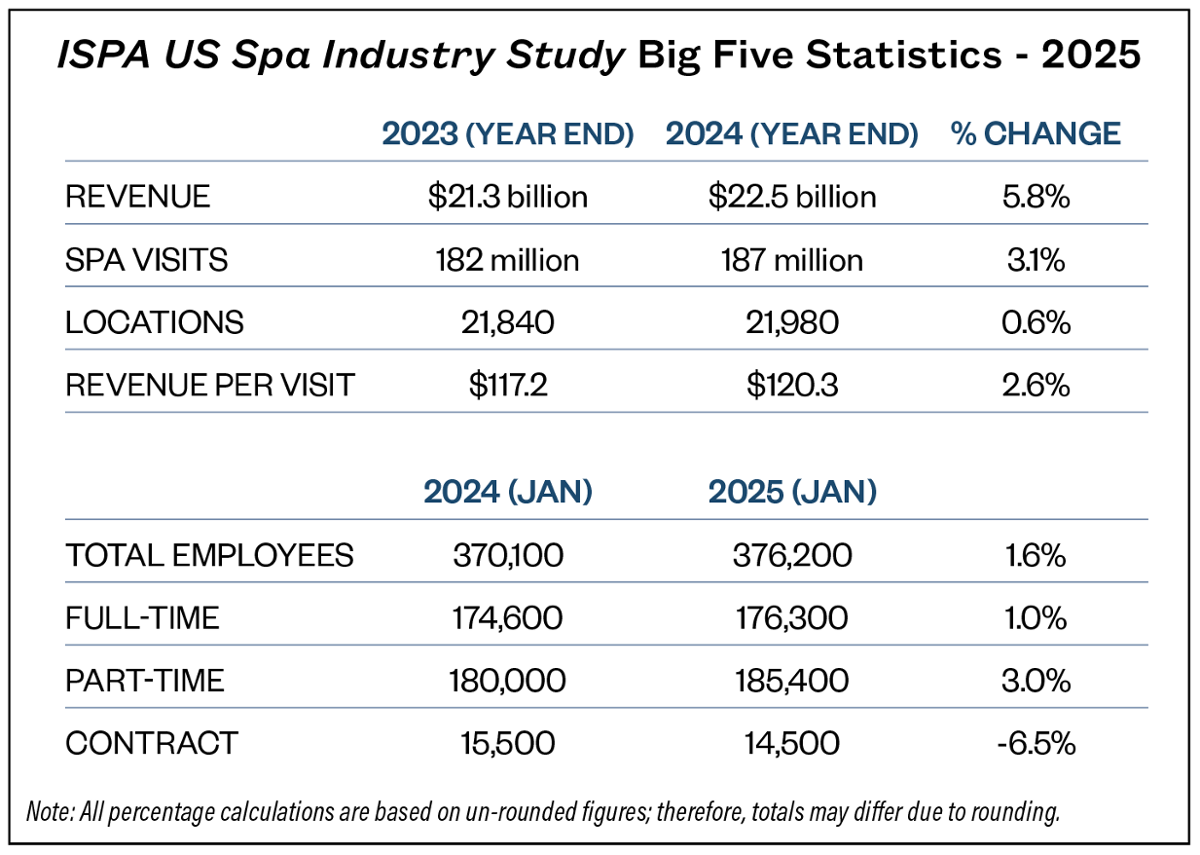
Total spa industry revenue The spa industry in the US generated an estimated US$22.5 billion (€19.4 billion, £16.6 billion) in total revenue in 2024, marking a 5.8 per cent increase from US$21.3 billion (€18.4 billion, £15.7 billion) in 2023. This $1.2 billion rise continues a trend of upward momentum seen in recent years and reflects broader consumer demand for spa and self-care services.
Additionally, the average revenue per spa establishment crossed the $1 million threshold for the first time, reaching $1,024,000 (€864,000, £734,000)in 2024. This represents a 5.1 per cent increase over 2023’s average of $974,000 (€842,000, £717,000) per establishment.
Spa visits An estimated 187 million spa visits took place in 2024, up from 182 million in 2023 – a 3.1 per cent increase. This growth suggests strong and sustained consumer engagement, as individuals continue to prioritise personal wellbeing through spa experiences.
Number of spa locations The number of operating spa establishments in the US saw a modest increase of 0.6 per cent, rising from 21,840 in 2023 to 21,980 in 2024. While this change represents a net addition of 140 locations, it also reflects a broader stabilisation trend in the market after the significant shifts of previous years. The steady growth in locations demonstrates an industry that is expanding at a cautious yet consistent pace.
Revenue per visit The average revenue generated per spa visit reached $120.3 (€104, £89) in 2024, up 2.6 per cent from $117.20 (€101.24, £86.30) in 2023. This figure indicates a healthy average transaction value and aligns with the overall revenue growth seen across the industry.
Increases in spending per visit can be attributed to a variety of factors that are captured in more detail in the full ISPA 2025 US Spa Industry Study, including service pricing, enhancements and upgrades offered by establishments.
Total employment As of January 2025, the US spa industry employed an estimated 376,200 individuals, a 1.6 per cent increase from 370,100 in January 2024.
This growth in total employment was driven largely by a 3.0 per cent rise in part-time employees, from 180,000 in January 2024 to 185,400 a year later. Full-time employment rose 1.0 per cent, from 174,600 to 176,300 during the same period. The number of contract employees decreased by 6.5 per cent, from 15,500 to 14,500.
Together, these figures offer insight into the workforce dynamics of the industry and point to continued labour demand – particularly for part-time roles.
Profitability benchmarks In 2024, 54 per cent of spas located in resorts and hotels reported profit margins of 20 per cent or more. Although this is a slight decline from 59 per cent in 2023, the figure remains broadly in line with pre-pandemic levels. For spas in other categories, 68 per cent reported achieving a profit margin of 10 per cent or more, reflecting continued operational strength.
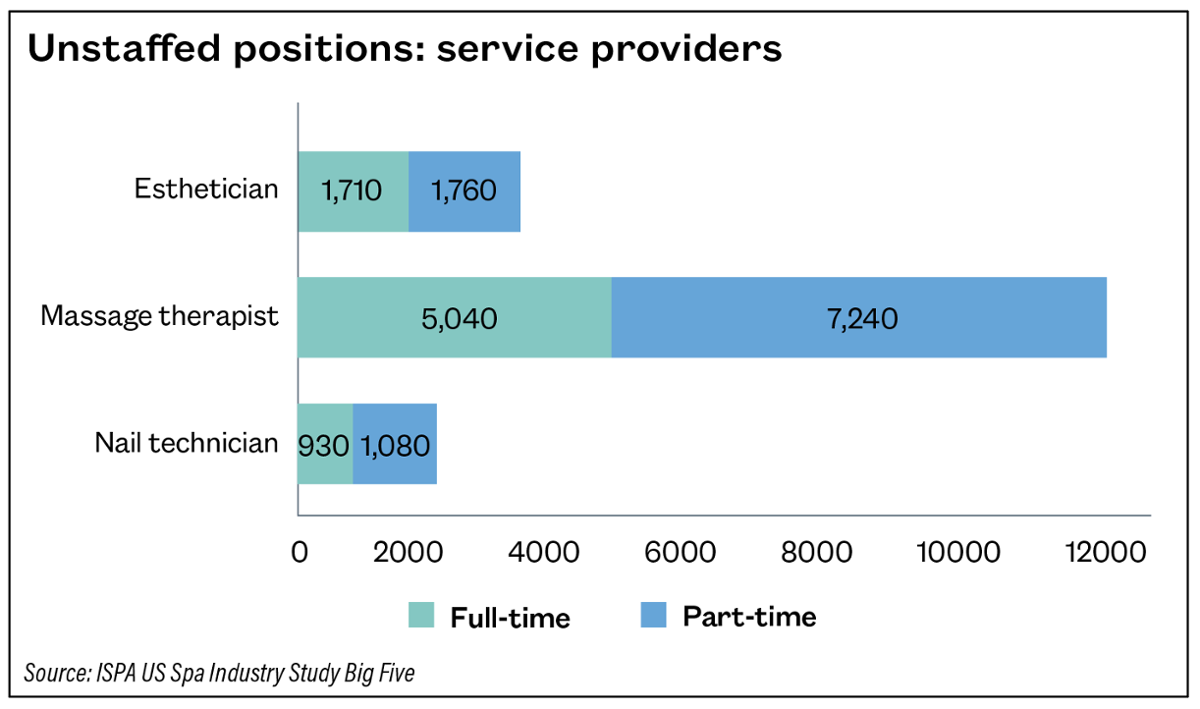
Open positions Staffing remains a key area of focus for the spa industry. When asked whether they currently had unstaffed service provider positions they were actively trying to fill, 45 per cent of all spas responded affirmatively. This figure includes 74 per cent of resort/hotel spas and 36 per cent of day spas, indicating that staffing needs may vary significantly by spa type.
Looking ahead When survey respondents were asked to identify the single biggest challenge facing their spa in 2025, the most common themes were facility upgrades and renovations, staffing and business growth. Additional concerns included inflation, operational costs, maintaining profit margins, enhancing customer experience and increasing retail sales.
Digging deeper The 2025 US Spa Industry Study’s Big Five statistics provide a clear view of the continued growth and resilience of the spa industry. With increases in revenue, visits, revenue per visit and employment, and with a steady number of new spa locations, the industry continues to demonstrate its stability and growing relevance.
To access the full report and explore deeper insights, ISPA members can visit the Research Library at experienceispa.com. Complimentary access to this spa industry and consumer research is one of ISPA’s most valued member benefits.
■ About the author:
ISPA
Nelson Lane is senior marketing manager for the International Spa Association.
In the fast-paced world of fitness and wellness, where high-intensity workouts push us to
our limits and the sweat pours, the importance of efficient recovery cannot be overstated. [more...]
An estimated 187 million spa visits took place in the US in 2024, up 3.1% / shutterstock/Krakenimages.com
The International SPA Association’s latest edition of its annual US Spa Industry Study offers a data-rich snapshot of the spa industry’s performance in 2024 and its encouraging position entering 2025. While the “Big Five” statistics – total revenue, spa visits, locations, revenue per visit and total employment – reveal another year of steady growth, they represent just a small portion of the study’s extensive findings.
Commissioned by the ISPA Foundation in collaboration with PricewaterhouseCoopers (PwC) and McIlheney Consulting, the study draws on a broad range of industry data. PwC facilitated survey distribution to US spa professionals, while McIlheney Consulting conducted the in-depth analysis and reporting.
The following breakdown of the Big Five metrics offers a focused glimpse into the industry’s core performance indicators – but for those seeking a deeper understanding of service trends, staffing challenges, compensation benchmarks and operational strategies, the full study provides a more detailed view.
Total spa industry revenue The spa industry in the US generated an estimated US$22.5 billion (€19.4 billion, £16.6 billion) in total revenue in 2024, marking a 5.8 per cent increase from US$21.3 billion (€18.4 billion, £15.7 billion) in 2023. This $1.2 billion rise continues a trend of upward momentum seen in recent years and reflects broader consumer demand for spa and self-care services.
Additionally, the average revenue per spa establishment crossed the $1 million threshold for the first time, reaching $1,024,000 (€864,000, £734,000)in 2024. This represents a 5.1 per cent increase over 2023’s average of $974,000 (€842,000, £717,000) per establishment.
Spa visits An estimated 187 million spa visits took place in 2024, up from 182 million in 2023 – a 3.1 per cent increase. This growth suggests strong and sustained consumer engagement, as individuals continue to prioritise personal wellbeing through spa experiences.
Number of spa locations The number of operating spa establishments in the US saw a modest increase of 0.6 per cent, rising from 21,840 in 2023 to 21,980 in 2024. While this change represents a net addition of 140 locations, it also reflects a broader stabilisation trend in the market after the significant shifts of previous years. The steady growth in locations demonstrates an industry that is expanding at a cautious yet consistent pace.
Revenue per visit The average revenue generated per spa visit reached $120.3 (€104, £89) in 2024, up 2.6 per cent from $117.20 (€101.24, £86.30) in 2023. This figure indicates a healthy average transaction value and aligns with the overall revenue growth seen across the industry.
Increases in spending per visit can be attributed to a variety of factors that are captured in more detail in the full ISPA 2025 US Spa Industry Study, including service pricing, enhancements and upgrades offered by establishments.
Total employment As of January 2025, the US spa industry employed an estimated 376,200 individuals, a 1.6 per cent increase from 370,100 in January 2024.
This growth in total employment was driven largely by a 3.0 per cent rise in part-time employees, from 180,000 in January 2024 to 185,400 a year later. Full-time employment rose 1.0 per cent, from 174,600 to 176,300 during the same period. The number of contract employees decreased by 6.5 per cent, from 15,500 to 14,500.
Together, these figures offer insight into the workforce dynamics of the industry and point to continued labour demand – particularly for part-time roles.
Profitability benchmarks In 2024, 54 per cent of spas located in resorts and hotels reported profit margins of 20 per cent or more. Although this is a slight decline from 59 per cent in 2023, the figure remains broadly in line with pre-pandemic levels. For spas in other categories, 68 per cent reported achieving a profit margin of 10 per cent or more, reflecting continued operational strength.
Open positions Staffing remains a key area of focus for the spa industry. When asked whether they currently had unstaffed service provider positions they were actively trying to fill, 45 per cent of all spas responded affirmatively. This figure includes 74 per cent of resort/hotel spas and 36 per cent of day spas, indicating that staffing needs may vary significantly by spa type.
Looking ahead When survey respondents were asked to identify the single biggest challenge facing their spa in 2025, the most common themes were facility upgrades and renovations, staffing and business growth. Additional concerns included inflation, operational costs, maintaining profit margins, enhancing customer experience and increasing retail sales.
Digging deeper The 2025 US Spa Industry Study’s Big Five statistics provide a clear view of the continued growth and resilience of the spa industry. With increases in revenue, visits, revenue per visit and employment, and with a steady number of new spa locations, the industry continues to demonstrate its stability and growing relevance.
To access the full report and explore deeper insights, ISPA members can visit the Research Library at experienceispa.com. Complimentary access to this spa industry and consumer research is one of ISPA’s most valued member benefits.
■ About the author:
ISPA
Nelson Lane is senior marketing manager for the International Spa Association.
Aditya Saluja, an industry leader in luxury wellness hospitality, has been
appointed as
commercial director of spa and wellness for the spa management division of
Minor Hotels,
MSpa International.
Preidlhof Luxury DolceVita Resort, a destination resort and spa in Naturno, South Tyrol in Italy,
will reveal a new spa in February 2027, which has been designed by wellness expert and
consultant Patrizia Bortolin.
Private hotel owner and developer HVL Hotels will open a new luxury resort and tourism
destination called Laval Hunter Valley in the second half of 2027 in Pokolbin, Australia.
The annual wellness festival dedicated to wellbeing, culture, longevity and human connection,
called Alma, will be hosted by Rocco Forte hotel, Verdura Resort in Sicily, Italy.
Capella Hotel Group has appointed Feisal Jaffer as chief development officer as the company
ramps up its global expansion of both its Capella and Patina brands.
People taking GLP-1 weight loss medications such as Ozempic, Wegovy, Mounjaro and Zepbound
may be losing weight, but they’re also becoming less physically active, according to new
research presented at the ENDO 2026 annual meeting of the Endocrine Society
In the fast-paced world of fitness and wellness, where high-intensity workouts push us to
our limits and the sweat pours, the importance of efficient recovery cannot be overstated. [more...]