Yes! Send me the FREE digital editions of Spa Business and Spa Business insider magazines and the FREE weekly Spa Business and Spa Business insider ezines and breaking news alerts!
45 per cent of respondents in the US have been impacted / PHOTO: shutterstock/ krakenimages.com
After speaking with numerous people from multiple sectors within the spa industry, it became clear that many were concerned about the new US trade tariffs that were introduced on 2 April to address the country's trade deficit.
The spa market has been trying to understand how best to deal with the changes, including a 10 per cent import levy to the US and steep country-specific duties. Therefore, I decided to conduct a global survey, primarily to quantify the current impact and gather strategies being used already, which could be shared with the wider industry to help anyone else negatively affected.
The awareness of this information, published in the report Impact of US Tariffs on the Spa Industry, will bring more confidence to those dealing with negative impacts, as well as employees who worry about their job security. It's good to note 53 per cent of survey respondents stated the new tariffs were unlikely to change the number of employees in the business this year.
Background The spa and wellness industry is facing rising costs and uncertain supply chains as a result of the economic turbulence. Many spas in the US rely on imported equipment, products and other supplies, which are now subject to the tariffs, while suppliers based outside the US face logistics complications, inflated export costs and must meet other changing trade requirements. The threats of squeezed margins, increased prices for consumers and disrupted service delivery loom as firms adapt to the turbulence.
Methodology The global online survey was completed by 83 respondents, with the sample including operators and suppliers – 26 per cent from the Americas (22 people), 49 per cent from Asia Pacific (41 people), 19 per cent from Europe (16 people) and 7 per cent from the Middle East and Africa (6 people)*.
Given 26 per cent of respondents were unsure of the impacts, some suggesting it was too early to know, it may be interesting to conduct a follow up survey towards the end of the year to share updates. (*NB, numbers have been rounded)
Find out more The report, which can be purchased from www.intelligentspas.com for US$30 (€26, £22), goes into detail on topics including specific impacts on the industry, the significance of these changes and strategies to mitigate the effects.
Key stats (sample = 83)
• 28 per cent of all survey respondents globally stated they are being negatively impacted by the new tariffs
• 72 per cent of all survey respondents globally say they have not yet been negatively impacted
• 32 per cent of those who stated they are not being negatively impacted have already changed their financial forecasts and budgets
• 47 per cent of those who sell products and/or services to the Americas said they’ve experienced negative impacts
• 45 per cent of respondents located in the US said they’re being negatively affected, versus 29 per cent of those located in the Asia Pacific region
• 8 per cent of respondents from Europe, Africa and the Middle East stated they’re being negatively impacted
PHOTO: Intelligent Spas
"The awareness of this information will bring more confidence to those dealing with negative impacts" –
Julie Garrow, MD, Intelligent Spas
In the fast-paced world of fitness and wellness, where high-intensity workouts push us to
our limits and the sweat pours, the importance of efficient recovery cannot be overstated. [more...]
+ More featured suppliers
COMPANY PROFILES
UK Spa Association
Our mission is to raise awareness of our industry within schools, colleges, society and crucially at [more...]
Swissline by Dermalab
Inspired by the science of cellular rejuvenation and driven by the desire to optimise skin health an [more...]
45 per cent of respondents in the US have been impacted / PHOTO: shutterstock/ krakenimages.com
After speaking with numerous people from multiple sectors within the spa industry, it became clear that many were concerned about the new US trade tariffs that were introduced on 2 April to address the country's trade deficit.
The spa market has been trying to understand how best to deal with the changes, including a 10 per cent import levy to the US and steep country-specific duties. Therefore, I decided to conduct a global survey, primarily to quantify the current impact and gather strategies being used already, which could be shared with the wider industry to help anyone else negatively affected.
The awareness of this information, published in the report Impact of US Tariffs on the Spa Industry, will bring more confidence to those dealing with negative impacts, as well as employees who worry about their job security. It's good to note 53 per cent of survey respondents stated the new tariffs were unlikely to change the number of employees in the business this year.
Background The spa and wellness industry is facing rising costs and uncertain supply chains as a result of the economic turbulence. Many spas in the US rely on imported equipment, products and other supplies, which are now subject to the tariffs, while suppliers based outside the US face logistics complications, inflated export costs and must meet other changing trade requirements. The threats of squeezed margins, increased prices for consumers and disrupted service delivery loom as firms adapt to the turbulence.
Methodology The global online survey was completed by 83 respondents, with the sample including operators and suppliers – 26 per cent from the Americas (22 people), 49 per cent from Asia Pacific (41 people), 19 per cent from Europe (16 people) and 7 per cent from the Middle East and Africa (6 people)*.
Given 26 per cent of respondents were unsure of the impacts, some suggesting it was too early to know, it may be interesting to conduct a follow up survey towards the end of the year to share updates. (*NB, numbers have been rounded)
Find out more The report, which can be purchased from www.intelligentspas.com for US$30 (€26, £22), goes into detail on topics including specific impacts on the industry, the significance of these changes and strategies to mitigate the effects.
Key stats (sample = 83)
• 28 per cent of all survey respondents globally stated they are being negatively impacted by the new tariffs
• 72 per cent of all survey respondents globally say they have not yet been negatively impacted
• 32 per cent of those who stated they are not being negatively impacted have already changed their financial forecasts and budgets
• 47 per cent of those who sell products and/or services to the Americas said they’ve experienced negative impacts
• 45 per cent of respondents located in the US said they’re being negatively affected, versus 29 per cent of those located in the Asia Pacific region
• 8 per cent of respondents from Europe, Africa and the Middle East stated they’re being negatively impacted
PHOTO: Intelligent Spas
"The awareness of this information will bring more confidence to those dealing with negative impacts" –
Julie Garrow, MD, Intelligent Spas
Preidlhof Luxury DolceVita Resort, a destination resort and spa in Naturno, South Tyrol in Italy,
will reveal a new spa in February 2027, which has been designed by wellness expert and
consultant Patrizia Bortolin.
Private hotel owner and developer HVL Hotels will open a new luxury resort and tourism
destination called Laval Hunter Valley in the second half of 2027 in Pokolbin, Australia.
The annual wellness festival dedicated to wellbeing, culture, longevity and human connection,
called Alma, will be hosted by Rocco Forte hotel, Verdura Resort in Sicily, Italy.
Capella Hotel Group has appointed Feisal Jaffer as chief development officer as the company
ramps up its global expansion of both its Capella and Patina brands.
People taking GLP-1 weight loss medications such as Ozempic, Wegovy, Mounjaro and Zepbound
may be losing weight, but they’re also becoming less physically active, according to new
research presented at the ENDO 2026 annual meeting of the Endocrine Society
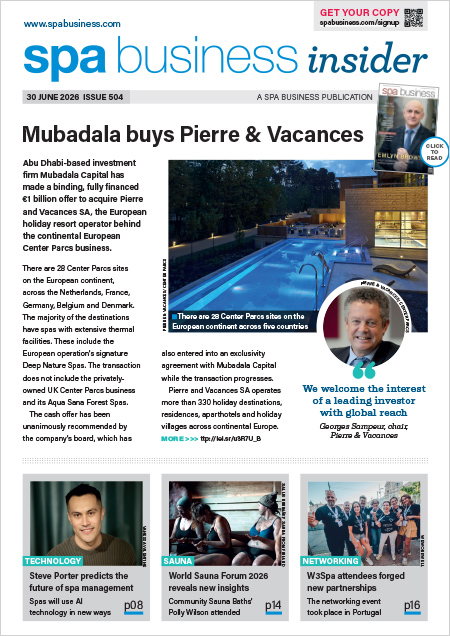
Abu Dhabi-based investment firm Mubadala Capital has made a binding, fully financed
€1 billion
offer to acquire Pierre and Vacances SA, the European holiday resort operator behind the
continental European Center Parcs business.
Global retreat trade show, Synergy The Retreat Show, has launched a resource called The
Source, which hosts an open-access online Transformation Series programme.
In the fast-paced world of fitness and wellness, where high-intensity workouts push us to
our limits and the sweat pours, the importance of efficient recovery cannot be overstated. [more...]
+ More featured suppliers
COMPANY PROFILES
UK Spa Association Our mission is to raise awareness of our industry within schools, colleges, society and crucially at [more...]