Yes! Send me the FREE digital editions of Spa Business and Spa Business insider magazines and the FREE weekly Spa Business and Spa Business insider ezines and breaking news alerts!
The technology has moved from the industrial sphere to the creative industries like film and TV
As an exhibitor at the Museum & Heritage show at Olympia, London, UK in May 2013, what struck me most was the diversity of projects that people in this sector were undertaking and the level of interest shown in how they could realise these projects through 3D scanning and printing technologies.
For several years now, the global media has been awash with stories of 3D scanning and printing (including the infamous ‘plastic’ gun) and everyone wants to be a part of the new technology, wondering how it may contribute to their sales and services in the coming years.
With the advent of sub-US$1,000 (£650, E770) 3D scanners and printers, there’s an urge to get involved because of the low level of investment needed. However, there’s a downside with production quality in this entry-level equipment, which is aimed at the home and hobby market.
You get what you pay for, and greater levels of complexity are required – both in the 3D scanning process and in 3D printing – to create professional exhibits, props, models, archive material and other items. The equipment involved at this level runs into tens of thousands of dollars and requires an intricate knowledge of the associated 3D software and hardware, so some people may find it wiser to invest in a professional 3D scanning service for their project rather than purchasing high-end equipment.
3D scanning Scanning in 3D has been around for a couple of decades and has developed mainly in engineering circles to scan, manipulate data and manufacture or reverse-engineer industrial parts for the automotive and aerospace industries.
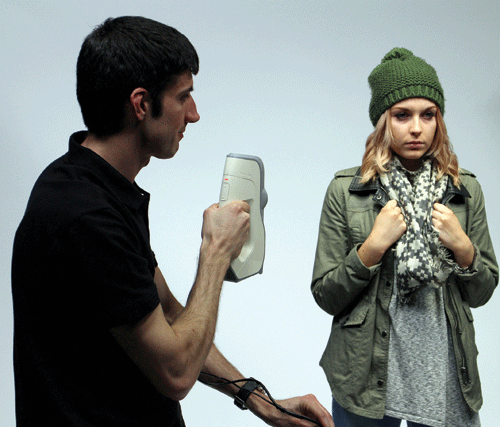
The development of 3D scanning equipment in this time has resulted in extremely accurate point-clouds of information creating a mesh, which can then be manipulated, rendered, used for casting or milling purposes, or printed out in 3D. Static 3D scanners are available for accurately scanning very small objects, such as jewellery or machine parts. Hand-held and laser-arm scanners are used for larger scale objects which need more comprehensive capture of the surface area, and large tracking scanners are capable of scanning whole buildings.
3D printing 3D printing allows 3D data to be “printed” in thin layers of ceramic, plastic and wax (for casting purposes) to build up the model and is ideal for industrial prototyping. Like 3D scanning, it has been around for a while in the engineering industries, but in the last few years the technology has improved with the demand.
For large-scale items, which can’t be printed on the footprint of even the largest 3D printers on the market, the 3D data can be used for milling purposes to create large-scale objects from metal, stone and other suitable materials.
Increasingly, the emphasis is shifting to the commercial and creative markets where the 3D data captured from the work of traditional model makers, for example, can be used to create sets and props for the TV and film industries.
This data-capture is also used in the film industry to rig the mesh and animate a scanned person or model-made creature and bespoke installations and the archiving of precious items in a non-damaging scanning process are proving popular with the attractions, museum and heritage industries.
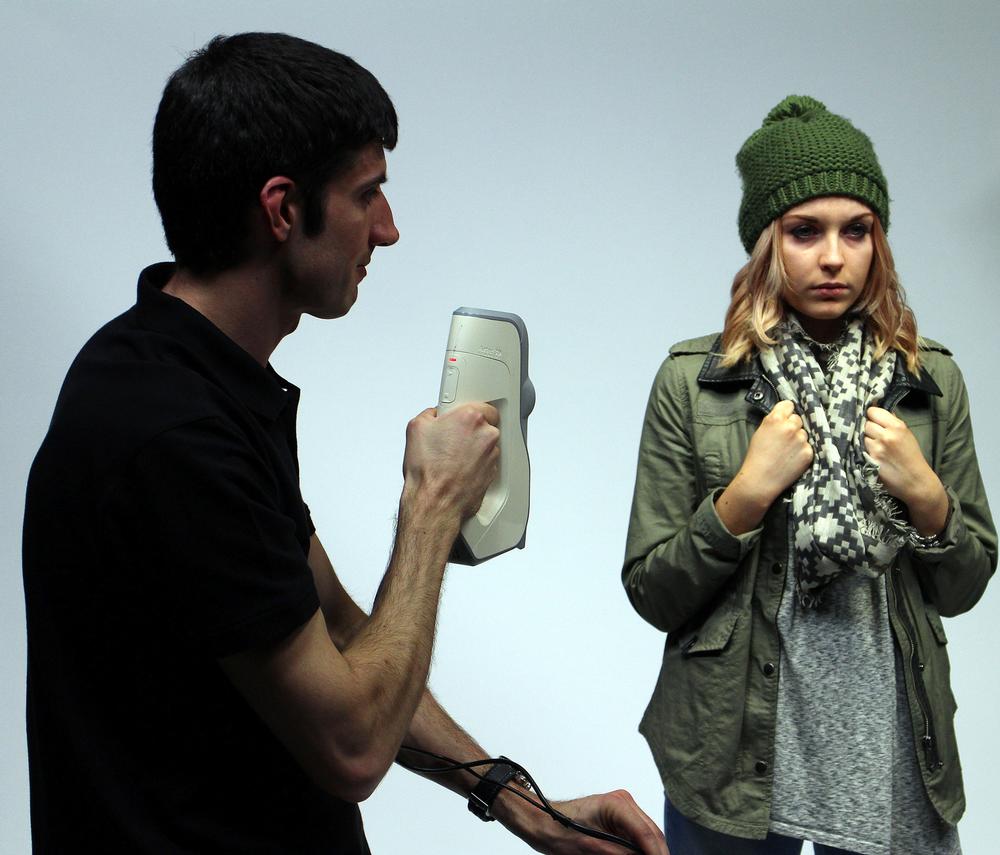
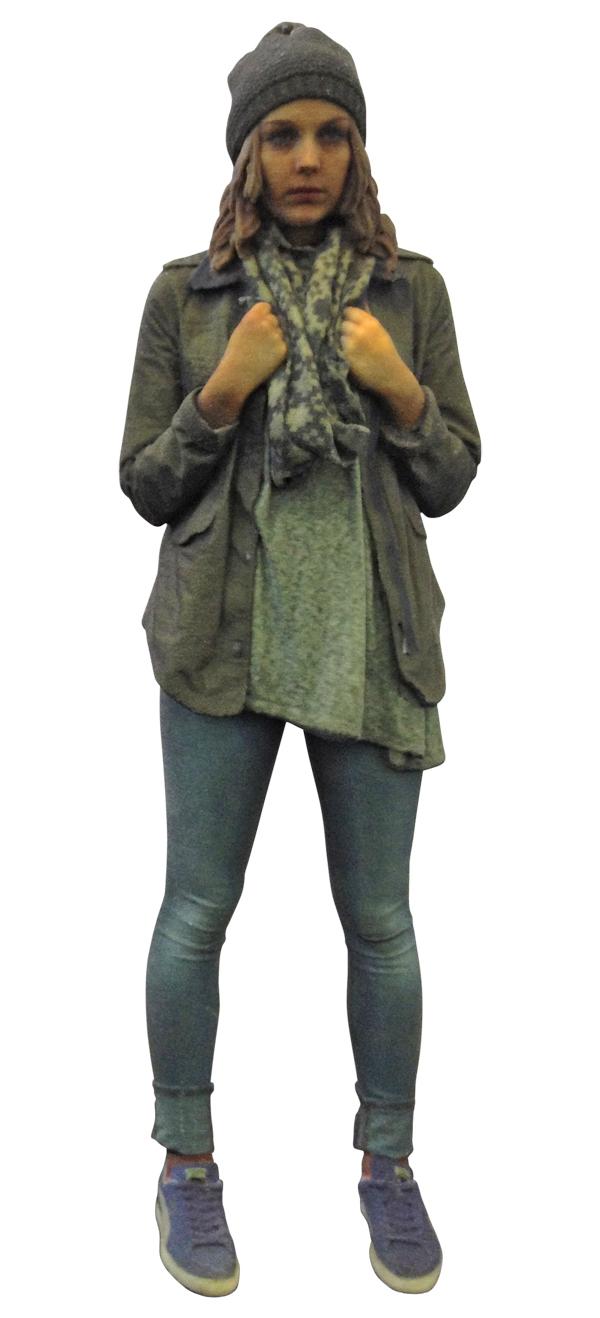
Full 3D bodyscanning is now also available, meaning a person can be scanned in 3D and the data printed as figurines. This is becoming popularised in the form of pop-up shops in supermarkets or at exhibitions and festivals where the general public can be scanned and a colour 3D-printed figurine mailed to them at a later date (current 3D machine printing technology is still too slow to do on-the-spot printouts). Corporate clients are using the technology to 3D print their staff, fine artists are starting to experiment with the capabilities of 3D scanning and printing, and advertising agencies are using the technology to develop or revamp product packaging.
Fashion houses are using 3D scanning to prototype designs and generate 3D rotatable web imagery for products, while the data from 3D scanning is being use in pioneering Augmented Reality projects.
And so the applications of 3D scanning and printing start to become limitless. Virtually anything is possible, and for the attractions, museum and heritage industries, this means the ability to archive (or recreate) precious items, create 3D interactive installations, or print out miniature novelty items and facsimiles of objects
Print predictions So what does the future hold for 3D scanning and 3D printing? As technology hurtles along, it won’t be surprising to see great advances in the quality of both scanners and printers, along with more competitive pricing and ease-of-use of the software and hardware to make the process more accessible to the public.
Printed foods, such as chocolate, are becoming available and various manufacturers are looking at the possibilities of people downloading 3D templates for household items and furnishings, which they can print out on home 3D printers.
It’s now possible to print in around 200 different materials, including 99.8 per cent titanium, using metal laser sintering, which will bring huge leaps forward in healthcare, while bespoke dental materials and body parts such as patellae are being tailored to individual needs.
And what of printing organic matter? Even further into the future, almost to the realms of science fiction, scientists and engineers are looking at replicating more than just metals, plastics and ceramics.
Bruce Hood – a psychologist at the University of Bristol – in his 2011 book The Self Illusion, says: “Imagine a machine that can copy any physical object, right down to its basic atomic structure. It can perfectly duplicate any material thing, irrespective of what it’s made of or how complicated it is.
“Remarkably, engineers are working on precisely this type of machine known as a 3D printer...It’s the sort of technology that would make constructing colonies on distant planets more feasible without having to transport every object.
“At the moment the technology is fairly crude and solving how to build internal structures of complicated objects made of different substances presents considerable challenges. However, just as the printing press of Johannes Gutenberg was considered a technological marvel in the 15th century, yet seems primitive by today’s standards, it may simply be a matter of time before we can manipulate matter to create accurate duplicates.”
Back on earth, for those operating in the attractions, museum and heritage industries, 3D scanning and printing is rapidly becoming a focal point in the areas of archiving, bespoke exhibition materials and educational projects.
The ability to create fully rotatable and high-resolution objects from 3D-scanned originals means children and students can interact with the 3D image in a screen environment where the item may be too precious to be handled. Or they can handle the recreated 3D printed version to experience size and detail.
From an archiving perspective, 3D scanning can capture high-resolution detail of an object, person or even a building. Whatever the size or scale of your project, 3D scanning and printing is here to stay and can add an array of solutions to help your operation.
Read more from this issue of Spa Business magazine
View contents of Spa Business 2014 issue 1
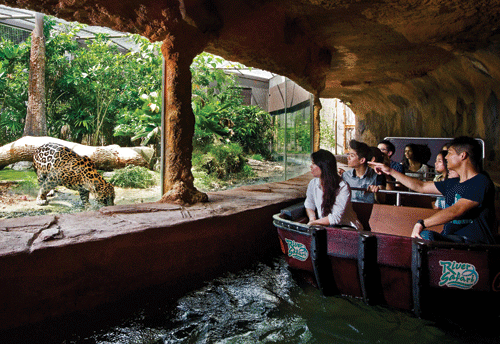
Editor's letter: Creating Wealth
Great companies like Merlin Entertainments generate whole
ecosystems around themselves, with employees and their families,
shareholders, investors, suppliers, stakeholders and customers
benefiting from the wealth, energy and opportunity they create
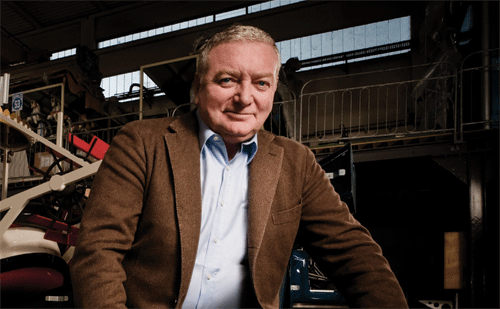
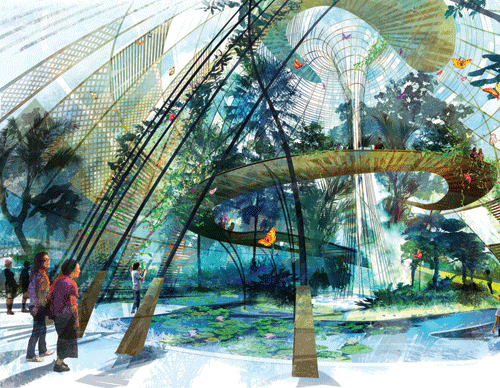
Profile: Alberto Zamperla
The Italian ride entrepreneur is
attracting international attention for
his ambitious plans to build a new
cultural attraction in the heart of
Venice. Liz Terry finds out more
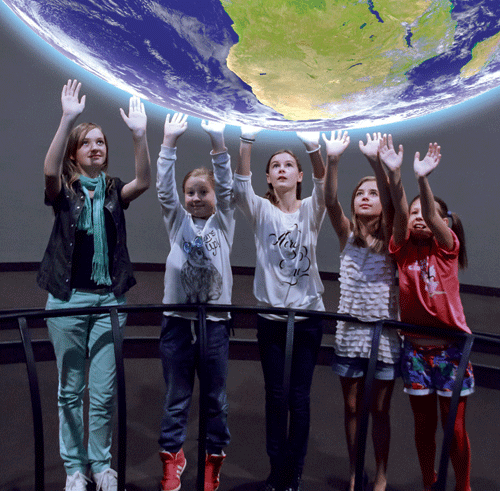
Planetariums: Science in the sky
We talk to Techmania's CEO Vlastimil
Volak and designer Glenn Smith
about the opening of the first 3D
Planetarium in the Czech Republic
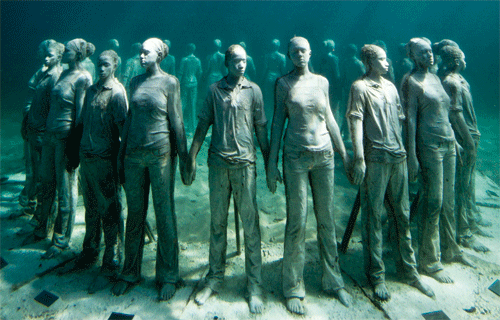
Museums: Sea Views
Exploring underwater museums with
eco-sculptor Jason deCaires Taylor
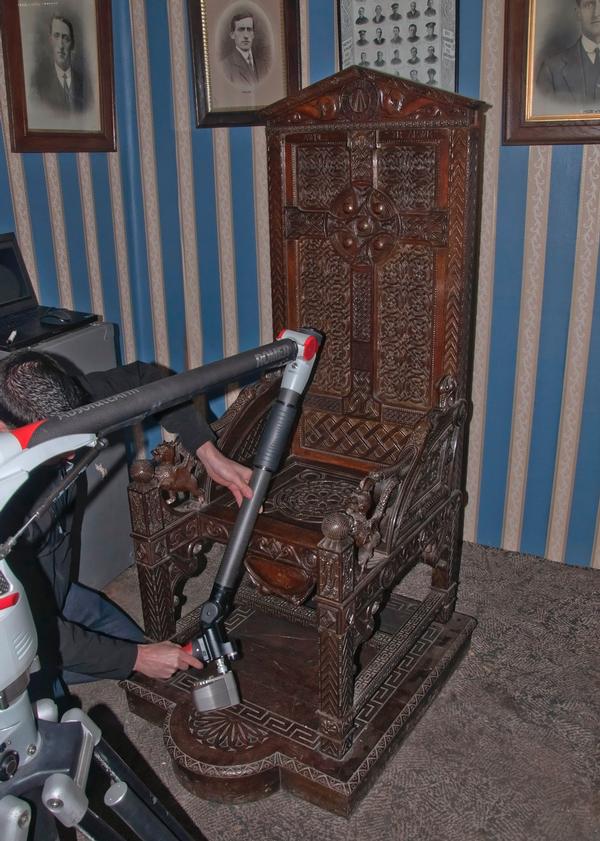
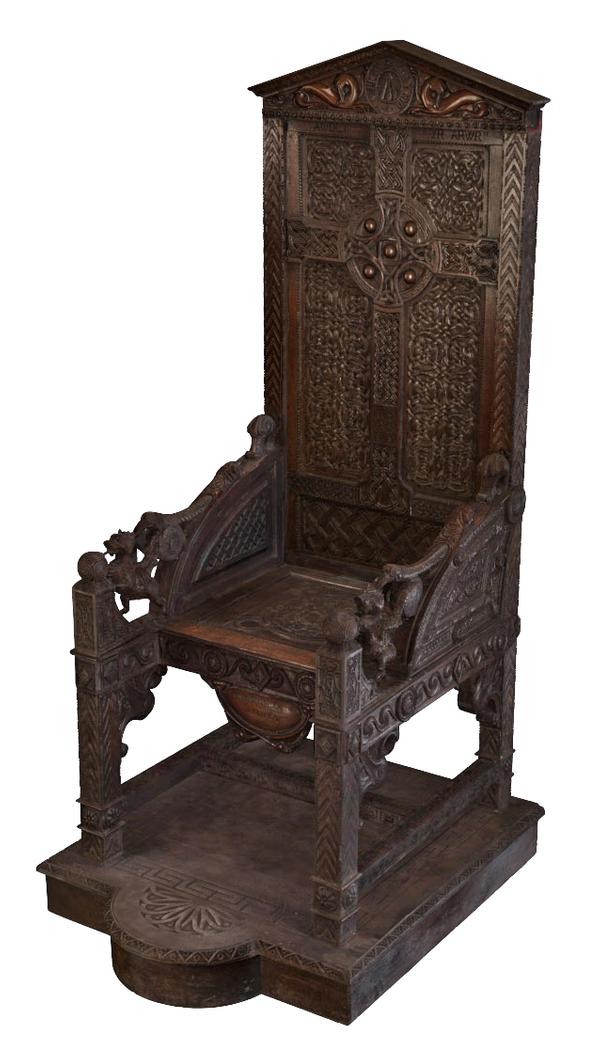
case study The poignant story of the eisteddfod chair 3D printing company Quod was commissioned by the Snowdonia National Park Authority and CyMAL to scan and reproduce the ‘Black Chair’, which is associated with the National Eisteddfod of Wales.
Welsh poet Ellis Humphrey Evan – who adopted the Welsh name Hedd Wyn – entered the Eisteddfod poetry competition under the assumed name of ‘fleur-de-lis’ in 1917. Tragically he was killed soon afterwards at the Battle of Passchendaele, just weeks before his entry was declared the winner.
The winner is traditionally presented with the Bardic Chair – on this occasion a wonderfully ornate work of art created by a Flemish refugee craftsman, Eugeen Vanfleteren, who decorated the chair lavishly with Celtic and Welsh symbols and motifs, making it one of the most impressive Eisteddfod chairs ever made.
When the poet ‘fleur-de-lis’ was announced as the Eisteddfod winner on September 6th, 1917, by the Archdruid and it was found that he had died in battle and was unable to claim his chair, a black sheet was draped over it and it was returned to his family farm in North Wales where it remains to this day.
The chair is symbolically seen to represent a lost generation of young men who died in the First World War.
In the small surroundings of the farmhouse, using hand-held 3D scanners, the chair was scanned to pick up the incredible detail in the woodcarving. With this information, the original chair has, in effect, been archived and the data can be used to re-engineer it in its entirety. In addition, people all over the world can now read the story of Hedd Wyn and see a rotatable version of the chair online.
The historic Eisteddfod Black Chair – a symbol of a lost generation of young men in WW1 – was replicated
The historic Eisteddfod Black Chair – a symbol of a lost generation of young men in WW1 – was replicated
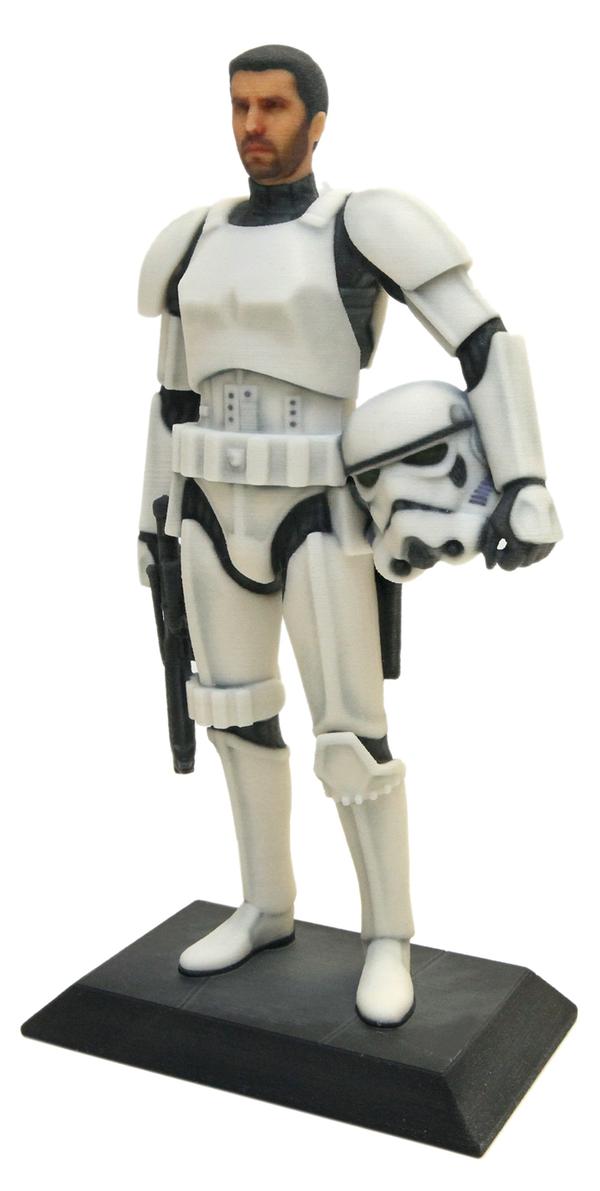
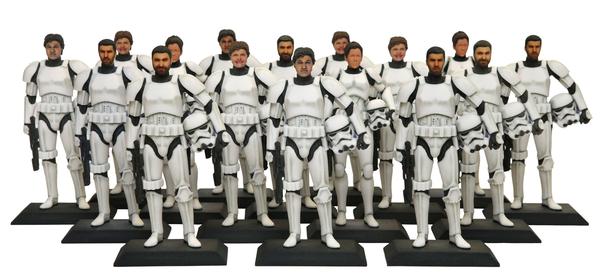
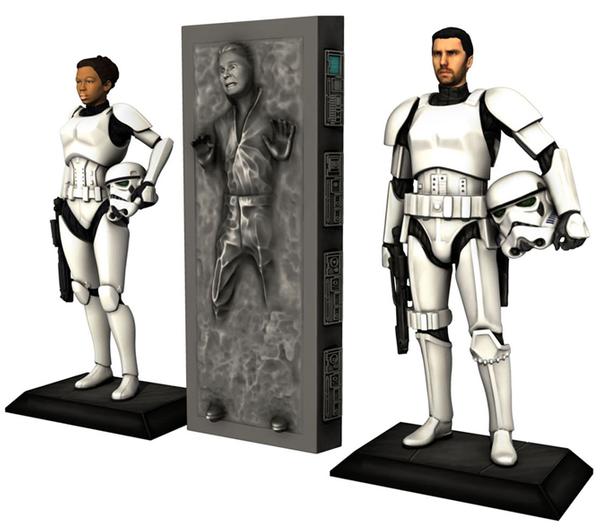
Case study 3D figures are a storming success Disney took full advantage of 3D print technology during its Star Wars Weekends events by giving fans the opportunity to put their face on a 3D-printed Stormtrooper figurine. The D-Tech Me experience at Disney’s Hollywood Studios used a high-resolution single-shot 3D face scanner created by Disney Research labs.
The 10-minute experience captured an image of the visitor, which was later sent to a high-resolution 3D printer to create a figurine, before being shipped to its owner. Disney also resurrected a popular Cast yourself in Carbonite option inspired by a scene from The Empire Strikes Back. Fans received either a Carbon-Freeze Me light-up band or a collector button depending on which option they chose.
The Star Wars D-Tech Me experience was priced at $99.95 (£60, E72) plus shipping and the applicable sales tax.
The Star Wars D-Tech Me figurine promotion ran earlier this year and was priced at just under $100
The Star Wars D-Tech Me figurine promotion ran earlier this year and was priced at just under $100
John Nuttall is creative and marketing manager at Quod [email protected] www.quodscan3d.com
3D scanning is also being used to prototype designs and to develop exciting Augmented Reality projects
3D scanning is also being used to prototype designs and to develop exciting Augmented Reality projects
In today’s premium spa environment, every detail shapes the guest experience – right down to
the softness of towels and the freshness of linens. [more...]
+ More featured suppliers
COMPANY PROFILES
Elemental Herbology
Founded in 2008 by a Traditional Chinese Medicine Practitioner, Elemental Herbology is a spa, retail [more...]
Blue Rakun
Blue Rakun spaces are thoughtful, intuitive,
and designed around real human
behaviour, taking into [more...]
The technology has moved from the industrial sphere to the creative industries like film and TV
As an exhibitor at the Museum & Heritage show at Olympia, London, UK in May 2013, what struck me most was the diversity of projects that people in this sector were undertaking and the level of interest shown in how they could realise these projects through 3D scanning and printing technologies.
For several years now, the global media has been awash with stories of 3D scanning and printing (including the infamous ‘plastic’ gun) and everyone wants to be a part of the new technology, wondering how it may contribute to their sales and services in the coming years.
With the advent of sub-US$1,000 (£650, E770) 3D scanners and printers, there’s an urge to get involved because of the low level of investment needed. However, there’s a downside with production quality in this entry-level equipment, which is aimed at the home and hobby market.
You get what you pay for, and greater levels of complexity are required – both in the 3D scanning process and in 3D printing – to create professional exhibits, props, models, archive material and other items. The equipment involved at this level runs into tens of thousands of dollars and requires an intricate knowledge of the associated 3D software and hardware, so some people may find it wiser to invest in a professional 3D scanning service for their project rather than purchasing high-end equipment.
3D scanning Scanning in 3D has been around for a couple of decades and has developed mainly in engineering circles to scan, manipulate data and manufacture or reverse-engineer industrial parts for the automotive and aerospace industries.
The development of 3D scanning equipment in this time has resulted in extremely accurate point-clouds of information creating a mesh, which can then be manipulated, rendered, used for casting or milling purposes, or printed out in 3D. Static 3D scanners are available for accurately scanning very small objects, such as jewellery or machine parts. Hand-held and laser-arm scanners are used for larger scale objects which need more comprehensive capture of the surface area, and large tracking scanners are capable of scanning whole buildings.
3D printing 3D printing allows 3D data to be “printed” in thin layers of ceramic, plastic and wax (for casting purposes) to build up the model and is ideal for industrial prototyping. Like 3D scanning, it has been around for a while in the engineering industries, but in the last few years the technology has improved with the demand.
For large-scale items, which can’t be printed on the footprint of even the largest 3D printers on the market, the 3D data can be used for milling purposes to create large-scale objects from metal, stone and other suitable materials.
Increasingly, the emphasis is shifting to the commercial and creative markets where the 3D data captured from the work of traditional model makers, for example, can be used to create sets and props for the TV and film industries.
This data-capture is also used in the film industry to rig the mesh and animate a scanned person or model-made creature and bespoke installations and the archiving of precious items in a non-damaging scanning process are proving popular with the attractions, museum and heritage industries.
Full 3D bodyscanning is now also available, meaning a person can be scanned in 3D and the data printed as figurines. This is becoming popularised in the form of pop-up shops in supermarkets or at exhibitions and festivals where the general public can be scanned and a colour 3D-printed figurine mailed to them at a later date (current 3D machine printing technology is still too slow to do on-the-spot printouts). Corporate clients are using the technology to 3D print their staff, fine artists are starting to experiment with the capabilities of 3D scanning and printing, and advertising agencies are using the technology to develop or revamp product packaging.
Fashion houses are using 3D scanning to prototype designs and generate 3D rotatable web imagery for products, while the data from 3D scanning is being use in pioneering Augmented Reality projects.
And so the applications of 3D scanning and printing start to become limitless. Virtually anything is possible, and for the attractions, museum and heritage industries, this means the ability to archive (or recreate) precious items, create 3D interactive installations, or print out miniature novelty items and facsimiles of objects
Print predictions So what does the future hold for 3D scanning and 3D printing? As technology hurtles along, it won’t be surprising to see great advances in the quality of both scanners and printers, along with more competitive pricing and ease-of-use of the software and hardware to make the process more accessible to the public.
Printed foods, such as chocolate, are becoming available and various manufacturers are looking at the possibilities of people downloading 3D templates for household items and furnishings, which they can print out on home 3D printers.
It’s now possible to print in around 200 different materials, including 99.8 per cent titanium, using metal laser sintering, which will bring huge leaps forward in healthcare, while bespoke dental materials and body parts such as patellae are being tailored to individual needs.
And what of printing organic matter? Even further into the future, almost to the realms of science fiction, scientists and engineers are looking at replicating more than just metals, plastics and ceramics.
Bruce Hood – a psychologist at the University of Bristol – in his 2011 book The Self Illusion, says: “Imagine a machine that can copy any physical object, right down to its basic atomic structure. It can perfectly duplicate any material thing, irrespective of what it’s made of or how complicated it is.
“Remarkably, engineers are working on precisely this type of machine known as a 3D printer...It’s the sort of technology that would make constructing colonies on distant planets more feasible without having to transport every object.
“At the moment the technology is fairly crude and solving how to build internal structures of complicated objects made of different substances presents considerable challenges. However, just as the printing press of Johannes Gutenberg was considered a technological marvel in the 15th century, yet seems primitive by today’s standards, it may simply be a matter of time before we can manipulate matter to create accurate duplicates.”
Back on earth, for those operating in the attractions, museum and heritage industries, 3D scanning and printing is rapidly becoming a focal point in the areas of archiving, bespoke exhibition materials and educational projects.
The ability to create fully rotatable and high-resolution objects from 3D-scanned originals means children and students can interact with the 3D image in a screen environment where the item may be too precious to be handled. Or they can handle the recreated 3D printed version to experience size and detail.
From an archiving perspective, 3D scanning can capture high-resolution detail of an object, person or even a building. Whatever the size or scale of your project, 3D scanning and printing is here to stay and can add an array of solutions to help your operation.
Read more from this issue of Spa Business magazine
View contents of Spa Business 2014 issue 1
Editor's letter: Creating Wealth
Great companies like Merlin Entertainments generate whole
ecosystems around themselves, with employees and their families,
shareholders, investors, suppliers, stakeholders and customers
benefiting from the wealth, energy and opportunity they create
Profile: Alberto Zamperla
The Italian ride entrepreneur is
attracting international attention for
his ambitious plans to build a new
cultural attraction in the heart of
Venice. Liz Terry finds out more
Planetariums: Science in the sky
We talk to Techmania's CEO Vlastimil
Volak and designer Glenn Smith
about the opening of the first 3D
Planetarium in the Czech Republic
Museums: Sea Views
Exploring underwater museums with
eco-sculptor Jason deCaires Taylor
case study The poignant story of the eisteddfod chair 3D printing company Quod was commissioned by the Snowdonia National Park Authority and CyMAL to scan and reproduce the ‘Black Chair’, which is associated with the National Eisteddfod of Wales.
Welsh poet Ellis Humphrey Evan – who adopted the Welsh name Hedd Wyn – entered the Eisteddfod poetry competition under the assumed name of ‘fleur-de-lis’ in 1917. Tragically he was killed soon afterwards at the Battle of Passchendaele, just weeks before his entry was declared the winner.
The winner is traditionally presented with the Bardic Chair – on this occasion a wonderfully ornate work of art created by a Flemish refugee craftsman, Eugeen Vanfleteren, who decorated the chair lavishly with Celtic and Welsh symbols and motifs, making it one of the most impressive Eisteddfod chairs ever made.
When the poet ‘fleur-de-lis’ was announced as the Eisteddfod winner on September 6th, 1917, by the Archdruid and it was found that he had died in battle and was unable to claim his chair, a black sheet was draped over it and it was returned to his family farm in North Wales where it remains to this day.
The chair is symbolically seen to represent a lost generation of young men who died in the First World War.
In the small surroundings of the farmhouse, using hand-held 3D scanners, the chair was scanned to pick up the incredible detail in the woodcarving. With this information, the original chair has, in effect, been archived and the data can be used to re-engineer it in its entirety. In addition, people all over the world can now read the story of Hedd Wyn and see a rotatable version of the chair online.
The historic Eisteddfod Black Chair – a symbol of a lost generation of young men in WW1 – was replicated
The historic Eisteddfod Black Chair – a symbol of a lost generation of young men in WW1 – was replicated
Case study 3D figures are a storming success Disney took full advantage of 3D print technology during its Star Wars Weekends events by giving fans the opportunity to put their face on a 3D-printed Stormtrooper figurine. The D-Tech Me experience at Disney’s Hollywood Studios used a high-resolution single-shot 3D face scanner created by Disney Research labs.
The 10-minute experience captured an image of the visitor, which was later sent to a high-resolution 3D printer to create a figurine, before being shipped to its owner. Disney also resurrected a popular Cast yourself in Carbonite option inspired by a scene from The Empire Strikes Back. Fans received either a Carbon-Freeze Me light-up band or a collector button depending on which option they chose.
The Star Wars D-Tech Me experience was priced at $99.95 (£60, E72) plus shipping and the applicable sales tax.
The Star Wars D-Tech Me figurine promotion ran earlier this year and was priced at just under $100
The Star Wars D-Tech Me figurine promotion ran earlier this year and was priced at just under $100
John Nuttall is creative and marketing manager at Quod [email protected] www.quodscan3d.com
3D scanning is also being used to prototype designs and to develop exciting Augmented Reality projects
3D scanning is also being used to prototype designs and to develop exciting Augmented Reality projects
Longevitix, a clinical platform for preventive and longevity medicine, has launched its AI-
powered intelligence system to help physicians deliver continuous, personalised longevity-
focused care at scale.
Atmantan Wellness Centre, an integrative wellness destination in Mulshi, near Pune in India, is
expanding its portfolio by adding a new centre in Hyderabad that will launch between 2028 and
2029.
A recent survey by the UK Spa Association (UKSA) into the industry’s approach to cancer care
has revealed that almost half of participating respondents (46 per cent) are unaware that
cancer is a disability and guests with a cancer diagnosis must be given
Mexican operator, Solmar Hotels and Resorts, is hosting a series of events in celebration of
Global Wellness Day, including a Temazcal ceremony at its Playa Grande Resort and Spa in Los
Cabos.
Mandarin Oriental has announced a standalone residence brand, Mansions, which will debut at
Emirates Palace, Mandarin Oriental Mansions, Abu Dhabi, in 2029.
Four Seasons Resort The Nam Hai in Hoi An, Vietnam, has put together a Global Wellness Day
(GWD) agenda with activations rooted in nature and shaped by four pillars of Joy – in
alignment with the day’s theme #JoyMagenta.
The Global Wellness Summit (GWS) will celebrate its 20th anniversary at the 2026 event in
Phuket, Thailand, later this year with the theme: The Science, Art and Soul of Wellness.
Auko, an all-inclusive development, is opening in Phong Nha in Vietnam in Q3 2026, with a
series of 30 tented eco-lodges and wellness hospitality operations by Lumina Wellbeing.
In today’s premium spa environment, every detail shapes the guest experience – right down to
the softness of towels and the freshness of linens. [more...]
+ More featured suppliers
COMPANY PROFILES
Elemental Herbology Founded in 2008 by a Traditional Chinese Medicine Practitioner, Elemental Herbology is a spa, retail [more...]