Yes! Send me the FREE digital editions of Spa Business and Spa Business insider magazines and the FREE weekly Spa Business and Spa Business insider ezines and breaking news alerts!
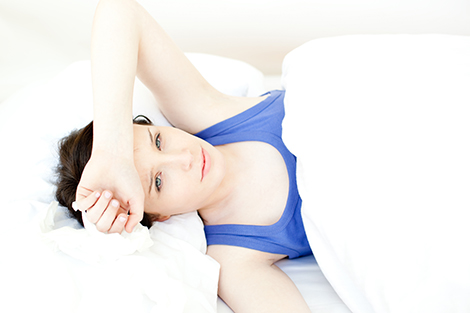
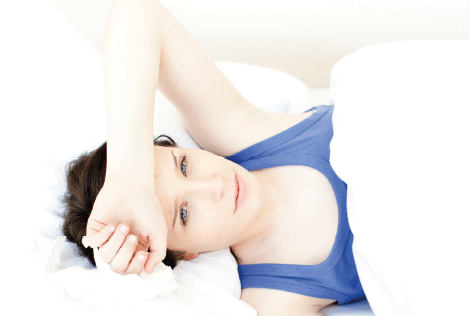
Ten per cent of people worldwide suffer from migraines
"This non-pharmacological approach (physical activity) may be an option for the prophylactic (preventative) treatment of migraine in patients who do not benefit from or do not want daily medication," wrote Dr Emma Varkey, lead author of a Swedish study published in the journal Cephalalgia in October.*
The aim of the research was to evaluate the effect of exercise in warding off migraine – a chronic neurological disorder characterised by moderate to severe headaches and nausea, which affects 10 per cent of people around the world.
Doctors use a variety of methods to prevent migraines, including topiramate – an anti-epilepsy drug – and relaxation exercises. While exercise is also prescribed, there has not previously been sufficient evidence to demonstrate that it works.
Three-month study Conducted by scientists at the University of Gothenburg, the randomised, controlled trial comprised 91 migraine patients aged 18-65 attending a headache clinic. All were women – the disorder is known to be more prominent in females – suffering from headaches two to eight times a month.
The women were split into three groups. One-third were prescribed a daily dose of topiramate – slowly increased to the individual’s highest tolerable level (with a maximum of 200mg a day). Another third carried out common forms of relaxation, breathing and stress-management techniques according to a recorded programme. The final group exercised on a static bike for 40 minutes, for three times a week, under the supervision of a physiotherapist.
Throughout the three-month study, the patients’ migraine status, quality of life, aerobic capacity and level of physical activity were evaluated before, during and after their respective treatment.
Surprising results The results show that migraine attacks decreased by approximately 75 per cent across all three groups and that there was no significant difference between them.
Commenting to Reuters Health, Dr Varkey said: “Topiramate is a drug of first choice that’s shown great effects in studies. It was a bit surprising and very interesting that the change in the number of migraine attacks was similar in all three groups. The only parameter where topiramate was better than exercise and relaxation was the reduction of pain intensity.
“On the other hand, the non-pharmacological options were free from adverse events and the exercise group increased oxygen uptake, which is very positive.”
While women in the exercise and relaxation groups had no issues, eight women taking topiramate had side-effects – tingling, fatigue, depression, vertigo and constipation – and consequently three left the study.
Varkey told Reuters Health: “From a wider health-based perspective, it should be stressed that patients with migraine are less physically active than the general population, and that exercise has positive effects in terms of general wellbeing and the prevention of disease.
“Additional and larger studies are, of course, needed to verify our results and to gain evidence for exercise as migraine treatment, but our results are hopeful.”
*Varkey, E et al. Exercise as migraine prophylaxis: A randomized study using relaxation and topiramate as controls. Cephalalgia. Vol 31, no 14, 1428–1438, Oct 2011.
Read more from this issue of Spa Business magazine
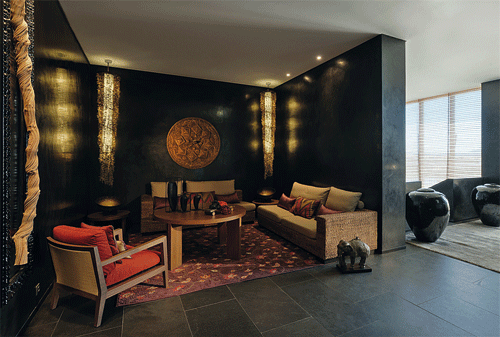
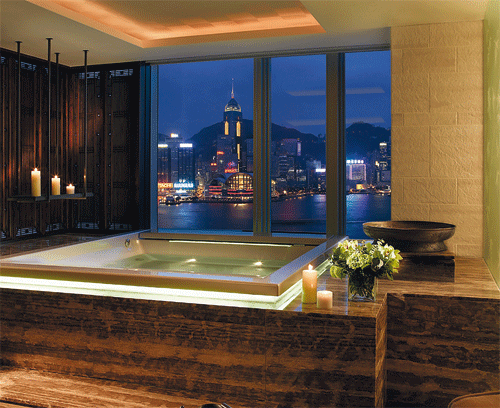
Top team: Peninsula Hotels
Kath Hudson talks to key figures behind the leading Asian hotel chain about how they run their spas and exciting future plans
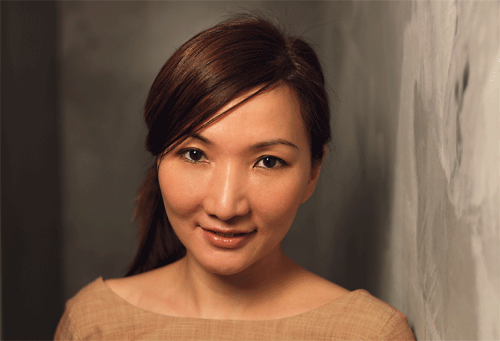
Profile: Cynthia Chua
The Singapore entrepreneur behind Ministry of Waxing and Browhaus has revolutionised personal grooming worldwide. She talks to Katie Barnes about the business of beauty and integration with spas
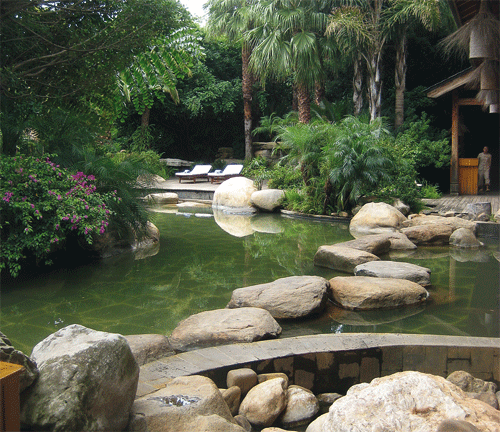
Hot springs: Chinese-style!
Lisa Starr tries out two hot spring spas - one catering to international visitors and the other to the domestic market - in China's Yunnan province
Bath time: The Chinese bathhouse
Lee David Stephens gives an insight into a traditional Chinese bathhouse and how Chinese people like to spa
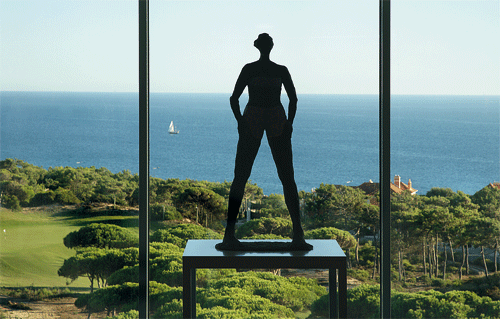
Resort Spa: Sands of time
The Oitavos hotel and spa on Portugal's Estoril coast is 90 years in the making. Tom Walker pays a visit
Interview: Gary Henkin
The president and founder of WTS International - the US-based spa management and consultancy firm - talks to Rhianon Howells about expanding globally
Ask an expert: Crisis control
The Arab Spring, the Japanese tsunami and bombings in Mumbai - what's the best way of dealing with a crisis? We ask those who have first-hand experience of the events
New Zealand thermal spa: Pooling resources
The Polynesian Spa in the geothermal town of Rotorua in New Zealand boasts 25 thermal pools and is one of the longest running attractions in the country. Chris McBeath takes a look
Tourism: Booming Baku
Terry Stevens reports on the Azerbaijan capital which has seen a surge of international hotel openings in the past two years
Fitness: Pilates pure vs applied
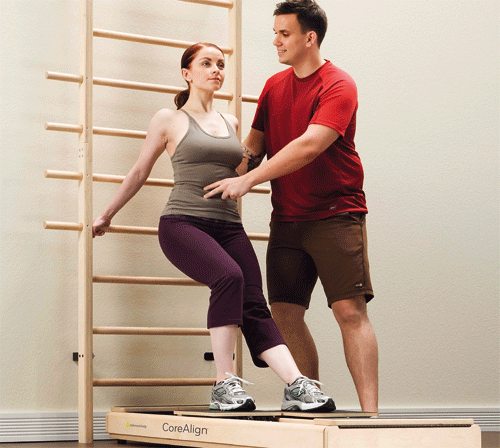
Pure vs applied - should pilates only ever involve the exercises designed by Joseph Pilates, or can his philosophy be applied while keeping the product moving with the times?
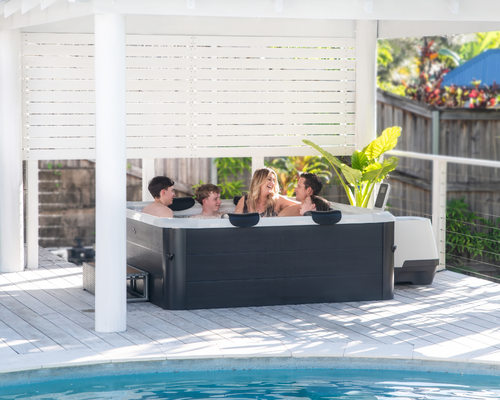
The MSpa Oslo series is a perennial bestseller in global markets. With innovative
engineering and premium performance, this completely portable spa line-up is expertly
designed to meet the needs of customers worldwide. [more...]
+ More featured suppliers
COMPANY PROFILES
Bellezi
Founded in 2009 as a Dutch family business, Bellezi brings more than 20 years of experience in treat [more...]
Ten per cent of people worldwide suffer from migraines
"This non-pharmacological approach (physical activity) may be an option for the prophylactic (preventative) treatment of migraine in patients who do not benefit from or do not want daily medication," wrote Dr Emma Varkey, lead author of a Swedish study published in the journal Cephalalgia in October.*
The aim of the research was to evaluate the effect of exercise in warding off migraine – a chronic neurological disorder characterised by moderate to severe headaches and nausea, which affects 10 per cent of people around the world.
Doctors use a variety of methods to prevent migraines, including topiramate – an anti-epilepsy drug – and relaxation exercises. While exercise is also prescribed, there has not previously been sufficient evidence to demonstrate that it works.
Three-month study Conducted by scientists at the University of Gothenburg, the randomised, controlled trial comprised 91 migraine patients aged 18-65 attending a headache clinic. All were women – the disorder is known to be more prominent in females – suffering from headaches two to eight times a month.
The women were split into three groups. One-third were prescribed a daily dose of topiramate – slowly increased to the individual’s highest tolerable level (with a maximum of 200mg a day). Another third carried out common forms of relaxation, breathing and stress-management techniques according to a recorded programme. The final group exercised on a static bike for 40 minutes, for three times a week, under the supervision of a physiotherapist.
Throughout the three-month study, the patients’ migraine status, quality of life, aerobic capacity and level of physical activity were evaluated before, during and after their respective treatment.
Surprising results The results show that migraine attacks decreased by approximately 75 per cent across all three groups and that there was no significant difference between them.
Commenting to Reuters Health, Dr Varkey said: “Topiramate is a drug of first choice that’s shown great effects in studies. It was a bit surprising and very interesting that the change in the number of migraine attacks was similar in all three groups. The only parameter where topiramate was better than exercise and relaxation was the reduction of pain intensity.
“On the other hand, the non-pharmacological options were free from adverse events and the exercise group increased oxygen uptake, which is very positive.”
While women in the exercise and relaxation groups had no issues, eight women taking topiramate had side-effects – tingling, fatigue, depression, vertigo and constipation – and consequently three left the study.
Varkey told Reuters Health: “From a wider health-based perspective, it should be stressed that patients with migraine are less physically active than the general population, and that exercise has positive effects in terms of general wellbeing and the prevention of disease.
“Additional and larger studies are, of course, needed to verify our results and to gain evidence for exercise as migraine treatment, but our results are hopeful.”
*Varkey, E et al. Exercise as migraine prophylaxis: A randomized study using relaxation and topiramate as controls. Cephalalgia. Vol 31, no 14, 1428–1438, Oct 2011.
Read more from this issue of Spa Business magazine
Top team: Peninsula Hotels
Kath Hudson talks to key figures behind the leading Asian hotel chain about how they run their spas and exciting future plans
Profile: Cynthia Chua
The Singapore entrepreneur behind Ministry of Waxing and Browhaus has revolutionised personal grooming worldwide. She talks to Katie Barnes about the business of beauty and integration with spas
Hot springs: Chinese-style!
Lisa Starr tries out two hot spring spas - one catering to international visitors and the other to the domestic market - in China's Yunnan province
Bath time: The Chinese bathhouse
Lee David Stephens gives an insight into a traditional Chinese bathhouse and how Chinese people like to spa
Resort Spa: Sands of time
The Oitavos hotel and spa on Portugal's Estoril coast is 90 years in the making. Tom Walker pays a visit
Interview: Gary Henkin
The president and founder of WTS International - the US-based spa management and consultancy firm - talks to Rhianon Howells about expanding globally
Ask an expert: Crisis control
The Arab Spring, the Japanese tsunami and bombings in Mumbai - what's the best way of dealing with a crisis? We ask those who have first-hand experience of the events
New Zealand thermal spa: Pooling resources
The Polynesian Spa in the geothermal town of Rotorua in New Zealand boasts 25 thermal pools and is one of the longest running attractions in the country. Chris McBeath takes a look
Tourism: Booming Baku
Terry Stevens reports on the Azerbaijan capital which has seen a surge of international hotel openings in the past two years
Fitness: Pilates pure vs applied
Pure vs applied - should pilates only ever involve the exercises designed by Joseph Pilates, or can his philosophy be applied while keeping the product moving with the times?
Private hotel owner and developer HVL Hotels will open a new luxury resort and tourism
destination called Laval Hunter Valley in the second half of 2027 in Pokolbin, Australia.
The annual wellness festival dedicated to wellbeing, culture, longevity and human connection,
called Alma, will be hosted by Rocco Forte hotel, Verdura Resort in Sicily, Italy.
Capella Hotel Group has appointed Feisal Jaffer as chief development officer as the company
ramps up its global expansion of both its Capella and Patina brands.
People taking GLP-1 weight loss medications such as Ozempic, Wegovy, Mounjaro and Zepbound
may be losing weight, but they’re also becoming less physically active, according to new
research presented at the ENDO 2026 annual meeting of the Endocrine Society
Abu Dhabi-based investment firm Mubadala Capital has made a binding, fully financed
€1 billion
offer to acquire Pierre and Vacances SA, the European holiday resort operator behind the
continental European Center Parcs business.
Global retreat trade show, Synergy The Retreat Show, has launched a resource called The
Source, which hosts an open-access online Transformation Series programme.
The Standards Authority for Touch in Cancer Care (SATCC) charity has announced its first five-
day Living with Cancer and Beyond retreat, which will be held at Carden Park Hotel and Spa in
Cheshire, UK, between 1 and 5 September.
Patmos Aktis, a Luxury Collection Resort and Spa, has opened in Greece, with a renovated and
rebranded wellness offering called Ansana Wellness and Spa.
The MSpa Oslo series is a perennial bestseller in global markets. With innovative
engineering and premium performance, this completely portable spa line-up is expertly
designed to meet the needs of customers worldwide. [more...]
+ More featured suppliers
COMPANY PROFILES
Bellezi Founded in 2009 as a Dutch family business, Bellezi brings more than 20 years of experience in treat [more...]