Could adding a touch of rivalry help spas to engage more customers in fitness and push them to get better results? Niamh Madigan looks at how operators can tap into that competitive streak
By Niamh Madigan | Published in Spa Business 2016 issue 1
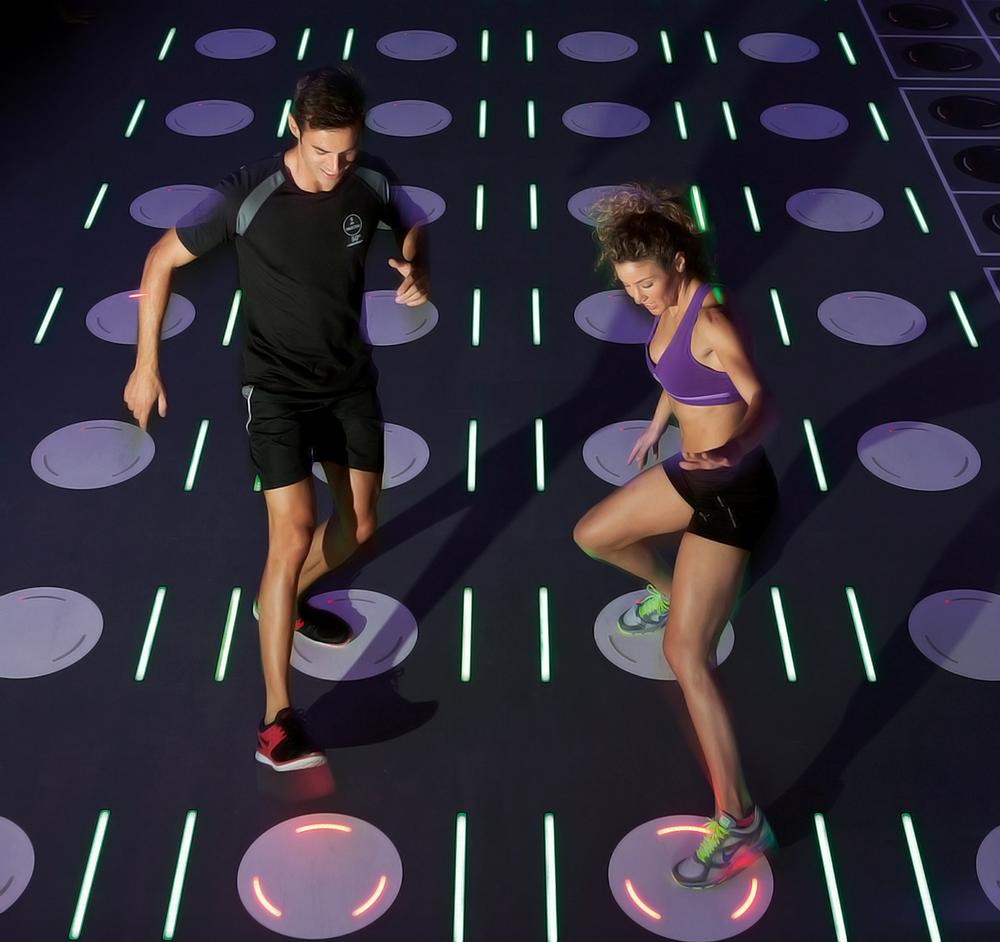
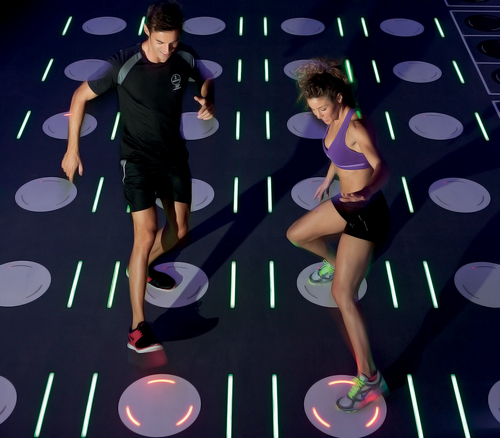
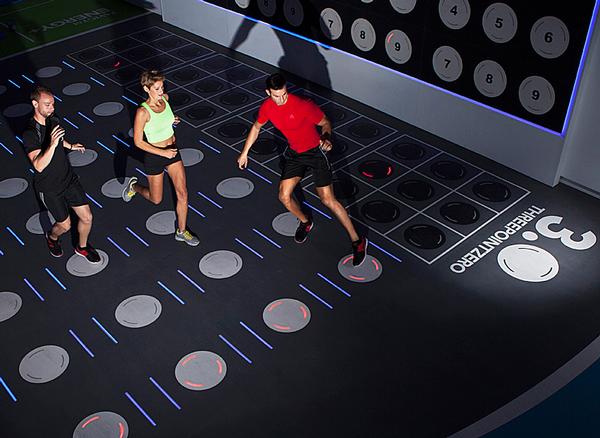
The Pavigym 3.0 Interactive Floor enables trainers to design and track workouts
Technology is having a massive impact on the way people exercise: from wearable devices and motivational apps to interactive training and virtual classes – the range of choice to suit all levels of fitness is huge. In hand with this, technology allows people to gamify their workouts to track and help improve their own performance or to compare their efforts with others. You only have to look at TV programmes such as The Biggest Loser, where obese couples race towards a target weight, to see how competition motivates the unlikeliest people to exercise.
It’s no secret that spas struggle to get customers – whether a member or one-off guest – to make full use of their fitness facilities and classes. So could competition or gaming be the key to boosting their engagement? We take a look at what operators can do to motivate people to exercise.
Read more from this issue of Spa Business magazine
Interview: Kenneth Ryan
Marriott’s global head of spa talks exclusively to Katie Barnes about the new ‘game-changing’ Ritz-Carlton Spa brand and market domination
Promotional feature: Steve Kass Consulting
Steve Kass, founder and former CEO of American Leisure, has launched a new business, Steve Kass Consulting. The global leader explains his goals as an innovative concept and design creator
Research: Work it out
Ophelia Yeung gives a sneak preview of a new study on workplace wellness that debuts later this month
Fitness: Competitive edge
Could a touch of rivalry help spas to engage more people in fitness? Niamh Madigan finds out
Promotional feature: Ojmar
A growing number of spa operators across the UK are working with Ojmar to upgrade their traditional keyed locking systems to electronic solutions
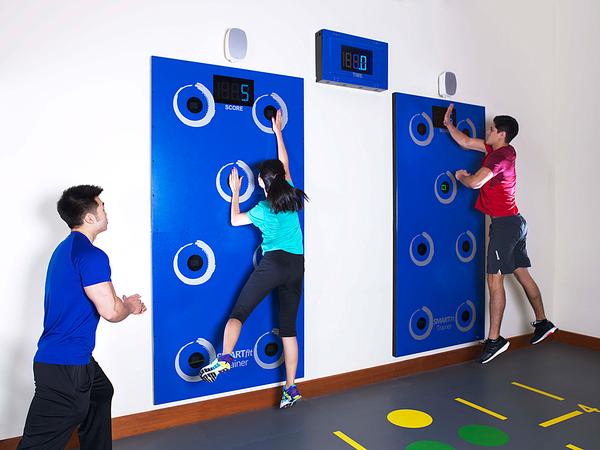
Getting interactive Multisensory Fitness Inc Sensory motor activity reaction training (SMARTfit™) programmes by Multisensory Fitness Inc combine cognitive and physical game-based workouts. Its interactive Trainer wall, the SMARTfit Multi Station Trainer, uses alphanumeric multicoloured targets, a scoreboard and a timer to encourage competing team play.
It's designed to stimulate the body and brain so the user gets an intensive full-body workout. This is something that appealed to Fairmont Singapore which installed the SMARTfit in its new cutting-edge fitness centre. “By using the concept of games and competition, guests get a quick cardio workout,” says Thea Huang, director of spa and wellness. “There are between 70-100 programmes which include different forms of physical activity, such as running, cross-training or circuit training. You can achieve a very intense cardio workout after only 10 minutes.”
She says the SMARTfit programmes are ideal for group workouts, a fun activity for corporate groups and have been a hit when it comes to personal training. They also act as a differentiator in the marketplace. Huang adds: “We want our guests to remember that we have this offering which they cannot get anywhere else at the moment.”
Pavigym In Dubai, Fairmont has also installed Pavigym’s 3.0 interactive floor and wall panels in its health club. Integrating LED lights controlled by touch screen software, the surfaces enable trainers to design and track workout sessions.
The average cost for a SMARTfit Trainer is US$20,000 (€18,780, £13,280). Pavigym says prices vary greatly according to facility size and mix of products.
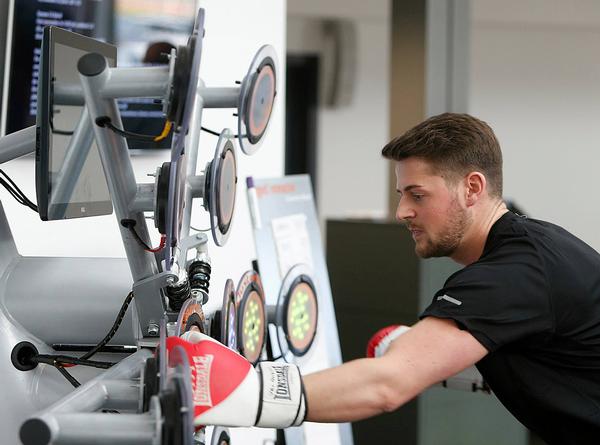
Rugged Interactive Similarly, CardioWall by Rugged Interactive has several light push points that illuminate in different sequences for various games. People can use their hands to set off the lights or incorporate accessories such as weighted balls, boxing gloves or balance boards into the mix.
CardioWall uses engaging vocal commands, colours and sounds to interact with and motivate the user. As an added incentive, scores are displayed on both an built-in screen and via a website to push users to beat their own total or those of rivals – anywhere in the world – to get a CardioWall ranking.
Simon Heap, who’s the founder of Rugged Interactive, says: “We’ve found results to be really effective especially when competition is encouraged. Our research has shown equivalent exertion with other gym equipment, but with a much higher user satisfaction rating.”
With worldwide distribution, CardioWall costs £6,000 (US$9,050, €8,530) to install.
Fairmont Singapore uses SMARTfit to motivate guests
Dubai Fairmont uses Pavigym flooring
Rugged Interactive supplies a range of products to stimulate the body and mind
On the leaderboard CrossFit CrossFit’s high-intensity cardio and strengthening workouts have become an explosive fitness phenomenon – there are now over 11,000 affiliated gyms globally – fuelled in part by the annual CrossFit Games for the “The Fittest on Earth”. To qualify for the games, people submit workout scores on an internet leaderboard: a tactic that attracted nearly 140,000 contestants in 2013 according to Forbes magazine.
Myzone Other companies such as Myzone® are using rating and points systems to engage spa fitness customers.
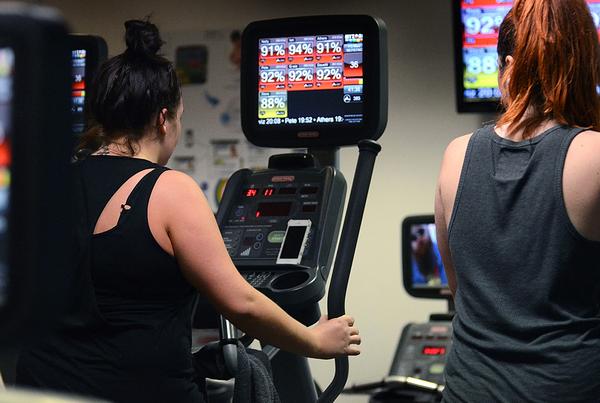
The Myzone chest strap tracks heart rate, calories burnt and time spent exercising and is used to calculate Myzone Effort Points (MEPs) which are awarded for every minute spent active. The more intense the workout, the more points earned. This information is displayed on a monitor or streamed to an app in real time.
Using the MEPs system, challenges can be set to keep users engaged and on track to achieve goals. With built-in leaderboards, status rankings and social integration, it’s easy to monitor progress and earn points, turning fitness into a game with an option to compete against others.
The Spa Naturel Fitness Club at Mercure’s Southgate Hotel, UK installed Myzone® a year ago. Gym manager Steve Forbes says: “Usage went up, people want to come to the gym to get their MEPs so they can appear on the leaderboard.”
Myzone is available globally and costs £295 (US$445, €420). Operators pay a monthly licence fee of £99 (US$149, €141).
Users work harder to earn more points with the Myzone rating system
Gaming & immersion Les Mills International Mixing indoor fitness with virtual reality is a popular way to motivate people to exercise. Leading the charge in this arena is group exercise specialist Les Mills. In mid 2014, it launched the Immersive Fitness™ experience that projects cinema-quality video content onto a screen, while instructors cue exercise moves to synchronise with music and graphics. Les Mills says an immersive environment brings a heightened sense of anticipation and reward. By suspending belief, people stop thinking about the duration of the workout and push themselves further.
Webracing Webracing is also combining gaming, virtual reality and competition.
Webracing™ gives spa fitness goers on machines such as bikes, rowers and cross trainers a chance to compete against individuals or groups, while watching themselves in a virtual world. A small device fitted to the equipment connects everyone online for an on-screen race. With voice over internet protocol, users can talk to competitors or training partners, turning static exercise into an engaging event.
“If exercisers are mentally engaged, they’re likely to put in 10-15 per cent more effort and anecdotal evidence shows that people are much more likely to complete a course or session,” says Webracing founder Duncan Lawson.
He says the Webracing Peloton programme for multiple bike racing would be a good fit for spas with studio space. It requires an average of five static bikes and a projector or LED screen with costs starting at £5,000 (US$7,540, €7,110).
Embedded Fitness Embedded Fitness blends physical fitness with entertainment, new media, technology and gaming. Using interactive devices, users can play games while they exercise. Activities include ice-skating, rowing, dancing, trampolining and even basketball. With some devices the user can set a high score and use it to compete against others.
CEO Carla Scholten says: “Embedded Fitness is fun, but also therapeutic. For spas we prefer to make specially designed and personalised interactive rooms.”
The Dutch-based company already has an installation in Qatar and is looking to continue its global expansion in 2016.
Les Mills’ Immersive Fitness launched in 2014 and is available globally
Niamh Madigan is a multimedia journalist and fitness enthusiast
In the fast-paced world of fitness and wellness, where high-intensity workouts push us to
our limits and the sweat pours, the importance of efficient recovery cannot be overstated. [more...]
Could adding a touch of rivalry help spas to engage more customers in fitness and push them to get better results? Niamh Madigan looks at how operators can tap into that competitive streak
By Niamh Madigan | Published in Spa Business 2016 issue 1
The Pavigym 3.0 Interactive Floor enables trainers to design and track workouts
Technology is having a massive impact on the way people exercise: from wearable devices and motivational apps to interactive training and virtual classes – the range of choice to suit all levels of fitness is huge. In hand with this, technology allows people to gamify their workouts to track and help improve their own performance or to compare their efforts with others. You only have to look at TV programmes such as The Biggest Loser, where obese couples race towards a target weight, to see how competition motivates the unlikeliest people to exercise.
It’s no secret that spas struggle to get customers – whether a member or one-off guest – to make full use of their fitness facilities and classes. So could competition or gaming be the key to boosting their engagement? We take a look at what operators can do to motivate people to exercise.
Read more from this issue of Spa Business magazine
Interview: Kenneth Ryan
Marriott’s global head of spa talks exclusively to Katie Barnes about the new ‘game-changing’ Ritz-Carlton Spa brand and market domination
Promotional feature: Steve Kass Consulting
Steve Kass, founder and former CEO of American Leisure, has launched a new business, Steve Kass Consulting. The global leader explains his goals as an innovative concept and design creator
Research: Work it out
Ophelia Yeung gives a sneak preview of a new study on workplace wellness that debuts later this month
Fitness: Competitive edge
Could a touch of rivalry help spas to engage more people in fitness? Niamh Madigan finds out
Promotional feature: Ojmar
A growing number of spa operators across the UK are working with Ojmar to upgrade their traditional keyed locking systems to electronic solutions
Getting interactive Multisensory Fitness Inc Sensory motor activity reaction training (SMARTfit™) programmes by Multisensory Fitness Inc combine cognitive and physical game-based workouts. Its interactive Trainer wall, the SMARTfit Multi Station Trainer, uses alphanumeric multicoloured targets, a scoreboard and a timer to encourage competing team play.
It's designed to stimulate the body and brain so the user gets an intensive full-body workout. This is something that appealed to Fairmont Singapore which installed the SMARTfit in its new cutting-edge fitness centre. “By using the concept of games and competition, guests get a quick cardio workout,” says Thea Huang, director of spa and wellness. “There are between 70-100 programmes which include different forms of physical activity, such as running, cross-training or circuit training. You can achieve a very intense cardio workout after only 10 minutes.”
She says the SMARTfit programmes are ideal for group workouts, a fun activity for corporate groups and have been a hit when it comes to personal training. They also act as a differentiator in the marketplace. Huang adds: “We want our guests to remember that we have this offering which they cannot get anywhere else at the moment.”
Pavigym In Dubai, Fairmont has also installed Pavigym’s 3.0 interactive floor and wall panels in its health club. Integrating LED lights controlled by touch screen software, the surfaces enable trainers to design and track workout sessions.
The average cost for a SMARTfit Trainer is US$20,000 (€18,780, £13,280). Pavigym says prices vary greatly according to facility size and mix of products.
Rugged Interactive Similarly, CardioWall by Rugged Interactive has several light push points that illuminate in different sequences for various games. People can use their hands to set off the lights or incorporate accessories such as weighted balls, boxing gloves or balance boards into the mix.
CardioWall uses engaging vocal commands, colours and sounds to interact with and motivate the user. As an added incentive, scores are displayed on both an built-in screen and via a website to push users to beat their own total or those of rivals – anywhere in the world – to get a CardioWall ranking.
Simon Heap, who’s the founder of Rugged Interactive, says: “We’ve found results to be really effective especially when competition is encouraged. Our research has shown equivalent exertion with other gym equipment, but with a much higher user satisfaction rating.”
With worldwide distribution, CardioWall costs £6,000 (US$9,050, €8,530) to install.
Fairmont Singapore uses SMARTfit to motivate guests
Dubai Fairmont uses Pavigym flooring
Rugged Interactive supplies a range of products to stimulate the body and mind
On the leaderboard CrossFit CrossFit’s high-intensity cardio and strengthening workouts have become an explosive fitness phenomenon – there are now over 11,000 affiliated gyms globally – fuelled in part by the annual CrossFit Games for the “The Fittest on Earth”. To qualify for the games, people submit workout scores on an internet leaderboard: a tactic that attracted nearly 140,000 contestants in 2013 according to Forbes magazine.
Myzone Other companies such as Myzone® are using rating and points systems to engage spa fitness customers.
The Myzone chest strap tracks heart rate, calories burnt and time spent exercising and is used to calculate Myzone Effort Points (MEPs) which are awarded for every minute spent active. The more intense the workout, the more points earned. This information is displayed on a monitor or streamed to an app in real time.
Using the MEPs system, challenges can be set to keep users engaged and on track to achieve goals. With built-in leaderboards, status rankings and social integration, it’s easy to monitor progress and earn points, turning fitness into a game with an option to compete against others.
The Spa Naturel Fitness Club at Mercure’s Southgate Hotel, UK installed Myzone® a year ago. Gym manager Steve Forbes says: “Usage went up, people want to come to the gym to get their MEPs so they can appear on the leaderboard.”
Myzone is available globally and costs £295 (US$445, €420). Operators pay a monthly licence fee of £99 (US$149, €141).
Users work harder to earn more points with the Myzone rating system
Gaming & immersion Les Mills International Mixing indoor fitness with virtual reality is a popular way to motivate people to exercise. Leading the charge in this arena is group exercise specialist Les Mills. In mid 2014, it launched the Immersive Fitness™ experience that projects cinema-quality video content onto a screen, while instructors cue exercise moves to synchronise with music and graphics. Les Mills says an immersive environment brings a heightened sense of anticipation and reward. By suspending belief, people stop thinking about the duration of the workout and push themselves further.
Webracing Webracing is also combining gaming, virtual reality and competition.
Webracing™ gives spa fitness goers on machines such as bikes, rowers and cross trainers a chance to compete against individuals or groups, while watching themselves in a virtual world. A small device fitted to the equipment connects everyone online for an on-screen race. With voice over internet protocol, users can talk to competitors or training partners, turning static exercise into an engaging event.
“If exercisers are mentally engaged, they’re likely to put in 10-15 per cent more effort and anecdotal evidence shows that people are much more likely to complete a course or session,” says Webracing founder Duncan Lawson.
He says the Webracing Peloton programme for multiple bike racing would be a good fit for spas with studio space. It requires an average of five static bikes and a projector or LED screen with costs starting at £5,000 (US$7,540, €7,110).
Embedded Fitness Embedded Fitness blends physical fitness with entertainment, new media, technology and gaming. Using interactive devices, users can play games while they exercise. Activities include ice-skating, rowing, dancing, trampolining and even basketball. With some devices the user can set a high score and use it to compete against others.
CEO Carla Scholten says: “Embedded Fitness is fun, but also therapeutic. For spas we prefer to make specially designed and personalised interactive rooms.”
The Dutch-based company already has an installation in Qatar and is looking to continue its global expansion in 2016.
Les Mills’ Immersive Fitness launched in 2014 and is available globally
Niamh Madigan is a multimedia journalist and fitness enthusiast
Global Wellness Day (GWD) will mark its 15th anniversary on Saturday 13 June 2026, with the
theme: #JoyMagenta – a celebration of the healing qualities of simple gestures and activities
that spark joy.
Global luxury hospitality brand, Six Senses, has partnered with longevity healthcare provider,
HUM2N, to launch a clinic at Six Senses London, at The Whiteley.
As part of its first hotel partnership, Mayrlife – the medical health resort company known for its
site in Altaussee, Austria – has launched a day clinic at the Rosewood Vienna.
Premium London health club, KX Chelsea, will imminently unveil its most significant
redevelopment since its launch in 2002 to create an integrated wellness model combining
training, recovery and relaxation.
Rosewood Le Guanahani St Barth, on the northeast coast of Saint Barthélemy in the French
West Indies, is offering a programme of ocean-inspired yoga classes between 8-14 June to
celebrate Global Wellness Day (GWD).
Hotel de France, located on the British Isle of Jersey, has created a wellness retreat package
that includes a hot yoga session that will take place in Jersey Zoo’s butterfly sanctuary.
The Ritz-Carlton, Langkawi, in Malaysia, has revealed a schedule for Global Wellness Day
(GWD) that includes guided rainforest walks, mindful movement and guided coastal meditation
experiences.
Longevitix, a clinical platform for preventive and longevity medicine, has launched its AI-
powered intelligence system to help physicians deliver continuous, personalised longevity-
focused care at scale.
Atmantan Wellness Centre, an integrative wellness destination in Mulshi, near Pune in India, is
expanding its portfolio by adding a new centre in Hyderabad that will launch between 2028 and
2029.
A recent survey by the UK Spa Association (UKSA) into the industry’s approach to cancer care
has revealed that almost half of participating respondents (46 per cent) are unaware that
cancer is a disability and guests with a cancer diagnosis must be given
In the fast-paced world of fitness and wellness, where high-intensity workouts push us to
our limits and the sweat pours, the importance of efficient recovery cannot be overstated. [more...]