Yes! Send me the FREE digital editions of Spa Business and Spa Business insider magazines and the FREE weekly Spa Business and Spa Business insider ezines and breaking news alerts!
As Saudi Arabia’s ambitious giga project, The Red Sea, gears up
to welcome its first guests in the next few months, the chair of
its advisory board reveals key details about the destination to
Megan Whitby and shares her passion for regenerative tourism
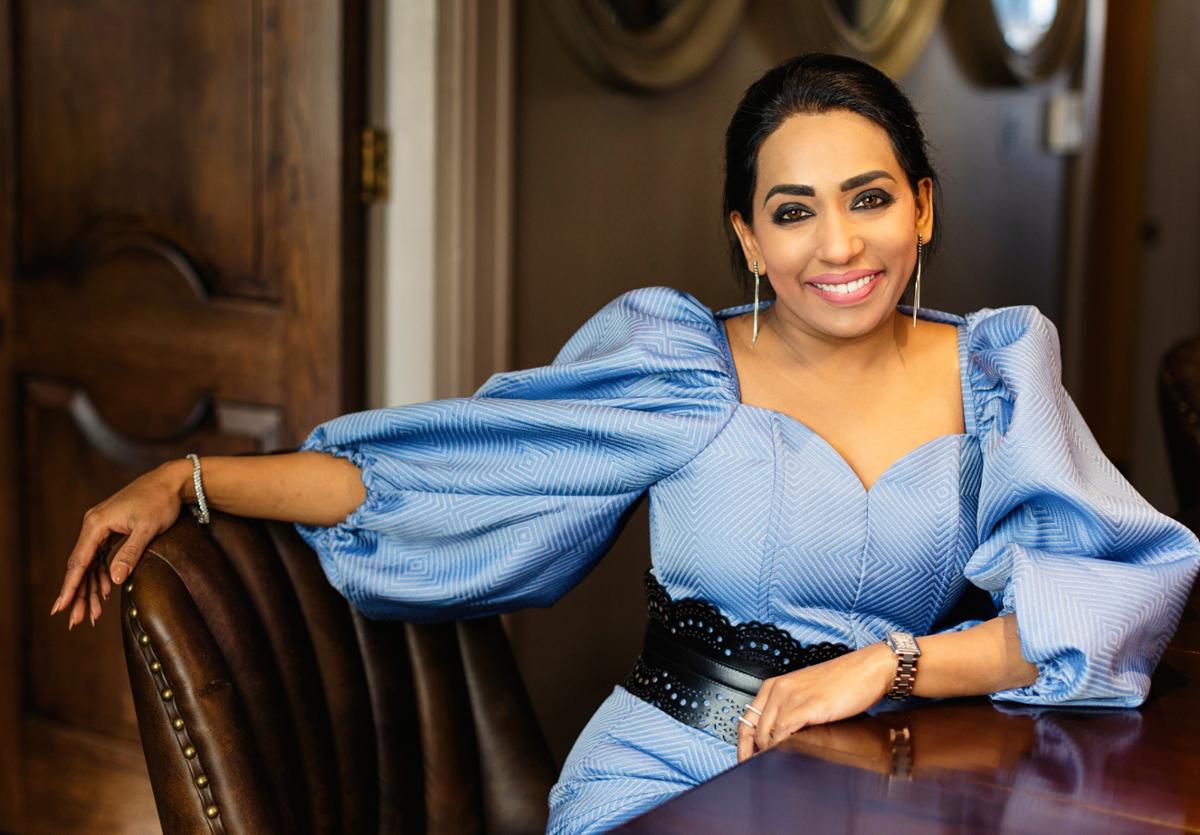
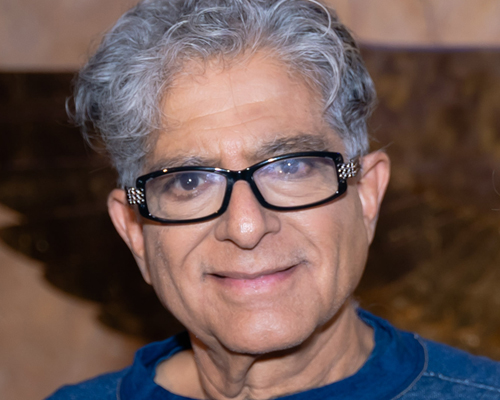
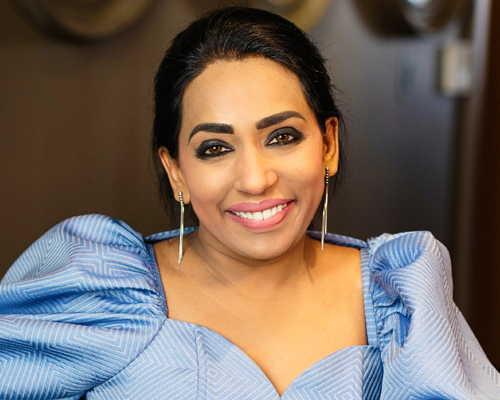
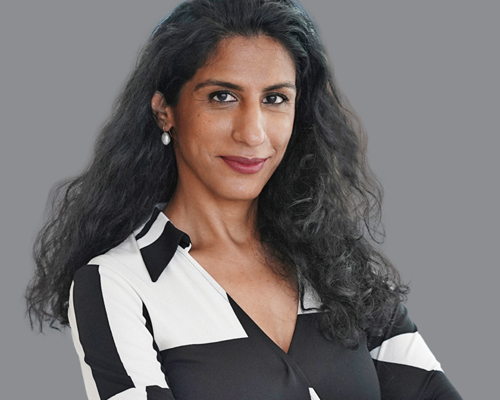
Khowala is a women’s health advocate and spoke on this topic at this year’s GWS / Photo: Aptamind Partners
Aradhana Khowala is a strategy specialist in travel and hospitality, diversity, inclusion and women’s health.
With qualifications from Ecole hôtelière de Lausanne, Cornell and INSEAD, she’s leveraging her experience to chair the advisory board for Red Sea Global (RSG) – the developer behind The Red Sea, a resort destination nearly the size of Belgium.
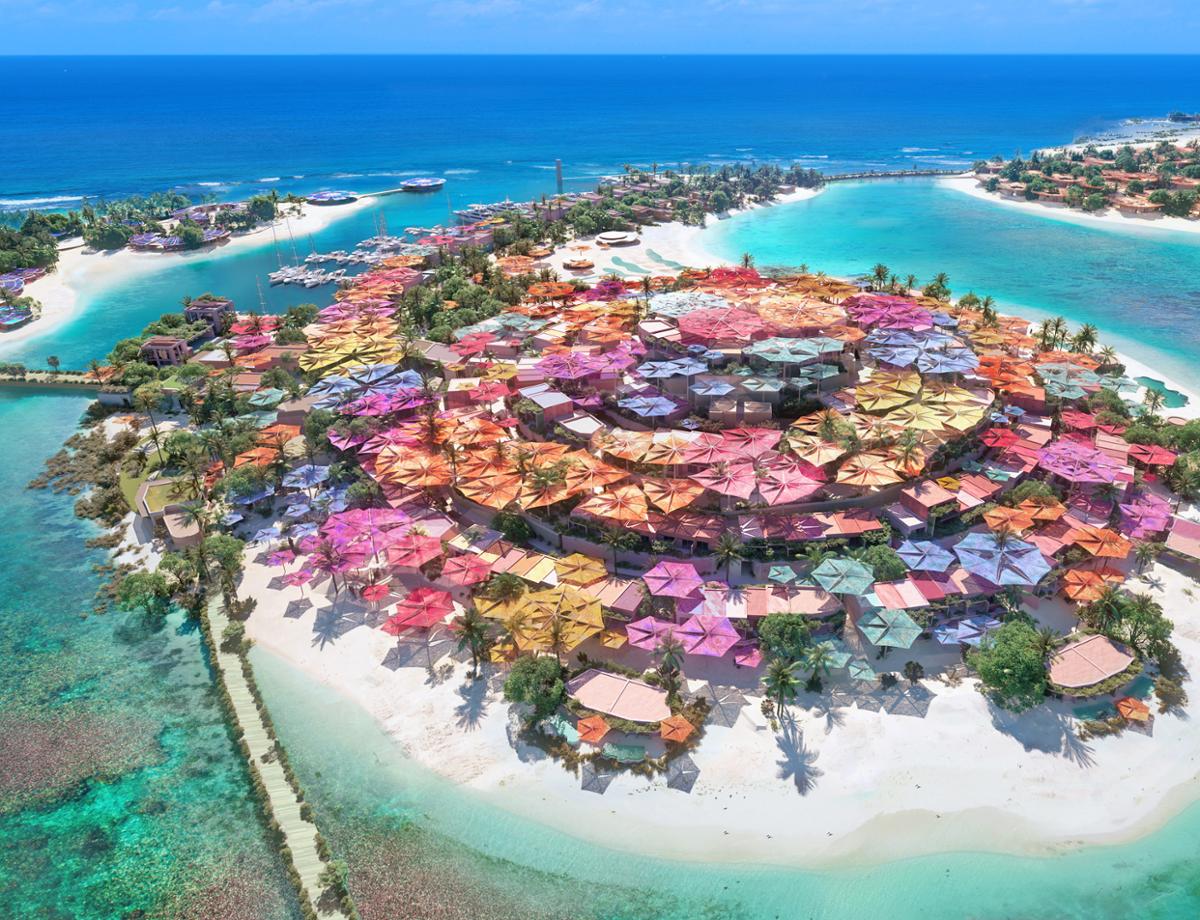
RSG is owned by the Public Investment Fund of Saudi. The Red Sea, billed as one of the most ambitious ever tourism infrastructure projects, extends across 28,000sq km of Saudi Arabian coastline.
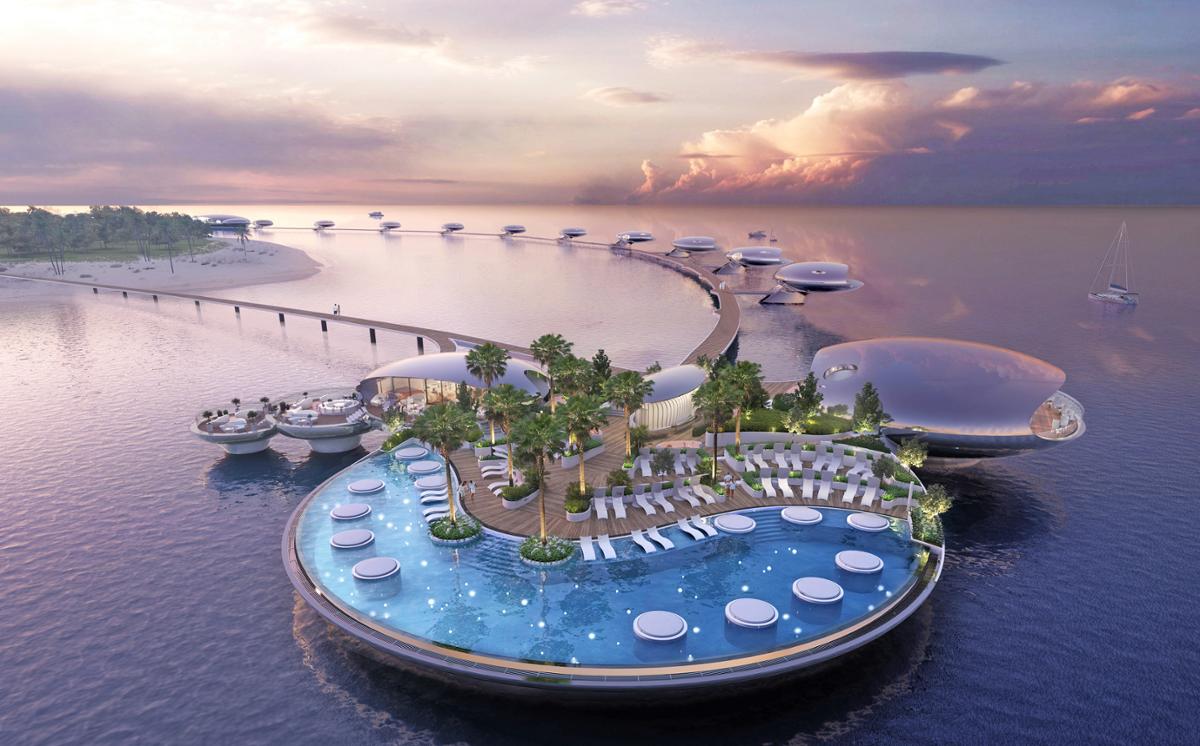
Construction began in 2019 and work is on track to welcome guests in early 2023 when the first hotels open. This initial phase of development is set for completion in 2024, by which time it will boast 16 hotels, including wellness-focused brands such as Six Senses, Miraval, Raffles and Rosewood (see p54).
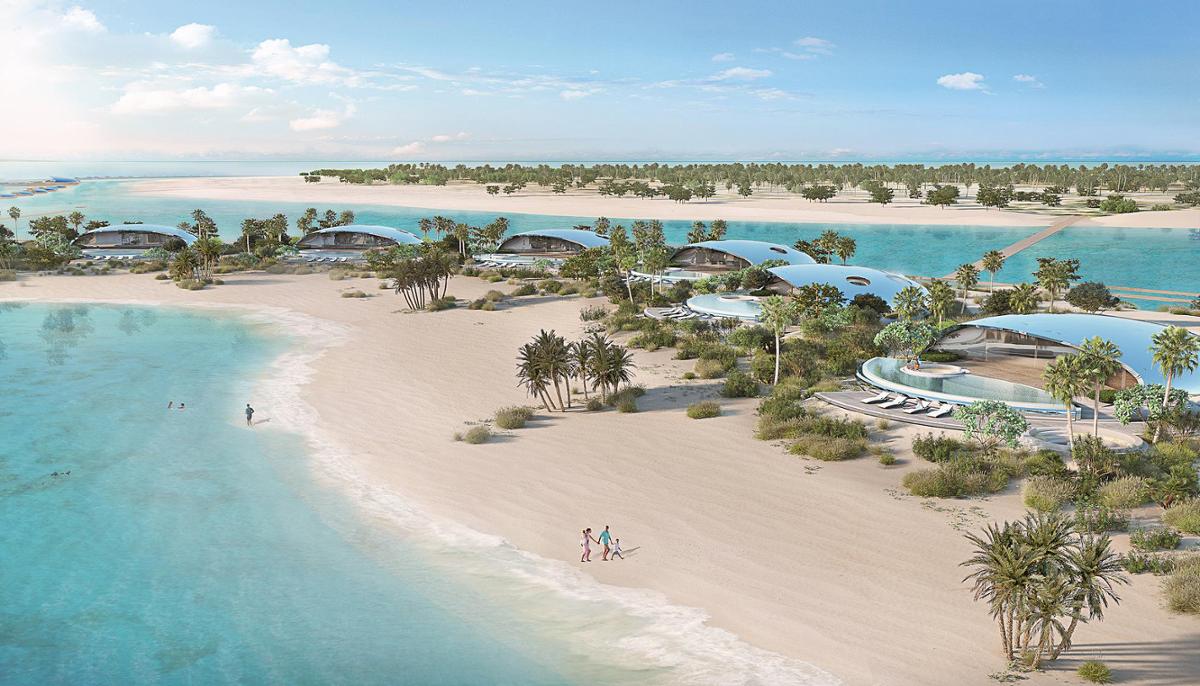
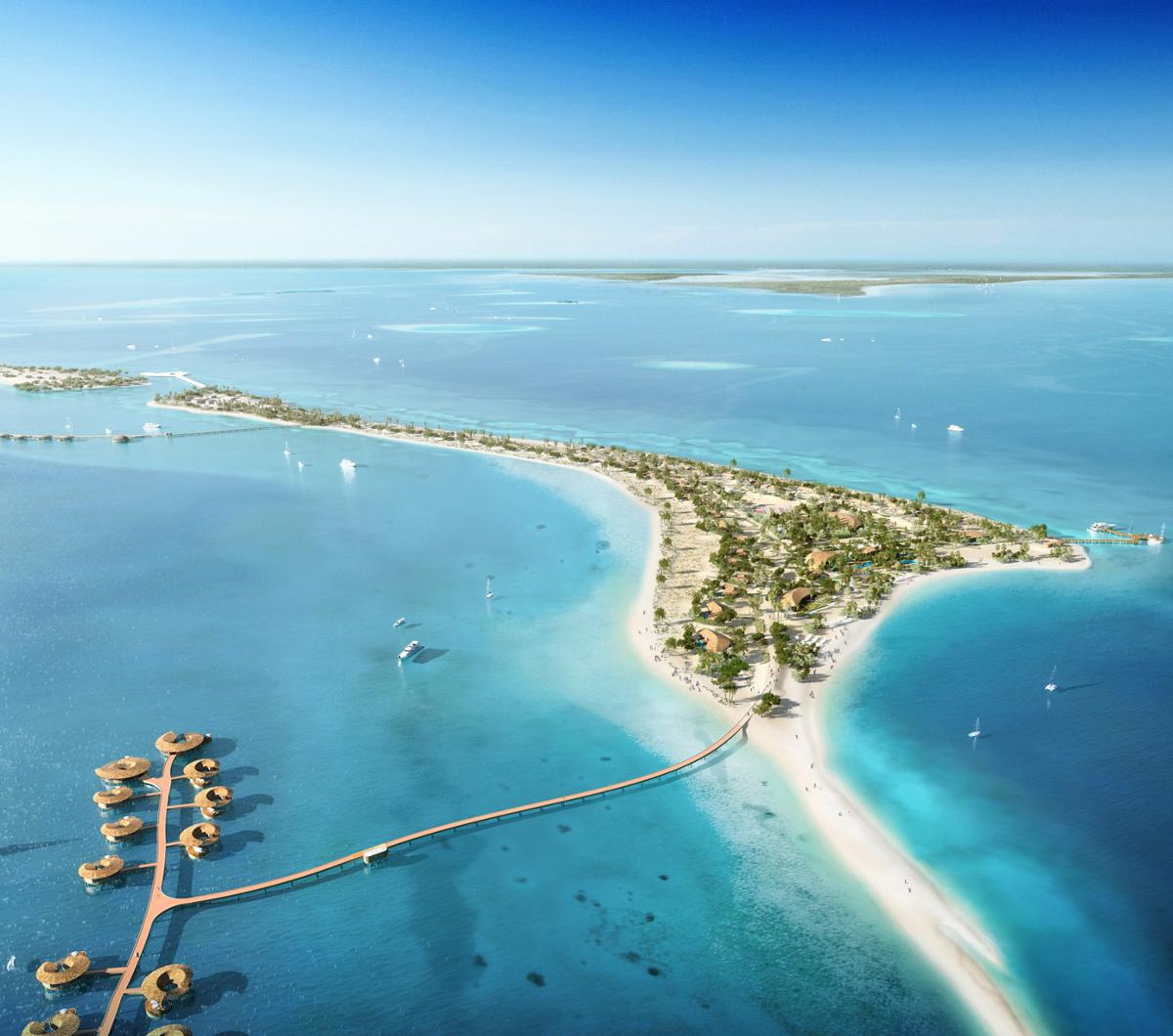
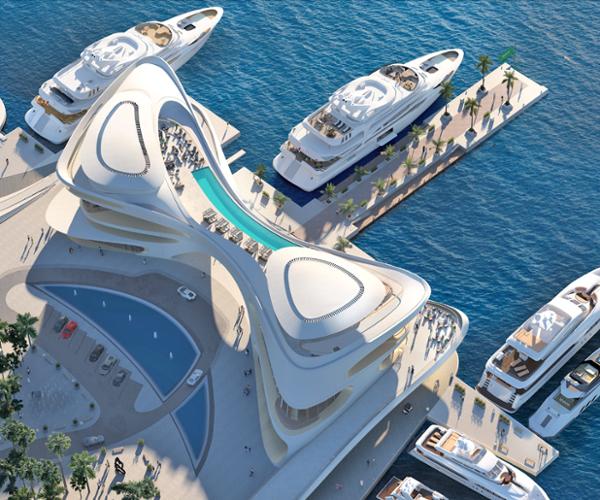
Once the entire destination is finished in 2030, it will have 50 hotels stretching across 22 islands and six inland locations, offering 8,000 hotel rooms and 1,300 residential properties.
The Red Sea will also have an international airport, which will be operational next year, marinas, golf courses and entertainment and leisure facilities.
The overall aim is to attract a million visitors a year – capped in line with its sustainability ambitions – by 2030 creating 70,000 jobs and contributing SAR22bn (US$5.9bn, €5.1bn, £4.3bn) to the nation’s GDP.
Khowala, who’s been running her tourism consultancy Aptamind Partners for 15 years, says RSG’s commitment to regenerative travel is game changing as it raises standards and accelerates the pace of change for everybody else.
The company has committed to creating a destination with a net positive conservation impact, taking measures to not only keep the site as close to its natural state as possible, but also to enhance it.
Developed in partnership with WATG and Buro Happold, the masterplan focuses on the pristine natural environment, which is home to the world’s fourth-largest barrier reef system, untouched corals and a significant number of endangered species. RSG’s in-house scientists have recently concluded an 11-month-long Environmental Baseline Survey to assess the needs of the ecosystem ahead of and during development, as well as after opening.
Khowala sat down with Spa Business to give the lowdown on the project.
How does Red Sea link to Saudi Arabia’s Vision 2030 strategy? It’s the largest of six giga projects that make up Vision 2030, the government’s strategy to increase Saudi Arabia’s tourist industry revenues from the current 3 per cent of GDP, to 10 per cent by 2030. RSG’s combined projects will contribute approximately SAR33bn (US$8.7bn, €8.5bn, £7.2bn) to GDP, coupled with 120,000 new jobs.
I feel honoured to be able to support the transformation and the development of an industry that creates jobs, drives economic growth and showcases the richness of Saudi culture to the world.
What’s the vision for the project? The goal is to put people and the planet first, leveraging innovative technologies to deliver projects that enhance the wellbeing of customers, communities and environments. By doing so, it will open Saudi Arabia’s doors to a new wave of tourism.
Guests will be able to experience the diverse landscape and rich history and culture of the region, exploring dormant volcanoes, diving with turtles, star gazing in one of the most stunning places on earth or swimming in a turquoise lagoon. They’ll come away with treasured memories of both the natural environment and the extraordinary hospitality.
Why is regenerative tourism a priority? All too often tourism is disruptive – and sometimes damaging – for destinations. Globally tourism accounts for 10 per cent of CO2 emissions and this is expected to rise by 25 per cent by 2030. But it doesn’t have to be this way.
Our project is centred on the belief that nature is the world’s most important asset and we all have a part to play in protecting it. Regenerative tourism is the commitment to implementing policies that don’t just avoid harming the environment, but actively enhance it.
This philosophy is expressed in one of our aims: delivering a net conservation benefit of 30 per cent to the surrounding area by 2040. To support this commitment we utilised marine spatial planning software to generate a picture of our lagoon. We then assessed the potential environmental impacts of our development and the opportunities to optimise conservation benefits, leading to the decision to leave 75 per cent of the islands untouched and designate nine as special conservation zones.
This year we also released our Environmental Baseline Report which collates detailed information about the surrounding ecosystem. It analyses the populations, behaviours and habitats of the wildlife across 200km of Red Sea coastline and will inform our development plans and conservation efforts.
We want to show that development, tourism and environmental destruction don’t have to go hand in hand if done in the right way.
When will the first phase open? The first hotels will welcome guests in early 2023 and the project will be fully operational by 2030.
We’re constantly adapting and working on solutions to the challenges we face and given our ongoing commitment to improving the natural surroundings and economic vitality of the region, I can only see our work increasing as time goes on.
How important will wellness be to attract guests? We’re aiming to provide an all-encompassing experience, in which wellness will play an important part. Some activities will encourage guests to experience the natural environment and heritage at a personal level. These include a range of culinary, musical and artisanal activities, as well as hikes and guided eco-excursions on land and sea, such as hiking on dormant volcanoes and observing rare animals and plants in their natural habitat.
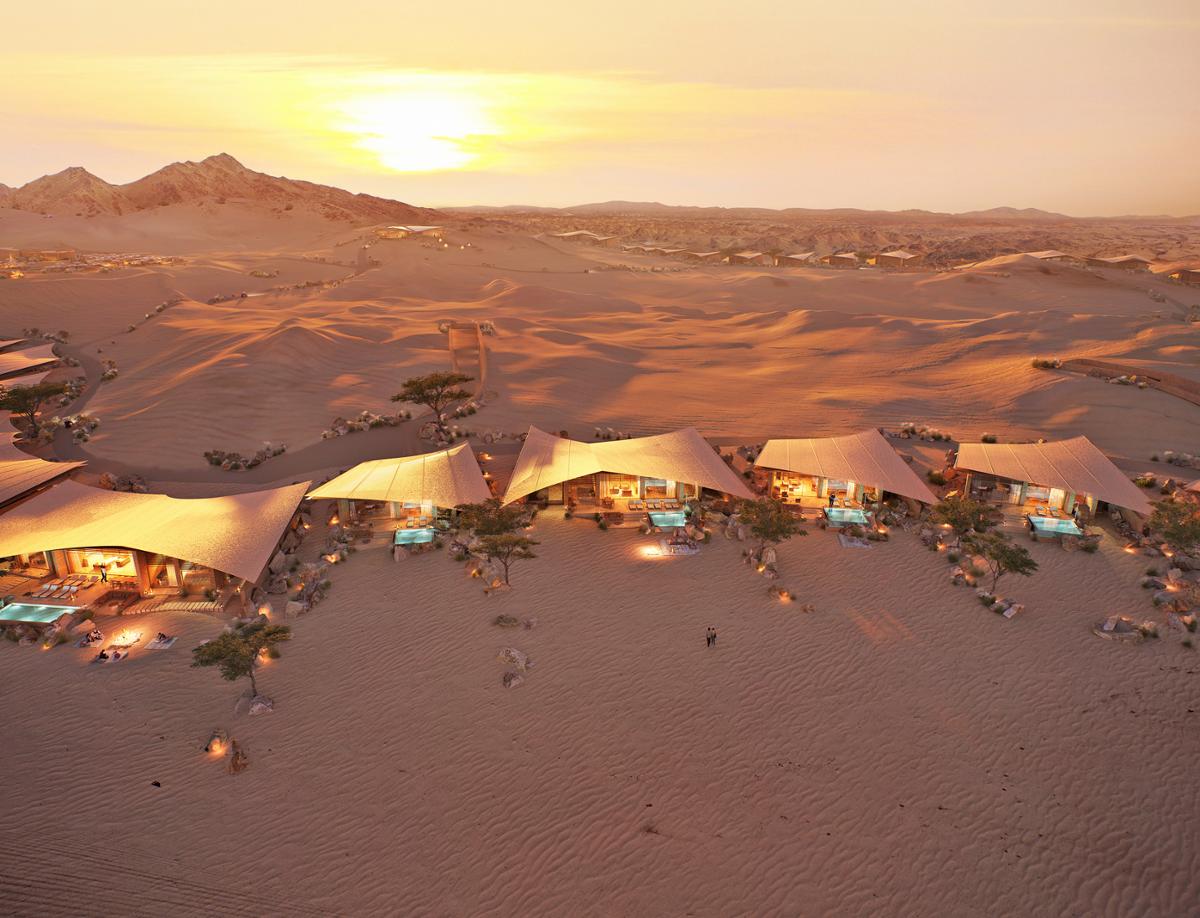
Some of the world’s most iconic hotel brands are involved (see ‘Project Partners’ table) and many of these are well-known for their health and wellness offerings, such as Rosewood, Miraval, Raffles and Ritz-Carlton Reserve. Six Senses will be operating our Southern Dunes resort that will include a holistic anti-ageing centre, sensory suites, wet zones and outdoor treatment cabanas.
What kind of visitors do you expect to attract? Our airport will be within eight hours’ flying time of 80 per cent of the global population, so we hope we’ll have a very diverse guestbook.
What does regenerative tourism mean to you? My passion stems from the fact that I couldn’t sit on the sidelines and ignore the widening gap between what we talk about and what’s happening around us.
I founded my consultancy, Aptamind, with a mission to make sustainability, community empowerment and diversity and inclusion non-negotiable pillars for every business in the travel, tourism and hospitality sector.
We lobby about the importance of these values, both in terms of economic power and positive change in the societies and communities that travel touches.
Why is it important for business? I genuinely believe the most successful companies of the future will be those that profit from fixing the world’s problems, not from creating them.
Regenerative tourism isn’t anti-growth; it simply asks that we grow the things that matter most in ways that benefit the entire system and not at the expense of others.
Public opinion is shifting so fast that those businesses sensing and responding to the emerging need to be regenerative are gaining ground while others are being left behind.
Increasingly, guests are developing an appetite for connecting with the soul of a destination. The community-enhancing regeneration that underpins higher levels of care for everyone is a real differentiator.
• What's the latest with Amaala, Saudi's wellness-focused giga project? Read our interview with Stephan Wagner on p44
The Red Sea
– Sustainability initiatives
• Relying on 100 per cent renewable energy, using solar and wind
• Operating as a carbon-neutral destination
• Banning the use of single-use plastic
• Implementing dark sky lighting measures to reduce light pollution
• Pledging to send zero waste to landfill or the sea
• Mitigating noise pollution
• Creating a battery storage facility to allow the destination to remain off-grid during sandstorms
• Bringing in hydroponic greenhouses and vertical farming to help local farmers meet new demand
• Utilising low-carbon concrete made from recycled raw materials
• Promoting walkability
• Adopting a clean mobility strategy built around electric and hydrogen-powered vehicles, boats and aircraft
• Organising marine clean-ups with the local community
• Establishing a plant nursery that will grow 15 million plants for landscaping by 2030
Project Partners
International hotel brands
Edition Hotels
Faena
Fairmont
Grand Hyatt
InterContinental
Jumeirah
Miraval
Raffles
Ritz-Carlton Reserve
Rosewood
Six Senses
SLS Hotels & Residences
St Regis
Architectural firms
Foster + Partners
Killa Design
Kengo Kuma
RSG advisory board members
September 2022/alphabetically
• Philippe Cousteau Jr, president, EarthEcho International
• Carlos Duarte, professor, Red Sea Research Centre
• Maryam Ali Ficociello, chief governance officer, RSG
• Sue Harmsworth, founder, Espa
• Frances-Anne Keeler, specialist in tourism destination marketing
• Aradhana Khowala, CEO, Aptamind Partners
• Piers Schmidt, founder, Luxury Branding
• Horst Schulze, co-founder of Ritz-Carlton, chair and CEO Capella
• Dr Mohamed Waheed Hassan,fifth president of the Maldives
Read more from this issue of Spa Business magazine
Spa People: Marc Cohen
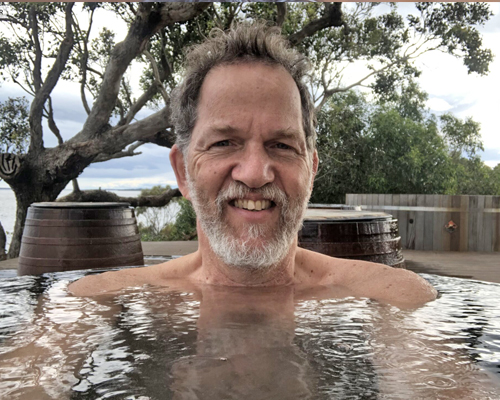
Leading medical, research, science and educational activities are all part of the new medical director’s role at the Peninsula Hot Springs Group in Australia
Menu engineering: At your service
Get inspired by the latest wellness services including a high-tech diagnostic circuit at SHA and a Zita West fertility programme at Bürgenstock
Interview: Stephan Wagner
As Saudi Arabia taps into tourism, the man heading up wellness at Amaala talks to Spa Business about what the major development is looking to bring to a previously undiscovered part of the Kingdom
Interview: Aradhana Khowala
The chair of the advisory board of the Red Sea – a Saudi development the size of Belgium – shares her passion for regenerative tourism with Spa Business
Sponsored: RKF: Dressed to impress
Following exciting new launches at Equip Hotel in Paris, including the new DresSoft line, RKF Luxury Linen is gearing up for an eco-friendly and fashion-conscious 2023
Everyone’s talking about...: Cold water immersion
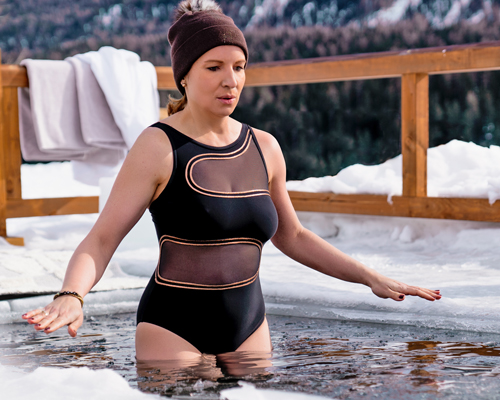
A new scientific paper warns of the significant risk of cold water therapies. Spa Business investigates how operators can protect those taking part in extreme bathing programmes
Event report: Healing summit
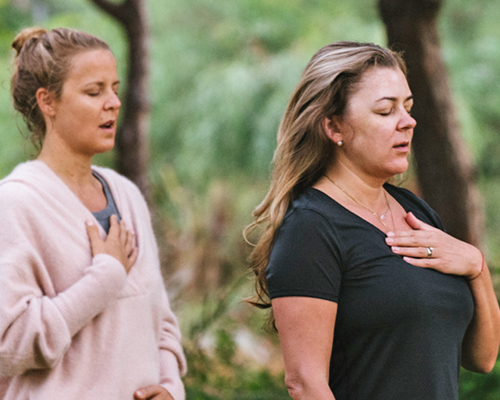
Self-help and self-love were the key messages from this wellness event in Portugal, says Spa Business’ Lisa Starr
Sponsored: Comfort Zone: Effective by nature
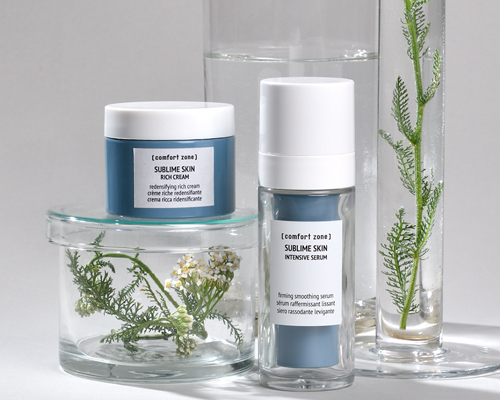
Comfort Zone has revealed three new
products, including a new neck and
décolleté fluid, leveraging the power of
botanical bioactive extracts
Interview: Alex & Sue Glasscock
Editor-at-large, Jane Kitchen is put through her paces at The Ranch's new outpost in Palazzo Fiuggi, Italy and catches up with the owners
Event Report: Global Wellness Summit
The 16th annual GWS, held in Tel Aviv, Israel, homed in on the sector’s biggest issues following the pandemic. Spa Business reports on the highlights
Research: Wellness for all
A new study by the Global Wellness Institute provides a framework for businesses and governments to make healthy lifestyles accessible to all
Sponsored: TechnoAlpin Snowroom
The TechnoAlpin Snowroom made our Grand Aufguss Masters event extra special, says Robert Heinevetter
Finishing Touch: Cold call
Tumor suppression and boosting ‘good fat’ are two potential benefits of exposure to cool temperatures and swimming in icy waters, scientists reveal
Contrast therapy, based on the alternation of hot and cold rituals, has become one of the
most valued practices in the fields of wellness and recovery. [more...]
+ More featured suppliers
COMPANY PROFILES
Clinique La Prairie
Clinique La Prairie is a name that has been synonymous with health and longevity for over 90 years, [more...]
Blu Spas, Inc.
Blu is a full-service firm offering project feasibility, planning and design as well as operational [more...]
As Saudi Arabia’s ambitious giga project, The Red Sea, gears up
to welcome its first guests in the next few months, the chair of
its advisory board reveals key details about the destination to
Megan Whitby and shares her passion for regenerative tourism
Khowala is a women’s health advocate and spoke on this topic at this year’s GWS / Photo: Aptamind Partners
Aradhana Khowala is a strategy specialist in travel and hospitality, diversity, inclusion and women’s health.
With qualifications from Ecole hôtelière de Lausanne, Cornell and INSEAD, she’s leveraging her experience to chair the advisory board for Red Sea Global (RSG) – the developer behind The Red Sea, a resort destination nearly the size of Belgium.
RSG is owned by the Public Investment Fund of Saudi. The Red Sea, billed as one of the most ambitious ever tourism infrastructure projects, extends across 28,000sq km of Saudi Arabian coastline.
Construction began in 2019 and work is on track to welcome guests in early 2023 when the first hotels open. This initial phase of development is set for completion in 2024, by which time it will boast 16 hotels, including wellness-focused brands such as Six Senses, Miraval, Raffles and Rosewood (see p54).
Once the entire destination is finished in 2030, it will have 50 hotels stretching across 22 islands and six inland locations, offering 8,000 hotel rooms and 1,300 residential properties.
The Red Sea will also have an international airport, which will be operational next year, marinas, golf courses and entertainment and leisure facilities.
The overall aim is to attract a million visitors a year – capped in line with its sustainability ambitions – by 2030 creating 70,000 jobs and contributing SAR22bn (US$5.9bn, €5.1bn, £4.3bn) to the nation’s GDP.
Khowala, who’s been running her tourism consultancy Aptamind Partners for 15 years, says RSG’s commitment to regenerative travel is game changing as it raises standards and accelerates the pace of change for everybody else.
The company has committed to creating a destination with a net positive conservation impact, taking measures to not only keep the site as close to its natural state as possible, but also to enhance it.
Developed in partnership with WATG and Buro Happold, the masterplan focuses on the pristine natural environment, which is home to the world’s fourth-largest barrier reef system, untouched corals and a significant number of endangered species. RSG’s in-house scientists have recently concluded an 11-month-long Environmental Baseline Survey to assess the needs of the ecosystem ahead of and during development, as well as after opening.
Khowala sat down with Spa Business to give the lowdown on the project.
How does Red Sea link to Saudi Arabia’s Vision 2030 strategy? It’s the largest of six giga projects that make up Vision 2030, the government’s strategy to increase Saudi Arabia’s tourist industry revenues from the current 3 per cent of GDP, to 10 per cent by 2030. RSG’s combined projects will contribute approximately SAR33bn (US$8.7bn, €8.5bn, £7.2bn) to GDP, coupled with 120,000 new jobs.
I feel honoured to be able to support the transformation and the development of an industry that creates jobs, drives economic growth and showcases the richness of Saudi culture to the world.
What’s the vision for the project? The goal is to put people and the planet first, leveraging innovative technologies to deliver projects that enhance the wellbeing of customers, communities and environments. By doing so, it will open Saudi Arabia’s doors to a new wave of tourism.
Guests will be able to experience the diverse landscape and rich history and culture of the region, exploring dormant volcanoes, diving with turtles, star gazing in one of the most stunning places on earth or swimming in a turquoise lagoon. They’ll come away with treasured memories of both the natural environment and the extraordinary hospitality.
Why is regenerative tourism a priority? All too often tourism is disruptive – and sometimes damaging – for destinations. Globally tourism accounts for 10 per cent of CO2 emissions and this is expected to rise by 25 per cent by 2030. But it doesn’t have to be this way.
Our project is centred on the belief that nature is the world’s most important asset and we all have a part to play in protecting it. Regenerative tourism is the commitment to implementing policies that don’t just avoid harming the environment, but actively enhance it.
This philosophy is expressed in one of our aims: delivering a net conservation benefit of 30 per cent to the surrounding area by 2040. To support this commitment we utilised marine spatial planning software to generate a picture of our lagoon. We then assessed the potential environmental impacts of our development and the opportunities to optimise conservation benefits, leading to the decision to leave 75 per cent of the islands untouched and designate nine as special conservation zones.
This year we also released our Environmental Baseline Report which collates detailed information about the surrounding ecosystem. It analyses the populations, behaviours and habitats of the wildlife across 200km of Red Sea coastline and will inform our development plans and conservation efforts.
We want to show that development, tourism and environmental destruction don’t have to go hand in hand if done in the right way.
When will the first phase open? The first hotels will welcome guests in early 2023 and the project will be fully operational by 2030.
We’re constantly adapting and working on solutions to the challenges we face and given our ongoing commitment to improving the natural surroundings and economic vitality of the region, I can only see our work increasing as time goes on.
How important will wellness be to attract guests? We’re aiming to provide an all-encompassing experience, in which wellness will play an important part. Some activities will encourage guests to experience the natural environment and heritage at a personal level. These include a range of culinary, musical and artisanal activities, as well as hikes and guided eco-excursions on land and sea, such as hiking on dormant volcanoes and observing rare animals and plants in their natural habitat.
Some of the world’s most iconic hotel brands are involved (see ‘Project Partners’ table) and many of these are well-known for their health and wellness offerings, such as Rosewood, Miraval, Raffles and Ritz-Carlton Reserve. Six Senses will be operating our Southern Dunes resort that will include a holistic anti-ageing centre, sensory suites, wet zones and outdoor treatment cabanas.
What kind of visitors do you expect to attract? Our airport will be within eight hours’ flying time of 80 per cent of the global population, so we hope we’ll have a very diverse guestbook.
What does regenerative tourism mean to you? My passion stems from the fact that I couldn’t sit on the sidelines and ignore the widening gap between what we talk about and what’s happening around us.
I founded my consultancy, Aptamind, with a mission to make sustainability, community empowerment and diversity and inclusion non-negotiable pillars for every business in the travel, tourism and hospitality sector.
We lobby about the importance of these values, both in terms of economic power and positive change in the societies and communities that travel touches.
Why is it important for business? I genuinely believe the most successful companies of the future will be those that profit from fixing the world’s problems, not from creating them.
Regenerative tourism isn’t anti-growth; it simply asks that we grow the things that matter most in ways that benefit the entire system and not at the expense of others.
Public opinion is shifting so fast that those businesses sensing and responding to the emerging need to be regenerative are gaining ground while others are being left behind.
Increasingly, guests are developing an appetite for connecting with the soul of a destination. The community-enhancing regeneration that underpins higher levels of care for everyone is a real differentiator.
• What's the latest with Amaala, Saudi's wellness-focused giga project? Read our interview with Stephan Wagner on p44
The Red Sea
– Sustainability initiatives
• Relying on 100 per cent renewable energy, using solar and wind
• Operating as a carbon-neutral destination
• Banning the use of single-use plastic
• Implementing dark sky lighting measures to reduce light pollution
• Pledging to send zero waste to landfill or the sea
• Mitigating noise pollution
• Creating a battery storage facility to allow the destination to remain off-grid during sandstorms
• Bringing in hydroponic greenhouses and vertical farming to help local farmers meet new demand
• Utilising low-carbon concrete made from recycled raw materials
• Promoting walkability
• Adopting a clean mobility strategy built around electric and hydrogen-powered vehicles, boats and aircraft
• Organising marine clean-ups with the local community
• Establishing a plant nursery that will grow 15 million plants for landscaping by 2030
Project Partners
International hotel brands
Edition Hotels
Faena
Fairmont
Grand Hyatt
InterContinental
Jumeirah
Miraval
Raffles
Ritz-Carlton Reserve
Rosewood
Six Senses
SLS Hotels & Residences
St Regis
Architectural firms
Foster + Partners
Killa Design
Kengo Kuma
RSG advisory board members
September 2022/alphabetically
• Philippe Cousteau Jr, president, EarthEcho International
• Carlos Duarte, professor, Red Sea Research Centre
• Maryam Ali Ficociello, chief governance officer, RSG
• Sue Harmsworth, founder, Espa
• Frances-Anne Keeler, specialist in tourism destination marketing
• Aradhana Khowala, CEO, Aptamind Partners
• Piers Schmidt, founder, Luxury Branding
• Horst Schulze, co-founder of Ritz-Carlton, chair and CEO Capella
• Dr Mohamed Waheed Hassan,fifth president of the Maldives
Read more from this issue of Spa Business magazine
Spa People: Marc Cohen
Leading medical, research, science and educational activities are all part of the new medical director’s role at the Peninsula Hot Springs Group in Australia
Menu engineering: At your service
Get inspired by the latest wellness services including a high-tech diagnostic circuit at SHA and a Zita West fertility programme at Bürgenstock
Interview: Stephan Wagner
As Saudi Arabia taps into tourism, the man heading up wellness at Amaala talks to Spa Business about what the major development is looking to bring to a previously undiscovered part of the Kingdom
Interview: Aradhana Khowala
The chair of the advisory board of the Red Sea – a Saudi development the size of Belgium – shares her passion for regenerative tourism with Spa Business
Sponsored: RKF: Dressed to impress
Following exciting new launches at Equip Hotel in Paris, including the new DresSoft line, RKF Luxury Linen is gearing up for an eco-friendly and fashion-conscious 2023
Everyone’s talking about...: Cold water immersion
A new scientific paper warns of the significant risk of cold water therapies. Spa Business investigates how operators can protect those taking part in extreme bathing programmes
Event report: Healing summit
Self-help and self-love were the key messages from this wellness event in Portugal, says Spa Business’ Lisa Starr
Sponsored: Comfort Zone: Effective by nature
Comfort Zone has revealed three new
products, including a new neck and
décolleté fluid, leveraging the power of
botanical bioactive extracts
Interview: Alex & Sue Glasscock
Editor-at-large, Jane Kitchen is put through her paces at The Ranch's new outpost in Palazzo Fiuggi, Italy and catches up with the owners
Event Report: Global Wellness Summit
The 16th annual GWS, held in Tel Aviv, Israel, homed in on the sector’s biggest issues following the pandemic. Spa Business reports on the highlights
Research: Wellness for all
A new study by the Global Wellness Institute provides a framework for businesses and governments to make healthy lifestyles accessible to all
Sponsored: TechnoAlpin Snowroom
The TechnoAlpin Snowroom made our Grand Aufguss Masters event extra special, says Robert Heinevetter
Finishing Touch: Cold call
Tumor suppression and boosting ‘good fat’ are two potential benefits of exposure to cool temperatures and swimming in icy waters, scientists reveal
The Wellness Tourism Association (WTA) has published a non-regulatory global industry
framework designed to ensure the retreat market offers responsible experiences.
A new survey of UK and international spa practitioners shows that stress, burnout and
wellbeing concerns have caused one in three respondents to consider leaving the industry.
The UK's four Chief Medical Officers have published a refreshed edition of Physical activity
guidelines: UK Chief Medical Officers' report, updating the evidence that underpins the nation's
physical activity recommendations and placing greater emphasis on strength, balance, reducing
sedentary behaviour and, for the first time, supporting people taking weight loss medications.
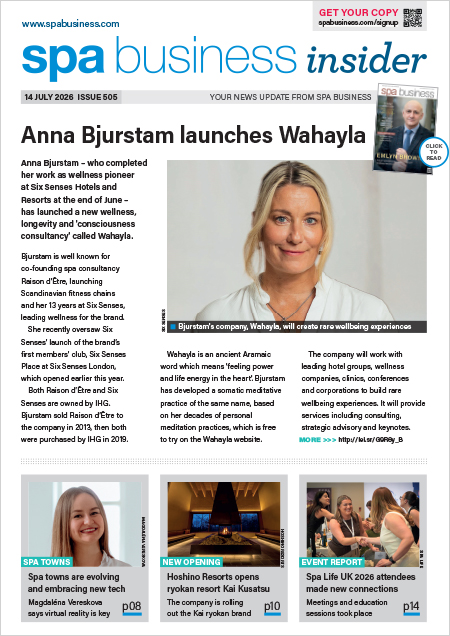
Anna Bjurstam has left her role as Wellness Pioneer at Six Senses Hotels and Resorts and
launched a new wellness, longevity and “consciousness consultancy” called Wahayla.
Fairmont Cheshire, The Mere, has opened today (10 July) in the Northwest of England
with a
1,715sq m Fairmont Spa that has been designed using a ‘Wellness without Walls’
concept.
Wellness hotels generating less than US$1 million (€932,700, £785,200) – or 10 per cent of
total revenue from wellness and leisure – recorded the strongest RevPAR and TRevPAR growth
in 2025 across categories when compared with 2024, according to the latest Wellness Real
Estate Report by RLA Global, produced in partnership with P and L benchmarking firm HotStats.
Lefay Resorts, the portfolio of two luxury wellness properties in Italy, has added emotional
dance classes and group cold plunge sessions in response to market demand for social
connection.
Contrast therapy, based on the alternation of hot and cold rituals, has become one of the
most valued practices in the fields of wellness and recovery. [more...]
+ More featured suppliers
COMPANY PROFILES
Clinique La Prairie Clinique La Prairie is a name that has been synonymous with health and longevity for over 90 years, [more...]