Latest
issue
Uniting the world of spa & wellness
Get Spa Business and Spa Business insider digital magazines FREE
Sign up here ▸
News   Features   Products   Company profilesProfiles   Press releasesProfiles   Magazine   Handbook   Advertise    Subscribe  
NEWS
Revealed: The demountable World Cup stadium Qatar plans to build with shipping containers
POSTED 28 Nov 2017 . BY Kim Megson
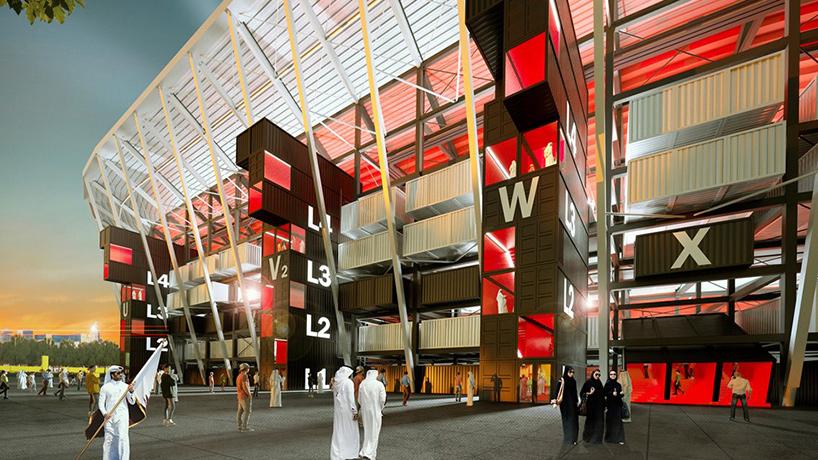
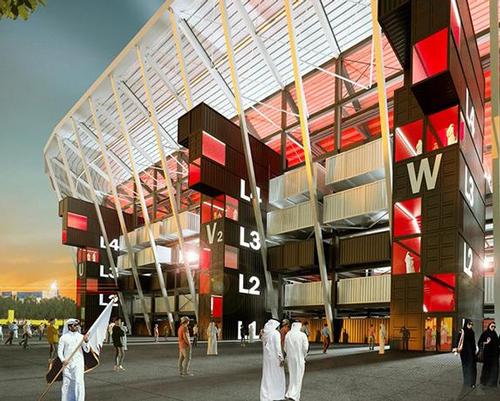
Recyclable materials will be used to to boost sustainability, with even the shipping containers used to ship the materials becoming part of the stadium Credit: Supreme Committee for Delivery & Legacy

This venue offers the perfect legacy, capable of being reassembled in a new location in its entirety or built into numerous small sports and cultural venues
– Hassan Al Thawadi, secretary general, Supreme Committee for Delivery & Legacy
The seventh proposed stadium for the 2022 FIFA World Cup in Qatar will be constructed using shipping containers and will be completely demounted and rebuilt elsewhere after the tournament.

The design of the Ras Abu Aboud Stadium – which will have a capacity of 40,000 and host matches up to the quarter-finals stage – has been officially revealed today (28 November), with World Cup organisers saying “it will change the way host nations deliver mega-event facilities.”

Architecture firms Fenwick Iribarren (FI-A), Schlaich Bergermann Partner and Hilson Moran have devised a modular structure using building blocks that can easily be taken apart when required. Recyclable materials will be used to boost sustainability, with even the shipping containers used to transport the materials becoming part of the stadium.

The demountable nature of the structure means it will either be rebuilt in its entirety elsewhere – in Qatar or another country – or separated into different sections that will be redistributed to create smaller facilities. Everything from the roof to rows of seating can be recycled in this way, and the architects have said the venue could even re-appear at a future World Cup.

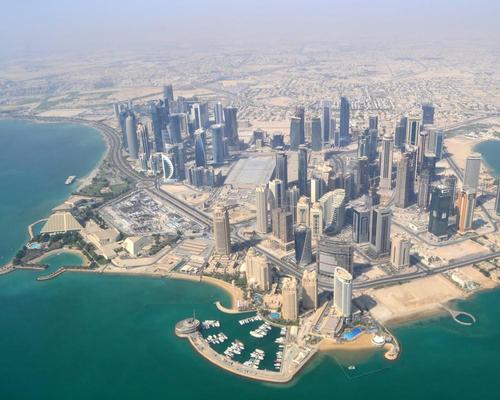
Once the stadium has been removed post-tournament, a 450,000sq m (4.8 million sq ft) waterfront leisure and commercial development will be built in its place on the shoreline of the Arabian Gulf, next to Corniche Beach.


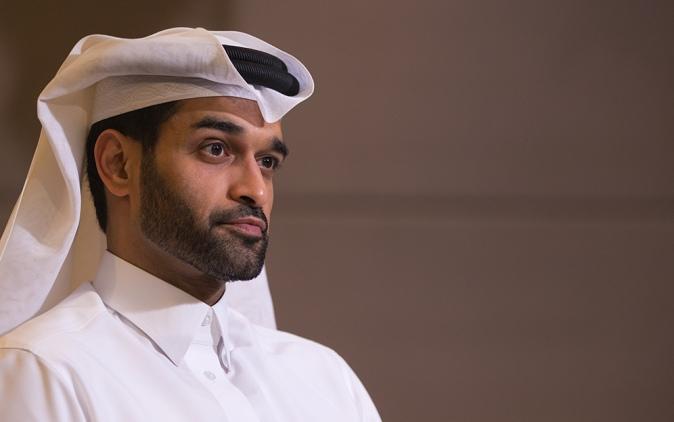
“Innovation has always been central to our plans for delivering a historic FIFA World Cup that leaves a legacy for Qatar and the world, and there is no better example of this than the design of Ras Abu Aboud Stadium,” said Hassan Al Thawadi, secretary general of Qatar’s Supreme Committee for Delivery & Legacy.

“This venue offers the perfect legacy, capable of being reassembled in a new location in its entirety or built into numerous small sports and cultural venues. All of this in a stadium that delivers the atmosphere fans expect at a World Cup and which we will build in a more sustainable way than ever before. I’m delighted with this design and confident that Ras Abu Aboud will become a blueprint for future mega-event planners to follow.”

FI-A Senior Partner and architect, Mark Fenwick, said: “We're very proud that our design for Ras Abu Aboud Stadium will go down in history as the first-ever moveable and reusable FIFA World Cup stadium. We're confident this innovative and sustainable concept will be an inspiration for stadium developers and architects around the world, capable of creating aesthetically pleasing venues that offer new legacy possibilities.”

He added that the modular approach requires fewer materials, creates less waste, reduces the carbon footprint of the building process and decreases construction time to as little as three years.

Fenwick’s firm have previously designed the Casablanca Football Stadium in Morocco, Norway’s National Stadium and the Qatar Foundation Stadium, also for the World Cup.

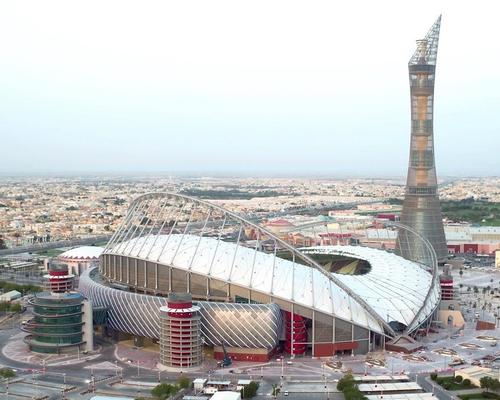
The launch of the design of Ras Abu Aboud Stadium follows the announcement of the Al Thumama Stadium in August 2017 and the completion of Khalifa International Stadium in May.

Ras Abu Aboud Stadium is one of eight proposed host venues for the World Cup, with others designed by the likes of Foster + Partners and Zaha Hadid Architects.

The sustainability of sporting venues has become a hot-button issue in recent times, particularly in the Olympic movement, with architects experimenting with temporary or reusable facilities.

For the 2016 Rio Olympics and Paralympics, Brazilian architecture practices Oficina de Arquitetos and Lopes, Santos & Ferreira Gomes, in collaboration with London studio AndArchitects, created a temporary 12,000-seat handball arena that was dismantled after the Games so that its materials could be used to build four schools.

Meanwhile, South African architect Ruben Reddy – who was planning a host of temporary stadiums for the 2022 Commonwealth Games in Durban before the event was taken away from the city earlier this year – has told CLADglobal that all stadia and arenas built for events such as the FIFA World Cup and the Olympic Games should be demountable.

The demountable nature of the structure means that it will either be rebuilt in its entirety elsewhere, in Qatar or in another country requiring sporting infrastructure, Credit: Supreme Committee for Delivery & Legacy
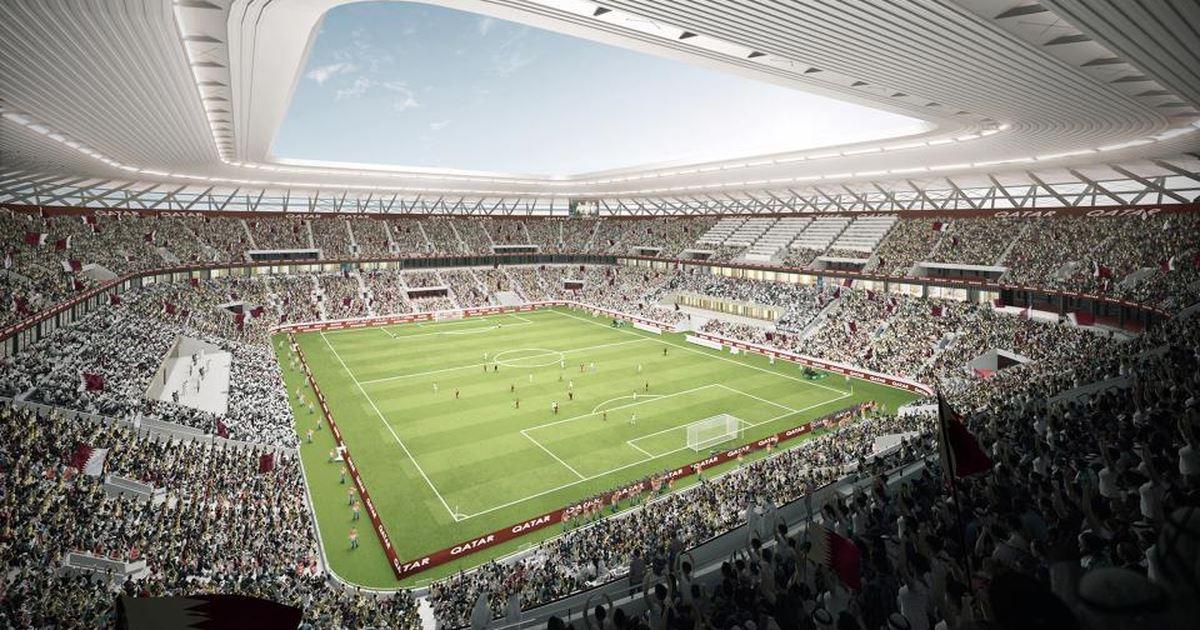
The stadium will have a capacity of 40,000 and host matches up to the quarter-finals stage Credit: Supreme Committee for Delivery & Legacy
PROJECT PROFILE:

qatar
The seventh proposed stadium for the 2022 FIFA World Cup in Qatar will be constructed using shipping containers and will be completely demounted and rebuilt elsewhere after the tournament.


RELATED STORIES
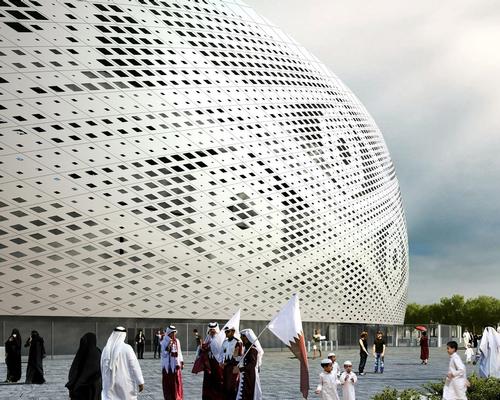
  Design unveiled for Qatar 2022 World Cup stadium inspired by Arabian cap


Details of the latest proposed stadium for the 2022 FIFA World Cup in Qatar have been officially revealed, with a design inspired by the traditional Arab ‘gahfiya’ headdress.
  First 2022 World Cup stadium completed in Qatar


The first host venue of the 2022 FIFA World Cup in Qatar has been completed, five years ahead of the tournament.
  South Korean studio net contract to design Qatar World Cup stadium


South Korean architecture studio Heerim Architects and Planners Co are reportedly in line to design Qatar’s 40,000-capacity Fifth Precinct Stadium, which will host matches up to the quarter-final stage at the 2022 FIFA World Cup.
  Stadium seats made from palm tree waste proposed for Qatar World Cup innovation challenge


A team of engineers in Saudi Arabia has proposed how stadium seats in the near future could be made more sustainably using the fibres of palm trees.
MORE NEWS
Barons Eden rebrands to Hiddenwell ahead of spa hotel portfolio expansion
Barons Eden, the UK parent company that operates luxury destination properties in England, has rebranded to become Hiddenwell.
Belgin Aksoy marks 15 years of Global Wellness Day
Global Wellness Day (GWD) marked its 15th anniversary on Saturday 13 June 2026, with the theme: #JoyMagenta – a celebration of the healing qualities of simple gestures and activities that spark joy.
HUM2N launches longevity clinic at Six Senses London
Global luxury hospitality brand, Six Senses, has partnered with longevity healthcare provider, HUM2N, to launch a clinic at Six Senses London, at The Whiteley.
Mayrlife opens first hotel day clinic in partnership with Rosewood Vienna
As part of its first hotel partnership, Mayrlife – the medical health resort company known for its site in Altaussee, Austria – has launched a day clinic at the Rosewood Vienna.
+ More news   

FEATURED SUPPLIERS

Embrace the chill: TechnoAlpin's Snowsky revolutionises post-fitness recovery with falling snow
In the fast-paced world of fitness and wellness, where high-intensity workouts push us to our limits and the sweat pours, the importance of efficient recovery cannot be overstated. [more...]

Glow beyond protection: meet Comfort Zone Hydramemory Hybrid Glow SPF 30
Sun protection is no longer just about shielding the skin – it's about enhancing it. [more...]
+ More featured suppliers  
COMPANY PROFILES
Elemental Herbology

Founded in 2008 by a Traditional Chinese Medicine Practitioner, Elemental Herbology is a spa, retail [more...]
Lovinfit Group

Lovinfit Group was founded in Parma, Italy in 2016 by a team of doctors, wellness and sports profess [more...]
+ More profiles  
CATALOGUE GALLERY
 

+ More catalogues  

DIRECTORY
+ More directory  
DIARY


21-23 Jun 2026

Spa Life International (UK)

Midlands (Venue TBA), Liphook, United Kingdom
22-22 Jun 2026

World Bathing Day

Worldwide,
+ More diary  
 
ABOUT LEISURE MEDIA
LEISURE MEDIA MAGAZINES
LEISURE MEDIA HANDBOOKS
LEISURE MEDIA WEBSITES
LEISURE MEDIA PRODUCT SEARCH
 
SPA BUSINESS
SPA OPPORTUNITIES
SPA BUSINESS HANDBOOK
PRINT SUBSCRIPTIONS
FREE DIGITAL SUBSCRIPTIONS
ADVERTISE . CONTACT US

Leisure Media
Tel: +44 (0)1462 431385

©Cybertrek 2026
Uniting the world of spa & wellness
Get Spa Business and Spa Business insider digital magazines FREE
Sign up here ▸
News   Products   Magazine   Subscribe
NEWS
Revealed: The demountable World Cup stadium Qatar plans to build with shipping containers
POSTED 28 Nov 2017 . BY Kim Megson
Recyclable materials will be used to to boost sustainability, with even the shipping containers used to ship the materials becoming part of the stadium Credit: Supreme Committee for Delivery & Legacy
This venue offers the perfect legacy, capable of being reassembled in a new location in its entirety or built into numerous small sports and cultural venues
– Hassan Al Thawadi, secretary general, Supreme Committee for Delivery & Legacy
The seventh proposed stadium for the 2022 FIFA World Cup in Qatar will be constructed using shipping containers and will be completely demounted and rebuilt elsewhere after the tournament.

The design of the Ras Abu Aboud Stadium – which will have a capacity of 40,000 and host matches up to the quarter-finals stage – has been officially revealed today (28 November), with World Cup organisers saying “it will change the way host nations deliver mega-event facilities.”

Architecture firms Fenwick Iribarren (FI-A), Schlaich Bergermann Partner and Hilson Moran have devised a modular structure using building blocks that can easily be taken apart when required. Recyclable materials will be used to boost sustainability, with even the shipping containers used to transport the materials becoming part of the stadium.

The demountable nature of the structure means it will either be rebuilt in its entirety elsewhere – in Qatar or another country – or separated into different sections that will be redistributed to create smaller facilities. Everything from the roof to rows of seating can be recycled in this way, and the architects have said the venue could even re-appear at a future World Cup.

Once the stadium has been removed post-tournament, a 450,000sq m (4.8 million sq ft) waterfront leisure and commercial development will be built in its place on the shoreline of the Arabian Gulf, next to Corniche Beach.


“Innovation has always been central to our plans for delivering a historic FIFA World Cup that leaves a legacy for Qatar and the world, and there is no better example of this than the design of Ras Abu Aboud Stadium,” said Hassan Al Thawadi, secretary general of Qatar’s Supreme Committee for Delivery & Legacy.

“This venue offers the perfect legacy, capable of being reassembled in a new location in its entirety or built into numerous small sports and cultural venues. All of this in a stadium that delivers the atmosphere fans expect at a World Cup and which we will build in a more sustainable way than ever before. I’m delighted with this design and confident that Ras Abu Aboud will become a blueprint for future mega-event planners to follow.”

FI-A Senior Partner and architect, Mark Fenwick, said: “We're very proud that our design for Ras Abu Aboud Stadium will go down in history as the first-ever moveable and reusable FIFA World Cup stadium. We're confident this innovative and sustainable concept will be an inspiration for stadium developers and architects around the world, capable of creating aesthetically pleasing venues that offer new legacy possibilities.”

He added that the modular approach requires fewer materials, creates less waste, reduces the carbon footprint of the building process and decreases construction time to as little as three years.

Fenwick’s firm have previously designed the Casablanca Football Stadium in Morocco, Norway’s National Stadium and the Qatar Foundation Stadium, also for the World Cup.

The launch of the design of Ras Abu Aboud Stadium follows the announcement of the Al Thumama Stadium in August 2017 and the completion of Khalifa International Stadium in May.

Ras Abu Aboud Stadium is one of eight proposed host venues for the World Cup, with others designed by the likes of Foster + Partners and Zaha Hadid Architects.

The sustainability of sporting venues has become a hot-button issue in recent times, particularly in the Olympic movement, with architects experimenting with temporary or reusable facilities.

For the 2016 Rio Olympics and Paralympics, Brazilian architecture practices Oficina de Arquitetos and Lopes, Santos & Ferreira Gomes, in collaboration with London studio AndArchitects, created a temporary 12,000-seat handball arena that was dismantled after the Games so that its materials could be used to build four schools.

Meanwhile, South African architect Ruben Reddy – who was planning a host of temporary stadiums for the 2022 Commonwealth Games in Durban before the event was taken away from the city earlier this year – has told CLADglobal that all stadia and arenas built for events such as the FIFA World Cup and the Olympic Games should be demountable.

The demountable nature of the structure means that it will either be rebuilt in its entirety elsewhere, in Qatar or in another country requiring sporting infrastructure, Credit: Supreme Committee for Delivery & Legacy
The stadium will have a capacity of 40,000 and host matches up to the quarter-finals stage Credit: Supreme Committee for Delivery & Legacy
RELATED STORIES
Design unveiled for Qatar 2022 World Cup stadium inspired by Arabian cap


Details of the latest proposed stadium for the 2022 FIFA World Cup in Qatar have been officially revealed, with a design inspired by the traditional Arab ‘gahfiya’ headdress.

First 2022 World Cup stadium completed in Qatar


The first host venue of the 2022 FIFA World Cup in Qatar has been completed, five years ahead of the tournament.
South Korean studio net contract to design Qatar World Cup stadium


South Korean architecture studio Heerim Architects and Planners Co are reportedly in line to design Qatar’s 40,000-capacity Fifth Precinct Stadium, which will host matches up to the quarter-final stage at the 2022 FIFA World Cup.
Stadium seats made from palm tree waste proposed for Qatar World Cup innovation challenge


A team of engineers in Saudi Arabia has proposed how stadium seats in the near future could be made more sustainably using the fibres of palm trees.
MORE NEWS
Barons Eden rebrands to Hiddenwell ahead of spa hotel portfolio expansion
Barons Eden, the UK parent company that operates luxury destination properties in England, has rebranded to become Hiddenwell.
Belgin Aksoy marks 15 years of Global Wellness Day
Global Wellness Day (GWD) marked its 15th anniversary on Saturday 13 June 2026, with the theme: #JoyMagenta – a celebration of the healing qualities of simple gestures and activities that spark joy.
HUM2N launches longevity clinic at Six Senses London
Global luxury hospitality brand, Six Senses, has partnered with longevity healthcare provider, HUM2N, to launch a clinic at Six Senses London, at The Whiteley.
Mayrlife opens first hotel day clinic in partnership with Rosewood Vienna
As part of its first hotel partnership, Mayrlife – the medical health resort company known for its site in Altaussee, Austria – has launched a day clinic at the Rosewood Vienna.
KX Chelsea invests £15 million to upgrade its wellness offering
Premium London health club, KX Chelsea, will imminently unveil its most significant redevelopment since its launch in 2002 to create an integrated wellness model combining training, recovery and relaxation.
Rosewood Le Guanahani St Barth offers ocean-themed yoga for Global Wellness Day
Rosewood Le Guanahani St Barth, on the northeast coast of Saint Barthélemy in the French West Indies, is offering a programme of ocean-inspired yoga classes between 8-14 June to celebrate Global Wellness Day (GWD).
+ More news   
 
FEATURED SUPPLIERS

Embrace the chill: TechnoAlpin's Snowsky revolutionises post-fitness recovery with falling snow
In the fast-paced world of fitness and wellness, where high-intensity workouts push us to our limits and the sweat pours, the importance of efficient recovery cannot be overstated. [more...]

Glow beyond protection: meet Comfort Zone Hydramemory Hybrid Glow SPF 30
Sun protection is no longer just about shielding the skin – it's about enhancing it. [more...]
+ More featured suppliers  
COMPANY PROFILES
Elemental Herbology

Founded in 2008 by a Traditional Chinese Medicine Practitioner, Elemental Herbology is a spa, retail [more...]
+ More profiles  
CATALOGUE GALLERY
+ More catalogues  

DIRECTORY
+ More directory  
DIARY


21-23 Jun 2026

Spa Life International (UK)

Midlands (Venue TBA), Liphook, United Kingdom
22-22 Jun 2026

World Bathing Day

Worldwide,
+ More diary  


ADVERTISE . CONTACT US

Leisure Media
Tel: +44 (0)1462 431385

©Cybertrek 2026

ABOUT LEISURE MEDIA
LEISURE MEDIA MAGAZINES
LEISURE MEDIA HANDBOOKS
LEISURE MEDIA WEBSITES
LEISURE MEDIA PRODUCT SEARCH
PRINT SUBSCRIPTIONS
FREE DIGITAL SUBSCRIPTIONS