The world’s spa economy grew by 5 per cent between 2013 and 2015 to reach US$98.6bn (€90.1bn, £80.6bn), according to preliminary findings from the 2016 Global Wellness Economy Monitor
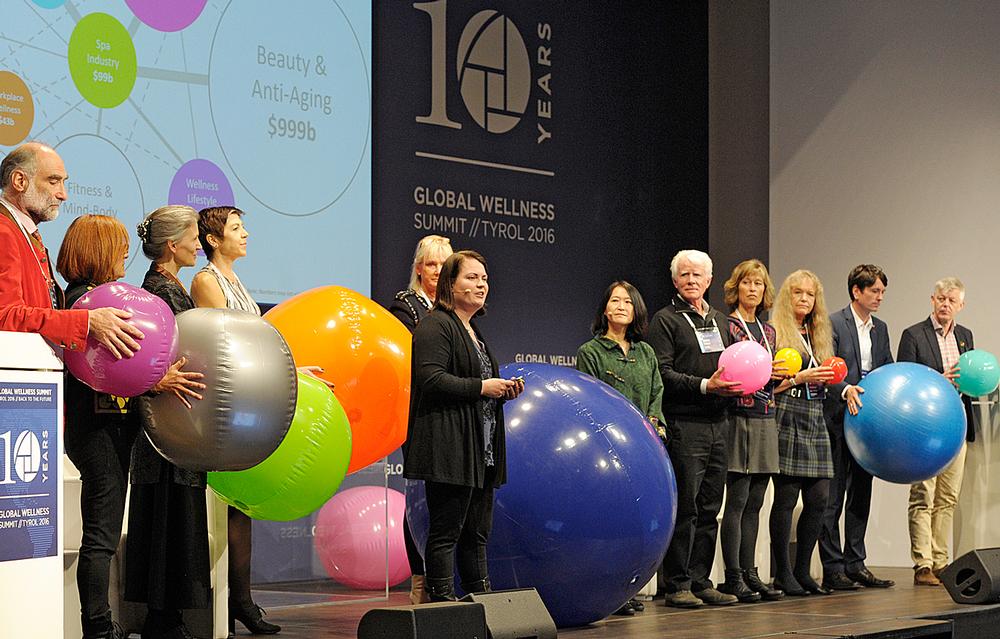
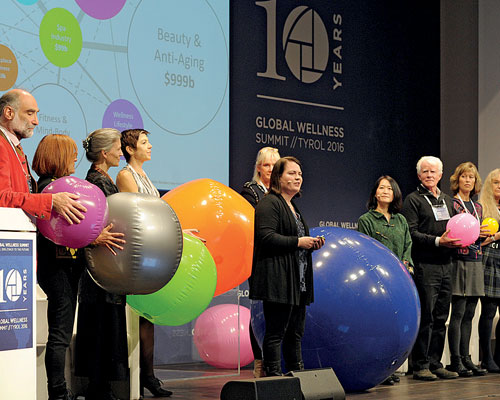
Presenting the data: different size balls represent the 10 sectors in the US$3.72tn wellness industry
The topline figure includes spa facility revenues of US$77.6bn (€71.1bn, £63.4bn) as well as the associations and education, consulting, media and event sectors that support spas, which are valued at US$21bn (€19.2bn, £17.2bn).
And while worldwide spa revenues increased by a modest 2.3 per cent from 2013 to 2015, researchers at the Global Wellness Institute (GWI) – the organisation behind the report – says this is largely due to the US dollar currency conversion from large spa markets across Europe and Asia. If global spa facility revenues are converted to the euro instead, the market actually grew at a robust 25 per cent.
Spa locations worldwide jumped from 105,591 in 2013 to 121,595 in 2015 – meaning the industry has added just over 16,000 spas, more than 230,000 workers (to reach 2.1m) and US$3.5bn (€3.2bn, £2.9bn) in revenue.
These figures from the spa sector feed into the wider international wellness market which the GWI estimates is now a US$3.72 trillion (€3.4tn, £3tn) industry, a number which has increased by 10.6 per cent since 2013.
“Recent years have been marked by global economic contraction and disruptive geopolitical events, but a ‘wellness economy’ just keeps rising, with an upward trajectory that seems unstoppable,” says GWI senior research fellow Ophelia Yeung.
Yeung pointed to ‘megatrends’ of an emerging global middle class, a rapidly ageing population, increase in chronic disease and stress, the failure of the ‘sick-care’ medical model, and a growing subset of more affluent, educated consumers “seeking experiences rooted in meaning, purpose, authenticity and nature”, as fuelling the growth in the market.
Revenue-earning thermal and mineral springs added 660 facilities across 109 countries between 2013 and 2015, earning US$51bn (€46.7bn, £42bn) in 2015, up 2 per cent from 2013. The GWI said that while these gains look modest, its research finds rapidly rising consumer interest in springs-based activities – and similarly, 2015 revenues are also heavily impacted by the depreciation of European currencies against the dollar.
Wellness tourism grew 14 per cent in the same two-year period – more than twice as fast as overall tourism expenditures. World travellers made 691 million wellness trips in 2015.
Wellness real estate – which includes residential, hospitality and mixed-use developments incorporating wellness – was one of the fastest-growing sectors, up 19 per cent to US$118.6bn (€108.6bn, £97bn) in 2015.
Other subsets measured in the report include beauty and anti-ageing; workplace wellness; fitness and mind-body; healthy eating, nutrition and weight loss; preventative and personalised medicine and public health; and complementary and alternative medicine.
* The preliminary figures were unveiled at the Global Wellness Summit in late October, ahead of the full research which will be released in January. Turn to p80 to read about the summit in more depth.
Read more from this issue of Spa Business magazine
Promotional feature: Phytomer
As a pioneer of marine skincare, Phytomer represents a story of three impassioned generations and a dedication to cultivating the purest spa ingredients from the northern French coast
Le Atelier by C.O.D.E. doesn't offer a standard bespoke service, it provides a highly
customised approach to designing massage beds and loungers in high-end wellness
environments. [more...]
In a world where imbalance often accumulates quietly, Wildsmith unveils its newest
wellbeing innovation: Silent Loads, an approach designed to meet the needs of modern spa
guests with precision and depth. [more...]
+ More featured suppliers
COMPANY PROFILES
Aromatherapy Associates
Aromatherapy Associates is a world-leading British wellness brand, harnessing the power of essential [more...]
Lovinfit Group
Lovinfit Group was founded in Parma, Italy in 2016 by a team of doctors, wellness and sports profess [more...]
The world’s spa economy grew by 5 per cent between 2013 and 2015 to reach US$98.6bn (€90.1bn, £80.6bn), according to preliminary findings from the 2016 Global Wellness Economy Monitor
Presenting the data: different size balls represent the 10 sectors in the US$3.72tn wellness industry
The topline figure includes spa facility revenues of US$77.6bn (€71.1bn, £63.4bn) as well as the associations and education, consulting, media and event sectors that support spas, which are valued at US$21bn (€19.2bn, £17.2bn).
And while worldwide spa revenues increased by a modest 2.3 per cent from 2013 to 2015, researchers at the Global Wellness Institute (GWI) – the organisation behind the report – says this is largely due to the US dollar currency conversion from large spa markets across Europe and Asia. If global spa facility revenues are converted to the euro instead, the market actually grew at a robust 25 per cent.
Spa locations worldwide jumped from 105,591 in 2013 to 121,595 in 2015 – meaning the industry has added just over 16,000 spas, more than 230,000 workers (to reach 2.1m) and US$3.5bn (€3.2bn, £2.9bn) in revenue.
These figures from the spa sector feed into the wider international wellness market which the GWI estimates is now a US$3.72 trillion (€3.4tn, £3tn) industry, a number which has increased by 10.6 per cent since 2013.
“Recent years have been marked by global economic contraction and disruptive geopolitical events, but a ‘wellness economy’ just keeps rising, with an upward trajectory that seems unstoppable,” says GWI senior research fellow Ophelia Yeung.
Yeung pointed to ‘megatrends’ of an emerging global middle class, a rapidly ageing population, increase in chronic disease and stress, the failure of the ‘sick-care’ medical model, and a growing subset of more affluent, educated consumers “seeking experiences rooted in meaning, purpose, authenticity and nature”, as fuelling the growth in the market.
Revenue-earning thermal and mineral springs added 660 facilities across 109 countries between 2013 and 2015, earning US$51bn (€46.7bn, £42bn) in 2015, up 2 per cent from 2013. The GWI said that while these gains look modest, its research finds rapidly rising consumer interest in springs-based activities – and similarly, 2015 revenues are also heavily impacted by the depreciation of European currencies against the dollar.
Wellness tourism grew 14 per cent in the same two-year period – more than twice as fast as overall tourism expenditures. World travellers made 691 million wellness trips in 2015.
Wellness real estate – which includes residential, hospitality and mixed-use developments incorporating wellness – was one of the fastest-growing sectors, up 19 per cent to US$118.6bn (€108.6bn, £97bn) in 2015.
Other subsets measured in the report include beauty and anti-ageing; workplace wellness; fitness and mind-body; healthy eating, nutrition and weight loss; preventative and personalised medicine and public health; and complementary and alternative medicine.
* The preliminary figures were unveiled at the Global Wellness Summit in late October, ahead of the full research which will be released in January. Turn to p80 to read about the summit in more depth.
Read more from this issue of Spa Business magazine
Promotional feature: Phytomer
As a pioneer of marine skincare, Phytomer represents a story of three impassioned generations and a dedication to cultivating the purest spa ingredients from the northern French coast
Longevitix, a clinical platform for preventive and longevity medicine, has launched its AI-
powered intelligence system to help physicians deliver continuous, personalised longevity-
focused care at scale.
Atmantan Wellness Centre, an integrative wellness destination in Mulshi, near Pune in India, is
expanding its portfolio by adding a new centre in Hyderabad that will launch between 2028 and
2029.
A recent survey by the UK Spa Association (UKSA) into the industry’s approach to cancer care
has revealed that almost half of participating respondents (46 per cent) are unaware that
cancer is a disability and guests with a cancer diagnosis must be given
Mexican operator, Solmar Hotels and Resorts, is hosting a series of events in celebration of
Global Wellness Day, including a Temazcal ceremony at its Playa Grande Resort and Spa in Los
Cabos.
Mandarin Oriental has announced a standalone residence brand, Mansions, which will debut at
Emirates Palace, Mandarin Oriental Mansions, Abu Dhabi, in 2029.
Four Seasons Resort The Nam Hai in Hoi An, Vietnam, has put together a Global Wellness Day
(GWD) agenda with activations rooted in nature and shaped by four pillars of Joy – in
alignment with the day’s theme #JoyMagenta.
The Global Wellness Summit (GWS) will celebrate its 20th anniversary at the 2026 event in
Phuket, Thailand, later this year with the theme: The Science, Art and Soul of Wellness.
Auko, an all-inclusive development, is opening in Phong Nha in Vietnam in Q3 2026, with a
series of 30 tented eco-lodges and wellness hospitality operations by Lumina Wellbeing.
Le Atelier by C.O.D.E. doesn't offer a standard bespoke service, it provides a highly
customised approach to designing massage beds and loungers in high-end wellness
environments. [more...]
In a world where imbalance often accumulates quietly, Wildsmith unveils its newest
wellbeing innovation: Silent Loads, an approach designed to meet the needs of modern spa
guests with precision and depth. [more...]
+ More featured suppliers
COMPANY PROFILES
Aromatherapy Associates Aromatherapy Associates is a world-leading British wellness brand, harnessing the power of essential [more...]