Yes! Send me the FREE digital editions of Spa Business and Spa Business insider magazines and the FREE weekly Spa Business and Spa Business insider ezines and breaking news alerts!
The world’s spa economy grew by 5 per cent between 2013 and 2015 to reach US$98.6bn (€90.1bn, £80.6bn), according to preliminary findings from the 2016 Global Wellness Economy Monitor
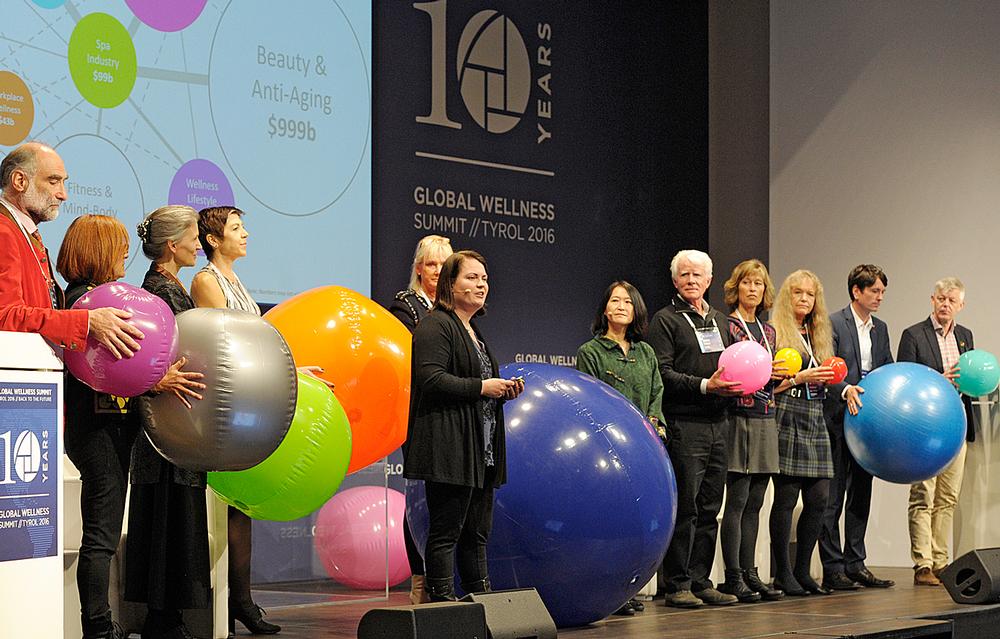
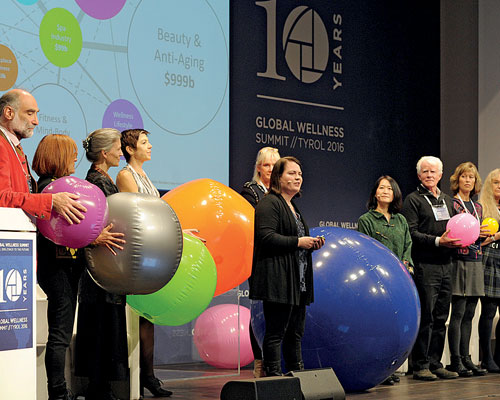
Presenting the data: different size balls represent the 10 sectors in the US$3.72tn wellness industry
The topline figure includes spa facility revenues of US$77.6bn (€71.1bn, £63.4bn) as well as the associations and education, consulting, media and event sectors that support spas, which are valued at US$21bn (€19.2bn, £17.2bn).
And while worldwide spa revenues increased by a modest 2.3 per cent from 2013 to 2015, researchers at the Global Wellness Institute (GWI) – the organisation behind the report – says this is largely due to the US dollar currency conversion from large spa markets across Europe and Asia. If global spa facility revenues are converted to the euro instead, the market actually grew at a robust 25 per cent.
Spa locations worldwide jumped from 105,591 in 2013 to 121,595 in 2015 – meaning the industry has added just over 16,000 spas, more than 230,000 workers (to reach 2.1m) and US$3.5bn (€3.2bn, £2.9bn) in revenue.
These figures from the spa sector feed into the wider international wellness market which the GWI estimates is now a US$3.72 trillion (€3.4tn, £3tn) industry, a number which has increased by 10.6 per cent since 2013.
“Recent years have been marked by global economic contraction and disruptive geopolitical events, but a ‘wellness economy’ just keeps rising, with an upward trajectory that seems unstoppable,” says GWI senior research fellow Ophelia Yeung.
Yeung pointed to ‘megatrends’ of an emerging global middle class, a rapidly ageing population, increase in chronic disease and stress, the failure of the ‘sick-care’ medical model, and a growing subset of more affluent, educated consumers “seeking experiences rooted in meaning, purpose, authenticity and nature”, as fuelling the growth in the market.
Revenue-earning thermal and mineral springs added 660 facilities across 109 countries between 2013 and 2015, earning US$51bn (€46.7bn, £42bn) in 2015, up 2 per cent from 2013. The GWI said that while these gains look modest, its research finds rapidly rising consumer interest in springs-based activities – and similarly, 2015 revenues are also heavily impacted by the depreciation of European currencies against the dollar.
Wellness tourism grew 14 per cent in the same two-year period – more than twice as fast as overall tourism expenditures. World travellers made 691 million wellness trips in 2015.
Wellness real estate – which includes residential, hospitality and mixed-use developments incorporating wellness – was one of the fastest-growing sectors, up 19 per cent to US$118.6bn (€108.6bn, £97bn) in 2015.
Other subsets measured in the report include beauty and anti-ageing; workplace wellness; fitness and mind-body; healthy eating, nutrition and weight loss; preventative and personalised medicine and public health; and complementary and alternative medicine.
* The preliminary figures were unveiled at the Global Wellness Summit in late October, ahead of the full research which will be released in January. Turn to p80 to read about the summit in more depth.
Read more from this issue of Spa Business magazine
Promotional feature: Phytomer
As a pioneer of marine skincare, Phytomer represents a story of three impassioned generations and a dedication to cultivating the purest spa ingredients from the northern French coast
In the fast-paced world of fitness and wellness, where high-intensity workouts push us to
our limits and the sweat pours, the importance of efficient recovery cannot be overstated. [more...]
Le Atelier by C.O.D.E. doesn't offer a standard bespoke service, it provides a highly
customised approach to designing massage beds and loungers in high-end wellness
environments. [more...]
+ More featured suppliers
COMPANY PROFILES
Lovinfit Group
Lovinfit Group was founded in Parma, Italy in 2016 by a team of doctors, wellness and sports profess [more...]
The world’s spa economy grew by 5 per cent between 2013 and 2015 to reach US$98.6bn (€90.1bn, £80.6bn), according to preliminary findings from the 2016 Global Wellness Economy Monitor
Presenting the data: different size balls represent the 10 sectors in the US$3.72tn wellness industry
The topline figure includes spa facility revenues of US$77.6bn (€71.1bn, £63.4bn) as well as the associations and education, consulting, media and event sectors that support spas, which are valued at US$21bn (€19.2bn, £17.2bn).
And while worldwide spa revenues increased by a modest 2.3 per cent from 2013 to 2015, researchers at the Global Wellness Institute (GWI) – the organisation behind the report – says this is largely due to the US dollar currency conversion from large spa markets across Europe and Asia. If global spa facility revenues are converted to the euro instead, the market actually grew at a robust 25 per cent.
Spa locations worldwide jumped from 105,591 in 2013 to 121,595 in 2015 – meaning the industry has added just over 16,000 spas, more than 230,000 workers (to reach 2.1m) and US$3.5bn (€3.2bn, £2.9bn) in revenue.
These figures from the spa sector feed into the wider international wellness market which the GWI estimates is now a US$3.72 trillion (€3.4tn, £3tn) industry, a number which has increased by 10.6 per cent since 2013.
“Recent years have been marked by global economic contraction and disruptive geopolitical events, but a ‘wellness economy’ just keeps rising, with an upward trajectory that seems unstoppable,” says GWI senior research fellow Ophelia Yeung.
Yeung pointed to ‘megatrends’ of an emerging global middle class, a rapidly ageing population, increase in chronic disease and stress, the failure of the ‘sick-care’ medical model, and a growing subset of more affluent, educated consumers “seeking experiences rooted in meaning, purpose, authenticity and nature”, as fuelling the growth in the market.
Revenue-earning thermal and mineral springs added 660 facilities across 109 countries between 2013 and 2015, earning US$51bn (€46.7bn, £42bn) in 2015, up 2 per cent from 2013. The GWI said that while these gains look modest, its research finds rapidly rising consumer interest in springs-based activities – and similarly, 2015 revenues are also heavily impacted by the depreciation of European currencies against the dollar.
Wellness tourism grew 14 per cent in the same two-year period – more than twice as fast as overall tourism expenditures. World travellers made 691 million wellness trips in 2015.
Wellness real estate – which includes residential, hospitality and mixed-use developments incorporating wellness – was one of the fastest-growing sectors, up 19 per cent to US$118.6bn (€108.6bn, £97bn) in 2015.
Other subsets measured in the report include beauty and anti-ageing; workplace wellness; fitness and mind-body; healthy eating, nutrition and weight loss; preventative and personalised medicine and public health; and complementary and alternative medicine.
* The preliminary figures were unveiled at the Global Wellness Summit in late October, ahead of the full research which will be released in January. Turn to p80 to read about the summit in more depth.
Read more from this issue of Spa Business magazine
Promotional feature: Phytomer
As a pioneer of marine skincare, Phytomer represents a story of three impassioned generations and a dedication to cultivating the purest spa ingredients from the northern French coast
People taking GLP-1 weight loss medications such as Ozempic, Wegovy, Mounjaro and Zepbound
may be losing weight, but they’re also becoming less physically active, according to new
research presented at the ENDO 2026 annual meeting of the Endocrine Society
Abu Dhabi-based investment firm Mubadala Capital has made a binding, fully financed
€1 billion
offer to acquire Pierre and Vacances SA, the European holiday resort operator behind the
continental European Center Parcs business.
Global retreat trade show, Synergy The Retreat Show, has launched a resource called The
Source, which hosts an open-access online Transformation Series programme.
The Standards Authority for Touch in Cancer Care (SATCC) charity has announced its first five-
day Living with Cancer and Beyond retreat, which will be held at Carden Park Hotel and Spa in
Cheshire, UK, between 1 and 5 September.
Patmos Aktis, a Luxury Collection Resort and Spa, has opened in Greece, with a renovated and
rebranded wellness offering called Ansana Wellness and Spa.
The Mauna Kea Beach Hotel, an Autograph Collection property in Hawaii, US, has opened its
22,000 sq ft indoor-outdoor Spa at Mauna Kea as the final step in the property’s overall
renovation, which has cost more than US$180 million (€166 million, £140 mill
The UK spa review and discovery platform for consumers, the Good Spa Guide, has announced
it will host the Good Spa Guide Awards 2026 during an event on 16 November at Sopwell House
Hotel in St Albans, UK.
Eighty-four per cent of consumers now say wellness is a top priority in their lives, with this
percentage increasing year on year, according to a preview presentation of McKinsey’s Future of
Wellness 2026 research report.
Mass protests have been taking place since Monday 1 June in Albania over the development of
a luxury resort by Donald Trump’s daughter Ivanka Trump and her husband Jared Kushner.
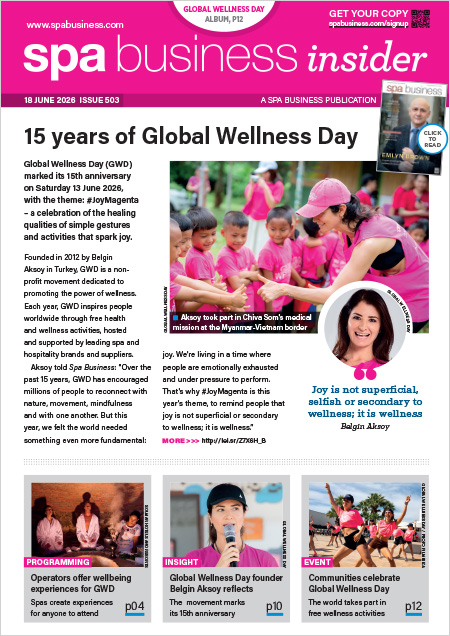
Global Wellness Day (GWD) marked its 15th anniversary on Saturday 13 June 2026, with the
theme: #JoyMagenta – a celebration of the healing qualities of simple gestures and activities
that spark joy.
In the fast-paced world of fitness and wellness, where high-intensity workouts push us to
our limits and the sweat pours, the importance of efficient recovery cannot be overstated. [more...]
Le Atelier by C.O.D.E. doesn't offer a standard bespoke service, it provides a highly
customised approach to designing massage beds and loungers in high-end wellness
environments. [more...]
+ More featured suppliers
COMPANY PROFILES
Lovinfit Group Lovinfit Group was founded in Parma, Italy in 2016 by a team of doctors, wellness and sports profess [more...]