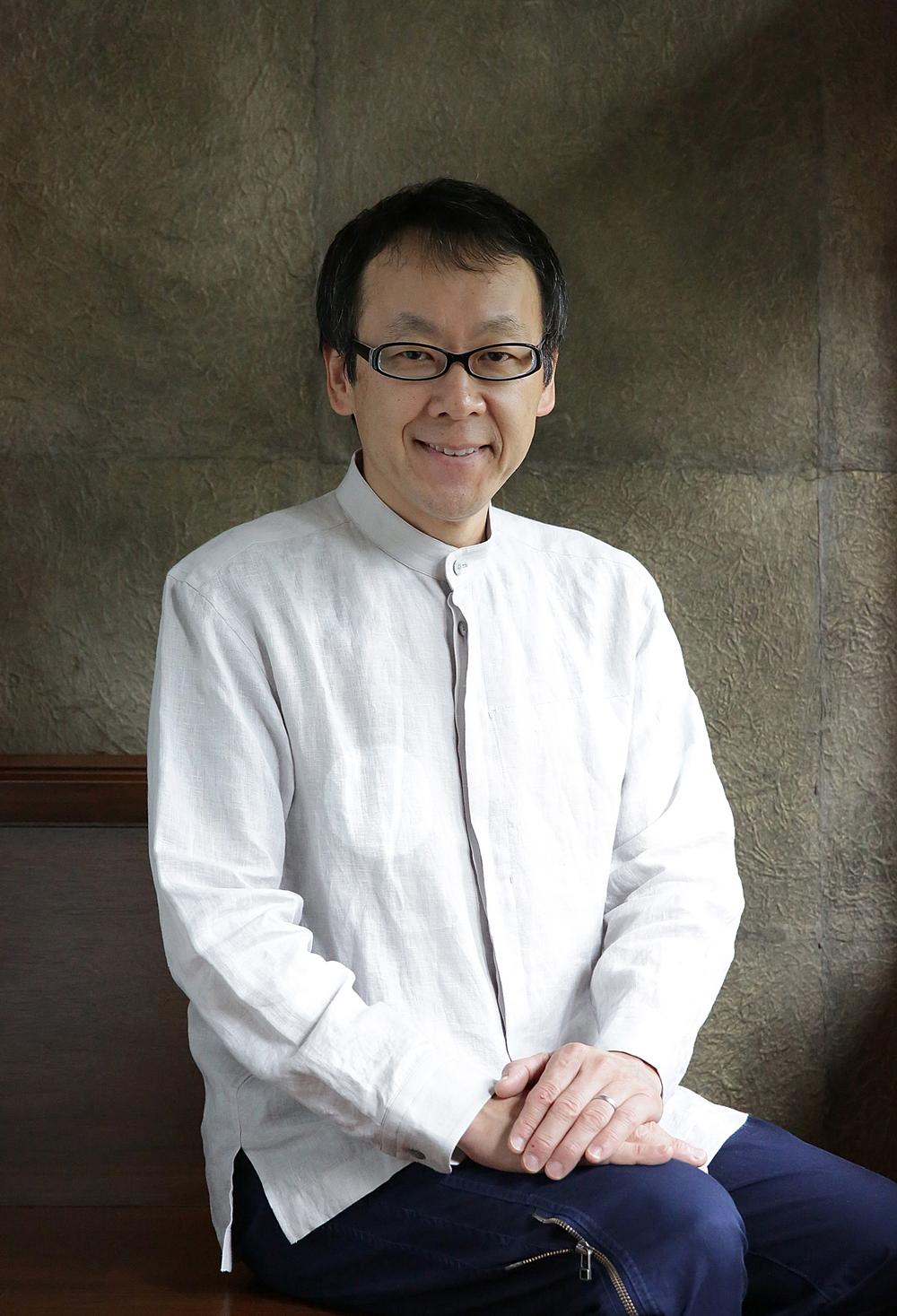
The Hoshino Resort Company opened its first onsen inn a century ago, but in the past two decades the business has grown and changed beyond measure. Fourth-generation president Yoshiharu Hoshino explains why the Japanese onsen industry must move with the times
By Rhianon Howells | Published in Spa Business 2014 issue 1
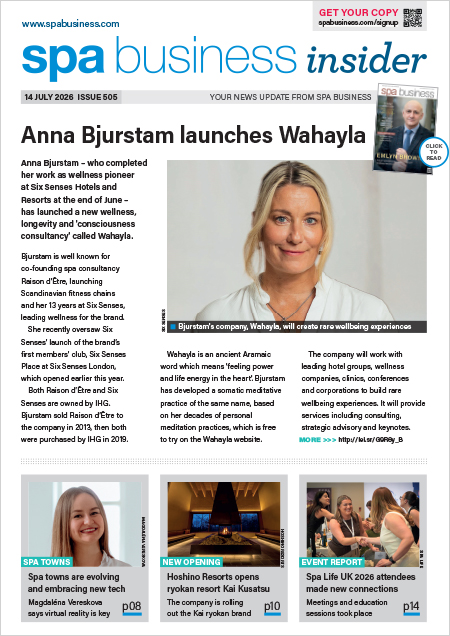
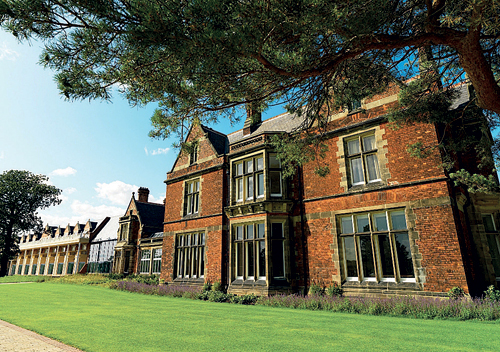
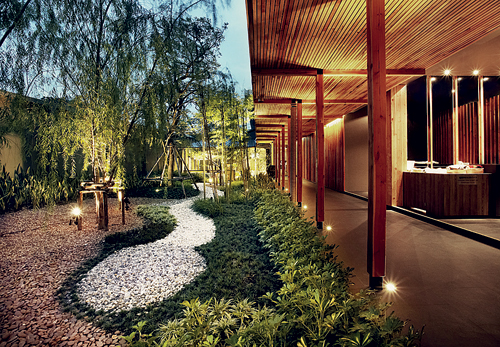
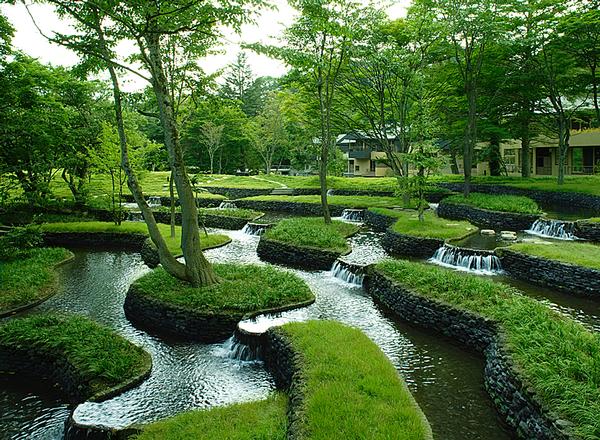
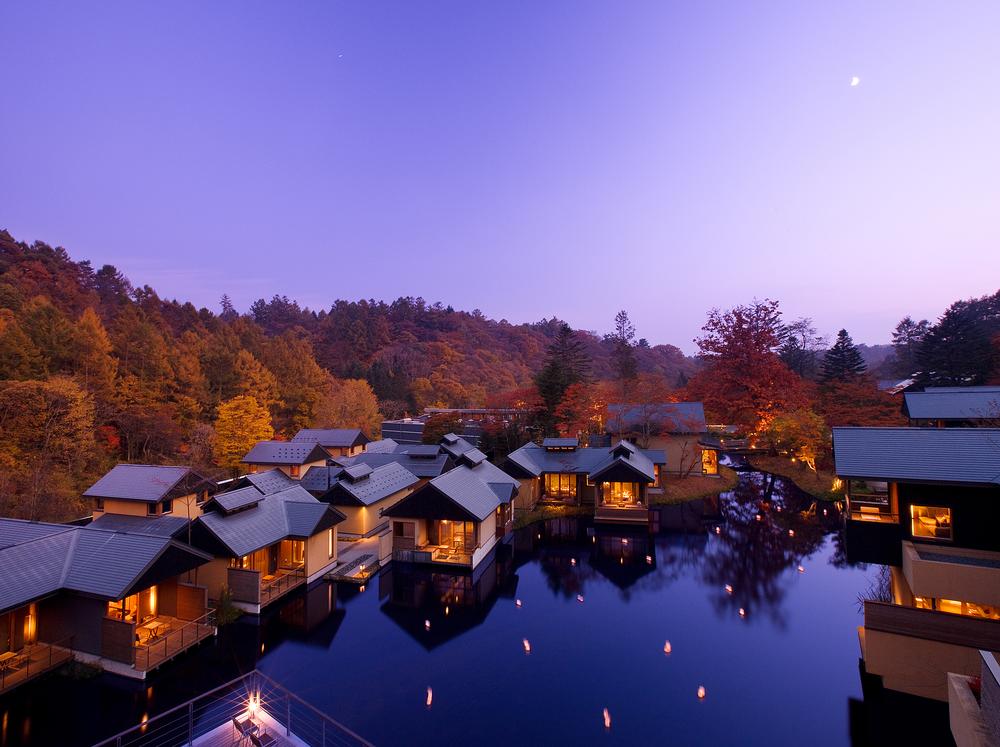
The original property opened in Karuizawa, central Japan, in 1914
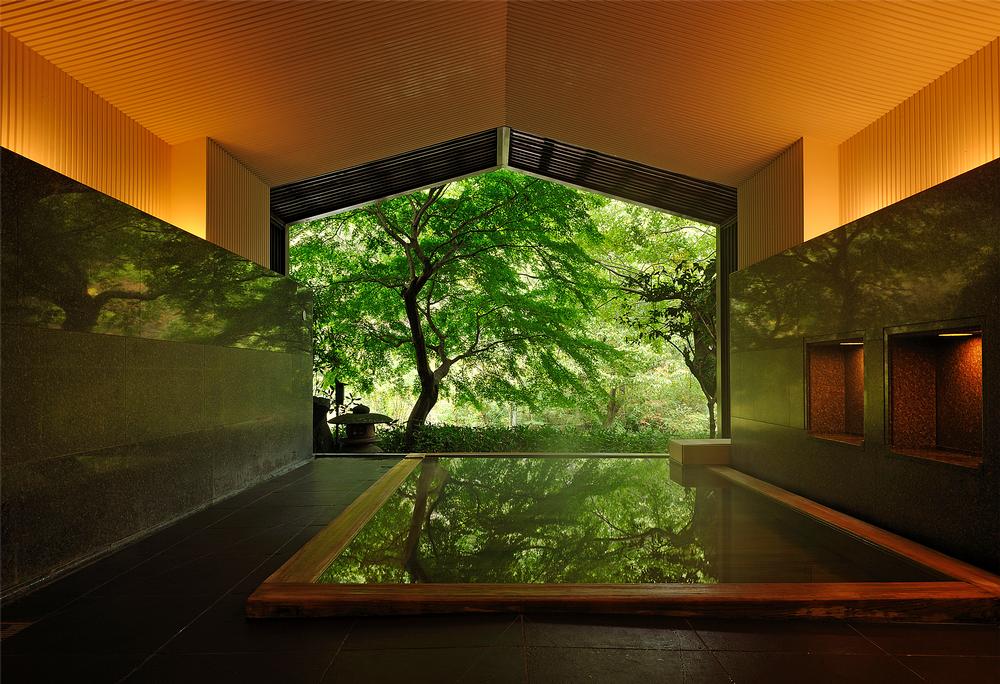
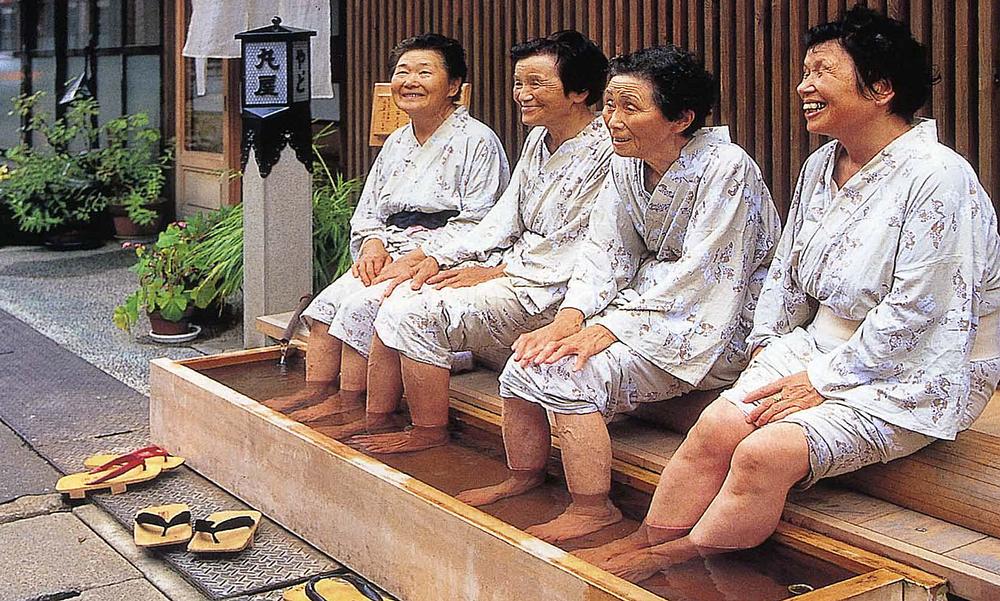
In Japan, bathing in hot springs is a centuries-old passion. The practice of peeling off clothes, washing the body and then immersing it in bubbling hot spring water is every bit as popular today as it was in the 12th century, when records show that the first onsen (hot spring) resorts were established.
The nation’s obsession with onsen as an aid to health and relaxation is largely due to geology. Japan has over 100 active volcanoes and a long history of earthquakes, the upside of which is 3,100 hot springs scattered across the country.
Over the years, resort towns with both public baths and onsen-ryokan (small inns with hot springs) have developed in these locations, making the onsen a staple of Japanese domestic tourism, not to mention increasingly popular with overseas visitors.
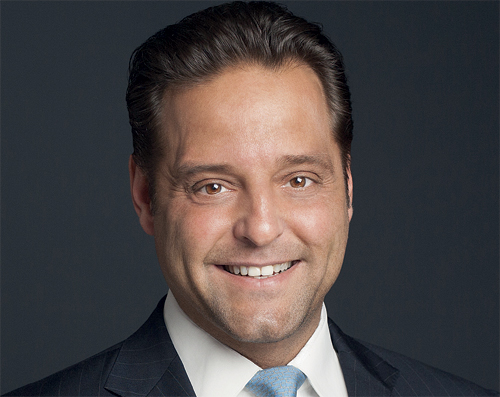
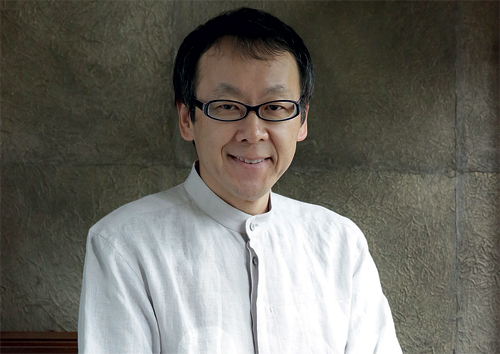
To the Japanese going to the onsen is an experience that embodies the very best of what their country has to offer. “Onsen resorts are extremely precious cultural assets,” says Yoshiharu Hoshino, president of Hoshino Resorts Inc, a 100-year-old onsen resort operator that now has 32 luxury properties across Japan. “They feature excellent food, relaxing hot springs baths and top-notch customer service.”
Yet despite the enduring popularity of hot spring bathing, onsen resorts themselves have had a challenging couple of decades. Although the capacity of western-style hotels versus onsen-ryokans is comparable – 800,000 rooms across 9,629 hotels versus 764,000 rooms across 49,906 ryokans – the number of onsen-ryokan rooms has declined over the last 20 years. A key factor in this, says Hoshino, has been resistance to change: “There’s not been enough innovation,” he explains. “There’s such a long tradition in our industry and our fathers are very stubborn… we haven’t made the changes [needed].”
However, his company has undergone sweeping changes since he inherited a single site – the Hoshino Onsen Resort in Karuizawa, central Japan – from his father in 1991. Not only has he rapidly expanded the family business, he’s also modernised resorts and brought the model firmly into the 21st century.
Long history The company was founded in 1904, when the current president’s great-grandfather, Kuniji Hoshino, started a forestry business in Karuizawa. The area was just developing as a holiday destination, and in 1914 Hoshino opened a hot spring resort. The facility attracted many intellectuals, as well as those interested in the region’s rich wildlife.
For years, the resort thrived. But when Yoshiharu Hoshino took over the business, he knew it was time to make some changes. “In the late 1980s, Japan was in the midst of a bubble economy,” he explains, “and there were many new entries in the resort sector.”
Faced with growing competition, Hoshino decided there was strength in numbers and expanded the company through operations. In 1995, Hoshino Resorts Inc opened the Hotel Bleston Court, also in Kaurizawa, before taking over the management of three other resorts between 2001 and 2004. In a strategic move, Hoshino also developed a unique chain of Japanese-style onsen under the brand name Hoshinoya, while taking on more management contracts for standalone properties.
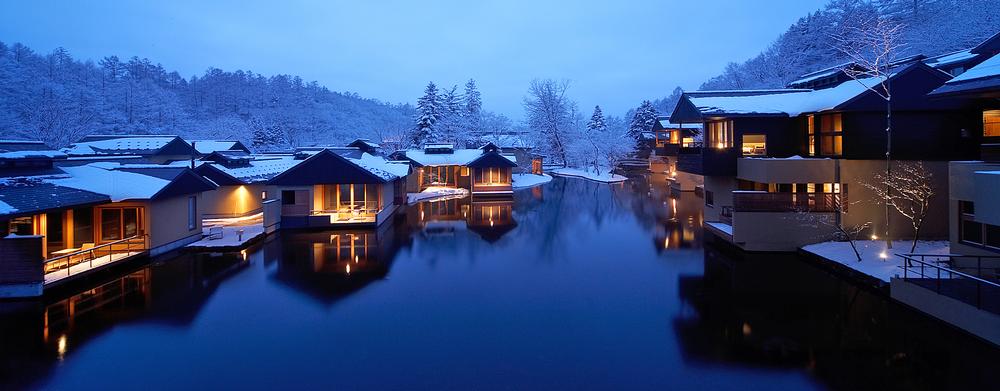
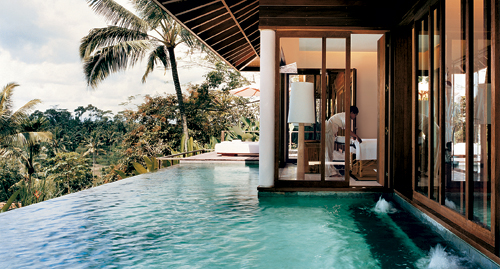
In 2004, the original Hoshino Onsen Resort was renovated and rebranded as Hoshinoya Karuizawa. Hoshinoya Kyoto and Hoshinoya Okinawa (a new build) followed in 2009 and 2012 respectively. The more contemporary style properties range in size from 25 rooms (Kyoto) to 77 rooms (Karuizawa).
In 2011, the company opened four properties under a second brand, Kai –traditional-style ryokans, all with fewer than 50 rooms. There are now 10 Kai resorts and the ultimate aim is to have one in every onsen location in the country. The final brand to be developed was Risonare, targeting the family market, of which there are currently three.
The decision to concentrate on branded operations was driven by the recognition that there’s more leverage with a chain. “Because the number of [ryokan] guest rooms is declining, the cost advantage is minimal,” says Hoshino. “With fierce competition and foreign capital being pumped into the [hospitality] industry, there’s a limit to how long individual resorts can stay independent.”
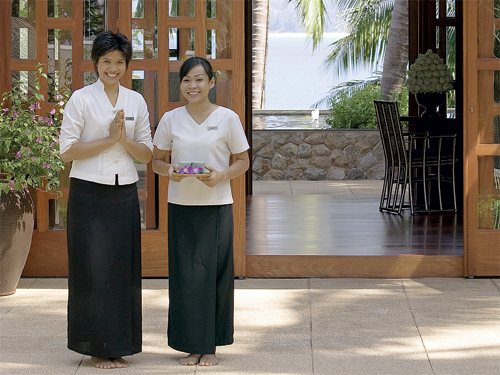
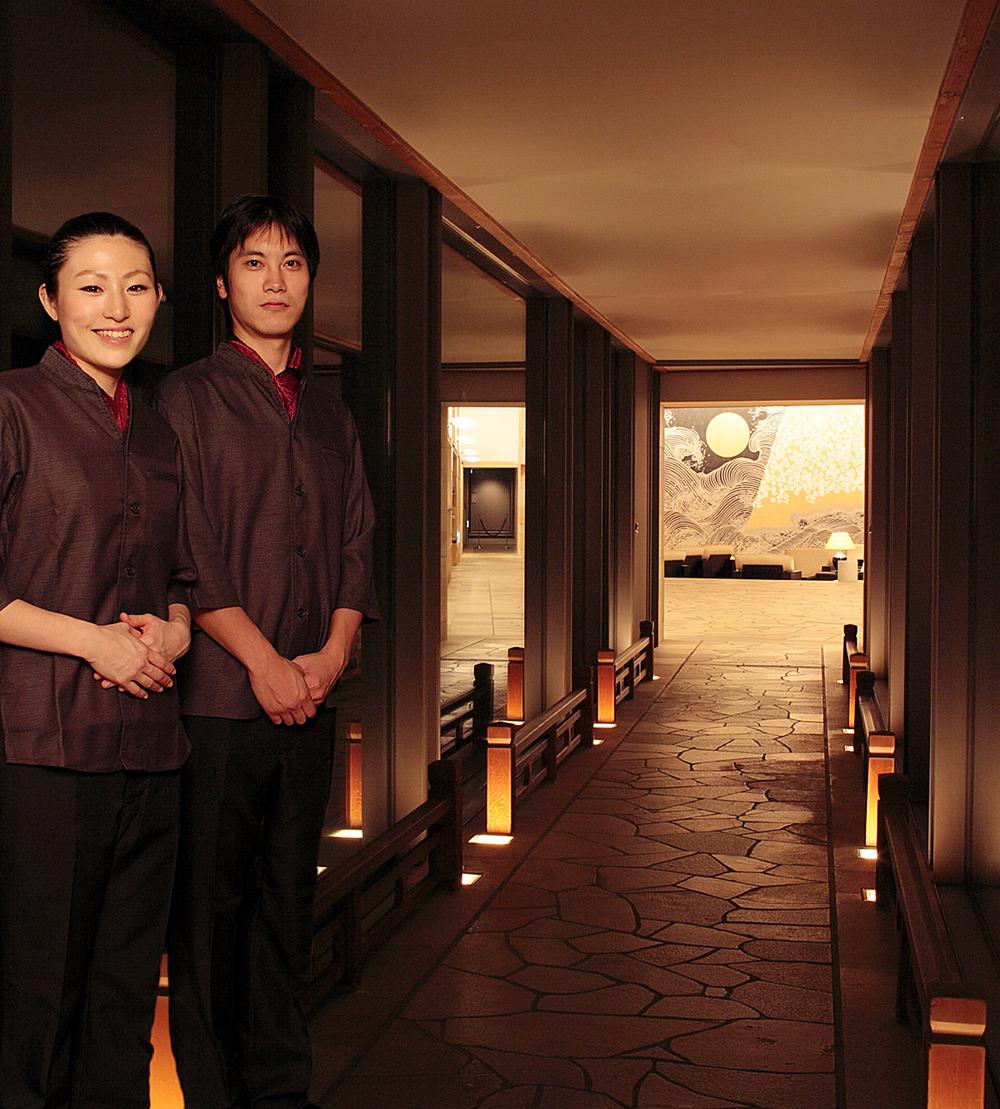
Changing times Notwithstanding these developments, the company has remained true to its heritage by respecting four key elements in its operations, says Hoshino: in addition to natural hot springs, all Hoshino resorts incorporate Japanese architecture and design, either traditional or modern; they all serve locally prepared, beautifully presented Japanese cuisine; and they all take great pride in delivering ‘omotenashi’, the buzzword of the candidature speech for the 2020 Tokyo Olympic Games, which can be loosely translated as ‘selfless hospitality’.
To be competitive in a changing market, however, Hoshino has, from the outset, been keenly aware that onsen resorts need to modernise – and not just for foreign visitors. “The younger generation in Japan is used to western-style living and now feels some discomfort and inconvenience when staying in traditional Japanese inns,” he says. “So my job has been to transform these old-style onsen-ryokan – while maintaining the important elements – so modern Japanese and international guests can enjoy staying more frequently.”
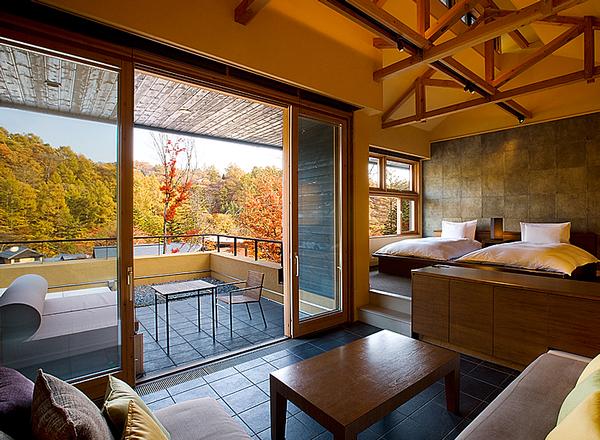
One way the company does this is to make a significant investment in the renovation of every newly acquired property, in close consultation with leading architects and designers, to ensure the environment appeals to modern travellers while remaining authentically Japanese. But no less important is the way that it’s adapted the traditional onsen-ryokan model to better suit the needs of its current customers.
Onsen-ryokan, for example, usually charge by the package, rather than the room, and traditional programmes have rigid meal times for breakfast and dinner every day. While Hoshino resorts are still based on accommodation packages, guests can choose meals and mealtimes to suit their own tastes and schedule. What’s more, sleeping arrangements have also been brought up to date: while traditional tatami rooms with futons are available, most Hoshino resorts now offer western-style beds too.
Another change concerns ‘traditional tipping’, which Hoshino has banned; while tipping is not customary in Japan, ryokans have always been the exception to this rule, due to the level of personal attention that guests receive. Finally, the company has invested in English-speaking staff and developed an English-language website to better cater for overseas guests.
Business shake-up For Hoshino, however, modernising the onsen-resort industry in Japan involves more than renovating the physical structures and overhauling the customer experience, crucial though these are. Ensuring that the industry not only survives but thrives in a competitive global marketplace also requires a complete shake-up of the underlying business practices.
The company measures the success of the resorts in three key areas – customer satisfaction, operating profit and environmental burden – and numbers are taken seriously. The goal for operating profit is 20 per cent, while customer satisfaction is based on an internal assessment. For environmental burden, the aim is to reach 24.3 points (out of a maximum of 25), as determined by the Green Purchasing Network – a Tokyo-based organisation that measures eco-friendly operations. While none of the resorts have reached all three targets simultaneously yet, “the vision of [achieving this] is upheld as the benchmark of all managerial decisions,” according to the Hoshino resort website.
Included in this is the consistent application of three operational strategies. The first is the use of regular surveys to assess and raise customer satisfaction levels, while empowering staff to make autonomous changes. The second is the optimisation of reservation channels, no longer depending solely on customer phone calls and local travel agencies, but also utilising the resorts’ websites, online travel providers and foreign agencies. The third strategy is the dramatic improvement of labour productivity across the group, by improving working conditions, upskilling staff and ending the industry’s traditional reliance on temporary workers and external contracts.
Having developed a new and viable business model for the onsen resort industry, Hoshino last year took this to the next stage by creating a Real Estate Investment Trust (REIT) – Hoshino Resorts REIT Inc – and listing it on the Tokyo Stock Exchange. With a clear aim of enabling investment in Hoshino resorts while also delivering stable profits, the REIT raised JPY10.2bn (US$100m, €73m, £62m) in its initial public offering. It has since gone on to buy six of Hoshino Resorts Inc’s owned resorts for JPY15bn (US$147m, €108m, £90m), with a view to eventually acquiring all of its branded properties.
Next year is another big year for Hoshino. As well as continuing to roll out the Kai brand, the company will open not only Hoshinoya Fuji but also its first overseas resort, Hoshinoya Bali, which will be a departure from its typical model. “Just as ryokans stay true to Japanese methods rather than copying their western counterparts, our resort in Bali will incorporate traditions that the Balinese take pride in,” says Hoshino.
Although he won’t reveal details, Hoshino confirms that the company is looking at opening resorts in other areas of Asia. Meanwhile, in 2016, the company will open its first city resort in Tokyo, with plans for more in other major cities of the world.
As for why it is so important for the company to have an urban presence, Hoshino explains: “Hospitality is a major part of Japanese culture. In big cities the world over, Japanese products and services stand out. If someone is considering a new car, they have the option of a Japanese car; if someone is considering what to eat for dinner, they have the option of Japanese food. In the same way, we want to give people considering resort lodging a Japanese choice.”
Read more from this issue of Spa Business magazine
Interview: Paul Scialla
Delos founder talks to Katie Barnes about creating the first set of wellbeing building standards and securing investment from Leonardo DiCaprio
Ask an expert: Detox
Done well, detox presents numerous business opportunities – but what's the best approach to take and what treatments should be avoided?
Business analysis: Spa inclusive
Some resorts are enticing clients with free, daily spa treatments. Neena Dhillon takes a look at the business model
Wellness tourism: Time to shine
Sophie Benge reports on wellness tourism in central and eastern Europe – a market that's ripe for development
Wellness research: Culture king
The Futures Company provides an insightful overview on how different cultures view health and wellbeing
Hotel spa research: Top division
In the hotel sector, spa revenue is growing faster than other revenue streams, according to a new PKF report. Andrea Foster analyses the findings
In the fast-paced world of fitness and wellness, where high-intensity workouts push us to
our limits and the sweat pours, the importance of efficient recovery cannot be overstated. [more...]
The Hoshino Resort Company opened its first onsen inn a century ago, but in the past two decades the business has grown and changed beyond measure. Fourth-generation president Yoshiharu Hoshino explains why the Japanese onsen industry must move with the times
By Rhianon Howells | Published in Spa Business 2014 issue 1
The original property opened in Karuizawa, central Japan, in 1914
In Japan, bathing in hot springs is a centuries-old passion. The practice of peeling off clothes, washing the body and then immersing it in bubbling hot spring water is every bit as popular today as it was in the 12th century, when records show that the first onsen (hot spring) resorts were established.
The nation’s obsession with onsen as an aid to health and relaxation is largely due to geology. Japan has over 100 active volcanoes and a long history of earthquakes, the upside of which is 3,100 hot springs scattered across the country.
Over the years, resort towns with both public baths and onsen-ryokan (small inns with hot springs) have developed in these locations, making the onsen a staple of Japanese domestic tourism, not to mention increasingly popular with overseas visitors.
To the Japanese going to the onsen is an experience that embodies the very best of what their country has to offer. “Onsen resorts are extremely precious cultural assets,” says Yoshiharu Hoshino, president of Hoshino Resorts Inc, a 100-year-old onsen resort operator that now has 32 luxury properties across Japan. “They feature excellent food, relaxing hot springs baths and top-notch customer service.”
Yet despite the enduring popularity of hot spring bathing, onsen resorts themselves have had a challenging couple of decades. Although the capacity of western-style hotels versus onsen-ryokans is comparable – 800,000 rooms across 9,629 hotels versus 764,000 rooms across 49,906 ryokans – the number of onsen-ryokan rooms has declined over the last 20 years. A key factor in this, says Hoshino, has been resistance to change: “There’s not been enough innovation,” he explains. “There’s such a long tradition in our industry and our fathers are very stubborn… we haven’t made the changes [needed].”
However, his company has undergone sweeping changes since he inherited a single site – the Hoshino Onsen Resort in Karuizawa, central Japan – from his father in 1991. Not only has he rapidly expanded the family business, he’s also modernised resorts and brought the model firmly into the 21st century.
Long history The company was founded in 1904, when the current president’s great-grandfather, Kuniji Hoshino, started a forestry business in Karuizawa. The area was just developing as a holiday destination, and in 1914 Hoshino opened a hot spring resort. The facility attracted many intellectuals, as well as those interested in the region’s rich wildlife.
For years, the resort thrived. But when Yoshiharu Hoshino took over the business, he knew it was time to make some changes. “In the late 1980s, Japan was in the midst of a bubble economy,” he explains, “and there were many new entries in the resort sector.”
Faced with growing competition, Hoshino decided there was strength in numbers and expanded the company through operations. In 1995, Hoshino Resorts Inc opened the Hotel Bleston Court, also in Kaurizawa, before taking over the management of three other resorts between 2001 and 2004. In a strategic move, Hoshino also developed a unique chain of Japanese-style onsen under the brand name Hoshinoya, while taking on more management contracts for standalone properties.
In 2004, the original Hoshino Onsen Resort was renovated and rebranded as Hoshinoya Karuizawa. Hoshinoya Kyoto and Hoshinoya Okinawa (a new build) followed in 2009 and 2012 respectively. The more contemporary style properties range in size from 25 rooms (Kyoto) to 77 rooms (Karuizawa).
In 2011, the company opened four properties under a second brand, Kai –traditional-style ryokans, all with fewer than 50 rooms. There are now 10 Kai resorts and the ultimate aim is to have one in every onsen location in the country. The final brand to be developed was Risonare, targeting the family market, of which there are currently three.
The decision to concentrate on branded operations was driven by the recognition that there’s more leverage with a chain. “Because the number of [ryokan] guest rooms is declining, the cost advantage is minimal,” says Hoshino. “With fierce competition and foreign capital being pumped into the [hospitality] industry, there’s a limit to how long individual resorts can stay independent.”
Changing times Notwithstanding these developments, the company has remained true to its heritage by respecting four key elements in its operations, says Hoshino: in addition to natural hot springs, all Hoshino resorts incorporate Japanese architecture and design, either traditional or modern; they all serve locally prepared, beautifully presented Japanese cuisine; and they all take great pride in delivering ‘omotenashi’, the buzzword of the candidature speech for the 2020 Tokyo Olympic Games, which can be loosely translated as ‘selfless hospitality’.
To be competitive in a changing market, however, Hoshino has, from the outset, been keenly aware that onsen resorts need to modernise – and not just for foreign visitors. “The younger generation in Japan is used to western-style living and now feels some discomfort and inconvenience when staying in traditional Japanese inns,” he says. “So my job has been to transform these old-style onsen-ryokan – while maintaining the important elements – so modern Japanese and international guests can enjoy staying more frequently.”
One way the company does this is to make a significant investment in the renovation of every newly acquired property, in close consultation with leading architects and designers, to ensure the environment appeals to modern travellers while remaining authentically Japanese. But no less important is the way that it’s adapted the traditional onsen-ryokan model to better suit the needs of its current customers.
Onsen-ryokan, for example, usually charge by the package, rather than the room, and traditional programmes have rigid meal times for breakfast and dinner every day. While Hoshino resorts are still based on accommodation packages, guests can choose meals and mealtimes to suit their own tastes and schedule. What’s more, sleeping arrangements have also been brought up to date: while traditional tatami rooms with futons are available, most Hoshino resorts now offer western-style beds too.
Another change concerns ‘traditional tipping’, which Hoshino has banned; while tipping is not customary in Japan, ryokans have always been the exception to this rule, due to the level of personal attention that guests receive. Finally, the company has invested in English-speaking staff and developed an English-language website to better cater for overseas guests.
Business shake-up For Hoshino, however, modernising the onsen-resort industry in Japan involves more than renovating the physical structures and overhauling the customer experience, crucial though these are. Ensuring that the industry not only survives but thrives in a competitive global marketplace also requires a complete shake-up of the underlying business practices.
The company measures the success of the resorts in three key areas – customer satisfaction, operating profit and environmental burden – and numbers are taken seriously. The goal for operating profit is 20 per cent, while customer satisfaction is based on an internal assessment. For environmental burden, the aim is to reach 24.3 points (out of a maximum of 25), as determined by the Green Purchasing Network – a Tokyo-based organisation that measures eco-friendly operations. While none of the resorts have reached all three targets simultaneously yet, “the vision of [achieving this] is upheld as the benchmark of all managerial decisions,” according to the Hoshino resort website.
Included in this is the consistent application of three operational strategies. The first is the use of regular surveys to assess and raise customer satisfaction levels, while empowering staff to make autonomous changes. The second is the optimisation of reservation channels, no longer depending solely on customer phone calls and local travel agencies, but also utilising the resorts’ websites, online travel providers and foreign agencies. The third strategy is the dramatic improvement of labour productivity across the group, by improving working conditions, upskilling staff and ending the industry’s traditional reliance on temporary workers and external contracts.
Having developed a new and viable business model for the onsen resort industry, Hoshino last year took this to the next stage by creating a Real Estate Investment Trust (REIT) – Hoshino Resorts REIT Inc – and listing it on the Tokyo Stock Exchange. With a clear aim of enabling investment in Hoshino resorts while also delivering stable profits, the REIT raised JPY10.2bn (US$100m, €73m, £62m) in its initial public offering. It has since gone on to buy six of Hoshino Resorts Inc’s owned resorts for JPY15bn (US$147m, €108m, £90m), with a view to eventually acquiring all of its branded properties.
Next year is another big year for Hoshino. As well as continuing to roll out the Kai brand, the company will open not only Hoshinoya Fuji but also its first overseas resort, Hoshinoya Bali, which will be a departure from its typical model. “Just as ryokans stay true to Japanese methods rather than copying their western counterparts, our resort in Bali will incorporate traditions that the Balinese take pride in,” says Hoshino.
Although he won’t reveal details, Hoshino confirms that the company is looking at opening resorts in other areas of Asia. Meanwhile, in 2016, the company will open its first city resort in Tokyo, with plans for more in other major cities of the world.
As for why it is so important for the company to have an urban presence, Hoshino explains: “Hospitality is a major part of Japanese culture. In big cities the world over, Japanese products and services stand out. If someone is considering a new car, they have the option of a Japanese car; if someone is considering what to eat for dinner, they have the option of Japanese food. In the same way, we want to give people considering resort lodging a Japanese choice.”
Read more from this issue of Spa Business magazine
Interview: Paul Scialla
Delos founder talks to Katie Barnes about creating the first set of wellbeing building standards and securing investment from Leonardo DiCaprio
Ask an expert: Detox
Done well, detox presents numerous business opportunities – but what's the best approach to take and what treatments should be avoided?
Business analysis: Spa inclusive
Some resorts are enticing clients with free, daily spa treatments. Neena Dhillon takes a look at the business model
Wellness tourism: Time to shine
Sophie Benge reports on wellness tourism in central and eastern Europe – a market that's ripe for development
Wellness research: Culture king
The Futures Company provides an insightful overview on how different cultures view health and wellbeing
Hotel spa research: Top division
In the hotel sector, spa revenue is growing faster than other revenue streams, according to a new PKF report. Andrea Foster analyses the findings
Gran Hotel Taoro in northern Tenerife, Spain, has completed the final phase of its three-year
renovation with the debut of its Sandára Wellness Centre.
Hand and Stone Massage and Facial Spa, the spa business with more than 650 locations across
the US and Canada, has appointed franchise expert Carrie Walsh as CEO as the company plans
to expand.
Synergy – The Retreat Show, the global trade show for retreats, has launched a global research
initiative that will provide insights into the retreat sector from both consumer and industry
perspectives.
The Wellness Tourism Association (WTA) has published a non-regulatory global industry
framework designed to ensure the retreat market offers responsible experiences.
A new survey of UK and international spa practitioners shows that stress, burnout and
wellbeing concerns have caused one in three respondents to consider leaving the industry.
The UK's four Chief Medical Officers have published a refreshed edition of Physical activity
guidelines: UK Chief Medical Officers' report, updating the evidence that underpins the nation's
physical activity recommendations and placing greater emphasis on strength, balance, reducing
sedentary behaviour and, for the first time, supporting people taking weight loss medications.
Anna Bjurstam has left her role as Wellness Pioneer at Six Senses Hotels and Resorts and
launched a new wellness, longevity and “consciousness consultancy” called Wahayla.
In the fast-paced world of fitness and wellness, where high-intensity workouts push us to
our limits and the sweat pours, the importance of efficient recovery cannot be overstated. [more...]