Yes! Send me the FREE digital editions of Spa Business and Spa Business insider magazines and the FREE weekly Spa Business and Spa Business insider ezines and breaking news alerts!
Tomi Isaacs gives an overview of the health and wellness landscape globally and explains how it’s heavily influenced by cultural nuances as captured by The Futures Company’s latest Global MONITOR studies
By Tomi Isaacs | Published in Spa Business 2014 issue 1
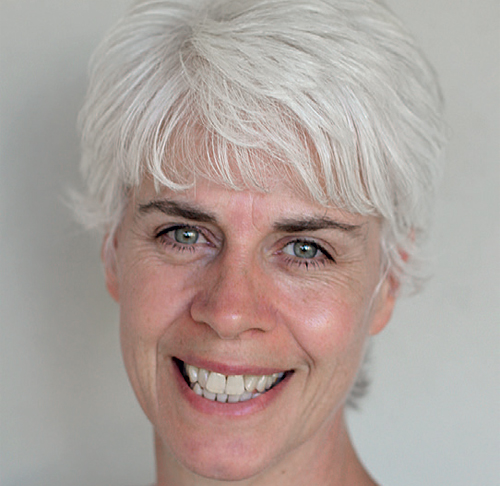
Just over half of people take steps to improve their health, whether they feel ill or not / shutterstock.com/Subbotina Anna
Responsibility for healthcare is increasingly being pushed onto the public. With greater concern over the social and economic costs of both dealing with and not dealing with health, governments around the world are nudging us to take better care of ourselves – creating challenges and opportunities to shape the global health and wellbeing landscape.
The consumer response As consumers begin to take on more responsibility for their own health, there’s a recognition that emotional and spiritual needs are as important as physical health. This holistic approach to wellness has led consumers to adopt a wide range of measures with the aim of making themselves feel happy, healthy and strong.
Global MONITOR (see p60) data reveals that 52 per cent of people take steps to improve their health, regardless of whether they feel ill or not: and we’re now seeing that this preventative mindset is on the rise across the majority of global markets. However, despite this, fewer than half of consumers worldwide say they are satisfied with their emotional and physical wellbeing.
Understanding consumers’ approaches to health can be complicated, as they’re often very personal and heavily influenced by cultural nuances. Global MONITOR uses a metaphor to explore this complexity and visualise the potential strategies people may use. We ask consumers: ‘How do you think of your body?’ and offer them three options.
The Car is the metaphor for those people who see their body as a machine in which the component parts can be fixed. Among this group, strategies towards health and wellness tend to be short-term and reactive.
Those who identify with the Fortress see their body as something they have to strengthen and defend against external attack. This is also short-term, but predominantly a proactive approach.
Finally, the Tree is for those who see their body as something they nurture, taking an ongoing holistic approach to managing health. This is a much more long-term, proactive strategy.
It’s this final option, with its holistic approach to managing health, that’s here to stay: the percentage of Global MONITOR respondents identifying with the tree rose from 50 per cent in 2006 to 56 per cent in 2013. In comparison those in the car category fell from 20 to 15 per cent, while fortress went up just 1 per cent, to 29 per cent.
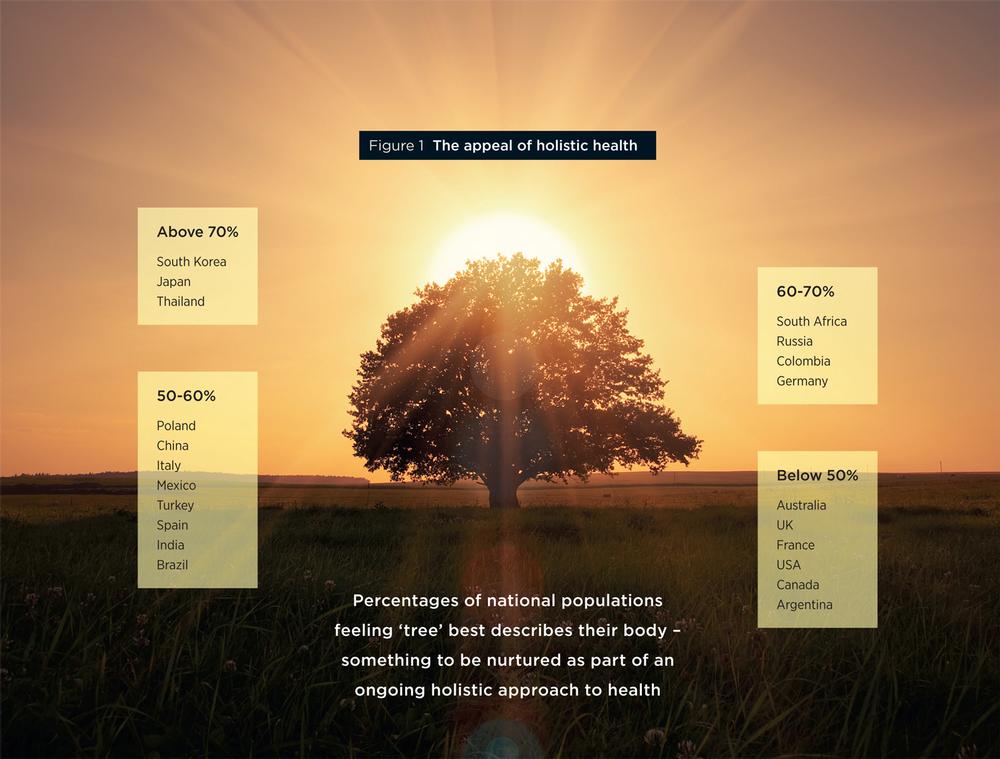
This growing interest in a holistic approach is evident across all markets, although there remain big differences. In countries such as Thailand, Japan and South Korea, over 70 per cent of people picked tree; and in South Africa, Colombia and Germany, tree came in at 60-70 per cent (see Figure 1).
Meanwhile in countries such as Spain, Italy, Brazil and India, tree registered between 50 and 60 per cent, but with fortress also important; in China, tree was also 50-60 per cent but car came out above average; and markets including the UK, US, Canada and Australia remained below 50 per cent for tree, with car above average. Interestingly, tree logged above average responses in Russia.
One of the big shifts registered in the above findings has occurred in some Asian markets, where a holistic approach was traditionally more of a culturally embedded behaviour. We’re beginning to see movement towards a more defensive strategy, however: a 10 per cent shift from tree to fortress in India, for example, indicates that there’s a more mixed approach to self-health management in that country. We suspect this could this be a response to recent risks of contracting foreign-derived viruses such as bird flu.
The market response However consumers view their bodies, opportunities abound to support those who want to optimise their wellbeing. There’s been significant development in this space, including innovations that help people to manage their mental acuity, boost the body’s renewal processes and protect themselves against disease.
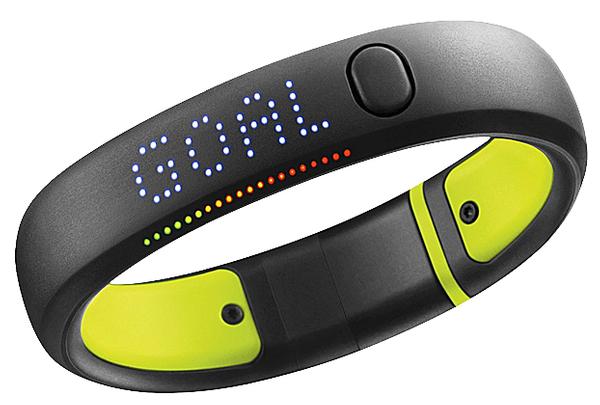
Some of the latest things include Kinohimistu, a lutein drink from Japan which claims to preserve optical health and drinks in the US that have been designed to help keep skin looking young while asleep. In Sweden the Vigo chewing gum is said to increase mental performance. Self-monitoring, devices such as Fitband and Fuelband can help consumers track and potentially optimise their health and fitness levels. However, consumers need to be motivated to improve their records rather than just passively reading the data.
When it comes to spa specific innovations, holistic ayurvedic treatments which were big in the 60s/70s are making a comeback; and salt saunas/inhalation rooms offer a natural, drug-free remedy for asthma, sinusitis, hay fever and other respiratory illnesses.
Spas in Austria, which focus more on natural health, rejuvenation, wellness and healing, are particularly cutting edge. Facilities there offer everything from laughter therapy to yoga and those that offer beauty treatments do so in a holistic fashion. In the Feng Shui beauty centre at the Qullenhotel, the equipment, experiences and therapists are all focused on energy flow and the harmony of Yin and Yang.
Seize the opportunity The business landscape is changing. There’s a chance to reframe wellbeing and move brands into the lifestyle choice space, where there are more points to connect, serve and support consumers in their quest for better health.
We will see an increase in corporate wellness schemes as employers take an active interest in staff’s wellbeing as part of a commercial agenda – as well as their duty of care.
Meanwhile, our ability to collect and analyse big data about health will deliver solutions at mass and personalised levels. With the cost of decoding an individual genome likely to fall drastically to just US$1,000 (€738, £605) in the next two years, we can expect to see the personalised health market explode.
Our message to companies and brands is simple: seize the opportunity. There has never been a better time for brands to shape the future of wellness and assist consumers in their quest to live better and healthier lives.
The global momentum behind wellness is poised to impact everything about the way we live our lives, from the products we buy to the places we work and play.
Read more from this issue of Spa Business magazine
Interview: Paul Scialla
Delos founder talks to Katie Barnes about creating the first set of wellbeing building standards and securing investment from Leonardo DiCaprio
Ask an expert: Detox
Done well, detox presents numerous business opportunities – but what's the best approach to take and what treatments should be avoided?
Business analysis: Spa inclusive
Some resorts are enticing clients with free, daily spa treatments. Neena Dhillon takes a look at the business model
Wellness tourism: Time to shine
Sophie Benge reports on wellness tourism in central and eastern Europe – a market that's ripe for development
Wellness research: Culture king
The Futures Company provides an insightful overview on how different cultures view health and wellbeing
Hotel spa research: Top division
In the hotel sector, spa revenue is growing faster than other revenue streams, according to a new PKF report. Andrea Foster analyses the findings
The Futures Company is an award-winning global strategic insight and innovation consultancy with expertise in foresight and futures. It unlocks new sources of growth for its clients through consultancy, global insight and a range of subscription solutions. The Futures Company is a Kantar company within WPP, with teams in Europe, North America, Latin America and Asia and was formed through the integration of The Henley Centre, Yankelovich and TRU. Twitter: @FuturesCo Web: www.thefuturescompany.com
GLOBAL MONITOR
Global MONITOR is a comprehensive set of resources for global foresights and trends that provides insight into the global and local forces shaping the business environment, consumers and brands. The resource includes data and analysis from a consumer survey that covers 28,000 respondents across 21 countries.
Figure 1 The appeal of holistic health
There has never been a better time for brands to shape the future of wellness and assist consumers in their quest to live better and healthier lives / shutterstock.com/dotshock
Health-based innovations have burst onto the scene and will continue to thrive
The MSpa Oslo series is a perennial bestseller in global markets. With innovative
engineering and premium performance, this completely portable spa line-up is expertly
designed to meet the needs of customers worldwide. [more...]
In the fast-paced world of fitness and wellness, where high-intensity workouts push us to
our limits and the sweat pours, the importance of efficient recovery cannot be overstated. [more...]
+ More featured suppliers
COMPANY PROFILES
bbspa_Group
The technical advice offered by bbspa is
delivered via four specialist departments which offer turn [more...]
Borghese Roma
Borghese is an Italian luxury skincare brand founded in 1957 by Princess Marcella Borghese. [more...]
Tomi Isaacs gives an overview of the health and wellness landscape globally and explains how it’s heavily influenced by cultural nuances as captured by The Futures Company’s latest Global MONITOR studies
By Tomi Isaacs | Published in Spa Business 2014 issue 1
Just over half of people take steps to improve their health, whether they feel ill or not / shutterstock.com/Subbotina Anna
Responsibility for healthcare is increasingly being pushed onto the public. With greater concern over the social and economic costs of both dealing with and not dealing with health, governments around the world are nudging us to take better care of ourselves – creating challenges and opportunities to shape the global health and wellbeing landscape.
The consumer response As consumers begin to take on more responsibility for their own health, there’s a recognition that emotional and spiritual needs are as important as physical health. This holistic approach to wellness has led consumers to adopt a wide range of measures with the aim of making themselves feel happy, healthy and strong.
Global MONITOR (see p60) data reveals that 52 per cent of people take steps to improve their health, regardless of whether they feel ill or not: and we’re now seeing that this preventative mindset is on the rise across the majority of global markets. However, despite this, fewer than half of consumers worldwide say they are satisfied with their emotional and physical wellbeing.
Understanding consumers’ approaches to health can be complicated, as they’re often very personal and heavily influenced by cultural nuances. Global MONITOR uses a metaphor to explore this complexity and visualise the potential strategies people may use. We ask consumers: ‘How do you think of your body?’ and offer them three options.
The Car is the metaphor for those people who see their body as a machine in which the component parts can be fixed. Among this group, strategies towards health and wellness tend to be short-term and reactive.
Those who identify with the Fortress see their body as something they have to strengthen and defend against external attack. This is also short-term, but predominantly a proactive approach.
Finally, the Tree is for those who see their body as something they nurture, taking an ongoing holistic approach to managing health. This is a much more long-term, proactive strategy.
It’s this final option, with its holistic approach to managing health, that’s here to stay: the percentage of Global MONITOR respondents identifying with the tree rose from 50 per cent in 2006 to 56 per cent in 2013. In comparison those in the car category fell from 20 to 15 per cent, while fortress went up just 1 per cent, to 29 per cent.
This growing interest in a holistic approach is evident across all markets, although there remain big differences. In countries such as Thailand, Japan and South Korea, over 70 per cent of people picked tree; and in South Africa, Colombia and Germany, tree came in at 60-70 per cent (see Figure 1).
Meanwhile in countries such as Spain, Italy, Brazil and India, tree registered between 50 and 60 per cent, but with fortress also important; in China, tree was also 50-60 per cent but car came out above average; and markets including the UK, US, Canada and Australia remained below 50 per cent for tree, with car above average. Interestingly, tree logged above average responses in Russia.
One of the big shifts registered in the above findings has occurred in some Asian markets, where a holistic approach was traditionally more of a culturally embedded behaviour. We’re beginning to see movement towards a more defensive strategy, however: a 10 per cent shift from tree to fortress in India, for example, indicates that there’s a more mixed approach to self-health management in that country. We suspect this could this be a response to recent risks of contracting foreign-derived viruses such as bird flu.
The market response However consumers view their bodies, opportunities abound to support those who want to optimise their wellbeing. There’s been significant development in this space, including innovations that help people to manage their mental acuity, boost the body’s renewal processes and protect themselves against disease.
Some of the latest things include Kinohimistu, a lutein drink from Japan which claims to preserve optical health and drinks in the US that have been designed to help keep skin looking young while asleep. In Sweden the Vigo chewing gum is said to increase mental performance. Self-monitoring, devices such as Fitband and Fuelband can help consumers track and potentially optimise their health and fitness levels. However, consumers need to be motivated to improve their records rather than just passively reading the data.
When it comes to spa specific innovations, holistic ayurvedic treatments which were big in the 60s/70s are making a comeback; and salt saunas/inhalation rooms offer a natural, drug-free remedy for asthma, sinusitis, hay fever and other respiratory illnesses.
Spas in Austria, which focus more on natural health, rejuvenation, wellness and healing, are particularly cutting edge. Facilities there offer everything from laughter therapy to yoga and those that offer beauty treatments do so in a holistic fashion. In the Feng Shui beauty centre at the Qullenhotel, the equipment, experiences and therapists are all focused on energy flow and the harmony of Yin and Yang.
Seize the opportunity The business landscape is changing. There’s a chance to reframe wellbeing and move brands into the lifestyle choice space, where there are more points to connect, serve and support consumers in their quest for better health.
We will see an increase in corporate wellness schemes as employers take an active interest in staff’s wellbeing as part of a commercial agenda – as well as their duty of care.
Meanwhile, our ability to collect and analyse big data about health will deliver solutions at mass and personalised levels. With the cost of decoding an individual genome likely to fall drastically to just US$1,000 (€738, £605) in the next two years, we can expect to see the personalised health market explode.
Our message to companies and brands is simple: seize the opportunity. There has never been a better time for brands to shape the future of wellness and assist consumers in their quest to live better and healthier lives.
The global momentum behind wellness is poised to impact everything about the way we live our lives, from the products we buy to the places we work and play.
Read more from this issue of Spa Business magazine
Interview: Paul Scialla
Delos founder talks to Katie Barnes about creating the first set of wellbeing building standards and securing investment from Leonardo DiCaprio
Ask an expert: Detox
Done well, detox presents numerous business opportunities – but what's the best approach to take and what treatments should be avoided?
Business analysis: Spa inclusive
Some resorts are enticing clients with free, daily spa treatments. Neena Dhillon takes a look at the business model
Wellness tourism: Time to shine
Sophie Benge reports on wellness tourism in central and eastern Europe – a market that's ripe for development
Wellness research: Culture king
The Futures Company provides an insightful overview on how different cultures view health and wellbeing
Hotel spa research: Top division
In the hotel sector, spa revenue is growing faster than other revenue streams, according to a new PKF report. Andrea Foster analyses the findings
The Futures Company is an award-winning global strategic insight and innovation consultancy with expertise in foresight and futures. It unlocks new sources of growth for its clients through consultancy, global insight and a range of subscription solutions. The Futures Company is a Kantar company within WPP, with teams in Europe, North America, Latin America and Asia and was formed through the integration of The Henley Centre, Yankelovich and TRU. Twitter: @FuturesCo Web: www.thefuturescompany.com
GLOBAL MONITOR
Global MONITOR is a comprehensive set of resources for global foresights and trends that provides insight into the global and local forces shaping the business environment, consumers and brands. The resource includes data and analysis from a consumer survey that covers 28,000 respondents across 21 countries.
Figure 1 The appeal of holistic health
There has never been a better time for brands to shape the future of wellness and assist consumers in their quest to live better and healthier lives / shutterstock.com/dotshock
Health-based innovations have burst onto the scene and will continue to thrive
Gran Hotel Taoro in northern Tenerife, Spain, has completed the final phase of its three-year
renovation with the debut of its Sandára Wellness Centre.
Hand and Stone Massage and Facial Spa, the spa business with more than 650 locations across
the US and Canada, has appointed franchise expert Carrie Walsh as CEO as the company plans
to expand.
Synergy – The Retreat Show, the global trade show for retreats, has launched a global research
initiative that will provide insights into the retreat sector from both consumer and industry
perspectives.
The Wellness Tourism Association (WTA) has published a non-regulatory global industry
framework designed to ensure the retreat market offers responsible experiences.
A new survey of UK and international spa practitioners shows that stress, burnout and
wellbeing concerns have caused one in three respondents to consider leaving the industry.
The UK's four Chief Medical Officers have published a refreshed edition of Physical activity
guidelines: UK Chief Medical Officers' report, updating the evidence that underpins the nation's
physical activity recommendations and placing greater emphasis on strength, balance, reducing
sedentary behaviour and, for the first time, supporting people taking weight loss medications.
Anna Bjurstam has left her role as Wellness Pioneer at Six Senses Hotels and Resorts and
launched a new wellness, longevity and “consciousness consultancy” called Wahayla.
Fairmont Cheshire, The Mere, has opened today (10 July) in the Northwest of England
with a
1,715sq m Fairmont Spa that has been designed using a ‘Wellness without Walls’
concept.
The MSpa Oslo series is a perennial bestseller in global markets. With innovative
engineering and premium performance, this completely portable spa line-up is expertly
designed to meet the needs of customers worldwide. [more...]
In the fast-paced world of fitness and wellness, where high-intensity workouts push us to
our limits and the sweat pours, the importance of efficient recovery cannot be overstated. [more...]
+ More featured suppliers
COMPANY PROFILES
bbspa_Group The technical advice offered by bbspa is
delivered via four specialist departments which offer turn [more...]